The Périfééries project’s heritage council of influence
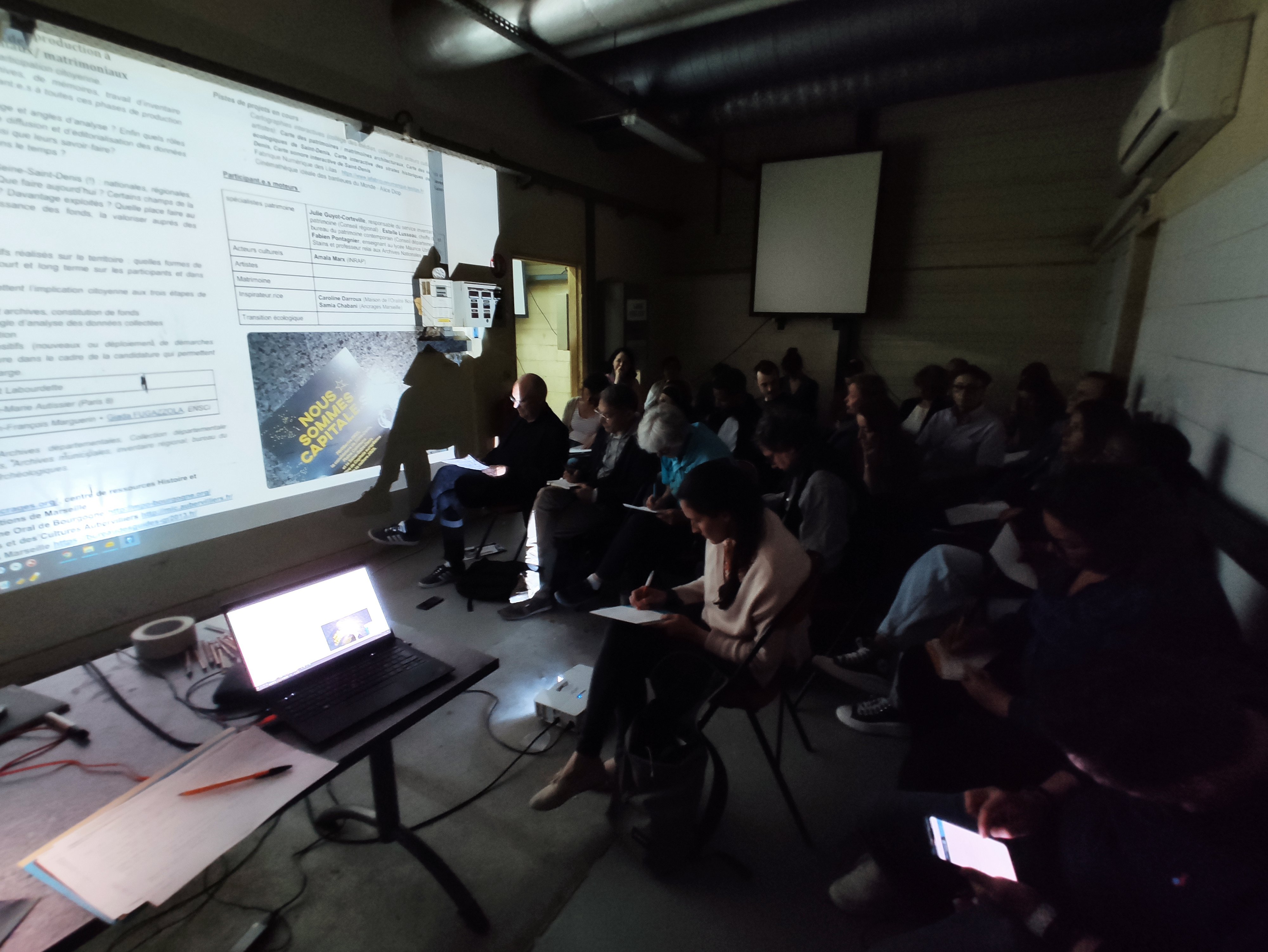
As part of Saint-Denis’s bid to become European Capital of Culture 2028, I led a collective intelligence session to collect proposals on the subject of “Making local residents active players, from the production to the editorialization of heritage content”. Here’s a look back at my method and the results it produced.
A vast co-construction
One of the initiatives taken by Juliette Bompoint, the project’s general delegate, was to organize “councils of influence”, day-long collective events attended by at least a hundred people, each time held at emblematic sites in the area, in order to gather contributions, ideas, territorial dynamics, desires...
On June 1, 2022, at the former Éclair laboratories in Épinay-sur-Seine, a day was devoted to the theme “Heritage(s) and stories”. I was invited to lead the collective intelligence of a working group on the topic “Making local people actors in the production and editorialization of matrimonial/patrimonial content”. The day’s other topics, led by other people, were:
- “Acting on the manufacture of representations of the peripheries.”
- “Linking individual and collective narratives, linking imaginaries, from the royal city to hip-hop.”
- “Taking better account of heritage in the making of the city.”
- “Decompartmentalize and amplify know-how.”
Method of collective intelligence through shared writing
The challenge of the mission was ambitious: to succeed, in just an hour and a half, in activating the intelligence and contributions of the 30 people present, given that it was also planned to start by presenting several innovative projects to the group. The time available for contributions from everyone was therefore less than 45 minutes, which is a very short time for thirty people! The aim was to gather relevant ideas that would feed into the writing of the application. I proceeded as follows:
- On-screen sharing of the meeting’s objective and schedule (which had been drawn up by Juliette Bompoint and her team), so that everyone had the same level of information as I did. In other words, to initiate a dynamic of cooperation and not simply participation.
- Public presentation of the projects as planned, which set the standard for the level of expectation of contributions (summary in Jean-François Marguerin’s text).
- As each∙e finished writing, he∙elle came to bring me his sheet, which I placed under a camera, replayed on the very large screen, so that each∙e could take note of the contributions of others.
- Putting all the contributions online on a specific web page (accessible via a QR code given to participants∙e∙s), the audio recording of the whole meeting, the recording of the summary restitution I had made in plenary afterwards, as well as a written made by one of the participants a few days later.
So, in keeping with the subject of the meeting, we created a heritage/matrimoniaux together from our exchanges, which was then the source of useful information for the Périfééries team in drawing up the bid project. You can take a look at all contributions, which are very rich, on the subject of “Rendre les habitants acteurs, de la production à l’éditorialisation des contenus patrimoniaux/matrimoniaux”. These contributions can be useful well beyond the city of Saint-Denis’ bid (the European Capital of Culture will be held in Bourges in 2028).

Logistics, technology and equipment
This venue, the former Éclair laboratories (France’s largest film laboratories until 2010), still had electricity, but was completely “fallow”. So, when I arrived, I had to find a place dark enough for the projection, the heart of the interaction device, to be clearly visible to the participants∙e∙s. The first room (where chairs were set up) was in full light, which made the project impossible.
I found a room that was dark, but devoid of electricity, and there wasn’t an extension cord long enough...Yes, facilitating collective intelligence means first and foremost taking care of the venue, the “scenography”, which must make it possible to be a showcase for the creative proposal. It also means managing the logistics and technical aspects of the event, so as to give full value to the moment that is to be shared.
I had a few tools with me, as well as a short-throw video projector (to be able to create a large image even in a small space), extension cords, the “visualizer” camera, and so on. The Périfééries team had so much logistical responsibility for the whole thing, that making collective intelligence possible also meant, at my level, ensuring autonomous technical implementation. My tools enabled me to open a sealed electrical panel, plug in my equipment, and install my set-up in a darkened room, which, thanks to the projection, gave great symbolic importance to what was going to be produced. Of course, I had also brought enough pens and a ream of A4 paper to be able to distribute this material to those present.
Heritage issues/citizen heritage
I believe that the legitimization of archives produced by citizens∙nes is an essential axis for the development of democracy today, because it comes to constitute other narratives than the narratives of the dominant. It is the pledge of an enriching diversity and envisaged as such. It’s difficult to put into practice, precisely because of questions of legitimacy, and it requires the construction of independent digital tools (no longer dependent on the major digital industrialists) and the development of participation and cooperation. This has long been one of my research-action subjects, and I’m sharing resources on the subject of Digital heritage.
Intent text
Workshop 4: Making residents players from production to editorialization of heritage/matrimonial content
From collecting to sharing data: choosing citizen participation.
- Archaeological digs, studies, archive and memory collections, heritage inventory work: how can we involve local residents more fully in all these content production phases?
- What role can they play in archiving choices and analysis angles? Finally, what role can local residents play in the dissemination and editorialization of the data produced? How can we involve them and their know-how?
- How can we maintain citizen participation over time?
Reminder: there are all levels of archives in Seine-Saint-Denis (!): national, regional, departmental, diplomatic, municipal. What can be done today? Are there fields of knowledge that need to be strengthened? Should more be done? What role should participation play? How can we improve knowledge of our collections, and promote them to local residents and young people?
Objectives:
- Diagnosis of participatory projects carried out in the region: what forms of participation? What are the short- and long-term effects on participants and their imagination?
- Identify projects that enable citizen involvement in the three stages of heritage development:
- collecting data and archives, building up collections
- choice of archiving and angle of analysis of collected data
- dissemination and editorialization
- identify projects and mechanisms (new or deployment of existing approaches) to be implemented as part of the bid, which will enable broad citizen participation.
Inspiring projects:
- Ancrages: https://ancrages.org/, Marseille’s History and Memory of Migration resource center
- Maison du Patrimoine Oral de Bourgogne http://mpo-bourgogne.org/
- Maison des langues et des Cultures Aubervilliers http://mlc.aubervilliers.fr/
- Bureau des Guides Marseille https://bureaudesguides-gr2013.fr/
- Greeters https://greeters.fr/
- Hotel du Nord Marseille https://www.hoteldunord.coop/ Fabrique d’histoires
Digital sharing space for contributions
Vocal review by Benoît Labourdette
Written report
By Jean-François Marguerin
Saint Denis/Plaine Commune European Capital of Culture 2028
Development focus: heritage/matrimony
Issues: making local residents active players in the production and editorialization of heritage/matrimonial content.
A one-and-a-half-hour workshop was held on Tuesday, June 1, 2022, with a digital report by Benoît Labourdette, accessible to all via a QR code. He has added a recording of his presentation to the general meeting. There’s no need to come back to this, we just need to be careful about who receives the report.
First of all, let’s go back to the meaning of the words: heritage, according to the Petit Robert, is that which is considered to be the common heritage of a group. It was Abbé Grégoire, constitutional bishop of Blois and member of the Third Estate, who first gave the term its disinterested meaning during the French Revolution. The patrimony of the Nation, unlike the private, notarial meaning. To put an end to acts of vandalism committed against despised symbols of the past, when sculptures, architecture and stained-glass windows are also witnesses to human genius, witnesses that belong to everyone.
Google only recognizes matrimoine with two notifications announcing... The June 1st Council of Influence!
The term was brought to the fore not long ago, when a group of women authors decided to establish a “matrimoine” day, coinciding with the “patrimoine” days, in order to rescue from oblivion the literary works of so many women over the centuries, unjustly put under the bushel.
In private law, the matrimonial property regime (matrimonial property relating to marriage) determines the distribution of assets between spouses. The matrimonial regime decides on the patrimonial regime, a linguistic twist of fate.
While we await clarification on the relevance of the concept of matrimonial heritage, we won’t deal here with its mobilizing capacity, its comprehension by inhabitants for whom heritage, once it transcends its community dimension (language, habits and customs, signs of origins, exile...) to reach that of the daily shared territory, remains a distant preoccupation.
During this workshop, we heard presentations from the following associative and institutional initiatives: Ancrages (Marseille); Maison du Patrimoine Oral (Morvan); Service départemental de l’architecture et du patrimoine (Seine Saint Denis); Maison des Langues et des Cultures (Aubervilliers); La Fabrique Numérique (Les Lilas); Service éducatif des Archives Nationales (based in Pierrefitte-sur-Seine).
(The experiences of the Bureau des Guides de Marseille, Greeters, Hôtel du Nord de Marseille, mentioned in the preparatory document, were not reported)
The various presentations are available on Benoît Labourdette’s website, which is easy to access: https://www.benoitlabourdette.com/_docs/projets/2022/2022_perifeeries_conseil_influence_matrimoine/
Here, I offer the verbatims of three feedbacks that feed my questioning to follow. The other feedbacks, as fascinating as they are, do not raise the same questions about the contribution of local residents to the production of a heritage that is representative of their territory.
- Ancrages (Centre de ressources, Histoire et mémoires des migrations à Marseille) including Samia Chabani, its director, a sociologist committed to issues of gender and immigration.
Marseille is a metropolis that was built on the bangs of national identity. How can residents be involved when they are excluded from the urban narrative? Less visible than the immigrant is the immigrant’s wife. Marseille’s northern neighborhoods are heritage neglect zones. In the bid phase for Marseille Provence 2013, Marseille’s cosmopolitan dimension was a strong argument in its favor. This dimension has now disappeared. Inhabitants are excluded from the designation of heritage (the choice of the plural is not insignificant.) What constitutes heritage for them? Ancrages drew on the skills of public heritage departments to carry out oral and paper collections. The preferred method is oral collection, in keeping with the great tradition of orality. Intangible heritage is insufficiently taken into account in France. The relationship, the “negotiation” with residents (borrowed from sociologist Michel Anselme’s book Du bruit à la parole. La scène politique des cités, published by Editions de l’Aube) are not easy. Speech is situated, and the question of who is speaking is very important. She refers to the 2005 Faro Convention adopted by the Council of Europe, to which France is not a signatory, which “calls for cultural heritage to be presented as a resource for human development, for the enhancement of cultural diversity, for the promotion of intercultural dialogue, and for a model of economic development based on the principles of sustainable use of resources”.
- Maison du patrimoine oral de Bourgogne. Situated in the “diagonal of emptiness”, a very rural area in the heart of the Morvan, no public services, no doctors, no local shops. This is an ethno-pole accredited by the French Ministry of Culture. “We’re on the bangs because there are so few of us”. (dixit Caroline Darroux, ethnologist, representative of the MPOB, coordinator of its scientific mission, whose work focuses “on the performative aspects of oral narratives in terms of the production of collective narratives). This same house is the result of militant movements by residents accompanied by researchers. A founding moment: in the ’80s, an artist registered a piece of Morvan folk music with the SACEM, which meant that musicians who played it in bars or at festivals had to pay royalties. It was this collective refusal that gave rise to the collection of these events, and demonstrated the existence of a free culture made up of “discreet practices”, both musical and linguistic (languages other than French). It’s the work of “very ordinary people” who have used digital tools to certify that works exist in the public domain, works that have been created by a great many authors over time, and which they keep alive by interpreting them.
“There’s always a tendency to replace humans with the documents they’ve produced. Archives are only there to nourish living practice. We must prefer the human to the object,” insists Caroline Darroux.”We claim to turn people into actors. But these same people retort that they do ’stuff’ and that before trying to get them to do something, let’s take an interest in what they’re already doing."
- Service de l’architecture et du patrimoine de Seine Saint Denis. It provides an atlas of the department’s architecture and heritage.The local authority has chosen to set up a department to study, promote and help preserve its heritage, given the intense and rapid changes taking place in the 93 region. It is committed to taking into account the views of local residents and encouraging their involvement.
It has put a small heritage survey application on line, enabling them to identify, document and take part in the inventory of the department’s heritage, according to suggested themes.
For example, the application enables users to identify the plaques on the facades of buildings that bear the names of the architects responsible for their construction.
The application registered 15,000 entries from local residents... But a total of 58 participants.
The person in charge of the application sees this as the limit to the involvement of local residents by an institutional service that can only mobilize people who are already motivated.
“Seine Saint Denis is a cultural ecosystem (she declares), but one that includes very few associations with a heritage focus.” Without their involvement, without forging partnerships with a network of associations, the institution struggles to connect with local residents.
Extensions, my questions:
The theme that this workshop has merely introduced through these testimonials needs to be worked on intensively over the coming months, and in particular the following questions:
- In a highly cosmopolitan territory (with over 150 nationalities, as we are regularly reminded), what constitutes a heritage (in the memorial, not notarial sense of the term) for each and every one of us? When and where can they make the most of it? How can we build common ground with diversity? What large-scale actions need to be undertaken to ensure that the intangible heritage (languages, songs, tales, instrumental music, customs, especially culinary customs, rituals, etc.) and tangible heritage (real estate and furniture, everyday, decorative or symbolic objects, costumes, images, etc.) of both communities receive the care required for their conservation, study, enhancement, knowledge, appropriation by younger generations, sharing and transmission? The heritage of each community becomes, in a way, that of an entire population on the scale of Saint Denis, Plaine Commune?
- What resources and initiatives are needed to make this approach a convincing priority in a bid to become a European capital?
- What forms of co-production should be initiated between heritage professionals (archivists; sociologists, ethnologists, linguists, anthropologists, musicologists, curators, restorers... computer scientists) and groups of local residents, cultural associations of diverse backgrounds, which transcend the classic scheme whereby the latter are the temporary (or permanent) objects of study for the former, with the latter returning the results of their work to the most curious of these residents, as well as to school “audiences” (of course), in elaborate forms (publications, exhibitions...)?
What collection and conservation methods should be implemented to ensure that local residents are effectively involved in the identification, production and publication of heritage? So that they don’t desert, through lack of interest, leaving the field to the specialists alone, once the collection stage is over. - The “Grande Collecte” (large-scale collection) organized by the French National Archives to mark the 80th anniversary of the Armistice was a huge success, given the large number of families involved in the “Great War”, including those in the colonial empire.
- Should we propose (in association with the Archives Départementales) a “Grande Collecte(s)” (large collection(s)) on the Capital’s territory, relating to one or more past events identified at the end of a broad popular consultation, constituting a collective memory?
- The example of Morvan provides a counterpoint, as the identification of a common intangible heritage is apparently easy.
* To cross the territory is to be immediately aware of the power and depth (as well as the complexity of understanding it) of the cosmopolitanism that is its inexhaustible wealth. - So how can we raise the profile of this cosmopolitanism to the scale of a capital city project? How can we give this cosmopolitanism all its visibility when the competition is trying to impose standards of excellence and distinction, in the face of the palpitations of the abundant, messy and perhaps cacophonous life of such diversity?
- Wouldn’t SAINT DENIS, LA DIFFÉRENCE be a fitting slogan when it comes to the only periphery (perifery) in competition?
In short, there’s a lot of work to be done to answer the essential question, the subject of this workshop. Starting with the search for the best way to combine the skills of institutions, associations and individuals.
Jean-François Marguerin, June 9, 2022


Drawing on Benoît Labourdette’s 30 years of experience in the field of cultural innovation and his research and methodological work, the Benoît Labourdette production agency supports cultural policies in their need for innovation, better encounters with populations, use of digital tools and cooperation, definition of mediation strategies, and support for artistic teams, technicians and elected representatives. Our method is always based on collective intelligence, cooperation and empowerment of people and structures. We work with cities and other local authorities, national networks, institutions and associations.
-

Creating to think
A French-Finnish meeting at L’Alhambra in Marseille on 4 May 2026, as part of the Erasmus+ Visual Thinkers project.
On 4 May 2026, I facilitated a professional meeting at L’Alhambra in Marseille, organised by the Image Clé association as part of the European (…) -

The Book Archipelago
A proposal to elected representatives: making plural bookshops the backbone of territorial cultural policies.
Faced with the tensions running through the bookshop sector today, it is time to put an end to the sanctuary myth. Rather than seeking an (…) -

The photography workshop: creating, showing, looking together
Reflections on a hands-on workshop facilitated by Benoît Labourdette at the professional conference “Cinema, images and young people’s mental health”, held on 14 April 2026 in Romainville, France.
A workshop in nine small groups, fifteen minutes to produce a photograph, then a moment of collective viewing in which the authors remain silent (…) -

« Mental Health and Cinema »
Synthesis of the day “Young people, their images, their spaces: new paradigms” (14 April 2026)
Synthesis of a day of professional gatherings at the Le Trianon cinema in Romainville, bringing together the perspectives of professionals from (…) -

Mental health, young people, images: what are we talking about?
Text of Benoît Labourdette’s opening talk at the professional meetings held on 14 April 2026.
Before entering into projects, we need to pin down the words. Mental health, young people, images: three notions we often use together without (…) -

Transmitting cultural rights: a question of coherence
What facilitation methods reveal about our relationship with people.
How can we talk about cultural democracy within an authoritarian framework? How can we defend respect for each person’s culture while imposing a (…) -

Mental Health and Cinema - Experiencing the World Through Images
Two professional conferences in Romainville (April 14 and 15, 2026).
On April 14 and 15, 2026, ACRIF, as part of its coordination mission for Passeurs d’images in Île-de-France, is organizing two days of (…) -

Collaborative assessment of screen literacy education in Nouvelle-Aquitaine
Collective intelligence methodology, digital platform, and collaborative publication for ALCA (2026).
ALCA, Agence Livre, Cinéma et Audiovisuel en Nouvelle-Aquitaine, entrusted me with the methodological support for a collaborative assessment of (…) -

Media Literacy: Should We Judge or Guide?
Reflections based on the National Meeting of Regional Centers for Media Literacy (Rouen, March 16–17, 2026).
On 16 and 17 March 2026, Normandie Images organised in Rouen the national meeting of France’s regional image education centres (pôles régionaux (…) -

The Meaning of Mediation Methods in Arts and Cultural Education
When practice reveals what theory ignores.
Artists and professionals involved in arts education develop singular methods that most often remain implicit. I wish to lift the veil on the (…) -

Cultural Mediation as a Device for Symbolic Emancipation
Methodological Principles for a Horizontal Approach to Collective Creation.
Lived experience radically transforms our relationship to thought. Cultural mediation does not consist of transmitting knowledge but of creating (…) -

Evaluating Arts and Cultural Education from the Artist’s Perspective
Review of a course given at INSEAC: conceptual and methodological tools for cultural professionals.
On January 15, 2026, as part of the CNAM module EAC104 “Building tools to evaluate ACE projects: qualitative and quantitative survey methodologies (…) -

Developing Psychosocial Skills Through Artistic Practices
Methodological principles for an experiential approach.
Psychosocial skills (PSS) are now at the heart of public health, education, and child protection policies. The 2023-2027 intersectoral roadmap, (…) -

When thirty-five professionals discover their psychosocial skills through creative experience
A look back at the interprofessional seminar of January 12, 2026, in Limoges: a day where theory gave way to lived experience.
At the DRAC Nouvelle-Aquitaine, educators, teachers, caregivers, and cultural actors experienced together what it truly means to develop (…) -

Image Education and Citizenship: When Youth Professionals Rethink Their Practices
{{Reflections on the “Out-of-School Time” professional day that I co-designed with ALCA and the Gironde Departmental Council.}}
On December 2, 2025, around a hundred youth, animation, and culture professionals gathered at the MECA auditorium in Bordeaux to explore together (…) -

Art and Culture in the Service of Psychosocial Skills
Account of a founding seminar for professionals of the Judicial Protection of Youth in Limousin.
On November 27, 2025, the Limousin Regional Directorate of PJJ brought together its teams for a half-day of collective reflection on psychosocial (…) -

Youth and culture: for a radical change in posture
Giving young people the power to create, not just consume culture.
How can cultural institutions break out of their chronic failure with young people? By abandoning condescension to embrace a genuine cultural (…) -

Reinventing youth reception in cinemas
Remote training for cinema operators in Lot-et-Garonne.
How can we transform our cinemas into spaces for authentic encounters with 15-25 year-olds? This question guided an intense training session with (…) -

“Participatory creation as a laboratory for democracy?”
4th edition of the biennial festival of participatory creation - Les Rencontres de la Poudrerie - Théâtre des habitants - May 16 & 17, 2025.
Les Rencontres de la Poudrerie are a moment for reflection and co-construction, at the intersection of art forms and the practice of social life. (…) -

Pour une robustesse coopérative des projets culturels
Réflexion sur les modalités de coopération territoriale et d’évaluation.
Pour que les projets culturels puissent trouver pleinement leur sens social et devenir plus robustes face aux attaques politiques qui les jugent « (…) -

Design of a professional day on “Artistic and digital practices for young people”
Act’art, artistic and cultural action in Seine-et-Marne.
As part of its mission to promote collective intelligence by facilitating local think tanks, Act’art asked Benoît Labourdette to design, (…) -

OPC Media: “What if we changed our posture?”
How can we learn to consider the richness of teenage digital practices and avoid giving in to preconceived ideas?
How can we learn to consider the richness of teenagers’ digital practices and not give in to preconceived ideas? For Benoît Labourdette, if we (…) -

Itinéraire bis, the path of cultural rights
Action research conducted by the MPAA (Paris).
Accompaniment in the animation, production of traces and fabrication of the web platform resources of the research-action “Itinéraire bis, chemin (…) -

Helping young people and professionals to speak out: “Cultures and youth policies” national meeting
Observatory of Cultural Policies / Villeurbanne (TNP, May 11 & 12, 2023).
As part of the Rencontres nationales “Cultures et politiques de la jeunesse” (“Cultures and youth policies”), which brought the year of the French (…) -

"Culture, youth and digital: designing new modalities for cultural and educational projects
Sharing of methodological tracks and professional training.
Deconstructing preconceived ideas about digital transformation and developing projects adapted to young people.The cultural offer is sometimes (…) -

“Media College” platform for Périfééries
Creation of a digital collective intelligence tool.
To meet a need for creative, intellectual emulation and the production of ideas for one of the axes of the Saint-Denis (93) city’s bid for the (…) -

Giant digital brainstorming
Design and implementation of a digital collective intelligence tool.
Method of activating a vast contribution for the axes of a cultural project. The needIn the solidarity I had with the city of Saint-Denis’ bid (…) -

The Périfééries project’s heritage council of influence
Facilitating collective intelligence in a short space of time.
As part of Saint-Denis’s bid to become European Capital of Culture 2028, I led a collective intelligence session to collect proposals on the (…) -

Reinventing cultural projects with youth?
Proposal of questions.
While public cultural action aims to reach people in their great diversity, it is clear that it is often difficult to mobilize youth. However, (…)


-

Dilapidation of resources in supply logic For a democratic revolution of cultural practices.
Faced with the crisis in the cultural sector, it is urgent to shift from a top-down supply logic to a culture of connection and listening, (…) -

Legitimate participation as the horizon of cultural events From legitimacy to participate: how cultural rights transform our practices.
Cultural rights are often misunderstood. Their strength lies in their capacity to transform our practices: moving from a top-down programming (…) -

Professional meeting “Public participation”: presentation by Benoît Labourdette Interview of Benoît Labourdette by Jean-Yves de Lépinay (11’37s, 2020).
Sharing examples of audiovisual creation workshops conducted in the spirit of cultural rights: moving from “participation” to “interaction.” (…) -

“Territorial approach, participation, youth and digital technology”: interview of Benoît Labourdette by Serge Saada (52’, 2021) Observatory of cultural mediation in the social field.
As part of the Observatory of cultural mediation in the social field, Serge Saada interviewed Benoît Labourdette on the impact of the (…) -

The marginality of cultural institutions Lucidity of a paradigm shift.
Traditional cultural institutions, once central, have become marginal in the face of digital practices that now dominate citizens’ attention. This (…)
