Create your film about imaginary disasters - 2nd edition
The imaginary of disasters: creating together to better navigate uncertainty.
Why imagining disasters makes us stronger
Neuroscience shows us: our brain does not differentiate between an intensely lived experience and an experience imagined with precision. It is this particularity that gives the imaginary its transformative power. When we create narratives about possible disasters, whether climatic, technological or social, we are not just telling stories. We are building neural pathways that prepare us, individually and collectively, to better react to the unexpected.
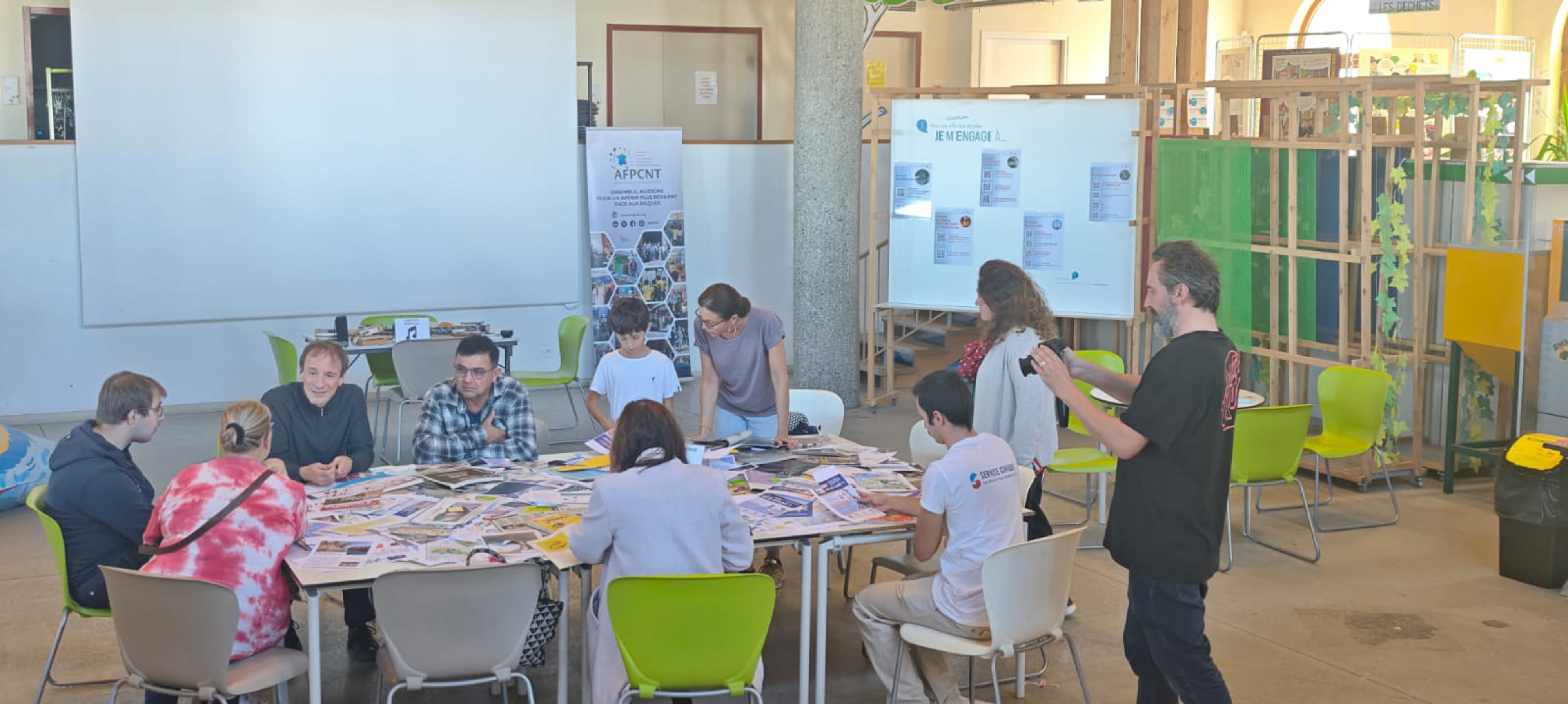
On October 11, 2025, during the second edition of this workshop at the Maison écocitoyenne in Bordeaux, twelve animated short films were created in a single day. These films, all viewable online on this page, testify to the creative richness that emerges when citizens are given the tools to express their representations of risks. What is striking is the diversity of modes of expression: with the same materials, paper, scissors, camera, each film tells a unique story. “Flood Alert” by Éliott and Virginie explores life-saving actions in the face of rising waters. “Danger and Seveso” by Zoé pedagogically explains industrial risks. “Fire and forest fire” by Carole integrates the dimension of solidarity, the one that is not written in official texts but naturally emerges when we imagine together.
The day revealed something essential: even with relatively few participants, collective creation comes to life. The mediators from the Ligue de l’enseignement, young people in civic service trained on environmental issues, themselves made several films, transforming this moment into an opportunity for authentic co-construction. “The way we are together when we do things, the listening that can exist between us, it can actually be felt in the works that are produced.” (Benoît Labourdette, during the presentation)
The imaginary is not an escape from reality, it is a tool to better inhabit it. These stories created together may help us all better navigate the storms to come.
Cut-out paper animation: a technique accessible to all
This device invented by filmmaker Benoît Labourdette uses the animated paper cut-out technique, a simple but powerful method that allows everyone, regardless of age or experience, to create a film in less than an hour. This approach democratizes audiovisual creation: no need to know how to draw, no need to master complex software. Scissors, paper, a camera, and above all your imagination are enough.
This artisanal technique has something reassuring in our hyper-technological era. It brings us back to the manual gesture, to patient cutting, to concrete manipulation. It is also a metaphor for resilience: with simple means, we can create something strong and significant. The twelve films made this year testify to this: from the humorous story about nuclear risks to the poetic fable about mutations caused by chemical pollution, each creation finds its own voice.
What is at stake in the act of collective creation
Participating in this workshop means living several experiences in one:
- Exploring one’s own representations: What do you see when you think “disaster”? How do you imagine survival, mutual aid, reconstruction? These questions, approached through creative means, allow access to parts of ourselves that are sometimes buried. The films created reveal this diversity: some imagine flights to Mars, others neighborhood solidarity, still others surprising ecological mutations.
- Transforming anxiety into creative action: Faced with climate crises and the uncertainties of our era, many feel a form of paralyzing eco-anxiety. Creating means regaining the power to act, transforming fear into narrative, anguish into shareable images. Even slips of the tongue become significant - when “fire” becomes “incident”, it’s our ambiguous relationship with danger that reveals itself.
- Sharing plural imaginaries: During the collective screening that closes the workshop, everyone discovers the visions of others. This diversity of perspectives is precious: it shows us that faced with the same risks, we don’t all have the same representations, the same imaginative resources. As Serge Tisseron emphasized during the screening: “An imaginary that we share, an imaginary from which everyone can return, an imaginary that everyone can enrich around the narrative, that’s what will allow us to create alternatives for the future.”
- Building a living risk culture: The films become freely reusable educational tools for awareness actions. They are contributed to a common pool in service of the collective prevention message, transforming abstract knowledge into living and appropriated culture.
Practical information
Saturday, October 11, 2025:
- 10am-4pm: Creation workshop (free participation, come when you want, stay as long as you wish)
- 4:45pm-6pm: Collective screening of films made
- Location: Maison écocitoyenne Bordeaux Métropole, Quai Richelieu, Bordeaux
- Free and open to all, from age 6
- No prior registration required
You can come alone, with family, with friends. The workshop is designed to accommodate flows of participants throughout the day. Even in 30 minutes, it is possible to create a very short film!
The films produced are available on the AFPCNT YouTube channel.
This project was born from the meeting between Serge Tisseron, psychoanalyst, and Benoît Labourdette, filmmaker, and was made possible by the active coordination of Virginie Perromat and the involvement of all partners.
This initiative is part of the Bordeaux Métropole Resilience Month and the National Resilience Day on October 13. It is carried out by the AFPCNT (French Association for the Prevention of Natural and Technological Disasters) and IHMEC (Institute for the History and Memory of Disasters), in partnership with Bordeaux Métropole and the City of Bordeaux, with the support of the Maison écocitoyenne of Bordeaux and the Ligue de l’Enseignement Fédération Gironde.
Organizers and partners
Alerte inondations (Elliot et Virginie)
La Vague (Lolita et Zoé)
Panique à bord (Rokia, Félix, Balla)
Accident majeur (Benoit, Mathieu, Raphaël)
Incendies et feux de forêt (Carole)
Jeux (Angélique)
Mars (Odile, Romain, Thierry, Benoît)
Inondation (Paul)
Jour de pluie au Cameroun (Marie et Michel)
Transport de matière dangereuses directed by raphael and Mathieu
Rupture (Théo)
- Dangers et Seveso (Zoé) (MPEG4)
- Alerte inondations (Elliot et Virginie) (MPEG4)
- La Vague (Lolita et Zoé) (MPEG4)
- Panique à bord (Rokia, Félix, Balla) (MPEG4)
- Accident majeur (Benoit, Mathieu, Raphaël) (MPEG4)
- Incendies et feux de forêt (Carole) (MPEG4)
- Jeux (Angélique) (MPEG4)
- Mars (Odile, Romain, Thierry, Benoît) (MPEG4)
- Inondation (Paul) (MPEG4)
- Jour de pluie au Cameroun (Marie et Michel) (MPEG4)
- Transport de matière dangereuses directed by raphael and Mathieu (MPEG4)
- Rupture (Théo) (MPEG4)



Workshops related to images, cinema, photography, animated films, but also writing, offered at cultural events to “passing” people. How to propose a requirement of creative quality, even in a very short time.
-

Raisons d’Agir Festival: When Collage Gives Voice to Ideas
A photography workshop at the Le Local community centre (Poitiers).
Strangers coming together around scissors, glue and quotes from Bourdieu. And leaving with images that say something about who they are. Workshop (…) -

Create your film about imaginary disasters - 2nd edition
Creative prevention workshop at the eco-citizen house (Bordeaux).
The imaginary of disasters: creating together to better navigate uncertainty. Why imagining disasters makes us strongerNeuroscience shows us: (…) -

Memory of sport in the Great War, participative creation of a photographic exhibition
Musée de la Grande Guerre de Meaux, summer 2024.
During three weeks in the summer of 2024, the Musée de la Grande Guerre in invited the public, including young people, groups, and adults, to (…) -

Create your own film about imaginary disasters
Creative prevention workshop and screening-debate, in Bègles (Bordeaux area).
No one wants to be confronted with a natural or technological disaster, yet it can happen in our lives. If we prepare ourselves for this (…) -

“CinémA.I” in Studio 13-16 at the Centre Pompidou
Workshop on creating films in collaboration with artificial intelligence, led by Benoît Labourdette.
Film-making workshop in collaboration with artificial intelligences, for teenagers at the Centre Pompidou’s Studio 13-16. Creative proposal (…) -

Gisèle Halimi Feminist Film Festival - Ville des Lilas: “Female gaze” workshop
Film creation workshop, to decode the images.
Male gaze ? Female gaze? What is the difference? How do images place us in positions of domination or submission? In the lobby of the Garde-Chasse (…) -

Trafik Festival 2019: collaborative audiovisual creation event
A high level cultural event, based on the creativity of the participants: making films from commented photographs, broadcast at the time, which (…) -

National Higher School of Architecture Paris-Belleville: drawn cinema workshop designed for the 50th anniversary
Proposal open to the public to make animated films to celebrate the 50th anniversary of the National Higher School of Architecture (…) -

Les Lilas town: day of cut paper films
Day of intergenerational filmmaking workshops at the Le Garde Chasse theatre-film theatre (Les Lilas - 93).As part of the support for the City (…) -

CCAS: Filmmaking workshops in holiday centres
Filmmaking workshops in holiday centres.Holiday centres CCAS traditionally offer holidaymakers many quality cultural activities. In the summer (…) -

Passeurs d’images : Drawn Cinema Workshop
Workshop for making animated films from drawings within the framework of a professional event.Within the framework of the professional evening (…) -

Les Lilas city : collaborative photographic storytelling of an event
Collaborative creation of photos by the inhabitants of a district, to record the memory of an event.During the 2017 Christmas celebrations, the (…) -

Museum of Man : Animated Cinema Workshop
Workshops for the production of animated films by visitors to an exhibition.As part of the exhibition“We and the others, biases to racism” at (…) -

Ile-de-France leisure centers: cartoon workshops
Animation animation workshops for the public of leisure centers.In the summer of 2017, the Ile-de-France Region organized screenings of outdoor (…) -

CCAS: Animated films workshop on the theme of work
Two animated films making workshops (filmed and commented drawings) for electric and gas industry workers on the theme of work.As part of its (…) -

Poitiers film festival : writing workshop “Écrits sur Images”
Writing workshop based around photographs. This project was part of the 8th international film festival Filmer le travail in the city of Poitiers (…)


-
Create your own film about imaginary disasters
Creative prevention workshop and screening-debate, in Bègles (Bordeaux area).
No one wants to be confronted with a natural or technological disaster, yet it can happen in our lives. If we prepare ourselves for this (…) -

“On the beach of my imagination” : video installation in the hospital Immersive device: permanent video installation at the Jacques Monod Hospital in Flers (Normandy - 2022).
Accounts of the issues at work in an art for health project. Every morning, the big wall of the waiting room of the hospital in Flers lights up by (…) -

All solutions are in nature A film by Benoît Labourdette (1’06s, 2024).
To empathize with the non-human, to be one, beyond oneself. -

Presence in the Unexpected The art of grafting the unexpected.
Faced with the unexpected that thwarts the best-laid plans, should we resist or open ourselves? Perhaps the issue is not so much in this question. (…) -

The Company, place of creation in Marseille : drone workshop Film workshops with drones
Inventing art forms, filmed with drone.The Company, place of contemporary art in Marseille, led by Paul-Emmanuel Odin, invited me to offer to (…)
