Making Room for Adolescents: Rethinking Our Approaches in Cultural Action
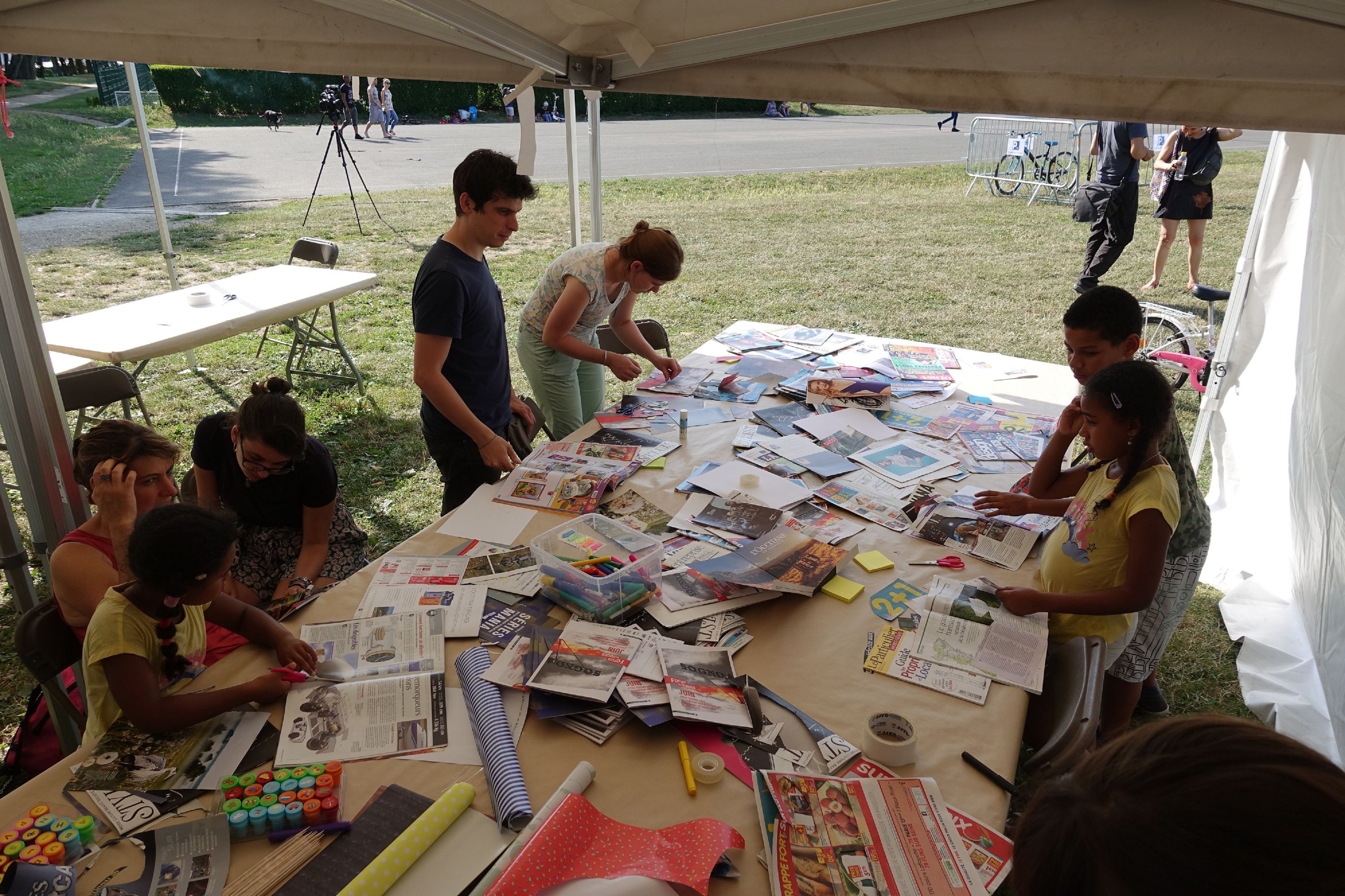
Cultural action and mediation with adolescents challenge the foundations of our practices: between framework and transgression, between physical presence and digital practices, what place is there for horizontality?
Two models of cultural policy
Cultural rights, now enshrined in French legislation (NOTRe law in 2015 and LCAP law in 2016), establish a fundamental distinction between cultural democratisation and cultural democracy:
- Cultural democratisation refers to the legacy of André Malraux: access to humanity’s great works, a culture that descends towards audiences. Many cultural facilities were built according to this logic, as evidenced by their very architecture.
- Cultural democracy, on the other hand, is based on more horizontal exchanges, recognising the diversity of practices. As Patrice Meyer-Bisch explains in Les droits culturels, une responsabilité politique (Observatory of Cultural Policies, 2008), « cultural democracy presupposes the recognition of the diversity of cultural expressions and the active participation of all in cultural life, as opposed to democratisation which imposes a legitimate culture from above ».
This distinction is not merely intellectual: it implies radically different professional approaches in supporting young audiences.
The report by the Economic, Social and Environmental Council (CESE), “Towards Cultural Democracy” (2017), emphasises that cultural policies must integrate these participatory approaches to truly strengthen citizen participation. However, mediation practices with adolescents remain largely shaped by the top-down model of cultural democratisation.
A framework that enables rather than constrains
Making room for adolescents first requires adults to shift their own positions. Mediation professionals must be able to move, to modify their own stances to create this space of freedom. This question often crystallises around transgression: how do adults, who maintain the framework, welcome shifts, deviations, unexpected and potentially transgressive proposals from adolescents?
This inquiry leads back to the very notion of framework, too often confused with a disciplinary device. Take the example of an artist working in a classroom where teachers wish to remain “to act as police”. This type of presence represents the opposite of a secure framework. It is a device that, contrary to what one might think, is profoundly destabilising for young people, because it introduces constraint, the possibility of sanction, which triggers the inhibition of the biological mechanisms of learning, as the body shifts into a reflexive protective mode. Disciplinary logic opposes any cognitive possibility of learning. As Bernard Stiegler explains in Prendre soin (2008), the capacity for attention is closely linked to feelings of trust and cognitive freedom. Cognitive resistance, this ability to resist one’s reflexive thinking developed by psychologist Olivier Houdé, can only unfold in an environment of trust, without fear of judgement.
A true framework is therefore not what constrains, but what enables. Within the context of an artistic proposal, individuals must feel authorised to create, to take risks before the gaze of others. Participation in a collective creation, however modest, always represents a personal risk. The question then becomes: how do we create sufficient conditions of trust for this risk to become possible? Consequently, transgression changes its nature: it is no longer something to be combated but rather welcomed as an integral part of the creative process.
Recognition through naming and documentation
The question of digital heritage and recognition of collective creations raises essential mediation issues. When participants take photographs, make videos or create any other work as part of a workshop, noting their first names and associating them with the works produced is not an administrative detail. It is a fundamental recognition of their creative identity. This can take time, as sometimes people do not dare to identify themselves, out of a sense of shame. And maintaining a constructive framework for them means precisely accompanying them, among other things, to dare to expose themselves, without fear of being judged. What this produces is recognition of their creation, which gives them a powerful psychological experience.
Without this nominative recognition, the person who created is not identified as the author of their work. Yet these are genuine collective creations, even when they occur within an educational framework. Under copyright law and French legislation, works must be attributed. This legal obligation covers a deeper issue of dignity and cultural rights. As Patrice Meyer-Bisch reminds us, « every person has the right to have their cultural identity respected in the diversity of its modes of expression ».
This question of naming opens onto that of documenting projects, the processes of cultural actions. To document is to give ourselves the means to create narratives. These narratives serve a dual function:
- These narratives allow participants to recognise the journey they have accomplished, to remember what they have been through. Often, lived experiences fade in memory; documentation allows them to be reactivated, to give them a lasting existence.
- But these narratives also serve the political sphere: elected officials need something other than attendance figures to understand and defend cultural policies, as do institutional leaders, partners and even parents.
Dominique Cardon emphasises in Culture numérique (2019) that « algorithms shape our access to information by privileging certain formats and certain sources ». Textual narratives remain the most powerful vectors of transmission in the digital ecosystem. Elected officials and institutional leaders cannot invent these narratives: they need cultural professionals to construct and share them.
Digital technology as a living environment
Digital technology is neither good nor bad in itself. It has become a living environment. One cannot be abstractly for or against digital technology: it is the environment in which a large part of our lives now unfolds. The same reasoning can be applied to artificial intelligence. This reality demands that we face contemporary cultural practices head-on: we all have cultural practices through digital means. We listen to music, watch films, performances, dance. We can even practise these arts through digital tools.
Usage surveys show that TikTok, often criticised, is primarily used for educational purposes by adolescents. This platform deserves more nuanced attention than the a priori judgements it generally provokes. My article « Et si on changeait de posture ? » published in L’Observatoire des politiques culturelles (no. 60, 2023) precisely documents this necessary change of perspective among cultural professionals.
“Trends” on TikTok illustrate this creative dimension well: they consist of music on which users can create and film their own choreography in just a few clicks. Tens of thousands of choreographies respond to each other, forming artistic palimpsests, accelerated histories of art. This massive cultural phenomenon deserves to be taken seriously rather than dismissed outright. It testifies to a creative vitality and a desire for artistic expression among young people who use these tools.
The anthropological transformation of the spectator’s position
TikTok represents the first social network that integrates a complete and accessible creation tool. What changes in anthropological terms regarding the position of people who use this platform is the awareness of an immediate creative potential. A user can be a mere spectator, but they know they can become a creator with a single click, if they choose. This does not mean they systematically activate this function, but the possibility exists, immediately available. Their status is therefore that of a potential actor, not a mere spectator.
In a traditional performance venue, spectators do not initially have this type of potential position. This anthropological change deserves consideration in reflections on cultural mediation. In the lived reality of young people, the position has changed. This possibility of watching, creating and broadcasting corresponds precisely to what Jean-Luc Godard described in the 1970s as the ideal tool: being able to make films freely, being able to share them with friends.
As Walter Benjamin reminds us in The Work of Art in the Age of Mechanical Reproduction (1935), techniques of reproduction freed art from its function as a tool in the service of tradition, which allowed it to access a form of cultural democracy. Current digital platforms extend and amplify this historical movement of democratising the means of cultural production. To deny this reality is to cut oneself off from understanding the contemporary cultural practices of adolescents.
Resizing the place of cultural institutions
Cultural practices through digital means are now extremely developed. Young people devote considerable time to these digital cultural activities: listening to music, watching videos, creating content, playing video games, participating in online communities. What traditional cultural institutions offer—theatres, museums, cinemas—represents only a tiny fraction of their daily cultural practices.
Cultural professionals are not THE culture for adolescents. They constitute one segment of it, sometimes important, but most often extremely minor. This awareness is in no way devaluing to the work of cultural actors. It simply allows us to better situate the real place of cultural institutions in the contemporary cultural ecosystem, profoundly transformed by digital technology. As Bernard Lahire notes in La Culture des individus (2004), « cultural democratisation also involves the invention of new spaces for encounter between works and audiences » (at the time, the term “cultural democratisation” covered both notions, democracy and democratisation).
Twenty years ago, this digital ecosystem did not exist in its current form. The cultural practices of adolescents were structured very differently. This rapid and profound transformation implies rethinking cultural action missions, not by abandoning the artistic and educational ambitions of institutions, but by accepting to work within an infinitely more diversified cultural landscape, where cultural legitimacy is primarily constructed through paths other than those of traditional institutions. Accepting this reality constitutes the first step towards more horizontal cultural action practices, more respectful of the cultural rights of adolescents, and ultimately more effective in their capacity to create authentic encounters with the arts and culture.

Cultural offerings are sometimes brutally questioned by the “young” audience. A challenge that manifests itself notably through indifference towards the prescriptions of cultural institutions, or even through disinterest in cultural venues. Over 15 years, digital technology has also revolutionized young people’s, and everyone’s, relationship to time and private space. The very definition of culture and its mode of access have been transformed.
To become capable of rethinking projects adapted to the real needs of contemporary youth, which falls under the mission of cultural policies, I believe we must first deconstruct our preconceived ideas, the judgments we may have without knowing. This involves taking the measure of new representations of the world and new cultural practices closely linked to digital technology.
How to do this? I believe that going through “doing,” precisely, is a very rich path for professionals. Experiencing through one’s own experience the stakes of cultural practices in the digital era, by participating in workshops with young people, by “playing” with digital technologies, by exploring new cooperation mechanisms, etc., with the aim of surpassing one’s usual criteria, in order to be enriched by youth’s ideas and uses. This is not about demagogy, but about weaving connections, which enables mutual transformation, creative hybridization.
Action-research on cultural policies for youth has always been one of the main areas of work for Benoît Labourdette, in cooperation with numerous actors from the cultural, educational and social fields. We propose here methods, accounts of actions and training, which we hope will be inspiring for actors from the cultural, social and educational fields at all levels. To offer an analysis of the stakes, as well as sociological, psychological, cultural foundations, to create solid supports in service of public service missions for youth.
-

Place as an Operative Concept for an Emancipatory Cultural Mediation
Taking one’s place is not about occupying a position, it’s about being able to move.
“What place for young people?” The question is wrongly framed. Place is not a position to occupy, it is the capacity to move within a relational (…) -

Making Room for Adolescents: Rethinking Our Approaches in Cultural Action
From democratisation to cultural democracy.
Cultural action and mediation with adolescents challenge the foundations of our practices: between framework and transgression, between physical (…) -

When Cultural Professionals Question Their Approaches to Adolescents
Reflections on a day of professional cross-fertilization.
An interprofessional day organized by the Réseau Jeune Public au Centre at Équinoxe, Scène nationale de Châteauroux on November 19, 2025, which I (…) -

The place of teenagers in cultural life
From cultural democratization to cultural democracy: rethinking our professional postures.
How can we create connections with adolescents in our cultural institutions? The question of their “place” reveals our power relationships and (…) -

Youth as a power relationship
Deconstructing infantilization to liberate potential.
Youth is not an age but a role we are made to play. Between infantilization and resistance, how can we rethink our intergenerational relationships (…) -

Youth and culture: for a radical change in posture
Giving young people the power to create, not just consume culture.
How can cultural institutions break out of their chronic failure with young people? By abandoning condescension to embrace a genuine cultural (…) -

Immersion VR: launch of an educational project, between collective creation and virtual reality
Three middle school classes are about to explore the narrative possibilities of 360° immersive cinema.
On October 15, 2025, at the Canopé workshop in Lyon: the start of a unique creative adventure, having three middle school classes create a virtual (…) -

Reinventing youth reception in cinemas
Remote training for cinema operators in Lot-et-Garonne.
How can we transform our cinemas into spaces for authentic encounters with 15-25 year-olds? This question guided an intense training session with (…) -

The value of cultural practices for young people
Towards a coherent, cross-functional youth culture policy.
Cultural practices, whether traditional or digital, are essential to young people’s development. It seems important to me to open up reflection on (…) -

Towards renewed cultural mediation for young people
Cultural rights and the digital age.
Digital practices of youth: legitimate cultural expressions for rethinking mediation and building a renewed cultural democracy. A necessary (…) -

Rethinking youth culture
From democratization to cultural democracy.
Cultural institutions often fail to reach youth. To reverse this trend, we must move from cultural democratization to cultural democracy, (…) -

Helping professionals design new types of projects adapted to the needs of young people
Laboratory for an original training and project development program.
In the face of young people’s indifference toward institutional culture, I propose exploring an innovative training framework aimed at helping (…) -

Conference: “EAC and cultural rights: convergences to be identified and implemented”
Dans le cadre des Rencontres territoriales “Artistic and cultural education & Territorial cultural projects” (Foix, February 5, 2025).
How can cultural rights be a tool for better implementation of artistic and cultural education projects? And how we can identify convergences (…) -

Tumo x IA - Creative journeys to the heart of AI
Film-making workshops in collaboration with A.I. by teenagers from TUMO Paris.
Large-scale creative experience for 350 teenagers, to raise awareness of the challenges of Artificial Intelligence, and equip them for critical (…) -

“Involving young people in summer cultural projects: issues, avenues of work, proposals”
Webinar hosted by Benoît Labourdette (Thursday, March 21, 2024, 9am-10am).
“Young people” are the main target of summer cultural projects in towns, villages and suburbs. And yet, professionals in the cultural, educational (…) -

“CinémA.I” in Studio 13-16 at the Centre Pompidou
Workshop on creating films in collaboration with artificial intelligence, led by Benoît Labourdette.
Film-making workshop in collaboration with artificial intelligences, for teenagers at the Centre Pompidou’s Studio 13-16. Creative proposal (…) -

Website: Artistic and digital practices for young people
Web resource platform for Act’art (Seine-et-Marne cultural agency).
Advice, development and support for the appropriation of a web resource platform for cultural professionals in the Seine-et-Marne department. (…) -

Design of a professional day on “Artistic and digital practices for young people”
Act’art, artistic and cultural action in Seine-et-Marne.
As part of its mission to promote collective intelligence by facilitating local think tanks, Act’art asked Benoît Labourdette to design, (…) -

OPC Media: “What if we changed our posture?”
How can we learn to consider the richness of teenage digital practices and avoid giving in to preconceived ideas?
How can we learn to consider the richness of teenagers’ digital practices and not give in to preconceived ideas? For Benoît Labourdette, if we (…) -

Helping young people and professionals to speak out: “Cultures and youth policies” national meeting
Observatory of Cultural Policies / Villeurbanne (TNP, May 11 & 12, 2023).
As part of the Rencontres nationales “Cultures et politiques de la jeunesse” (“Cultures and youth policies”), which brought the year of the French (…) -

"Culture, youth and digital: designing new modalities for cultural and educational projects
Sharing of methodological tracks and professional training.
Deconstructing preconceived ideas about digital transformation and developing projects adapted to young people.The cultural offer is sometimes (…) -

“Creative digital practices and critical thinking training”: conference by Benoît Labourdette
Atelier Canopé 86 - Poitiers. Study and training day “EAC at the service of the development of critical thinking”.
Participative conference to illustrate how the training of critical thinking can effectively pass by the means of artistic creation. To inaugurate (…) -

Reinventing cultural projects with youth?
Proposal of questions.
While public cultural action aims to reach people in their great diversity, it is clear that it is often difficult to mobilize youth. However, (…) -

OPC: “Culture, youth and digital” training
Designing new modalities for cultural and educational projects. March 2022.
A new concept of internship for cultural professionals, in order to build an opening to the public who have deserted the public and associative (…) -

Tutorials for doing video activities with your children
Podcast by Benoît Labourdette (1’37s, 2020).
Very simple tutorial (1 minute 30) to conduct two creative audiovisual activities with your children.During the confinement period in (…) -

DRAC and DAAC Pays de la Loire: “Learning to see and hear, a collective experience”
A professional training to collectively invent projection devices in order to build a greater intimacy with the material of the image. Then draw (…) -

Growing up with culture : “The contribution of digital technology in cultural mediation”
Conference by Benoît Labourdette about cultural mediation with digital tools, on the example of the travelling projections within the framework of (…) -

Vatos Locos Video: “Designing and implementing artistic practice projects to combat racism and discrimination”
Vocational training for leaders, teachers and managers of social and cultural structures. Video as a Tool for Citizenship.The association Vatos (…)


-

“Territorial approach, participation, youth and digital technology”: interview of Benoît Labourdette by Serge Saada (52’, 2021) Observatory of cultural mediation in the social field.
As part of the Observatory of cultural mediation in the social field, Serge Saada interviewed Benoît Labourdette on the impact of the (…) -
Reinventing cultural projects with youth? Proposal of questions.
While public cultural action aims to reach people in their great diversity, it is clear that it is often difficult to mobilize youth. However, (…) -
“Involving young people in summer cultural projects: issues, avenues of work, proposals” Webinar hosted by Benoît Labourdette (Thursday, March 21, 2024, 9am-10am).
“Young people” are the main target of summer cultural projects in towns, villages and suburbs. And yet, professionals in the cultural, educational (…) -

Dilapidation of resources in supply logic For a democratic revolution of cultural practices.
Faced with the crisis in the cultural sector, it is urgent to shift from a top-down supply logic to a culture of connection and listening, (…) -

The Périfééries project’s heritage council of influence Facilitating collective intelligence in a short space of time.
As part of Saint-Denis’s bid to become European Capital of Culture 2028, I led a collective intelligence session to collect proposals on the (…)
