Workshop “Tools, games and workshops for image education” - Images en bibliothèques
Images en bibliothèques has launched a new course, designed by Florian Lecron, for professionals in the library, film, education and culture sectors. I contributed to the design of the course, and led the final session: light, flexible mediation devices that allow us to take another look at the experience of an image education workshop, putting the experience and the path we want the audience to follow at the center.
Session program “How to run a video-making workshop differently”
In 2h30, my aim was to pass on a number of concrete, reproducible tools to share light-hearted yet profound methods for running audiovisual creation workshops.
Photographs to enrich ourselves through the eyes of others:
I kicked off the workshop by asking participants to each take a staged photograph of themselves, expressing an idea or emotion about the issues surrounding images in the contemporary world. The photographs were taken with the participants’ phones, and using a QR code I had distributed to them, which led to a “private cloud”, they put their photos online independently:

In the space of fifteen minutes, the digital tool made it possible to carry out in-depth individual creative work and share it with others. During this time, I reinstalled the room, with a powerful short-focus video projector I’d brought along, so that the image was bigger and brighter, and the chairs were set up as in a cinema, in a semi-circle around the screen. The technical set-up is very important, because it assigns a value to the images we make and watch.
And the most important thing is the way in which we look at these photographs together: we display them one by one in large format, and talk about them together. The person who made the image is not allowed to speak, and the others reflect back to him or her what they received, perceived and felt about the image. So, instead of “justifying” or trying to explain (i.e. reduce) the image we’ve made, we receive the often very different views of others, and we discover new things in our image, learn about ourselves, are enriched by others, and refine our perception. We also realize the extent to which images are always subject to interpretation (cf. critical thinking skills).
Books to share resources:
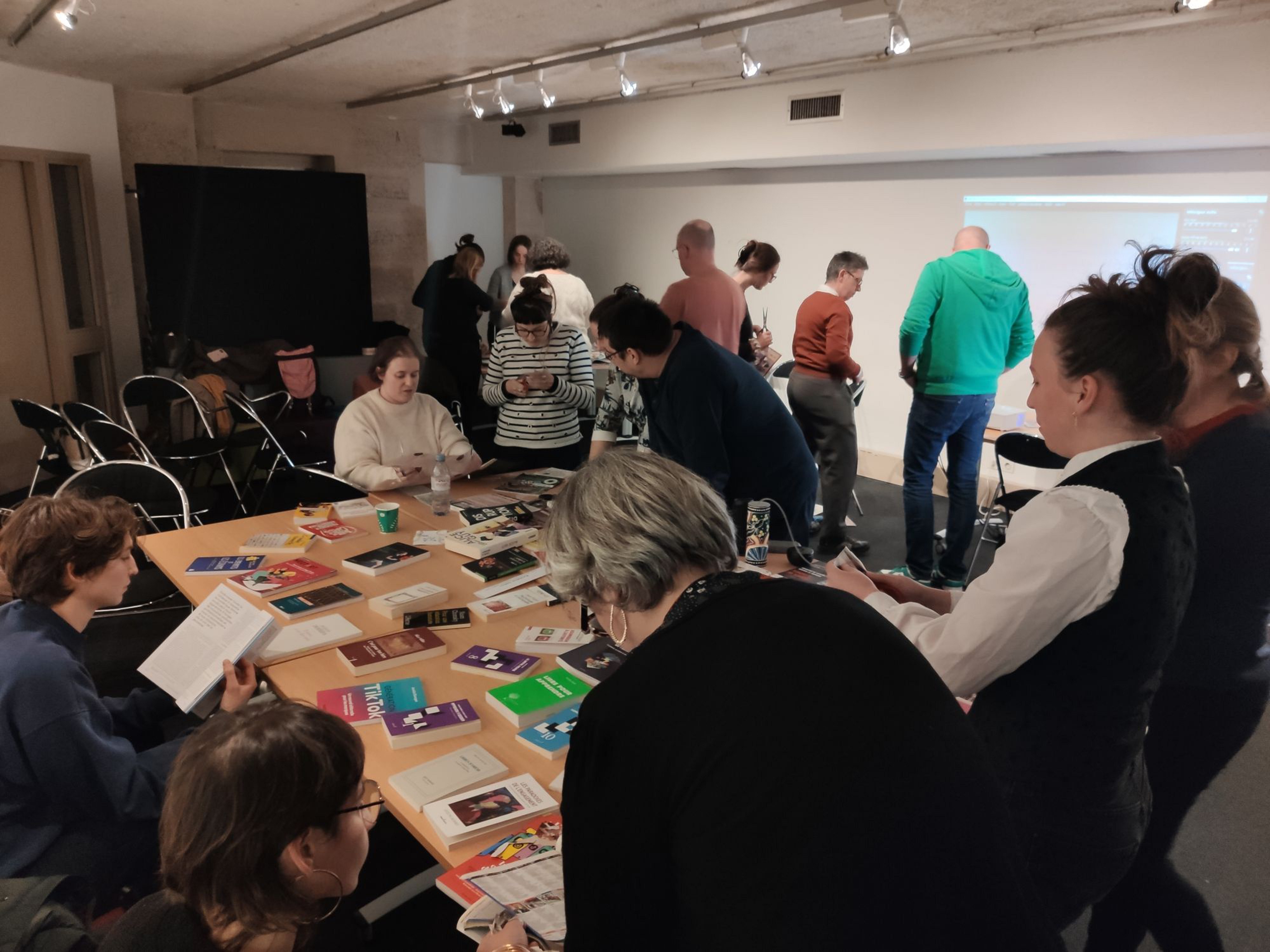
Next, I had brought along a large number of books on the topics of the workshop, laid out on a large table (the space had also been modified to accommodate this proposal). Each participant was asked to take a photo of one or more books, and to upload these photos to the sharing space (which will remain accessible, as it’s not a cloud dependent on a commercial service; I’m the operator and I guarantee its continuity), in order to build up a collective bibliography, decided by the participants, useful to one another, as follows:

Le fait que les livres soient ainsi appropriés et choisis par les participant.e.s change la relation à cette bibliographie.
Making animated films from paper cut-outs:
I set up four teams. Each team was tasked with creating an animated mini-film, using the cut-outs from a number of magazines I’d brought along, to be shot in sequence under a camera connected to a computer and associated with a high-quality microphone, in this set-up:

This setup allows you to see the result while filming, and gives the workshop a very collective dimension. But the same method can be used simply by filming with a phone or tablet. I also brought along some very simple musical instruments, so that the team could produce the film’s sound ambiance live. The four shoots followed in rapid succession.
Puis, nous regardons ensemble les quatre films, dont l’inventivité et la créativité surprennent tout le monde. Vous pouvez les voir ici (l’espace “cloud privé”) :
And there you have it! In 2.5 hours, all these creative activities have been carried out, invested in and returned. We’re also preserving a heritage trace thanks to digital technology.
I also invited participants to use the Capcut application, which is free, easy to use and packed with creative possibilities, and can be installed on both phone and computer. For example, from the photos created and shared, everyone can choose a photo of their choice (not necessarily their own) and create a montage from that image. The results are quicker to implement than a video shoot, and invested in the intention.
The Fifine K670 USB microphone I use (it took me several years of testing before I found this model), which is very inexpensive (40€), is chosen by participants.
I’ve also uploaded to the cloud the collective film they made at the start of the course, based on a concept I devised.
One of the most important points I’ve made, reassuringly noted by participants at the debriefing, is to never forget that what counts is the process you take people through, not the result (the film, photos, podcast...). When it comes to the feedback, it’s this process that needs to be recounted, and not just the results of the process. In this way, the participants no longer have to “improve” the films, for example, to make the feedback “rewarding”. Because “improving” the films means undermining the autonomy and responsibility of the participants in relation to the images they have produced, and thus destroying any “image education” project.
Training presentation text
Artistic and cultural education is a major concern for cultural mediators, who are increasingly turning to interactive workshops and creative initiation. This training course presents the tools needed to set up fun activities and creative workshops around cinema and the moving image.
The course gives participants the opportunity to test games, discover tools and use them to develop activities for different audiences within their own structure. The course not only presents the tools, but also gives participants the chance to play and experience them together.
The emphasis is on lightweight devices that do not require digital skills. Participants in the course will be able to appropriate and acquire them to build their own mediation actions. Part of the course will be devoted to setting up an audiovisual creation workshop, with a light version requiring no specific equipment and a more ambitious version with speakers.
Pedagogical objectives
- Acquire knowledge about film production
- Obtain the keys to setting up a film-making workshop
- Discover tools and resources
- Skills and abilities :
- Develop knowledge of cinema
- Acquire the skills needed to set up activities and initiatives to educate the public about images
- Acquire tools and working methods
The speakers
- Florian Lecron, chargé de formation à Images en Bibliothèques
- Juliette Monnier, médiatrice et formatrice cinéma
- Sylvie Matéo, créatrice de Cinaimant
- Claire Cochard, coordination Passeurs d’Image - Pays-de la Loire
- Léa Enjalbert, réalisatrice, membre du collectif Filmer l’Air de Rien
- Laurent Geniller , Coordinateur des projets audiovisuels à la Maison du Geste et de l’Image
- Bruno Bouchard, réalisateur de films, collectionneur de pré-cinéma et intervenant pour les
- dispositifs d’éducation à l’image
- Delphine Robin-Tyrek, coordinatrice des pratiques et enseignements artistiques à Ciclic Val-de-Loire
- Romuald Beugnon, créateur de la Mashup Table et la Mashup Box
- Philippe Denis, responsable numérique de la médiathèque de Lorient
- Benoît Labourdette, cinéaste, pédagogue, chercheur et consultant en innovation culturelle et stratégies numériques
Presentation page on the Images en bibliothèques website.
This workshop took place at the Maison du Geste et de l’Image (Paris) from November 8 to 10, 2023.

Design and delivery of professional training in the field of image education, for teachers, facilitators, responsible for educational facilities, cultural and social, and cinema theater directors.
With the new technology tools, to “connect” with the practices of youth and enlighten.
-

Participatory reverse photography workshop
A method for deconstructing relationships with images.
Pedagogical method that transforms the phone into a tool for collective creation to question our relationship with images, democratize the (…) -

Multidisciplinary photographic exhibition creation workshop
As part of the Awakening the eye training program (Institut pour la photographie).
Animation of the latest annual, hands-on image education training session for teachers, offered by the Institut pour la photographie as part of (…) -

Workshop “Tools, games and workshops for image education” - Images en bibliothèques
A story of the session “How to run a video production workshop differently”, led by Benoît Labourdette.
Images en bibliothèques has launched a new course, designed by Florian Lecron, for professionals in the library, film, education and culture (…) -

“The use of screens at the heart of child protection”: conference / training by Serge Tisseron and Benoît Labourdette
Proposed by the Federation of the sunbeams of childhood and the IRTS PACA - Corsica.
Training day for 80 social actors of the child protection, to equip the professionals with the good use of the images and the digital in an (…) -

DRAC and DAAC Pays de la Loire: “Learning to see and hear, a collective experience”
A professional training to collectively invent projection devices in order to build a greater intimacy with the material of the image. Then draw (…) -

House of the image, Appointments of the image #6: “Intimacy, images, social networks. Existing and living together in the digital age”
Training day and co-construction of educational tools to work on self-image, designed in collaboration between theMaison de l’image (Noémie Rubat (…) -

Pocketfilms-Empathy
Project to support psychosocial and pedagogical practices around the empathy clinic and using images. By Serge Tisseron and Benoît Labourdette, (…) -

CNPFT: Training on uses and educational projects around digital technology with young people and children from 12 years old
Training in digital image education at the CNFPT (Centre National de la Fonction Publique Territoriale)..The objective of this 4-day training (…) -

Ciné Lab # 6: “New usages, digital cultures. What (R) evolution for cinemas?”
Day of reflection and common development of innovative projects, for cinema operators and mediators.The ACRIRA and the GRAC (Rhône Alpes (…) -

Vatos Locos Video: “Designing and implementing artistic practice projects to combat racism and discrimination”
Vocational training for leaders, teachers and managers of social and cultural structures. Video as a Tool for Citizenship.The association Vatos (…) -

Observatory of Cultural Policies: “Territorial Projects and Cooperation”
Territory, digital, culture, participation, participation, creativity... keys to understanding and methodologies for relevant and innovative (…) -

Image’Est : Images education facing everyday image practices
As part of the Festival of documentary films “The real in sight”, Image’ is, business education to the images in Lorraine, proposed on 18 November (…) -

East image: Cover images that make violence happen
Training on how to teach about violent images.East Image, Regional Centre for Arts Education and Training in Cinema and Audiovisual, organized (…) -

National Meeting of coordinators School and Cinema: “Image education 2.0”
Benoît Labourdette Conference and workshop on the development of image educational practices in the digital era.Each year the association (…) -

Region Poitou-Charentes : Digital Practices Training
Cross Training to digital practices for mediators and teachers.With Red Pixel image pole of the Poitou Charentes region, we have provided (…) -

Ciclic - Training Passeurs image 2015 : The Pocket Film
“Pocket Films” trainging for social workers and street educators - Central France Region.Ciclic Regional Pole for the moving image, the book (…) -

Embassy of France in Spain: Pocket Films Training for teaching French as a foreign language
Filmmaking techniques using cell phones for teaching French as a foreign language in Spain.The linguistic and educational Cooperation (…) -

Speaking Cinema Association : Pocket Films Training
Learning Workshop in filmmaking with mobile phone.The Speaking Cinema Association in Angers (France), which is involved since a long time in (…) -

Poitou-Charentes Region : “Pocket Films Training” for teachers
Red Pixel image pole of the Poitou Charentes region, proposed as part of “Lycéens in cinemas”, that one of the features of the program be replaced (…) -

Tell me your technologies contest - Pocket Films training
Train mediators who will lead filmmaking workshops.The association Les atomes crochus offers since 2013 the contest “Tell me your (…) -

Video Les beaux jours : Mashup workshop
To make animated films from cut paper. The meetings of image education in AlsaceAs part of the meetings of image education in Alsace, organized (…) -

Association Hors champs - Formation Pocket Films
Transmission d’outils pédagogiques innovants pour l’éducation à l’image.L’association Hors Champs à Niort, organisatrice du Festival Takavoir (…) -

ECLA Aquitaine : 1st Regional Forum on Education in the image - Conference and Workshop
The agency ÉCLA, Pôle régional aquitain d’éducation artistique et de formation au cinéma et à l’audiovisuel, held Tuesday, December 10, 2013 the (…) -

“Image carriers” Brittany - Training “portable cinema”
At the invitation of the UFFEJ Britanny (Laurence Dabosville), I proposed a day of training for project managers “Smugglers images” of the (…) -

“Pocket Films” training for facilitators (Savigny-sur-Orge, France)
Peggy Nacitas, host video MJC Savigny-sur-Orge (and former coordinator of Imag’Essone Festival), having suggested that I host this year’s (…)


-

Media and ai education through creativity Account of a training session: when artificial intelligence becomes a pedagogical tool for developing critical thinking.
What if artificial intelligence became a tool for developing critical thinking? Account of a training sequence that proposes to rethink media (…) -

Research-action “Image Education 2.1” Cultural rights
Collaborative action-research project led by Benoît Labourdette production in 2018 and 2019, to develop the synergy between teenage cinema (…) -

I want to tell you something Collective film (3’38s, 2016).
What if the books spoke? -

Contents A film by Benoît Labourdette (2’24s, 2019, muet).
Why do we let ourselves be photographed?Based on photos of Mark Neville published in Le Monde “M”. -

Bounces A collective film supervised by Benoît Labourdette (8’57s, 2022).
Through a walk through each other’s photographs, an old library becomes the place where looks and lives meet in depth.
