The Example
The importance of a work of art lies in its form, for this is how it changes the way of looking at the world.
Quote from a text by Georges Raillard, “The Example”, published in Michel Butor’s “The Timetable” (10|18,1972):
Every great work is revolutionary, denouncing. Not so much by its literal messages - its explicit philosophy, the slogans it can launch, the politics it advocates - but by a subversion of our image of reality provoked by the whole work. There is no shortage of examples in contemporary literature of these novels, which were intended to be sowers of revolution and whose literary conservatism condemned them to ineffectiveness. On the other hand, Balzac himself provides an example of a distortion between the conservative goal he was aiming for (the defence of the throne and the altar) and the result achieved by the Comédie humaine, which Butor explains as follows:“the immense movement of the work of art provokes a kind of ploughing, a revolution in the image of the real that leads it well beyond, politically, the proposed goal first of all”.
Diffusion
- The Example (MPEG4)
- 2018_kaleidoscope_l_exemple-en.vtt (WebVTT)

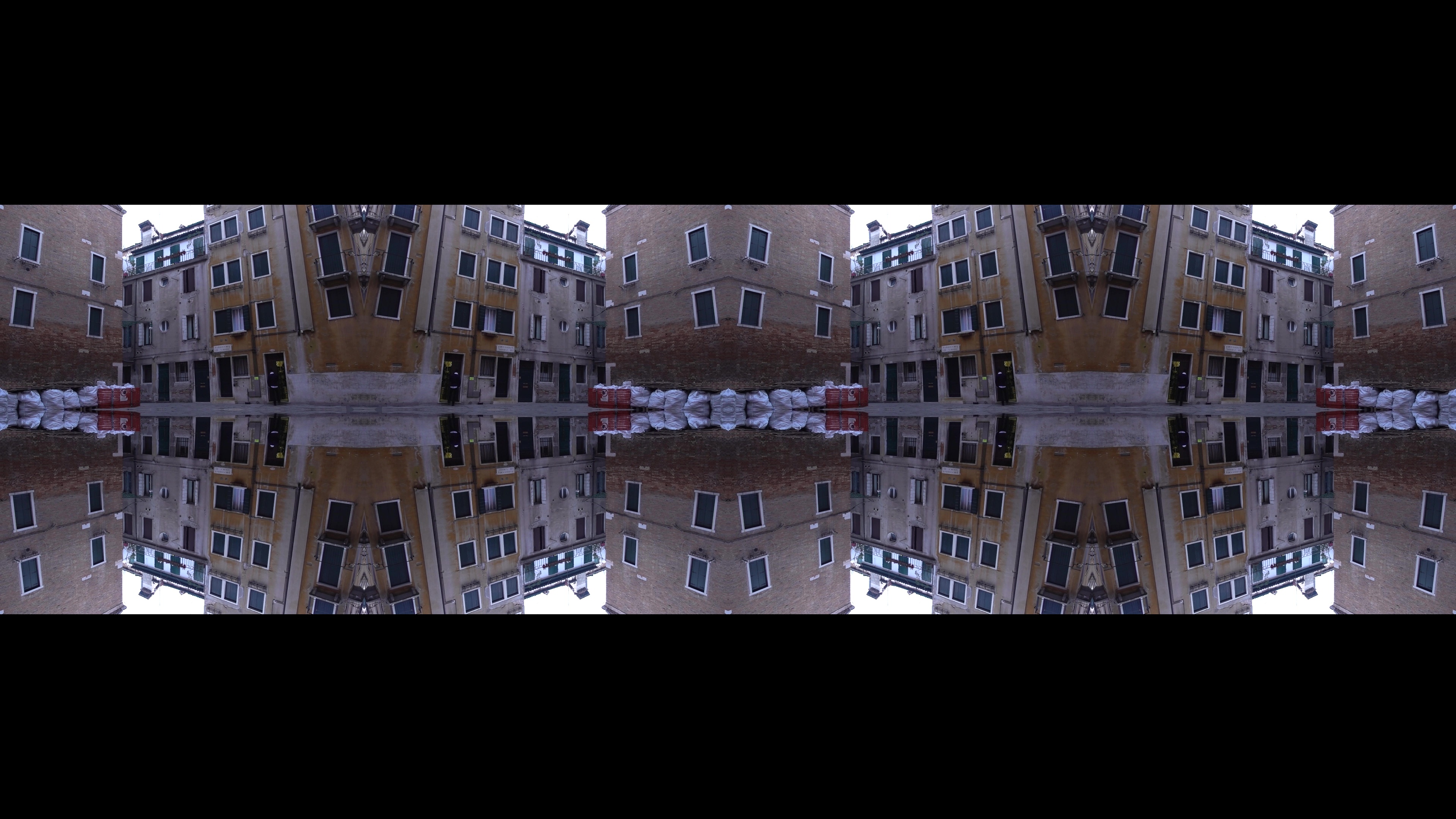


The kaleidoscope, a figure made up of mirrored replications of the same image, offers a very “organic” vision of things. Like a visual metaphor for cell division, it opens up a realm of perceptions and emotions far beyond the mere decoration it might at first appear to embody. This figure, very rare in films, has always questioned me, which is why I’ve been exploring it in film for a long time.
It’s been a nice surprise to see animated kaleidoscopes flourishing on screens over the last four or five years, in film and series credits in particular. I invite you to read the manifesto text on the practice of animated kaleidoscopes, which I wrote ten years ago, in 2014: « Thinking about moving kaleidoscope image ».


-

Hope Un film de Benoît Labourdette (1’50s, 2018).
To cling to pillars planted in the water for centuries, to hope. -

Montpellier 3 université : exploration of drone. Drone as a creative tool ? Trainings for new media
ThoughtsRecently, drones equipped with cameras are accessible to the public. Ie the flying camera, previously reserved for seasoned (…) -

Structure Création vidéo de Benoît Labourdette (3’07s, 2014).
Les structures architecturales, inanimées, supportent les reflets des mouvements de la vie. -

The Economy of Creative Abundance How Artificial Intelligence Redefines Value in the Cultural Sector.
AI is disrupting creation: it displaces scarcity and multiplies possibilities. Faced with an obsession for performance, the cultural sector can (…) -

A tear of fatigue at Gare d’Austerlitz Series of 217 photographs in rotation.
We turn, I turn on myself, and we don’t look at anything, I let myself be told.How much time is missing between each frame? What is its nature? (…)