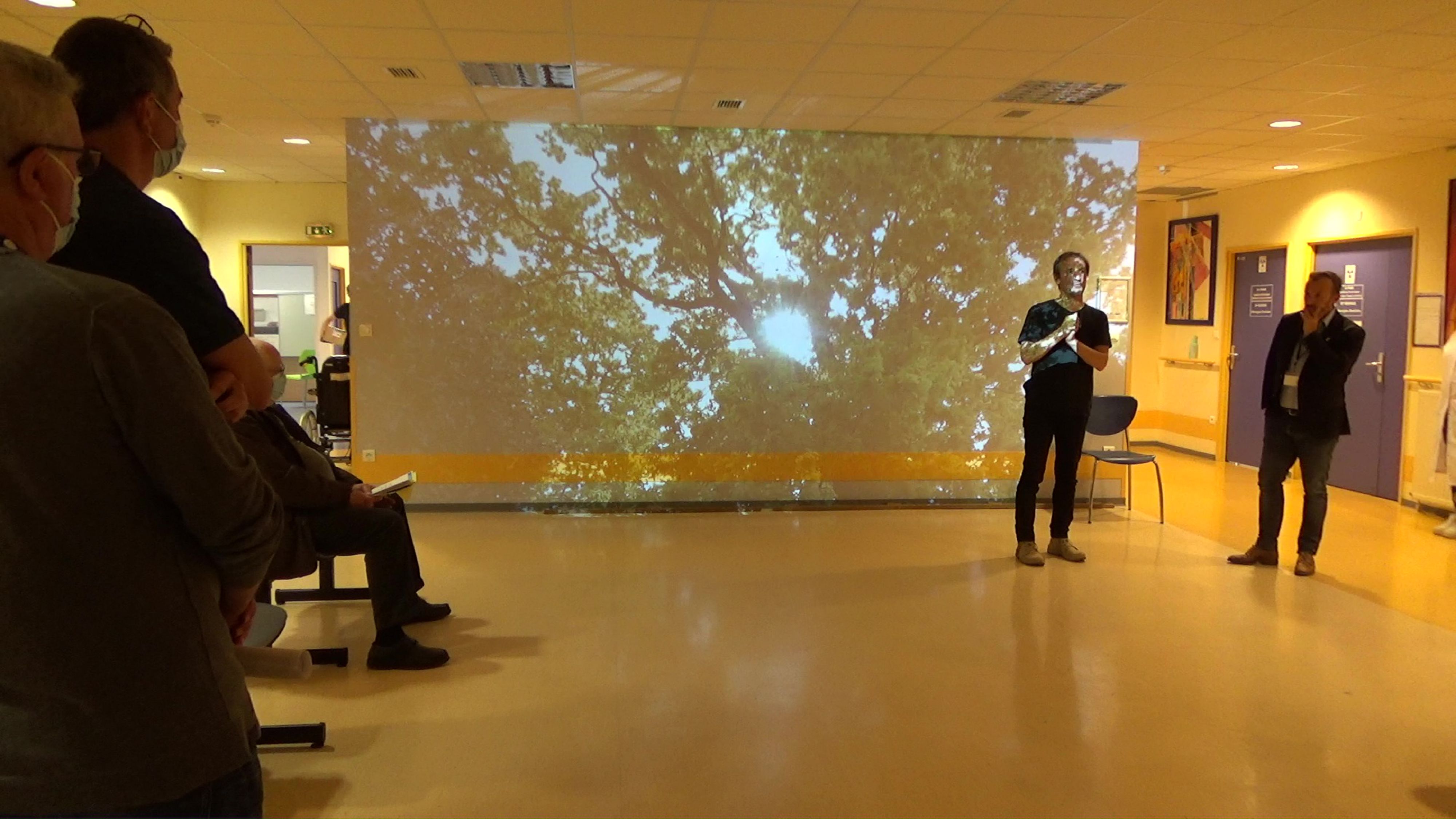
Accounts of the issues at work in an art for health project. Every morning, the big wall of the waiting room of the hospital in Flers lights up by itself. Video images of nature, calm and serene, are projected there all day long. It is a space of contemplation to make the patients feel good. It turns off automatically in the evening and turns on again the next day. How did these images fit into this place?
Art is beneficial to health, both physical and mental and can complement traditional medical treatments.
WHO report from November 11, 2019
Art has been a legitimate activity in the field of health for the past 20 years. This does not mean that the dialogue between art and the hospital is something simple. The needs are first of all medical, and art is part of this framework and not for itself. This is obvious, in theory. The real question is how to put it into practice, that is to say, how the artist can be present in the hospital context. From my experience of the installation of a perennial video work in the waiting room of the hospital of Flers in 2022, I wish to share what I have learned in terms of method.
Framework of the project
The association Art dans la cité is at the origin of this initiative, and had proposed me to think about an artistic project for this waiting room. At the request of Art dans la cité, I had previously made a one-hour film, « Promenade en forêt », which is shown in hospital rooms for the relaxation of patients.
The installation of this immersive work was a co-production between Art dans la Cité and RESAH. Each step of the work was documented and shared collectively as it went along. I left an audio message of the day’s results, synthesized and written by Rachel Even, Executive Director of Art dans la Cité, with Cécile Antonietti, Art dans la Cité’s project manager, then sent by email to all the partners. Within the Centre Hospitalier Jacques Monod de Flers, the project was led by Julie Loudière, culture-health referent and responsible for external communication and public relations.
Translated with www.DeepL.com/Translator (free version)
This work took place over a period of more than six months, which were necessary for it to take root. The project has evolved enormously over time, in its forms, contents, and technique, to the benefit of its objective, which is to use art for the well-being of patients and thus contribute to their health.
Priority to the connection and the experience
I believe that what is good about art, whether one is a spectator or an author, is the connection to oneself and to others, or rather the opening to new connections. These openings take place with our aesthetic, intimate, mysterious emotions... in connection with our cultures. Humanity is shared in depth through artistic forms. It is like a breath, one of the forms of life.
What is art? If we refer to John Dewey, art is a lived experience. To make work, for an artist who comes to intervene in a context outside his studio, is to work to weave links, it is to work to open up, to be surprised, to be moved, that is to say enriched, to make the project evolve so that it remains relevant, which is not necessarily comfortable. This movement is mutual: if the artist dares to propose it and to risk it, a “dance” can begin.
Labouring together the ground
In this project I would say that the work that is commonly called “artistic” (i.e. the actual creation of the images and their technical implementation as an installation) took 20% of the time. And 80% of the time, the essential part of the work, consisted in reinventing the project several times, thanks to the meetings, according to the context, the unforeseen events to be welcomed as enrichments, the links which could make that this project, little by little, was not any more the object of an artist, but the design of a team, of a place, was reborn in a common and shared energy.
My role as an artist, and I learned all the more from this experience, was to constitute, little by little, the fertile ground on which a project that makes sense beyond myself can be born, grow, live. Because the video work remains after my departure, and the goal is that it serves, that it lives for the patients and the staff of the hospital. At the beginning, the idea was a projection on the ground of a path in nature, inspired by the film « Pas à pas », shot on a beach, which gave its title to the installation. The idea was that the patients could project their own imaginary onto images of nature, on the ground as if they were there. Like when we walk in nature and our mind regenerates.
We installed a video projector on the ground, and brought these images to life. We tested them with patients. Doctors contributed, filming images, to add to mine. It was my initial device, original, singular and amazing. But... the security norms of a hospital impose a very luminous lighting, and the images were hardly visible, except when the light was off...
Ecology of relationships
I tried to check in detail this technical problem, with a light meter. No solution... I wanted the originality of this ground projection. I said to myself that we could project more contrasted images, texts in white on black. We did these tests. Julie Loudière then pointed out to me that it was no longer the project, that it was no longer the relaxation with images of nature. By the quality of the link woven between us, she was at that moment the bearer of the deep stake. We then tried to project the images on the big wall (which had to be cleared of many posters), and suddenly, the images of nature immersed us in a universe of relaxation, in a much stronger way than on the ground, and the luminosity was sufficient. This was immediately pointed out to us by patients who were present in the room during all these tests.
An unforeseen sequence of events, all happy if welcomed
So the work became more classic in form, but really useful for its purpose. And the videos of walks with the ground filmed did not work, moved too much. So we did several image-making workshops in the countryside around the hospital with staff members. Then we tested the images in the room, and thanks to the patients’ feedback, we found that we needed 5-minute wide still shots, with 1/3 of the ground below and 2/3 of the sky, with a deep perspective in the center. Shots that were too tight, or without perspective, had no place.
I shot a large number of sequences around the hospital and in the large park of the city of Flers, on the suggestions of staff members who came to the room for the tests and gave their opinion. And above all, so that the work lives on over the years, we created a “tutorial”, with the precise characteristics of the videos to be made, so that doctors or staff could add videos over the years.
Unforeseen circumstances, whether technical or human, always arise. The work to be done, I believe, is to remain open while we are destabilized, to let something else come. This will ultimately enrich the artistic project, whereas at first glance it may seem that we are deviating from it. What we must not lose sight of is the why of this work in this place.
“Silent natures”, a new genre of films
I realized a few months after the opening of this installation that these nature contemplation films I had shot for the waiting room also functioned independently. They have no soundtrack (because sound all day in a waiting room would become unbearable). I then created a new “genre”, the Silent Natures : there are 10 films for the moment. It is for me a form of rediscovery of the cinema, in connection with its origins.
The objects that make roots
It is through objects that the work has gradually taken root: the tests of video projectors, the projection on the floor finally not possible because the room was too bright, the ways of shooting the videos, adapted to the broadcasting device, which have evolved over time before finally settling, after a long road of evolution: how we live the situations together, how we hang the video projector on the ceiling after many very complex steps, how we make successive tests, how we are amazed by what we discover with patients and staff members, how around these new objects new spaces of relationships are born between people, around poetry.
In the end, it was the complete technical tutorial of the installation that was the last symbolic object of transmission, of bequest of the whole installation to the hospital team. He describes how to technically manage the whole device that we have co-constructed, and especially how to be able to create new videos and add them.
Finally, a movie theater
I, who initially wanted a rather discreet projection on the ground of images of nature, found myself being the bearer of a transformation of this waiting room into a kind of cinema. In spite of myself, the big wall became a movie screen, the seats of the waiting room were placed like the seats of a movie theater and the light was turned off. The space was reconfigured around the screen. The project has passed me by, it is no longer mine, it is that of this human community.
Complete account of the project
This document was realized by Art dans la cité and written by Cécile Antonietti :

Initial project by Benoît Labourdette
Project that was selected following the call for projects (the budgetary framework was defined upstream):
The main characters in this story
- Rachel Even, initiator of the project. General delegate, association Art dans la Cité.
- Cécile Antonietti, follow-up, communication and assessment of the project. Program manager, Art dans la Cité association.
- Benoît Labourdette, artist designer of the project and project manager of its realization.
- Julie Loudière, main interlocutor for the implementation and the links within the hospital, partner of creation. External communication officer, public relations and health culture referent, GHT Collines de Normandie.
- Kevin Tabourel, technical and human facilitator. Fire safety manager, GHT Collines de Normandie.
- Olivier Espinosa, manufacturer of the hanging solution. Technical Service Officer, GHT Collines de Normandie.
- Karolina Hurnikova. European projects and innovation officer, RESAH.
- And all the members of the medical, administrative and technical staff of the Centre Hospitalier Jacques Monod de Flers who contributed with their creativity and curiosity to the construction of the project.


