Helping young people and professionals to speak out: “Cultures and youth policies” national meeting
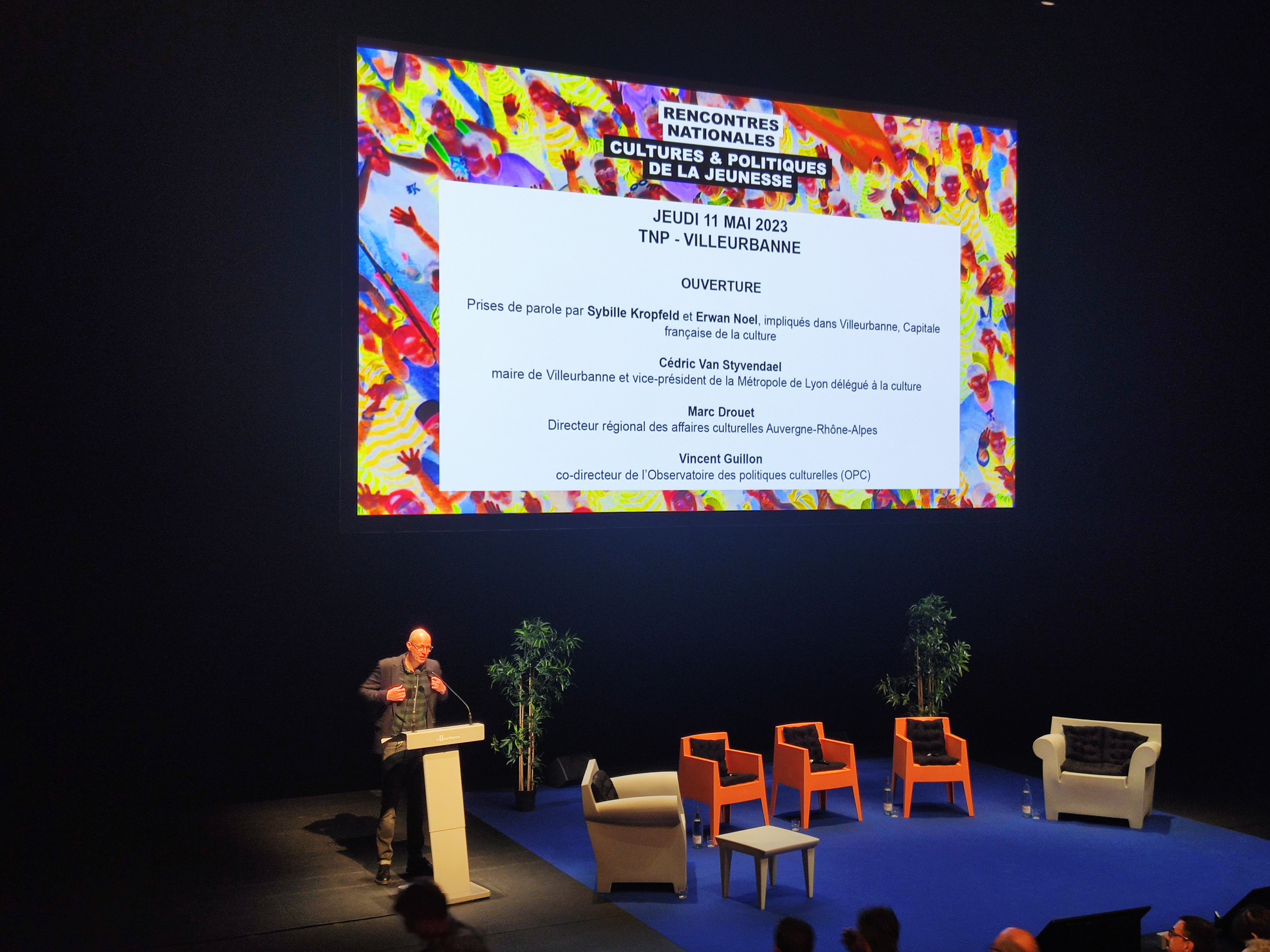
As part of the Rencontres nationales “Cultures et politiques de la jeunesse” (“Cultures and youth policies”), which brought the year of the French Capital of Culture to a close in Villeurbanne, I was commissioned by the Observatoire des Politiques Culturelles (organizer of the meetings) to lead preliminary discussion groups with young participants and local professionals, in order to prepare with them their public speeches during the meetings, planned for each of the themes: childhood, adolescence, entry into adulthood.
To enable people to speak out, I organized collective intelligence mechanisms, so that everyone could gain confidence. Then I had to organize the content of the discussions, so that they would be genuine and enriching, without putting people “at risk” in their institutional setting.
The Encounters were opened and closed by young people themselves, and local professionals also took the floor in public. The work also consisted in helping to structure these speeches and build self-confidence.
The contributions of young people and local professionals, based on their experiences of the French Capital of Culture, were concrete and enriching; we realize that if we know how to bring out the word and the thought, people on the ground have a real intelligence of their actions. Complementary to, but no less important than, that of sociologists and experts.
This work was carried out in close collaboration with emmanuel vergès (co-director of the OPC), Vincent Guillon (co-director of the OPC), Élise Colin Madan (in charge of meetings at the OPC), Élise Capogna (in charge of the Villeurbanne youth program) and Simon Meyer (director of cultural affairs for Villeurbanne).
“Cultures and youth policies” national meetings
From childhood to young adulthood, the different moments of youth raise specific questions. What aesthetic and educational experiences can we offer children? What cognitive and social constructs are involved? Is artistic and cultural education on the way to depoliticization? Do we need to support teenagers’ sociability and digital culture? Are young adults reinventing the forms and motives of political commitment?
With contributions from specialists and controversial discussions, these two days will provide an opportunity to debate these cultural issues as perspectives for renewing youth policies. An event designed for players in the fields of culture, youth and education.
National meetings organized by the City of Villeurbanne and the OPC to conclude a year 2022 “French Capital of Culture” placed under the sign of youth.
To find out more about the meetings and the subject:
Youth Speaking
The two young people (aged 17 and 18) who opened the meetings proposed (as a summary of the exchanges) four recommendations, which they felt were important for culture to be both accessible to young people and a tool for intergenerational emancipation. Their reflections were really based on what they had experienced in 2022 thanks to Villeurbanne Capitale Française de la Culture:
- Regularity of events that young people help to program :
- Because it brings so much to young people.
- Not events programmed by adults.
- All young people involved in programming.
- Open up to other cultures & cultural practices :
- To avoid gentrification.
- To avoid this trap.
- Don’t forget a part of culture, because you can exclude without realizing it.
- Bring together several establishments, as well as out-of-school youth (on social networks, there’s everyone).
- Raise awareness among families.
- Free :
- Essential for youth participation
- Spaces (in the city):
- This encourages encounters and links.
- And it encourages cultural practices.
Professionals speak out on entering adulthood
By Benoît :
I’m Benoît Labourdette, and I’ve been running workshops with local professionals and young people to prepare for these speaking events. On the subject of entering adulthood, a dozen players from the worlds of culture, youth and popular education were brought together to discuss and elaborate together. They wrote this collective text.By the group:
On April 27, we were brought together to take part in a working group on the cultural issues facing 18-25 year-olds, in preparation for our collective speech. 5 minutes is a very short time to respond to such a vast subject, nourished by our experiences in the field. So we decided to share with you what we had to say in the face of such astonishment. We asked ourselves: what is the place of young people in these meetings? What is the political and therefore cultural intention for young people behind this event?Let’s start with the notion of commitment: young people are very committed to politics, as we saw very recently with the protest mobilizations of young people for the right to retirement, or the refusal to generalize universal national service. But when it comes to cultural and social institutions, there’s more of an injunction to get young people involved in schemes, so that they can “say it works”. This is unhealthy, and creates “youth boxes”. We disagree with this approach, which serves not the needs of the beneficiaries, but those of the institutions behind the projects. We are asking ourselves the fundamental question of the mission of cultural players. And in practice, we question the relevance of the call for projects policy: is this funding really there for young people? We advocate global funding for the operation of structures, which would enable them to build with young people, in openness.
Calls for projects, which can be interesting, often don’t come at the right time for young people, so we end up “needing” them to fill projects. Socio-educational structures are not “public distributors”. Our actions must be carried out for and with local residents, at their pace. When we fight not to impose a project, but to build on the realities of our partners, their needs and their objectives, it changes everything.
With regard to the objective of “cultural emancipation”, i.e. autonomy in one’s cultural choices, we raise the question of EAC policies implemented before the age of 18? Do they promote emancipation? In their school careers, young people are mainly exposed to top-down culture, “thinking in the place of”. Isn’t it normal, then, that when they become independent, they want to emancipate themselves from legitimized culture?
So, what can we do for young people after the age of 18? Above all, don’t speak for others. This raises the question of the definition of culture. Do we mean the dominant culture? If a common culture makes society, why doesn’t society evolve with the metamorphosis of the cultures that populate our daily lives?
It’s a political issue, a matter of freedom and emancipation. Wouldn’t the idea of a joint ministry for youth and culture be more coherent?
- Setting up working groups
- Events program
- Session 1: Summary - 1. childhood
- Session 1 - Childhood - Discussion
- Session 1 - Childhood - Presentations
- Session 1 - Childhood - Speaking out
- Session 2: Summary - 2. Teens - young people
- Session 2 - Adolescence - Discussion
- Session 2 - Adolescence - Presentations
- Session 2 - Adolescence - Speaking out
- Session 2 - Adolescence - Discussion
- Session 2bis: Summary - 2. teenagers - pros
- Session 2bis - Adolescence - First interpellation
- Session 2bis - Adolescence - Presentations
- Session 3: Summary - 3 Adults
- Session 3 - Young adults - Discussion
- Session 3 - Young adults - Presentations
- Session 3 - Young adults - Hacking the system - Questions
- Session 3 - Young adults - Questions
- Session 3 - Young adults - Refocusing the subject


Drawing on Benoît Labourdette’s 30 years of experience in the field of cultural innovation and his research and methodological work, the Benoît Labourdette production agency supports cultural policies in their need for innovation, better encounters with populations, use of digital tools and cooperation, definition of mediation strategies, and support for artistic teams, technicians and elected representatives. Our method is always based on collective intelligence, cooperation and empowerment of people and structures. We work with cities and other local authorities, national networks, institutions and associations.
-

Creating to think
A French-Finnish meeting at L’Alhambra in Marseille on 4 May 2026, as part of the Erasmus+ Visual Thinkers project.
On 4 May 2026, I facilitated a professional meeting at L’Alhambra in Marseille, organised by the Image Clé association as part of the European (…) -

The Book Archipelago
A proposal to elected representatives: making plural bookshops the backbone of territorial cultural policies.
Faced with the tensions running through the bookshop sector today, it is time to put an end to the sanctuary myth. Rather than seeking an (…) -

The photography workshop: creating, showing, looking together
Reflections on a hands-on workshop facilitated by Benoît Labourdette at the professional conference “Cinema, images and young people’s mental health”, held on 14 April 2026 in Romainville, France.
A workshop in nine small groups, fifteen minutes to produce a photograph, then a moment of collective viewing in which the authors remain silent (…) -

« Mental Health and Cinema »
Synthesis of the day “Young people, their images, their spaces: new paradigms” (14 April 2026)
Synthesis of a day of professional gatherings at the Le Trianon cinema in Romainville, bringing together the perspectives of professionals from (…) -

Mental health, young people, images: what are we talking about?
Text of Benoît Labourdette’s opening talk at the professional meetings held on 14 April 2026.
Before entering into projects, we need to pin down the words. Mental health, young people, images: three notions we often use together without (…) -

Transmitting cultural rights: a question of coherence
What facilitation methods reveal about our relationship with people.
How can we talk about cultural democracy within an authoritarian framework? How can we defend respect for each person’s culture while imposing a (…) -

Mental Health and Cinema - Experiencing the World Through Images
Two professional conferences in Romainville (April 14 and 15, 2026).
On April 14 and 15, 2026, ACRIF, as part of its coordination mission for Passeurs d’images in Île-de-France, is organizing two days of (…) -

Collaborative assessment of screen literacy education in Nouvelle-Aquitaine
Collective intelligence methodology, digital platform, and collaborative publication for ALCA (2026).
ALCA, Agence Livre, Cinéma et Audiovisuel en Nouvelle-Aquitaine, entrusted me with the methodological support for a collaborative assessment of (…) -

Media Literacy: Should We Judge or Guide?
Reflections based on the National Meeting of Regional Centers for Media Literacy (Rouen, March 16–17, 2026).
On 16 and 17 March 2026, Normandie Images organised in Rouen the national meeting of France’s regional image education centres (pôles régionaux (…) -

The Meaning of Mediation Methods in Arts and Cultural Education
When practice reveals what theory ignores.
Artists and professionals involved in arts education develop singular methods that most often remain implicit. I wish to lift the veil on the (…) -

Cultural Mediation as a Device for Symbolic Emancipation
Methodological Principles for a Horizontal Approach to Collective Creation.
Lived experience radically transforms our relationship to thought. Cultural mediation does not consist of transmitting knowledge but of creating (…) -

Evaluating Arts and Cultural Education from the Artist’s Perspective
Review of a course given at INSEAC: conceptual and methodological tools for cultural professionals.
On January 15, 2026, as part of the CNAM module EAC104 “Building tools to evaluate ACE projects: qualitative and quantitative survey methodologies (…) -

Developing Psychosocial Skills Through Artistic Practices
Methodological principles for an experiential approach.
Psychosocial skills (PSS) are now at the heart of public health, education, and child protection policies. The 2023-2027 intersectoral roadmap, (…) -

When thirty-five professionals discover their psychosocial skills through creative experience
A look back at the interprofessional seminar of January 12, 2026, in Limoges: a day where theory gave way to lived experience.
At the DRAC Nouvelle-Aquitaine, educators, teachers, caregivers, and cultural actors experienced together what it truly means to develop (…) -

Image Education and Citizenship: When Youth Professionals Rethink Their Practices
{{Reflections on the “Out-of-School Time” professional day that I co-designed with ALCA and the Gironde Departmental Council.}}
On December 2, 2025, around a hundred youth, animation, and culture professionals gathered at the MECA auditorium in Bordeaux to explore together (…) -

Art and Culture in the Service of Psychosocial Skills
Account of a founding seminar for professionals of the Judicial Protection of Youth in Limousin.
On November 27, 2025, the Limousin Regional Directorate of PJJ brought together its teams for a half-day of collective reflection on psychosocial (…) -

Youth and culture: for a radical change in posture
Giving young people the power to create, not just consume culture.
How can cultural institutions break out of their chronic failure with young people? By abandoning condescension to embrace a genuine cultural (…) -

Reinventing youth reception in cinemas
Remote training for cinema operators in Lot-et-Garonne.
How can we transform our cinemas into spaces for authentic encounters with 15-25 year-olds? This question guided an intense training session with (…) -

“Participatory creation as a laboratory for democracy?”
4th edition of the biennial festival of participatory creation - Les Rencontres de la Poudrerie - Théâtre des habitants - May 16 & 17, 2025.
Les Rencontres de la Poudrerie are a moment for reflection and co-construction, at the intersection of art forms and the practice of social life. (…) -

Pour une robustesse coopérative des projets culturels
Réflexion sur les modalités de coopération territoriale et d’évaluation.
Pour que les projets culturels puissent trouver pleinement leur sens social et devenir plus robustes face aux attaques politiques qui les jugent « (…) -

Design of a professional day on “Artistic and digital practices for young people”
Act’art, artistic and cultural action in Seine-et-Marne.
As part of its mission to promote collective intelligence by facilitating local think tanks, Act’art asked Benoît Labourdette to design, (…) -

OPC Media: “What if we changed our posture?”
How can we learn to consider the richness of teenage digital practices and avoid giving in to preconceived ideas?
How can we learn to consider the richness of teenagers’ digital practices and not give in to preconceived ideas? For Benoît Labourdette, if we (…) -

Itinéraire bis, the path of cultural rights
Action research conducted by the MPAA (Paris).
Accompaniment in the animation, production of traces and fabrication of the web platform resources of the research-action “Itinéraire bis, chemin (…) -

Helping young people and professionals to speak out: “Cultures and youth policies” national meeting
Observatory of Cultural Policies / Villeurbanne (TNP, May 11 & 12, 2023).
As part of the Rencontres nationales “Cultures et politiques de la jeunesse” (“Cultures and youth policies”), which brought the year of the French (…) -

"Culture, youth and digital: designing new modalities for cultural and educational projects
Sharing of methodological tracks and professional training.
Deconstructing preconceived ideas about digital transformation and developing projects adapted to young people.The cultural offer is sometimes (…) -

“Media College” platform for Périfééries
Creation of a digital collective intelligence tool.
To meet a need for creative, intellectual emulation and the production of ideas for one of the axes of the Saint-Denis (93) city’s bid for the (…) -

Giant digital brainstorming
Design and implementation of a digital collective intelligence tool.
Method of activating a vast contribution for the axes of a cultural project. The needIn the solidarity I had with the city of Saint-Denis’ bid (…) -

The Périfééries project’s heritage council of influence
Facilitating collective intelligence in a short space of time.
As part of Saint-Denis’s bid to become European Capital of Culture 2028, I led a collective intelligence session to collect proposals on the (…) -

Reinventing cultural projects with youth?
Proposal of questions.
While public cultural action aims to reach people in their great diversity, it is clear that it is often difficult to mobilize youth. However, (…)


-

OPC: “Culture, youth and digital” training Designing new modalities for cultural and educational projects. March 2022.
A new concept of internship for cultural professionals, in order to build an opening to the public who have deserted the public and associative (…) -
Reinventing cultural projects with youth? Proposal of questions.
While public cultural action aims to reach people in their great diversity, it is clear that it is often difficult to mobilize youth. However, (…) -

Helping professionals design new types of projects adapted to the needs of young people Laboratory for an original training and project development program.
In the face of young people’s indifference toward institutional culture, I propose exploring an innovative training framework aimed at helping (…) -

“On the ineffectiveness of our works in real life”. Commentary on the text by Eva Doumbia & Kader Attia (2023).
In July 2023, visual artist Kader Attia and director Eva Doumba published a text (in Analyse Opinion Critique) in response to the youth “riots” (…) -

“Territorial approach, participation, youth and digital technology”: interview of Benoît Labourdette by Serge Saada (52’, 2021) Observatory of cultural mediation in the social field.
As part of the Observatory of cultural mediation in the social field, Serge Saada interviewed Benoît Labourdette on the impact of the (…)
