Developing Psychosocial Skills Through Artistic Practices
Psychosocial skills (PSS) are now at the heart of public health, education, and child protection policies. The 2023-2027 intersectoral roadmap, jointly led by the General Directorate for Social Cohesion and the Directorate for Judicial Youth Protection (DPJJ), bears witness to this: supporting children and young people in developing their emotional, social, and cognitive skills constitutes a transversal challenge that involves all professionals in contact with the public. But one question remains: how can these skills be developed other than through the transmission of information or the injunction to change behavior?
A unique approach: lived experience as a foundation
My practice as a filmmaker and educator has led me, for over twenty years, to explore a unique path: using cultural and digital media—photography, video, sound, digital creation—as levers for developing psychosocial skills. Not to “inform” or “raise awareness,” but to engage individuals in a lived experience that mobilizes their own emotions, their creativity, and their relationship with others.
This approach follows in the footsteps of John Dewey, who in Art as Experience (1934) placed experience at the center of any authentic learning process. For Dewey, experience is not simply something that “happens” to someone, but something that actively engages the subject in a transaction with their environment, producing a lasting transformation. This is precisely what I seek to implement in creative workshops: not to transmit knowledge about emotions or relationships, but to create the conditions for an experience that mobilizes and transforms these dimensions within each participant.
The DPJJ reference document on psychosocial skills (March 2024) identifies several recurring difficulties among the youth they support: fragile motivation, unfavorable health behaviors, attitudes of discouragement and self-deprecation, difficulties managing frustration, poor self-knowledge, and a school career marked by failures that have altered self-esteem. Faced with these issues, purely cognitive or informative approaches show their limits. This is why I advocate for a pedagogy of creative experience, where “doing together” precedes and founds reflection.
Empathy as a foundation: a robust theoretical framework
The work I carry out relies on the contributions of psychiatrists and psychoanalysts with whom I have collaborated for many years, notably Serge Tisseron and Marie-Noëlle Clément. Their major contribution has been to show that empathy is not just one psychosocial skill among others: it is the foundation of all the others. Without the development of empathy, access to all other psychosocial skills is compromised.
Marie-Noëlle Clément, a child psychiatrist and founding member of the “Les Petits Laboratoires d’Empathie” federation, clearly distinguishes empathy from compassion (suffering with the other) and sympathy (embracing the other’s cause). Empathy, more accomplished and complex, is defined as the ability to identify that the other is in difficulty, to imagine what it feels like to be in that situation, and to put something in place that will be able to help. It is a mental construction intended to gain a glimpse into the subjective experience of others, which implies being able to decentre oneself from one’s own experience.
The “Empathy Boat” model developed by Serge Tisseron shows how this skill is built in layers throughout life: emotional empathy (around age one), concern for the other (around age two), cognitive empathy (around age four-five), and emotional control or mature empathy (around age nine-ten). To these fundamental layers are added social empathy (accepting that the other has the same rights as I do) and intersubjective empathy (accepting that the other informs me about parts of myself that I am unaware of).
What is decisive for my practice is that these layers develop “all the better when there is an environment that puts words on things, that puts words on emotions, where emotions are more or less readable or predictable.” A child living with adults with unpredictable mood swings will have difficulties because, as Marie-Noëlle Clément says, “it is difficult to base one’s way of perceiving emotions on that.” The artistic practices I propose aim precisely to create these favorable environments.
The short creative workshop: methodological principles
One of the characteristics of my method is the use of very short creation formats, often only ten minutes. This choice may be surprising, but it rests on an intuition confirmed by experience: short time-frames release barriers, we act without thinking too much, and we mobilize resources we didn’t know we possessed. When we have little time, decisions are made partly consciously, but also unconsciously. We don’t know exactly why, but things just happen. In art, there are a lot of things that escape us, and it is precisely this part of the unknown that is formative.
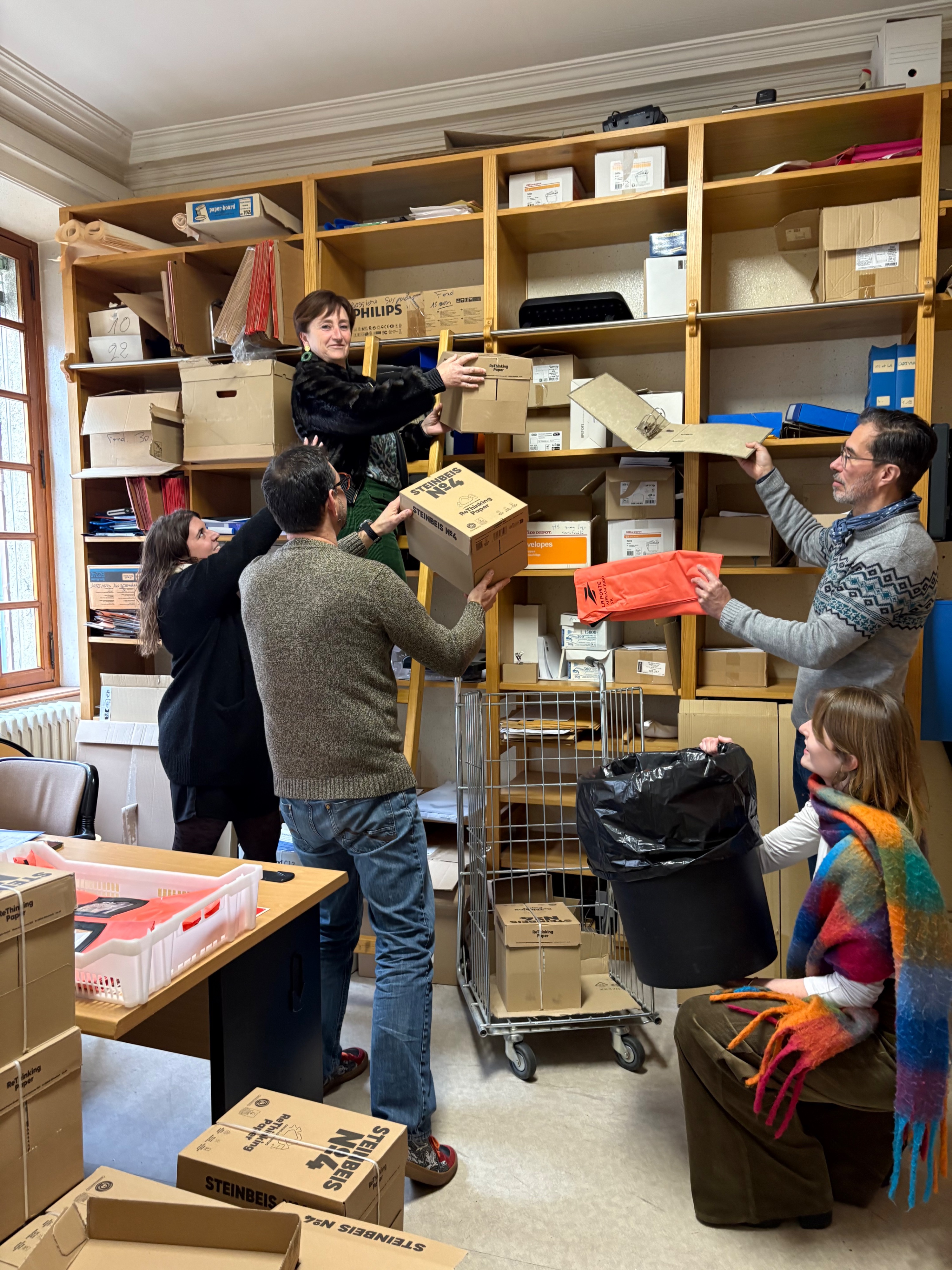
The instructions given to participants deserve special attention. I suggest, for example, that they take a photograph on the theme of psychosocial skills in teams of five or six people, in ten minutes. But I insist on several points: artistic creation is not imitation; it is an adventure. It is not about explaining, but about evoking, being together, trying something. It doesn’t matter if the result isn’t perfect; we don’t give grades; it’s not about succeeding or failing, it’s about entering into creativity.
Another essential principle: start from the place rather than from ideas. I ask participants to first find a location—a staircase, a corridor, an outdoor space—and let themselves be inspired by that place, rather than starting from preconceived ideas. This physical displacement and this dialogue with the space create the conditions for an authentic exploration, where solutions emerge from the encounter between people, the environment, and constraints.
Finally, the images created have no titles, only the first names of the creators. This detail, which may seem trivial, is actually of the highest importance: it is about recognizing the dignity of each person. The work exists as a trace of an identified collective of people, not as an illustration of a concept or a demonstration of a thesis.
The pedagogical reversal: the gaze of others as an instance of legitimization
The moment of feedback in the workshops I lead is subject to a specific protocol I call “pedagogical reversal.” Often, in an artistic creation workshop, during the feedback session, the people who created the work explain why they did what they did. I do exactly the opposite: the creators are not allowed to speak; instead, the other participants share what they see in the image and the impression it makes on them.
This device relies on several mechanisms. First, when one’s own image is displayed, one generally feels a movement of emotion, often negative: “it’s my crappy photo up there.” We always have a tendency to devalue ourselves. But the gaze of others institutes this image, giving it a social existence. And this gaze reveals dimensions that the creators themselves had not perceived. As I say to the participants: maybe you told yourself “they’re seeing things, but we never thought that far about the symbolism.” In fact, yes, it is in there. Because people saw it.
Thanks to the gaze of others, we better understand what we have done and who we are. This process directly relates to what Marie-Noëlle Clément describes as intersubjective empathy: accepting that the other reveals things about me that I ignore. In the safe framework of the workshop, where one cannot be judged since everyone did the exercise at the same time, the gaze of others allows us both to institute ourselves and to better understand ourselves, and to perceive that there is more richness in what we have done than we ourselves believed.
The process of symbolization and identity construction
The image created in a workshop is not just a technical production: it is a symbolic trace of lived experience. As Serge Tisseron shows in his work on the Psychoanalysis of the Image (1995), the act of creating images engages a process of symbolization where thought is constructed in and through the creative gesture. It is not thinking first and then creating, but creating in order to think.
This image symbolizes us. It is not us, but it symbolizes us because it enters a social space from which perhaps we hide ourselves. This is why I insist that the creators’ first names be systematically associated with the work: it is not just any photo; it is a photo made by people, and we must recognize the existence of those people. This recognition is constitutive of the dignity of each participant.
The act of receiving the gaze of others, on one hand, institutes the image; it exists, it has value, it is not “worthless.” This doesn’t mean that, as if by magic, the person suddenly has self-confidence, but it is a small stone on the path. In fact, I believe we are only sowing seeds. This metaphor of the seed is essential: I do not claim to transform people in one session, but to contribute to a long process where each positive experience reinforces self-esteem and the capacity to enter into relationships with others.
The framework that authorizes: a liberating conception of the rule
In my workshops, I give instructions. But it happens that participants do not respect them exactly—for example, by adding a title to their image when I had asked for none. How do we welcome this? My answer is clear: we welcome it, because an instruction is only an instruction. And an instruction is a framework. And what is a framework for?
A framework is not something to constrain. A framework is there to provide landmarks, to allow oneself to do something. And even if what was done was not what was planned, the most important thing is that something was done. This conception of the framework as an instance of authorization rather than constraint is fundamental to my approach. It aligns with what the 2023-2027 intersectoral roadmap identifies as the importance of “creating favorable environments” for the development of PSS.
The framework I propose is both demanding and benevolent. Demanding because there are rules, a limited time, a given theme. Benevolent because failure does not exist, because the gaze of others is valuing, and because everyone is recognized in their singularity. This double dimension—demand and benevolence—is, in my view, the condition for a true creative experience. It corresponds to what the PJJ framework documents describe as the necessity of a “psychological safety framework” for the development of PSS.
Implications for PSS development: professionals and publics
A dimension often neglected in PSS development approaches is the place of the professionals themselves. The DPJJ reference document insists on reciprocity: professionals mobilize their own skills while strengthening those of the youth. But this mobilization assumes that the professionals have themselves lived through what they are proposing to their publics.
This is why, in the interprofessional seminars I lead, I first have the professionals live the creative experience before analyzing its mechanics. We remobilize everything within us and also what has circulated unconsciously between us. It is only after having felt the process that one can understand its mechanisms and consider transposing it to the supported publics.
This approach aligns with what the intersectoral roadmap calls “professional buy-in” as a major challenge: it is about “demonstrating the relevance of strengthening PSS, giving meaning to practices and the use of tools, and training for the integration of PSS interventions into global support without imposing additional activities.” The creative workshops I propose are not one more activity to fit into an already busy schedule: they are a way of revisiting the whole of educational practice in the light of PSS.
Self-empathy—the ability to take care of oneself and avoid risky behaviors—is an integral part of empathic development. For professionals subjected to emotionally trying situations, this dimension is essential. Creative workshops are also an opportunity for them to take care of their own emotions, to name what they are going through, and to share their vulnerabilities in a safe environment.
The goal is not the work: toward a pedagogy of the process
I would like to conclude on what seems to me to be the heart of my approach: the goal is not to take photos. The goal is to live an emotional experience. Each participant has lived an experience between the instructions, the ideas, the act of doing it in a group, and how it all unfolded. All of this constitutes an experience, and it is through this entire process—up to the point of looking together, being afraid of feeling embarrassed, and perhaps being a little bit legitimized—that something is transformed.
This process-oriented approach fundamentally distinguishes the artistic practices I defend from media education approaches centered on decoding or “fact-checking.” It is not about learning to analyze the images of others, but about creating one’s own to understand, from the inside, what a symbolization process is. Media education can thus be done in the joy of creation rather than in the tension of verification.
The polysemy of the images we create together is the best illustration of this: the same image sparks different, sometimes opposite interpretations, and all are legitimate. There is no single “truth” to the image, but a plurality of gazes that enrich each other. This lived experience of legitimate subjectivity is, in my view, one of the major contributions of artistic practices to the development of psychosocial skills.
Because ultimately, what we learn in these workshops is that our gaze counts, that our words have value, and that we are capable of creating meaning with others. And that is perhaps the very essence of psychosocial skills: the capacity to inhabit the world with others, in trust.
Photograph taken by participants during the workshop « Developing psychosocial skills through cultural and digital media » on January 12, 2026.

Drawing on Benoît Labourdette’s 30 years of experience in the field of cultural innovation and his research and methodological work, the Benoît Labourdette production agency supports cultural policies in their need for innovation, better encounters with populations, use of digital tools and cooperation, definition of mediation strategies, and support for artistic teams, technicians and elected representatives. Our method is always based on collective intelligence, cooperation and empowerment of people and structures. We work with cities and other local authorities, national networks, institutions and associations.
-

Creating to think
A French-Finnish meeting at L’Alhambra in Marseille on 4 May 2026, as part of the Erasmus+ Visual Thinkers project.
On 4 May 2026, I facilitated a professional meeting at L’Alhambra in Marseille, organised by the Image Clé association as part of the European (…) -

The Book Archipelago
A proposal to elected representatives: making plural bookshops the backbone of territorial cultural policies.
Faced with the tensions running through the bookshop sector today, it is time to put an end to the sanctuary myth. Rather than seeking an (…) -

The photography workshop: creating, showing, looking together
Reflections on a hands-on workshop facilitated by Benoît Labourdette at the professional conference “Cinema, images and young people’s mental health”, held on 14 April 2026 in Romainville, France.
A workshop in nine small groups, fifteen minutes to produce a photograph, then a moment of collective viewing in which the authors remain silent (…) -

« Mental Health and Cinema »
Synthesis of the day “Young people, their images, their spaces: new paradigms” (14 April 2026)
Synthesis of a day of professional gatherings at the Le Trianon cinema in Romainville, bringing together the perspectives of professionals from (…) -

Mental health, young people, images: what are we talking about?
Text of Benoît Labourdette’s opening talk at the professional meetings held on 14 April 2026.
Before entering into projects, we need to pin down the words. Mental health, young people, images: three notions we often use together without (…) -

Transmitting cultural rights: a question of coherence
What facilitation methods reveal about our relationship with people.
How can we talk about cultural democracy within an authoritarian framework? How can we defend respect for each person’s culture while imposing a (…) -

Mental Health and Cinema - Experiencing the World Through Images
Two professional conferences in Romainville (April 14 and 15, 2026).
On April 14 and 15, 2026, ACRIF, as part of its coordination mission for Passeurs d’images in Île-de-France, is organizing two days of (…) -

Collaborative assessment of screen literacy education in Nouvelle-Aquitaine
Collective intelligence methodology, digital platform, and collaborative publication for ALCA (2026).
ALCA, Agence Livre, Cinéma et Audiovisuel en Nouvelle-Aquitaine, entrusted me with the methodological support for a collaborative assessment of (…) -

Media Literacy: Should We Judge or Guide?
Reflections based on the National Meeting of Regional Centers for Media Literacy (Rouen, March 16–17, 2026).
On 16 and 17 March 2026, Normandie Images organised in Rouen the national meeting of France’s regional image education centres (pôles régionaux (…) -

The Meaning of Mediation Methods in Arts and Cultural Education
When practice reveals what theory ignores.
Artists and professionals involved in arts education develop singular methods that most often remain implicit. I wish to lift the veil on the (…) -

Cultural Mediation as a Device for Symbolic Emancipation
Methodological Principles for a Horizontal Approach to Collective Creation.
Lived experience radically transforms our relationship to thought. Cultural mediation does not consist of transmitting knowledge but of creating (…) -

Evaluating Arts and Cultural Education from the Artist’s Perspective
Review of a course given at INSEAC: conceptual and methodological tools for cultural professionals.
On January 15, 2026, as part of the CNAM module EAC104 “Building tools to evaluate ACE projects: qualitative and quantitative survey methodologies (…) -

Developing Psychosocial Skills Through Artistic Practices
Methodological principles for an experiential approach.
Psychosocial skills (PSS) are now at the heart of public health, education, and child protection policies. The 2023-2027 intersectoral roadmap, (…) -

When thirty-five professionals discover their psychosocial skills through creative experience
A look back at the interprofessional seminar of January 12, 2026, in Limoges: a day where theory gave way to lived experience.
At the DRAC Nouvelle-Aquitaine, educators, teachers, caregivers, and cultural actors experienced together what it truly means to develop (…) -

Image Education and Citizenship: When Youth Professionals Rethink Their Practices
{{Reflections on the “Out-of-School Time” professional day that I co-designed with ALCA and the Gironde Departmental Council.}}
On December 2, 2025, around a hundred youth, animation, and culture professionals gathered at the MECA auditorium in Bordeaux to explore together (…) -

Art and Culture in the Service of Psychosocial Skills
Account of a founding seminar for professionals of the Judicial Protection of Youth in Limousin.
On November 27, 2025, the Limousin Regional Directorate of PJJ brought together its teams for a half-day of collective reflection on psychosocial (…) -

Youth and culture: for a radical change in posture
Giving young people the power to create, not just consume culture.
How can cultural institutions break out of their chronic failure with young people? By abandoning condescension to embrace a genuine cultural (…) -

Reinventing youth reception in cinemas
Remote training for cinema operators in Lot-et-Garonne.
How can we transform our cinemas into spaces for authentic encounters with 15-25 year-olds? This question guided an intense training session with (…) -

“Participatory creation as a laboratory for democracy?”
4th edition of the biennial festival of participatory creation - Les Rencontres de la Poudrerie - Théâtre des habitants - May 16 & 17, 2025.
Les Rencontres de la Poudrerie are a moment for reflection and co-construction, at the intersection of art forms and the practice of social life. (…) -

Pour une robustesse coopérative des projets culturels
Réflexion sur les modalités de coopération territoriale et d’évaluation.
Pour que les projets culturels puissent trouver pleinement leur sens social et devenir plus robustes face aux attaques politiques qui les jugent « (…) -

Design of a professional day on “Artistic and digital practices for young people”
Act’art, artistic and cultural action in Seine-et-Marne.
As part of its mission to promote collective intelligence by facilitating local think tanks, Act’art asked Benoît Labourdette to design, (…) -

OPC Media: “What if we changed our posture?”
How can we learn to consider the richness of teenage digital practices and avoid giving in to preconceived ideas?
How can we learn to consider the richness of teenagers’ digital practices and not give in to preconceived ideas? For Benoît Labourdette, if we (…) -

Itinéraire bis, the path of cultural rights
Action research conducted by the MPAA (Paris).
Accompaniment in the animation, production of traces and fabrication of the web platform resources of the research-action “Itinéraire bis, chemin (…) -

Helping young people and professionals to speak out: “Cultures and youth policies” national meeting
Observatory of Cultural Policies / Villeurbanne (TNP, May 11 & 12, 2023).
As part of the Rencontres nationales “Cultures et politiques de la jeunesse” (“Cultures and youth policies”), which brought the year of the French (…) -

"Culture, youth and digital: designing new modalities for cultural and educational projects
Sharing of methodological tracks and professional training.
Deconstructing preconceived ideas about digital transformation and developing projects adapted to young people.The cultural offer is sometimes (…) -

“Media College” platform for Périfééries
Creation of a digital collective intelligence tool.
To meet a need for creative, intellectual emulation and the production of ideas for one of the axes of the Saint-Denis (93) city’s bid for the (…) -

Giant digital brainstorming
Design and implementation of a digital collective intelligence tool.
Method of activating a vast contribution for the axes of a cultural project. The needIn the solidarity I had with the city of Saint-Denis’ bid (…) -

The Périfééries project’s heritage council of influence
Facilitating collective intelligence in a short space of time.
As part of Saint-Denis’s bid to become European Capital of Culture 2028, I led a collective intelligence session to collect proposals on the (…) -

Reinventing cultural projects with youth?
Proposal of questions.
While public cultural action aims to reach people in their great diversity, it is clear that it is often difficult to mobilize youth. However, (…)


-

“The use of screens at the heart of child protection”: conference / training by Serge Tisseron and Benoît Labourdette Proposed by the Federation of the sunbeams of childhood and the IRTS PACA - Corsica.
Training day for 80 social actors of the child protection, to equip the professionals with the good use of the images and the digital in an (…) -
Art and Culture in the Service of Psychosocial Skills Account of a founding seminar for professionals of the Judicial Protection of Youth in Limousin.
On November 27, 2025, the Limousin Regional Directorate of PJJ brought together its teams for a half-day of collective reflection on psychosocial (…) -
When thirty-five professionals discover their psychosocial skills through creative experience A look back at the interprofessional seminar of January 12, 2026, in Limoges: a day where theory gave way to lived experience.
At the DRAC Nouvelle-Aquitaine, educators, teachers, caregivers, and cultural actors experienced together what it truly means to develop (…) -

Audio recordings of the conferences Mobile Creation Symposium
The entire symposium was recorded. As if you were there !(the 2/3 of those recordings are in french, the other 1/3 in english) -

The Journal of animation : Action article “Making a film with a cell phone: creativity citizenship” Articles
Manage a workshop with mobile phone.The Journal of animation monthly reference tool for facilitators of socio-cultural field, invited me in (…)
