Image Education and Citizenship: When Youth Professionals Rethink Their Practices
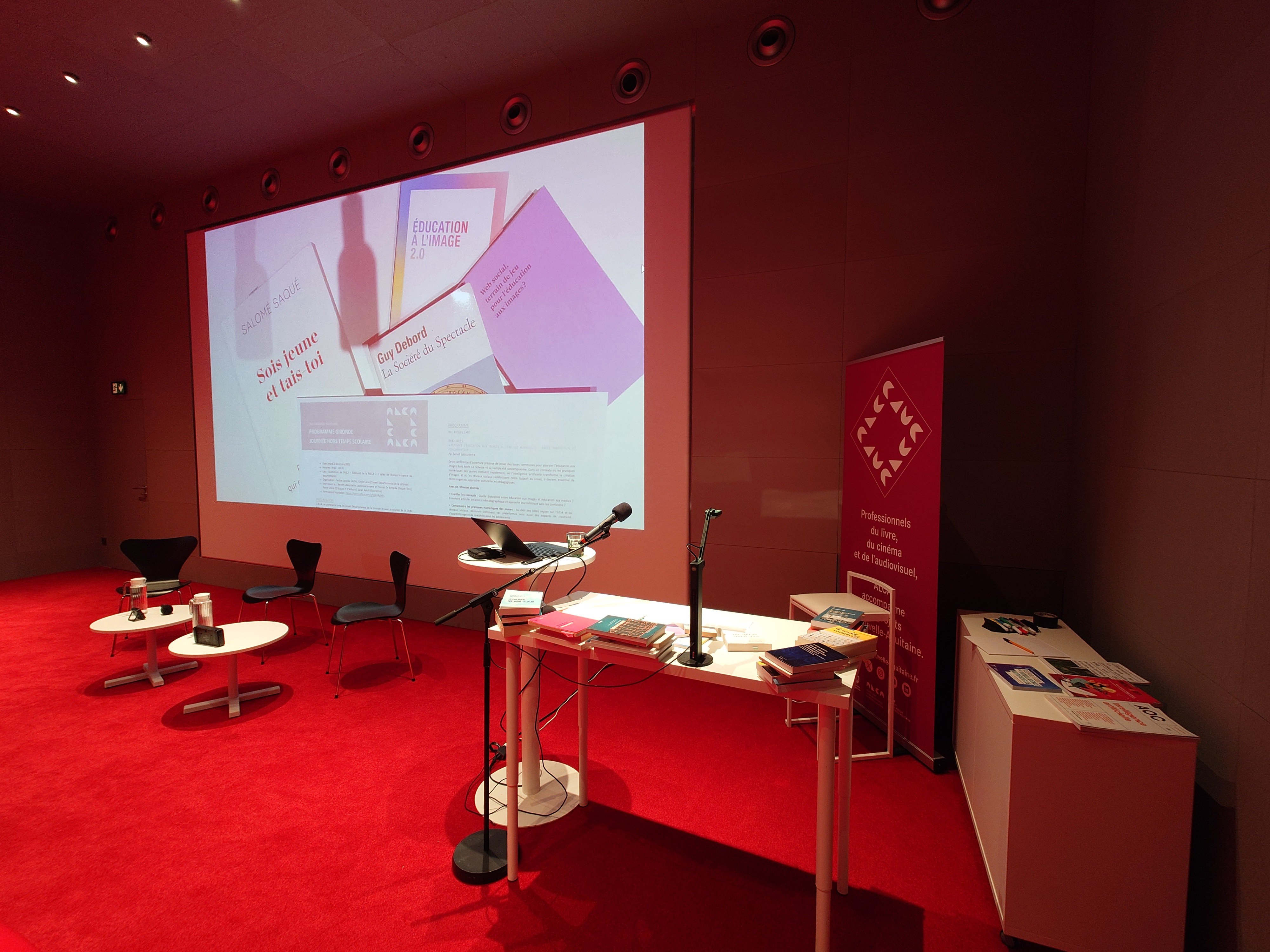
On December 2, 2025, around a hundred youth, animation, and culture professionals gathered at the MECA auditorium in Bordeaux to explore together the contemporary challenges of image education. I co-designed this day and facilitated its key moments: the opening lecture, the morning panel discussion, and the artificial intelligence workshop in the afternoon.
A day born from a committed territorial partnership
This professional day emerged from a collaboration between Pauline Lavallée, in charge of out-of-school image education and coordinator of “Passeurs d’images” and “Des cinés, la vie!” for ALCA, and Cécile Lucas from the Gironde Departmental Council. ALCA (Agence Livre, Cinéma, Audiovisuel en Nouvelle-Aquitaine), in partnership with the Departmental Council and with support from DRAC Nouvelle-Aquitaine, wanted to highlight out-of-school image education projects. Together, we conceived an event that would fit into a broader reflection on supporting young people facing digital transformations, at a time when images and artificial intelligence occupy an ever-growing place in their daily lives.
The target audience was intentionally broad: youth, animation, and prevention professionals, but also image education, cinema, and audiovisual practitioners. This professional diversity was one of the day’s bets, based on the observation that silos between sectors often undermine the quality of projects carried out with young people.
An opening lecture to lay the foundations for collective reflection
I opened the morning with a lecture titled « Rethinking Image Education in the Digital Age: Between Innovation and Fundamentals ». I chose to begin with a participatory exercise that immediately revealed the assembly’s paradoxes: many distrusted social media while themselves spending several hours daily in front of screens. This situation created a climate of honesty conducive to collective reflection.
The first axis I addressed concerned the observation of a certain failure by French cultural institutions to reach young people. Despite the Malrucian ambition to “make the great works of humanity accessible to the greatest number,” the gap with teenagers’ actual practices continues to widen. I drew on the work of sociologist Camille Peugny, particularly his book « Pour une politique de la jeunesse » (2022), to deconstruct the illusion of a homogeneous youth with uniform cultural tastes. His research demonstrates, on the contrary, an extreme diversity of cultural practices, directly linked to each young person’s sociocultural context.
I then clarified two fundamental distinctions:
- On one hand, the difference between image education and media education: the former relates to film creation and artistic expression, the latter to a journalistic approach and critical content analysis.
- On the other hand, the distinction between cultural democratization, a top-down logic inherited from Malraux, and cultural democracy, which recognizes the plurality of cultures and promotes their horizontal dialogue.
Cultural rights as a compass for changing posture
A substantial part of my presentation was devoted to cultural rights, enshrined in French law since the NOTRe and LCAP laws of 2015-2016, but still unknown to many practitioners. These rights, structured by the 2007 Fribourg Declaration, concern culture in its anthropological sense: what constitutes us, our languages, our practices, our references, our ways of life. Respecting cultural rights means recognizing the value of each person’s own culture, without hierarchy or value judgment.
I presented the concept of “symbolic third” as a tool for moving beyond the traditional dual relationship between “knower” and “learner.” I illustrated this principle with a concrete example from my practice: using a drone in a neighborhood undergoing urban renewal. The mediating object, the drone, enables an authentic encounter where each person develops their own relationship with the tool before sharing their experience. This granted trust generates in return a remarkable sense of responsibility among participants.
I also proposed the notion of “governing for the 3%”: this tendency of institutions to create complex security measures to protect themselves against a tiny minority of problematic behaviors, to the detriment of the 97% who simply want to participate. Entrusting a 200-euro camera to a young person from a working-class neighborhood without guarantee of return, accepting that a drone might break, letting participants transform the initial project: these calculated risks build authentic relationships and much more open, appropriated, and creative projects.
Understanding young people’s digital practices: beyond preconceptions
I then invited the assembly to move beyond the sterile opposition between “real” and “virtual.” For generations born with the Internet, digital is not a separate space but a living environment, just like the air they breathe. Michel Serres, in his essay « Petite Poucette » (2012), analyzed the invention of SMS language not as cultural degradation but as the emergence of new cognitive skills.
The case of TikTok was developed in particular detail. The data I presented challenged certain representations: 95 minutes of daily use on average, an average user age of 27, a primary use of an educational nature in the broad sense. Above all, 83% of users have posted at least one video, making it a platform for massive creation rather than mere consumption. TikTok has simple and powerful creation tools that correspond to the “ideal editing table” once dreamed of by Jean-Luc Godard.
A historical parallel with the invention of printing helped put contemporary fears into perspective. Gutenberg was decried by the intellectual elites of his time who thought printing would debase culture and pervert religion. In reality, it primarily threatened their power. Yet printing had the beneficial democratic consequences we know, starting with the Renaissance.
The panel discussion: three field experiences in Gironde
I then facilitated the panel discussion that constituted the second part of the morning, allowing theoretical reflections to be confronted with concrete experiences carried out in the Gironde territory. Lauranne Simpere and Thomas De Almeida, from Douze Films, a collective of filmmakers based in Bordeaux, presented projects supported within the Passeurs d’images program.
The experience in Brazil, based on the “real,” illustrates an approach where it’s not so much the script or the team that makes the film, but what you capture from reality. This posture involves reproducing in France, with little budget, techniques that have proven fruitful elsewhere. The collective intervenes particularly in out-of-school projects, through the Passeurs d’images programs and Departmental support, working with young people from priority neighborhoods.
Lauranne Simpere testified to an approach where young people who know their neighborhood arrive in a position to speak. This inversion of the knower/learner relationship precisely echoed the principles I had mentioned in my lecture. Thomas De Almeida presented projects on identity topics, particularly around LGBTQIA+ issues, with a precise methodology: not positioning oneself as the knower but including oneself in the exchange of speech, favoring “telling one’s own story” rather than “being told about.”
The exchanges highlighted several points of convergence: the importance given to people’s lived experience, the transmission of techniques as means rather than ends, symbolization through objects and protocols, valuing the process as much as the result. A recurring question ran through the discussions: how to articulate short and long projects? How to move from “film to document” to “writing the project in cooperation”?
The afternoon: three workshops for experimentation
The afternoon offered participants the choice of two workshops among the three proposed.
The first, led by Douze Films, allowed concrete experimentation with the dubbing and foley methods mentioned in the morning. Participants worked notably on sequences from the animated film “Frozen,” wondering together: “Does a wolf growl? How do we do that?” or “We have a body falling in the snow, what sound does that make?” This playful and collective dimension characterizes the approach defended by the collective.
The second workshop, led by Pauline Lavallée, consisted of an exchange of practices among participants on the subject of organizing, developing, and participating in an image education project. This workshop was very constructive.
The third workshop, which I led, was a filmmaking workshop with artificial intelligence, which I wish to detail because it illustrates a reproducible methodology. The objective was to create a complete film in one hour and thirty minutes, using free smartphone applications – CapCut for editing and Poe.com for image generation.
I began with a brief historical and critical introduction to artificial intelligence, from the Pascaline to Ada Lovelace, from Turing to Asimov, from deep learning to copyright issues and ecological impact. A “sit-stand” icebreaker in questions helped map uses: who has already used ChatGPT? Who uses it for homework? Who has already generated images with AI?
Participants, organized in pairs, then went through all the stages of creation: scriptwriting with AI assistance, image generation to create a storyboard, animation and editing. The themes proposed for the films—the future, the risks of AI, its promises, future jobs—were crossed with formal approaches: character facing camera, talking objects, music video with lyrics, fiction with two characters. This creative constraint, characteristic of image education workshops, channels creative energy while leaving great freedom of expression.
The critical dimension of the workshop unfolded during the collective screening and the debate that followed. I invited participants to question the limits of these tools, their visual stereotypes, their ethical issues. Is it a good creative tool? Why? And why not? What formatting does it induce? And what possibilities does it open? This reflexivity is at the heart of my approach: mobilizing cinematic creativity to build critical thinking on the subject of AI.
This method, which I have tested with more than 350 young people in other contexts (Studio 13/16 at the Centre Pompidou, TUMO school at the Forum des images), requires no technical prerequisites. Participants leave with skills directly transferable to their structures. The objective is not to promote AI but to understand these tools to better support young people who are already confronted with them, in a contemporary and critical approach to image education.
Participant feedback: a garland of words
Throughout the day, illustrator Sarah Ayadi created sketches capturing the highlights of the exchanges. This real-time visual documentation, displayed at the end of the day, constituted a form of artistic restitution that moved the assembly. Participants were also invited to hang their impressions and reflections on a garland, creating a collective installation that made visible the diversity of concerns.
Among the words hung, one could read: “Beautiful encounters,” “Education THROUGH images,” “Value the process,” “Adapting, the key to inspiring young people,” “The importance of building bridges between projects in and out of school,” “Cultural dignity,” “Audiovisual brings together all the arts.” Questions too: “Ecological catastrophe: regulate AI?”, “Temporality = obstacle or beginning of a journey?”, a reference to Pierre Le Bret followed by a question mark.
Some messages testified to more structural concerns: “Budget cuts imposed by cultural policies undermine image education projects. Our professions are in DANGER.” Or: “A lot of € is earmarked for ONLY school time OR out-of-school time. Rarely both.” These remarks remind us that pedagogical reflection cannot be abstracted from the material conditions under which professionals work.
A change of posture to be built collectively
This day allowed several strong ideas to circulate. The first concerns the need to clearly distinguish image education from media education, while articulating them when projects allow. The second relates to moving from a logic of cultural democratization, top-down and prescriptive, to a logic of cultural democracy that recognizes the value of young people’s cultural practices.
The third idea, perhaps the most destabilizing for some participants, invites us to consider digital platforms as legitimate spaces for creation rather than threats to be fought. This position refuses both technophobia and naive enthusiasm: “It’s not artificial intelligence that’s the problem, it’s how we use it,” as Sarah Ayadi illustrated in one of her sketches.
The day concluded with a call for the transformation of institutional practices. Rather than producing content for social media with top-down communication that systematically fails, institutions could facilitate content creation by young people themselves. Making a filming studio available, offering technical support, providing royalty-free resources: so many concrete approaches that reverse the traditional logic.
Perspectives: toward a renewed image education
Participants left with documentary resources, professional contacts, and, for many, renewed questions about their practices.
This day will have contributed to the emergence of a community of practice in the Gironde territory. Informal exchanges during breaks, collaborations sketched between organizations, projects mentioned for the coming year all testify to a collective dynamic that we hope to see continue. As one participant wrote on the garland: “The desire to create by oneself. Give young people the opportunity to get involved.”
The question of cultural rights, the common thread of this day that I had the pleasure of co-designing and facilitating, offers a framework for thinking about these transformations. It’s not about applying recipes but about continually re-examining our postures. Democracy is conversation. It means accepting that dialogue transforms, that encounter changes, that exchange enriches. The professionals present on December 2, 2025, at the MECA experienced, for the space of a day, this conversation.


Drawing on Benoît Labourdette’s 30 years of experience in the field of cultural innovation and his research and methodological work, the Benoît Labourdette production agency supports cultural policies in their need for innovation, better encounters with populations, use of digital tools and cooperation, definition of mediation strategies, and support for artistic teams, technicians and elected representatives. Our method is always based on collective intelligence, cooperation and empowerment of people and structures. We work with cities and other local authorities, national networks, institutions and associations.
-

Creating to think
A French-Finnish meeting at L’Alhambra in Marseille on 4 May 2026, as part of the Erasmus+ Visual Thinkers project.
On 4 May 2026, I facilitated a professional meeting at L’Alhambra in Marseille, organised by the Image Clé association as part of the European (…) -

The Book Archipelago
A proposal to elected representatives: making plural bookshops the backbone of territorial cultural policies.
Faced with the tensions running through the bookshop sector today, it is time to put an end to the sanctuary myth. Rather than seeking an (…) -

The photography workshop: creating, showing, looking together
Reflections on a hands-on workshop facilitated by Benoît Labourdette at the professional conference “Cinema, images and young people’s mental health”, held on 14 April 2026 in Romainville, France.
A workshop in nine small groups, fifteen minutes to produce a photograph, then a moment of collective viewing in which the authors remain silent (…) -

« Mental Health and Cinema »
Synthesis of the day “Young people, their images, their spaces: new paradigms” (14 April 2026)
Synthesis of a day of professional gatherings at the Le Trianon cinema in Romainville, bringing together the perspectives of professionals from (…) -

Mental health, young people, images: what are we talking about?
Text of Benoît Labourdette’s opening talk at the professional meetings held on 14 April 2026.
Before entering into projects, we need to pin down the words. Mental health, young people, images: three notions we often use together without (…) -

Transmitting cultural rights: a question of coherence
What facilitation methods reveal about our relationship with people.
How can we talk about cultural democracy within an authoritarian framework? How can we defend respect for each person’s culture while imposing a (…) -

Mental Health and Cinema - Experiencing the World Through Images
Two professional conferences in Romainville (April 14 and 15, 2026).
On April 14 and 15, 2026, ACRIF, as part of its coordination mission for Passeurs d’images in Île-de-France, is organizing two days of (…) -

Collaborative assessment of screen literacy education in Nouvelle-Aquitaine
Collective intelligence methodology, digital platform, and collaborative publication for ALCA (2026).
ALCA, Agence Livre, Cinéma et Audiovisuel en Nouvelle-Aquitaine, entrusted me with the methodological support for a collaborative assessment of (…) -

Media Literacy: Should We Judge or Guide?
Reflections based on the National Meeting of Regional Centers for Media Literacy (Rouen, March 16–17, 2026).
On 16 and 17 March 2026, Normandie Images organised in Rouen the national meeting of France’s regional image education centres (pôles régionaux (…) -

The Meaning of Mediation Methods in Arts and Cultural Education
When practice reveals what theory ignores.
Artists and professionals involved in arts education develop singular methods that most often remain implicit. I wish to lift the veil on the (…) -

Cultural Mediation as a Device for Symbolic Emancipation
Methodological Principles for a Horizontal Approach to Collective Creation.
Lived experience radically transforms our relationship to thought. Cultural mediation does not consist of transmitting knowledge but of creating (…) -

Evaluating Arts and Cultural Education from the Artist’s Perspective
Review of a course given at INSEAC: conceptual and methodological tools for cultural professionals.
On January 15, 2026, as part of the CNAM module EAC104 “Building tools to evaluate ACE projects: qualitative and quantitative survey methodologies (…) -

Developing Psychosocial Skills Through Artistic Practices
Methodological principles for an experiential approach.
Psychosocial skills (PSS) are now at the heart of public health, education, and child protection policies. The 2023-2027 intersectoral roadmap, (…) -

When thirty-five professionals discover their psychosocial skills through creative experience
A look back at the interprofessional seminar of January 12, 2026, in Limoges: a day where theory gave way to lived experience.
At the DRAC Nouvelle-Aquitaine, educators, teachers, caregivers, and cultural actors experienced together what it truly means to develop (…) -

Image Education and Citizenship: When Youth Professionals Rethink Their Practices
{{Reflections on the “Out-of-School Time” professional day that I co-designed with ALCA and the Gironde Departmental Council.}}
On December 2, 2025, around a hundred youth, animation, and culture professionals gathered at the MECA auditorium in Bordeaux to explore together (…) -

Art and Culture in the Service of Psychosocial Skills
Account of a founding seminar for professionals of the Judicial Protection of Youth in Limousin.
On November 27, 2025, the Limousin Regional Directorate of PJJ brought together its teams for a half-day of collective reflection on psychosocial (…) -

Youth and culture: for a radical change in posture
Giving young people the power to create, not just consume culture.
How can cultural institutions break out of their chronic failure with young people? By abandoning condescension to embrace a genuine cultural (…) -

Reinventing youth reception in cinemas
Remote training for cinema operators in Lot-et-Garonne.
How can we transform our cinemas into spaces for authentic encounters with 15-25 year-olds? This question guided an intense training session with (…) -

“Participatory creation as a laboratory for democracy?”
4th edition of the biennial festival of participatory creation - Les Rencontres de la Poudrerie - Théâtre des habitants - May 16 & 17, 2025.
Les Rencontres de la Poudrerie are a moment for reflection and co-construction, at the intersection of art forms and the practice of social life. (…) -

Pour une robustesse coopérative des projets culturels
Réflexion sur les modalités de coopération territoriale et d’évaluation.
Pour que les projets culturels puissent trouver pleinement leur sens social et devenir plus robustes face aux attaques politiques qui les jugent « (…) -

Design of a professional day on “Artistic and digital practices for young people”
Act’art, artistic and cultural action in Seine-et-Marne.
As part of its mission to promote collective intelligence by facilitating local think tanks, Act’art asked Benoît Labourdette to design, (…) -

OPC Media: “What if we changed our posture?”
How can we learn to consider the richness of teenage digital practices and avoid giving in to preconceived ideas?
How can we learn to consider the richness of teenagers’ digital practices and not give in to preconceived ideas? For Benoît Labourdette, if we (…) -

Itinéraire bis, the path of cultural rights
Action research conducted by the MPAA (Paris).
Accompaniment in the animation, production of traces and fabrication of the web platform resources of the research-action “Itinéraire bis, chemin (…) -

Helping young people and professionals to speak out: “Cultures and youth policies” national meeting
Observatory of Cultural Policies / Villeurbanne (TNP, May 11 & 12, 2023).
As part of the Rencontres nationales “Cultures et politiques de la jeunesse” (“Cultures and youth policies”), which brought the year of the French (…) -

"Culture, youth and digital: designing new modalities for cultural and educational projects
Sharing of methodological tracks and professional training.
Deconstructing preconceived ideas about digital transformation and developing projects adapted to young people.The cultural offer is sometimes (…) -

“Media College” platform for Périfééries
Creation of a digital collective intelligence tool.
To meet a need for creative, intellectual emulation and the production of ideas for one of the axes of the Saint-Denis (93) city’s bid for the (…) -

Giant digital brainstorming
Design and implementation of a digital collective intelligence tool.
Method of activating a vast contribution for the axes of a cultural project. The needIn the solidarity I had with the city of Saint-Denis’ bid (…) -

The Périfééries project’s heritage council of influence
Facilitating collective intelligence in a short space of time.
As part of Saint-Denis’s bid to become European Capital of Culture 2028, I led a collective intelligence session to collect proposals on the (…) -

Reinventing cultural projects with youth?
Proposal of questions.
While public cultural action aims to reach people in their great diversity, it is clear that it is often difficult to mobilize youth. However, (…)


-
Media Literacy: Should We Judge or Guide? Reflections based on the National Meeting of Regional Centers for Media Literacy (Rouen, March 16–17, 2026).
On 16 and 17 March 2026, Normandie Images organised in Rouen the national meeting of France’s regional image education centres (pôles régionaux (…) -

Training Eyes in the Age of AI: A Day to Rethink Image Education Account of a professional training day where teachers, librarians, and young people in civic service explored the challenges of artificial intelligence through creation and critical debate.
On November 26, 2025, in Reims, around sixty education professionals gathered for a training day entitled “Training Eyes in the Age of AI.” I (…) -

“The use of screens at the heart of child protection”: conference / training by Serge Tisseron and Benoît Labourdette Proposed by the Federation of the sunbeams of childhood and the IRTS PACA - Corsica.
Training day for 80 social actors of the child protection, to equip the professionals with the good use of the images and the digital in an (…) -

Short bio & filmo Benoît Labourdette
Benoît Labourdette is a filmmaker, educator, researcher, essayist and consultant in cultural innovation and digital strategies. He is also a (…) -

National Meeting of coordinators School and Cinema: “Image education 2.0” Trainings for image education
Benoît Labourdette Conference and workshop on the development of image educational practices in the digital era.Each year the association (…)
