Educating about images, organising disagreement
A detailed account of the lecture given on 10 June 2026 at the Archives départementales de Loire-Atlantique, for the Grandir avec la culture network: cultural rights, regimes of images, critical thinking and concrete devices, to build common ground around images with young people.
A gathering of the Grandir avec la culture network, designed as a day of training-in-action
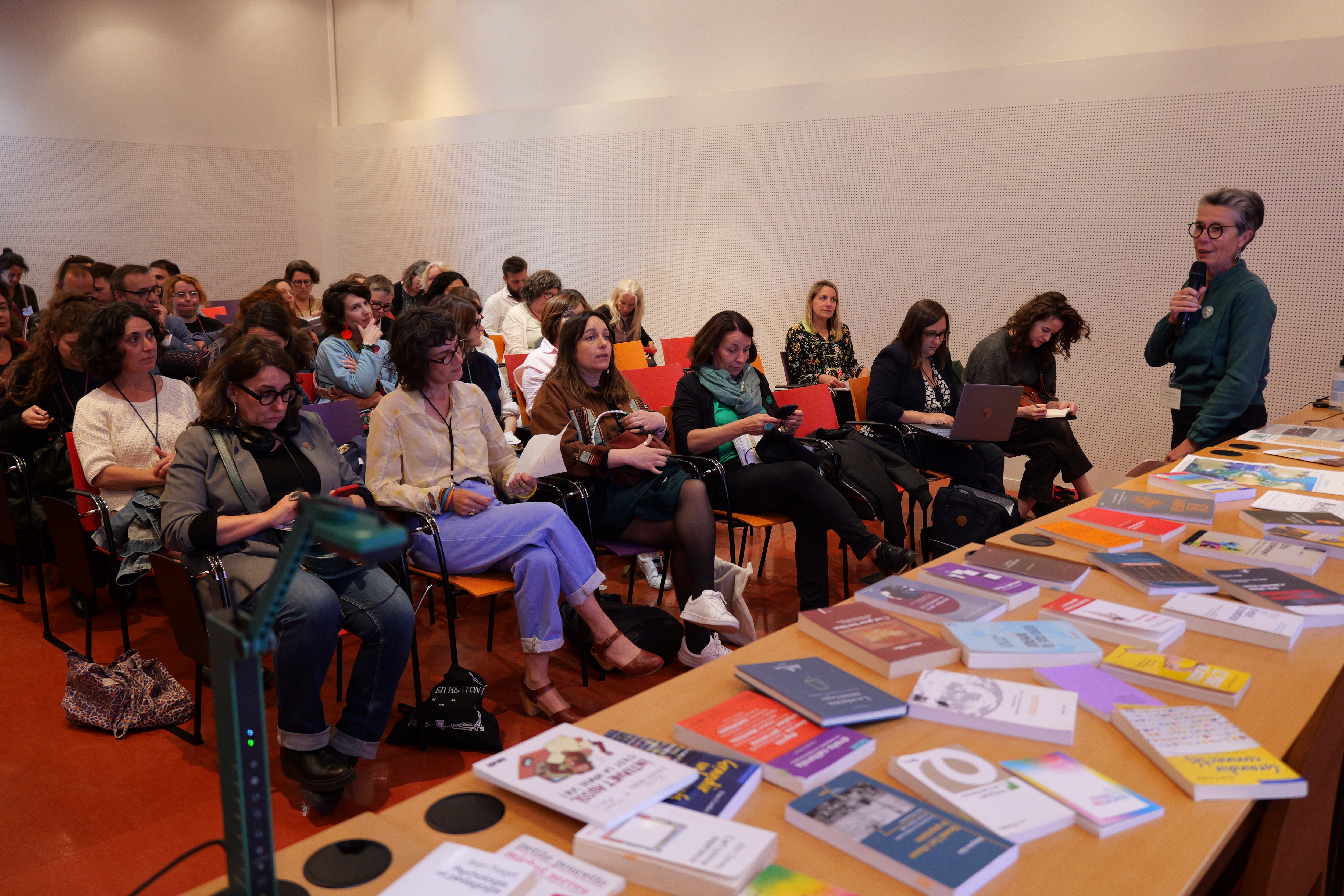
On 10 June 2026, the Département of Loire-Atlantique invited me to give a lecture entitled “Education about screens (small and large) and about images: towards a paradigm shift?”, at the gathering of the professionals and partners of the Grandir avec la culture (“Growing up with culture”) network, organised at the Archives départementales in Nantes by the culture and heritage directorate. Grandir avec la culture is the Département’s arts and cultural education plan, based on a partnership agreement between the Département, the DRAC of Pays de la Loire, the national education authority and Catholic education, which every year enables thousands of secondary school pupils to encounter the arts in all their forms, including cinema through the Collège au cinéma scheme and film practice workshops. The gathering, opened by Dominique Poirout, vice-president for culture and heritage, brought together around eighty people: teachers, associative cinemas of the Scala network, visiting artists, mediators from the departmental heritage sites, institutional partners. It continued with workshops, including the presentation of the Collège au cinéma programme for 2026-2027, and with a visit to the exhibition “Grand Écran, 130 years of cinema in Loire-Atlantique” created by the Archives départementales.
Conceived by Edith Coutant and Sabrina Ferchaud (culture and heritage directorate) as a day of training-in-action rather than a mere lecture slot, the gathering pursued four objectives we had specified together: giving keys and tools to teachers who today have far less training time than in the past; re-enchanting the Collège au cinéma scheme; enabling common ground and dialogue between professional worlds that seldom meet; and working on the motivation of people who had come on their day off, on a Wednesday afternoon in June.
The presentation text sent to the participants announced the subject as follows:
“The secondary school pupils we welcome into cinemas spend, elsewhere, hours on other screens, smaller and more intimate ones, which they produce as much as they consume. These two spaces, long thought of as foreign to one another, may in the end raise the same question, that of the place images take in our lives and of the place we ourselves take within them. Drawing on a few reference points from cultural rights, from the sociology of youth and from field experience, we will work on three knots that Collège au cinéma is living through today: a heritage-based programme that can turn into an assignation if we are not careful; the articulation between watching and making in practice workshops; and what we ourselves, as professionals, can learn from young people’s cultures, rather than limiting ourselves to what we wish to pass on to them.”
I share here, in detail, the line of argument I developed that day, because it seems to me to carry concrete stakes for professionals of education about images.
Building common ground means organising disagreement
My objective for the afternoon was to build common ground, that is, to look at what we share and at how we think about things. I proposed notions, definitions, examples and reflections that are my own and that rest on practice, making clear from the outset that no one is obliged to agree. We live in a democracy, so we are here precisely in order to be able to disagree, and to organise disagreement and controversy. That is what is rich: our diversity of thought. I have many proposals to make, but I am not necessarily right, and this question of posture conditions everything else.
I opened the session with a “stand up, sit down” exercise borrowed from popular education, a technique passed on to me by colleagues, to whom it had been passed on by Christelle Blouët of Réseau Culture 21, and which anyone may take up in turn. About ten questions; you stand up if the answer is yes:
- Who works directly with secondary school pupils, whether as a teacher or otherwise?
- Who works in a cinema?
- Who has, or has had, one or more teenagers at home?
- Who thinks social media are dangerous for young people? (Half and half in the room.)
- For whom is the notion of cultural rights perfectly clear, to the point that it would not even be worth discussing?
- Who is a teacher?
- Who has the TikTok app installed on their phone? (Two or three people, and I am not judging.)
- Who has experienced a Collège au cinéma screening that went very well?
- Who has experienced a Collège au cinéma screening that went badly?
- Who feels, or has felt, at a loss when preparing their pupils before a Collège au cinéma screening?
This kind of exercise looks silly, but it is not silly at all, because it makes it possible, and this is a slightly technical term from cultural rights, to identify communities. A community is not only one’s religion or the music one listens to; it is also what one shares, and many communities intersect within a single room. That day, the exercise revealed a cross-sector assembly in which teachers were not alone, confirming that what we were about to share did not concern school only. As adults, we all carry what is, in the end, a pedagogical responsibility, even when we are artists.
And the exercise brought something else, which cannot be read in the list of questions: a joy, a sharing, a complicity, a way of forming community in diversity. It looks simple, standing up and sitting down, but it is in fact a very powerful crossing, one we dare to make together, each person making something of themselves visible to the others. This exercise puts into play between us, physically, what I was about to talk about, and it opens a loop, that of the question of the frame that authorises, with which I would end.
The world changes, and that is what we call innovation
I am a filmmaker, a pedagogue and a researcher; I create mediation devices that are called innovative, and I support cultural actors and public policies on questions of innovation. But why “innovation”? What is it that absolutely needs innovating? In truth, it is not that we must innovate; it is simply that the world changes, notably through technologies, notably through mobile phones, which change things in people’s lives, in our own lives.
Twenty-one years ago, in 2005, I founded with the Forum des images in Paris the Pocket Films Festival, devoted to films shot with mobile phones, at the very moment the first cameras were appearing in phones. We created it for very bad reasons: SFR was launching 3G and had a great deal of money to sponsor cultural events. But it seemed fascinating to me, because I told myself that ten years later everyone would carry a camera in their pocket at all times, that this was an anthropological change, and that it was worth experimenting, seeing how artists could play with it, reflecting on what was happening to us. Some people said at the time that real films are made with real cameras. That was not the point. The point was the changes under way, and today we are right in the middle of them.
For the vast majority of people’s cultural practices, ours included, now pass through digital tools. The cultural, artistic and pedagogical proposals we make are marginal compared with people’s actual uses. Going to the cinema, in time spent, is a drop in the ocean compared with all the images people see. Faced with this, one can adopt a posture of judgement, claiming that we bring the good things, that young people’s uses are bad and that we carry a better culture. This is what is called cultural democratisation, and its problem is that it presupposes an imaginary of domination, in which I know better than the other what is good for them and in which, above all, I do not respect their culture.
The stigmatisation of the young, a historical constant
To think, it is precious to read those who give shape to their thought. I had brought along part of my library, physical books that I showed one by one under a camera connected to the big screen. This was an explicit request from the organisers: to give professionals’ intuitions an identified scientific grounding that makes them defensible. Throughout the lecture, it was also under this camera that I wrote by hand, with felt pens, the notions and distinctions as I went along, rather than projecting prepared slides. I give a few landmarks here.
Sois jeune et tais-toi (“Be young and shut up”) by Salomé Saqué documents the stigmatisation of the young, and reminds us that it is nothing new. Hesiod, around 720 BC, had “no hope left for the future of our country if today’s youth take command tomorrow”, and Socrates, two centuries later, deplored young people who “love luxury, have bad manners and mock authority”. The “child king” is not a recent invention, and this systematic stigmatisation lives in our culture, even when we believe ourselves free of it.
Michel Serres, in Petite Poucette (2012, published in English as Thumbelina), observed the era when text messages were written with the thumbs, and when an extraordinary linguistic invention, SMS language, was being judged as nonsense. Yet if that language was invented, it was precisely because adults did not understand it. It is the spontaneous appropriation of language through a technology, and that is excellent news for language, because language is alive. What Serres explains is that these are other ways of thinking, not necessarily lesser ones. Our culture is not that of people younger than us. When we were born, combustion engines already existed and seem normal to us, but those who saw the motor car replace the horse did not find it wonderful. Sacha Guitry refused to have a telephone when it arrived in the homes of the Parisian bourgeoisie: “I am not a servant to be rung for.” It is therefore useful to take some critical distance from one’s own judgements, because we always look through the lens of our own experience, and the other’s experience is not ours.
Cultural rights, from dignity to contribution
Cultural rights were named as such in 2007 with the Fribourg Declaration, carried by Patrice Meyer-Bisch, which builds on the Universal Declaration of Human Rights of 1948 and which is, incidentally, currently being reworked. They have been written into French law since 2015 and 2016 (the NOTRe and LCAP acts), and since no one is supposed to be ignorant of the law, we are supposed to respect people’s cultural rights. They consist, first, in considering culture in its anthropological sense, not culture with a capital C, but the culture that constitutes us, and in pointing, on the cultural terrain, to the respect of people’s dignity.
Why does this respect matter so much? The stakes are democratic. If my culture is stigmatised, if the music I listen to, the literature I read, the neighbourhood I live in, the way I dress are considered worthless by the institution, by teachers, by parents, and let us imagine I am a teenager, then I will struggle to recognise the value of my own culture. Many people say of themselves “what I watch is rubbish anyway”, thereby granting no legitimacy to their own culture. Yet if one feels legitimate, one is capable of contributing, and if one does not feel legitimate, there can be no citizenship. In a democratic system, I will not contribute to the common good if I am not legitimate as who I am. To recognise, institutionally, the value of each person’s culture is therefore to make contribution possible.
Cultural rights then draw a distinction, one of those I wrote with a felt pen under the camera, between cultural democratisation, “I know what is good for you, it is the great works of humanity, and I pass them on to you”, and cultural democracy, “we each have our own culture, and we have things to share”. This distinction is sometimes ill-received among cultural professionals, who hear relativism in it: if everything is of equal worth, what is the use of our expertise, our path, our training? In truth, it is not that everything is of equal worth. It is that we have different cultures and that we can enrich one another, with our singular forms of expertise. Marjorie Glas’s fine book Quand l’art chasse le populaire (“When art drives out the popular”) traces the history of public theatre from 1945 to today and shows how it gradually disconnected from people, a disconnection then instrumentalised by those who say “you can see for yourselves, we are not going to fund this stuff for the bobos”. The question, in our own places of teaching and of choosing activities, is how to reinvest cultural and artistic practices with their democratic and emancipatory power.
Youth is not a cultural category
The sociologist Camille Peugny, in Pour une politique de la jeunesse (“For a youth policy”), unsettles a widespread reflex: “we must find something that appeals to the young”. This is a supply-side logic, and the supply-side logic has a problem: I make a great film, I want people to come, but perhaps people could not care less about my great film. I will be told this is demagogic, that it would mean levelling everything down. No. It is the question of address. I address someone, and addressing someone begins with taking an interest in the other. Except that this is very easy to say, for what legitimate time do we have for it in our professions, as teachers or as workers in the cultural, social or health fields? Can I say “I am going for a walk, I will chat with people in the street, I will take an interest in people”? It is not easy to legitimise, and yet, in that informality, I might learn an enormous amount. This is also the question of the quantitative and the qualitative, for the figures from surveys about screen hours may be worrying, but what do I do with them, in my daily life, in my work? The answer lies in the bond. Ask teenagers what they do with their phones, instead of assuming from the outset that it is a problem.
What Peugny shows, with studies to support it, is that at the cultural level, youth is not a category. Between the ages of 15 and 65, cultural tastes are roughly the same, and whoever loves baroque music at 15 will still love it at 35. It is therefore problematic to put young people into a category, when their cultural diversity is enormous. What the young do have in common, on the other hand, is a feeling of insecurity in the world, across all social classes.
As for the famous question of screen time, I had prepared a question for the stand-up-sit-down exercise which I forgot to ask: who spends more than five hours a day in front of screens, computer included? We would all, or almost all, have stood up. And yet we, supposedly, feel fine. Why do we think the young are manipulated and we are not? Because we know what we do on our screens. It is not a question of screens; it is the question of what one uses them for, and young people, too, do many different things with their screens, things that may be entirely legitimate for them. The discourse on screen time is an external gaze, which captures only the form and takes no interest in the real subject.
Ordinary educational violence, institutions, and welcoming dissent
Alice Miller, a Swiss psychoanalyst, founded with C’est pour ton bien (1984, published in English as For Your Own Good) the concept of ordinary educational violence. France is the last country in Europe to have banned corporal punishment, in November 2019, when others had done so forty years earlier. “My parents hit me, it was for my own good, it made me who I am”: in truth, not at all, and Miller, notably through a biography of Adolf Hitler, shows what violence suffered in childhood produces and repeats. It is important to understand what lies, unconsciously, in our culture, of a relation of violence and brutality towards children.
We talk a great deal about school bullying, but let us also put the question to teachers: does the institution treat you well? I myself left the national education system, where I was a civil servant, a long time ago. When an institution mistreats us, how do we, caught in that culture, behave towards the young? Always with care? Not necessarily, and it is important to realise it. The school institution remains within systems of ranking, hence of competition, whereas a democratic society is founded on cooperation, and there are many different forms of intelligence, complementary ones, which would gain from being cultivated in their singularity. It is extremely complex, given the curricula, the teaching formats and the training available. With the Institut pour la photographie in Lille, for instance, we have been running for years a year-long training course for teachers, with workshops in their classrooms. The INSPE teacher-training institute replied that it had no time for it, and the teachers come to train during their holidays. Like the participants of this 10 June gathering, who came on a day they had chosen to give.
Nonviolent communication offers here a shift of posture: instead of “you hurt me”, saying “when you did that, I felt violated”. And the question of welcoming dissent extends that of institutional violence. Disobedience is written into our Constitution: if we judge that governance is failing, we have a duty to disobey, which is complex, almost paradoxical, but deserves to be raised. Two months ago I heard someone from the Centre national du cinéma protest, in public, that “even teenagers now criticise the programmes we make for them”, and call for “teaching them authority again”. I do not agree. If a disagreement is expressed, we run no risk in listening to it; we have everything to gain. It is not by listening to disagreement that we weaken ourselves; it is by rejecting it.
From John Dewey to bell hooks, art as experience
John Dewey, the American pragmatist philosopher, published Art as Experience in 1934. To the question “is art the object, the sculpture, the painting, the film?”, he answers that art is the experience a human being lives in the relation with an object, or in group relations. He positions art as an experience, not as an object external to us. This thought has a lineage: Dewey was one of the great inspirations of Célestin Freinet; Freinet deeply influenced Paulo Freire, who worked in the favelas on co-education, where people educate one another through experience; and Paulo Freire is a major inspiration of contemporary feminisms, notably intersectional ones, such as that of bell hooks. This experiential, shared, democratic, horizontal dimension thus nourishes very current strands of thought, far beyond the Freinet schools.
I also placed side by side two books on propaganda and disinformation, one by a sociologist, Gérald Bronner, the other by a historian. One analyses propaganda everywhere: in social media of course, but also in the mainstream media, as we can see with their far-right owners, and in the words of the state, as has always been the case. The other holds, broadly, that the right word is the word of the state. Yet they use the same tools of sociological analysis. This is to say that there is always a political position, that no one is objective, and that this is normal. I find it healthy to read, also, the things one disagrees with. Let me also mention, on our digital dependency, Ophélie Coelho’s book recounting the history of data centres and undersea cables, from the telegraph of 1850 to today’s multinationals.
A working lexicon, from image education to education through images
The title of the lecture spoke of education about screens and about images. For our professions, it seems useful to distinguish terms that partly overlap.
Education about the image (éducation à l’image, EAI) was born in the late 1990s, around École et cinéma, with a mobilisation of film distributors around the idea of having young people watch films, which also generates admissions for French cinema. I have nothing against that; the Pocket Films Festival had SFR at its base, after all. But it must be understood for what it is: rather an education in cinephilia. And the great strength of schemes such as Collège au cinéma is to create common ground, since we know which films have been seen, and since, between different actors, we can seize on what is common in the experiences of the people we address in order to weave cooperations.
Media and information literacy (éducation aux médias et à l’information, EMI) deals with information, and it is largely carried by journalists. This is somewhat problematic to my mind, because journalists, through media literacy, defend the legitimacy of their own profession. Pierre Bourdieu, in what he published on journalism at the end of his life, is extremely harsh, and I rather agree with him. An interview manufactures information; it is a worldview, a fiction that is shared. I think media education should be carried out by sociologists, psychoanalysts, anthropologists, ethnologists, but not by journalists; not that they are ill-intentioned, but they are judge and party, with the strongest cognitive biases on the subject. I am not saying everything should be discarded, but beware of the watchword of critical thinking.
Education about images (éducation aux images), in the plural, is the current formulation of EAI, encompassing all images, no longer only those of cinema, which are in the end rather rare images in people’s lives. Before or after accompanying young people to see a film, one can invite them to make one with their own phone, and seek that complementarity.
Arts and cultural education (éducation artistique et culturelle, EAC) is watching and making, to put it briefly. I am strongly in favour of it, more than of media literacy, because in arts education one is relaxed, so to speak, and this relaxation conditions learning, as I explain below.
Education about screens (éducation aux écrans), aimed rather at the very young, deals with uses, for instance the 3-6-9-12 framework of Serge Tisseron, a psychoanalyst with whom I work a great deal. I do not quite agree with him on “no screens before the age of three”, because that does not exist. All children, before the age of three, handle screens. I am not saying it is good, but that is how it is, and the question is how to accompany the uses that exist. For the real problem, in young children’s massive use of screens, is their parents’ use: the parents are themselves glued to screens, or hand the child a screen. Often we do not question ourselves, the other is responsible for everything, and it is the children who have to manage our failures of self-questioning.
Education through the image (éducation par l’image), finally, is sometimes confused with the preceding ones, as when the history teacher shows a sword-and-sandal epic to talk about Antiquity, or a dinosaur film without feathers when dinosaurs apparently had them. No harm done, it is an imaginary, but it is not the same thing as education about images.
Critical thinking is a social risk, and it requires a frame
Critical thinking is not saying what should be thought; it is not right-thinking. Critical thinking is thinking for oneself. Now, thinking for oneself is a major social risk, because one may not think like the others, and if one does not think like the others, one can be excluded from the group, which, for a teenager as for an adult, is potentially dangerous, socially or psychologically. This is why the benevolent frame, respectful of the diversity of thought, and hence of cultural rights, of the other’s culture and the other’s thinking, is decisive. If that frame is not set, if within the frame there is what one is allowed to think and what one is not allowed to think, then it is impossible for people to exercise critical thinking, because it is socially too dangerous. We are afraid of the other’s thought, because we do not know what is in their head and we fear being destabilised. Behind all this lies a question about how we represent the human being: is the child by nature disorderly and dangerous, to be framed and contained, or full of qualities to be developed?
Neuroscience offers concrete support here. Olivier Houdé, a psychologist, speaks of “learning to resist”, not political resistance, but cognitive resistance. When we learn something new, we must resist our automatic patterns of thought, our reflex thinking, in order to create new neural connections, which demands a great deal of energy, the brain being the organ that consumes the most. And to carry out this operation, indispensable to all learning, one must feel in confidence. If one is in danger, one switches straight into reflex thinking, and if I feel threatened, I absolutely cannot learn; it is impossible at the neurological level. This is why sanctions, threats and bad marks, which are stress factors, physiologically prevent learning, and this is why the relaxation of arts and cultural education is, in educational terms, more effective than approaches shot through with political or community tensions, where everyone knows there are things one had better not say, and young people know it very well.
A photography workshop to put cultural rights to the test
To show how these notions articulate with a practice, I recounted a workshop I very often have people do, and which we did not do that day, the afternoon workshops providing for it. In small groups or individually, participants go off to take photographs on a shared theme, for instance “teenagers and screens”, with an open instruction: create something, improvise, see what the place inspires in you; no obligation to be illustrative, it can be artistic, it can be abstract, but with an intention. The photographs are uploaded autonomously via a QR code, not through Google and the like but through a server located in Clermont-Ferrand, because if we use Microsoft 365 or Google, our accounts fall under American jurisdiction and can be closed, and the metropolitan authority of Nantes, which runs on Microsoft, could lose all its data if it displeased the American powers. The choice of a tool is an eminently political choice.
Then we look at the photographs together, full screen, lights off, with one rule: the person who took the photograph is not allowed to speak, which is very frustrating, and the others say what they see, what it evokes for them, what it does to them. What happens then illustrates everything above. First, creativity has been freed by the time constraint and by a simple gesture carried out autonomously; I held no one’s hand, whereas if I think too much, I set myself prohibitions. Then, listening to other people’s gazes on my photograph allows me to understand better what I have done, for the others see in it symbols I did not consciously put there, and yet they are there. This is exactly Dewey’s art as experience, the encounter between the one who looks and the work, which is not all-powerful. This is why the question “what did the author mean?” is, with apologies to the teachers, the silliest question there is; that is my opinion, and it is open to debate. What the author meant is one piece of information among others, and what counts is what I receive. We know this well: a work read two centuries later gives us something entirely different from what it gave at the time. One discovers, finally, the extraordinary polysemy of images, with people seeing opposite things in the same image, and that is very good, for there is no one right meaning; there is each person’s meaning, and this is not cultural relativism, it is mutual enrichment.
In art, a creative process produces, as the etymology of the word says, new things, for which no criteria of judgement exist. To say “it is good” or “it is not good” makes no sense in artistic terms; it can make sense in normative terms, for technical mastery, but not for art. That is the whole history of art, the Salon des refusés, the artists turned away because they did not fit the canon of their time. But how do we keep that openness, when we are the ones framing, without everything dissolving into anything-goes? That is the whole point of this example: a highly framed, highly organised workshop, which produces an encounter and discoveries, destabilises no one and enriches everyone. There is no democratisation in which someone who knows better explains to the others what is good; there is a democracy in which we enrich one another.
Regulated images, autonomous images, vernacular images
When we speak of image education, we should still know which images we are speaking of. I distinguish three regimes of images, which I again wrote out with a felt pen under the camera.
Regulated images are those holding an exploitation visa from the Centre national du cinéma, those shown in cinemas within the authorised commercial system or on television, that is, the images governed by our regulations. France is fortunate to have the CNC, wanted by the cultural milieu before the Second World War, whose administration was designed under the Vichy regime and which opened in 1946.
Autonomous images are professional too, but outside that regulation: a series produced abroad for a platform, artists’ films, museum images, experimental films, series on YouTube; images framed by professions but which do not belong to the same economic system, with no automatic redistribution mechanism, and which are nonetheless very important.
Vernacular images, finally, are the images made by people themselves, amateur images.
A priori, the latter are of no importance. Except that something happened. In 2005, at the same time as the camera was arriving in phones, a website called YouTube appeared in April, preceded by a month by the French Dailymotion. Before 2005, in the hierarchy of images, the vernacular image had no value. I could take my family hostage on a Sunday to show my slides, or stage accidents for a home-video gag show, but the production made by people had neither market value, since I do not charge people to watch my family films whereas I pay for my cinema ticket, my DVD, my Netflix subscription, nor any possibility of circulation, since to show images to the whole world one had to be a professional of television or cinema. What YouTube changed is that the whole world can now watch the little family film. In 2007, the economic weight of video games overtook that of cinema, and a few years later, the economic weight of the sharing of amateur audiovisual productions, photos, videos, sounds, in turn overtook that of professional images. The images that are, for us, the standard are no longer the economic standard.
Why do vernacular images generate money? Because advertising and algorithms latch on to an authentic sharing between people, which carries a value of horizontal recommendation. Patrick Le Lay, head of the TF1 channel, said he was selling Coca-Cola “available human brain time”, and he at least had the sincerity of his trade. Now we know that a message sent by a peer carries ten times the weight of an institutional message; this is the power of recommendation, which commercial platforms themselves try to reintegrate (“people who bought this book also bought...”). Horizontal recommendation is far more powerful than top-down prescription, and the question, for us, is how we integrate this into our professional frames.
The collective filmography, or giving value to each person’s film
The second device I shared is the collective filmography, which I have practised for a very long time with all kinds of people. I simply ask each person for their favourite film, truly the most important one in their heart, and I write it into a projected mind map, with the director, the country, the year, a map that can then be printed in A3 and shared. We sketched it in the room, and the map made that day accompanies this article:
- A Room with a View, James Ivory, British, 1985;
- Children of Paradise (Les Enfants du paradis), Marcel Carné, France, 1945;
- The Night of the Hunter, Charles Laughton, American, 1955;
- Dangerous Liaisons, Stephen Frears, British, 1989.
Zero women directors named that day, as at the Cannes Festival, unfortunately, and one may worry in passing about the Créteil International Women’s Film Festival, under threat after forty-seven years of existence.
It looks simple, and it mobilises a great deal. In a classroom, when I ask this question, the noise level rises, because we are talking about pleasure, about joy. I sometimes see the teacher worry about losing control of the class, but this noise is an expression of joy that I myself have elicited; it is I who asked for there to be noise. Saying “be quiet” would be a paradoxical injunction. Some cannot recall the title, some ask whether a YouTube series is a film, whether an anime is a film, whether an influencer’s series is a film, and these questions about forms are precisely the opportunity to discuss them, like the discovery that “a Louis de Funès film” is not directed by Louis de Funès. And when a pupil cannot find one, teachers sometimes suggest “just give any title, it doesn’t matter”. But that is not the idea. The idea is that he or she should find what matters to him or to her, and if it takes fifteen minutes, I have no problem with that, for that is exactly what we are doing: giving value to what counts for each person. The map is only a pretext, even if it has value of its own.
What astonishes me every time is the diversity of what young people love, films from countries whose existence I barely knew of, cinephilias I had never heard of, and I learn. When people say we should ask the young what they like, here is an exercise that does it without asking explicitly, in a paternalistic mode, simply by doing something together that enriches us mutually. And sometimes, among adults, someone comes back at the end of the session: “actually I want to change mine, I want to put down Le Père Noël est une ordure, I didn’t dare”. That is an authorisation to expression. It looks trivial, but it is already a risky expression, already the fear of being judged, and if we manage to lift it in a true openness to the other, we found the space of confidence from which critical thinking becomes possible: daring one’s singularity without being judged for it. All this is easy to say and hard to do, because one finds it oneself too long, too noisy. So I walk around the classroom and I listen, and after perhaps half an hour, we have an incredible filmography, because we have given each person the time to bring out something that matters.
TikTok and the contributive position
On algorithms and filter bubbles, I wanted to shift the gaze. TikTok is today a platform used by the young above all to learn things. It sounds odd, given the image of danced choreographies, but that was TikTok ten years ago; today the average age there is twenty-seven, all ages are present, and in its contents it is today’s YouTube, which YouTube and Instagram have in fact imitated. Talk about the TikTok algorithm with a teenager and you will see their eyes light up, for this algorithm is extraordinary, I dare say it, and it holds a genuine cultural diversity. It is addictive, and made to be, I am not saying otherwise, but it is not only that; it is both at once, and it is the question of use. I had a cousin who, in the 1970s and 1980s, read all the time, and her parents were very worried; today, someone who reads all the time is thought admirable.
Above all, in TikTok, one button triggers your camera. You have seen a choreography you like; the sound plays at half speed, you film yourself, you share, and within a few days there sometimes exist fifteen thousand versions of the same choreography, in palimpsest. Whatever one thinks of it, this changes one’s position. On TikTok, I am a spectator and I can become a creator in one click, with an extraordinary editing tool, and I share. It is an anthropological position of possible contribution, which is not the one we offer in a cinema, where one is a receiver. I am not saying we should imitate TikTok; I am saying we must take into account the contributive position that citizens, and young people in particular, now hold in their daily lives. For me, TikTok is a space of cultural democracy, however odd that sounds, with its censorship and its Chinese ownership, because I can express myself there, because I have the power to. The question that comes back to us is then whether, in our own institutions, we allow such a power of expression, and how we frame it.
The frame, that which authorises
I concluded on this notion of the frame, and one will understand that I am steeped in psychoanalysis. We often tell ourselves that we must frame, that the frame is a series of prohibitions so that things do not overflow. That is not what a frame is. The frame is what authorises, what authorises us to emancipate ourselves, for emancipation means being authorised to something. The professional question then becomes how to frame, not in order to contain, but in order to authorise self-expression and emancipation. The stand-up-sit-down exercise, the photography workshop, the collective filmography are frames in this sense, highly organised, and it is their very organisation that opens the space of confidence in which each person can take the risk of their singularity. The loop opened at the start of the session thus closed itself, for that crossing of the stand-up-sit-down, which we had dared to make together, with its joy and its complicity, was already a frame that authorises, experienced physically between us before being thought.
What the room brought, from film sound to sharing the codes
The exchange that followed extended and embodied the talk. I had invited not questions but contributions and disagreements, making clear that it was not necessarily for me to answer, that I had held the role of offering things but that I do not hold absolute knowledge. I transcribe these exchanges here in full.
A Collège au cinéma workshop leader (“sound in cinema” workshop). “I lead workshops for Collège au cinéma, notably the ’sound in cinema’ workshop, and I would like us one day to speak of education about image and sound, because sound matters too. It is my little battle, but it is included, in truth, as soon as we speak of images and cinema; this link must not be forgotten.”
I had planned to say it, and thank you for saying it, because as a result I had not, and I felt ashamed. It is indeed absolutely essential. For me, sound is 70% of a film.
A participant. “I was surprised by the average age of twenty-seven on TikTok, and I wanted to know where the youngest are, on which social networks.”
Twenty-seven is an average. There are enormous numbers of young people on TikTok, and there are also old people, and on average that makes twenty-seven. As you know, social networks are supposed to be forbidden under the age of fifteen, which is obviously the greatest of hypocrisies. The result is that the young learn to get around it, and that there will therefore be even less regulation. It is a real pity, but that is how it is. There are very many little ones, even very little ones, whom one sees on TikTok with their parents’ phones. And besides, YouTube and Instagram have imitated TikTok; everything looks like TikTok now. When I say TikTok, it is in truth broader than TikTok.
A participant, aged twenty. “I simply wanted to come back to what you were saying about TikTok. As a young person, I am twenty, I have the TikTok app, which I use very little, and I also use Instagram, where there are Reels, which are like TikTok. On Snapchat you find Spotlight. If you take away the app itself, as you said, you find similar formats everywhere, and the videos we post turn up on several apps. It is quite a particular subject, because at first I went on TikTok a lot when I was at secondary school, to entertain myself, to see things, and to learn some things too. A large part of my culture, in inverted commas, with friends my age, is on TikTok. It is a way of socialising among us, the young, so it is also something important. But we also realise, ourselves, that it is a danger, for everything around it, the images it shows us, the time it makes us lose, what it prevents us from discovering. We can no longer concentrate, we struggle to stay focused on longer subjects, on YouTube videos for example, and in the end we say to ourselves ’all that to say what? it’s rubbish’. I do not feel like a young person better than the others, but I, precisely, do not really use TikTok; I have even installed an app that prevents me from watching TikToks, which blocks me automatically when I go there. With my friends, there are four of us, we have this TikTok block, and it is really complicated. We all want to detach ourselves from it, as young people; we realise it is more negative than positive, but at the same time, when we detach ourselves, we fall behind the other young people, and it is quite complicated.”
Thank you for this contribution, because one can see it in listening to you, and we know it: a critical reflection on uses exists among the young. Talking about it with them, as we were doing at that moment, means that all of a sudden, instead of mutual judgement, there is listening; we share problems, we learn together and we support one another. We are in a bond, in confidence, and not in distrust or in a prohibition that does not understand what is at stake. Young people reflect on their lives; being young does not mean being stupid, quite the contrary.
A teacher in a priority-education secondary school. “I had a reflection concerning the pupils. I teach in a REP+ school, and I find that through screens, through networks, there is more and more visible violence, and no accompaniment by families. I am moving more and more towards a form of framing, or of accompanying children in the face of images, notably extremely violent ones, to which they are exposed all the time. With older teenagers, self-regulation happens, but with the little ones, it is truly an ordeal.”
You are absolutely right. All the more reason to open the dialogue about what is happening, about what is watched on screens, and for them to dare to share it. When young people or children live through things they dare not share with adults, because they think they will be judged outright, the bond is prevented, because the adults do not make the effort to understand, to go towards them, and to refrain from judging even activities that are not great. It is better that they dare to speak. It is truly difficult, and that is where our role as adults lies: building confidence in the right to talk about what you do, or about what is causing a problem.
The same teacher. “There are in the end few spaces for that. It exists in some lessons, at moments, but it is not something central, whereas in the current crisis it is. I think there is a very large gap between what we perceive of the real dangers for our pupils and the help we can concretely give them, everything that is put in place. I find that over the last three or four years there has been a rise in violence that frightens me greatly, because when they let go, whether in EVARS, the education in emotional, relational and sexual life, or simply in reflections on questions of gender equality, I measure the rise of a violence of which they are the first products.”
This allowed me to add a legal point, since the cultural rights I had spoken of are written into French law, through two acts, in 2015 and in 2016. No one is supposed to be ignorant of the law; we are supposed to respect people’s cultural rights. And the question raised there is exactly that one: we are supposed to be able to welcome cultures that are foreign to us, that shock us. It is our job, and it is particularly difficult to do.
A projectionist. “I found everything you brought about stepping back from education about the image, or images, very interesting. It is true that it is worth pausing, and realising that the whole context is changing, with the tools, the networks. But in the end, when I look from the point of view of the cinema itself, because I am a projectionist and I often take part in screenings with teenagers, something particular still always happens. It is the moment when we are all together in a room, in front of a big screen, sharing for a time, then talking about it a little afterwards. Things happen. On the whole I have always found reactions, even applause, emotions expressed, often.”
I so agree. And it is true that for this possibility of forming a community in front of a film to exist, one must also feel reassured, that is, the codes must have been shared with us. Because if, before even entering the room, we get told off for making too much noise, we arrive in the room in protection mode, and we cannot perform the cognitive resistance. That is why this whole dimension of accompaniment is so important, and that is why we are here. If we do not manage it, there truly is a neurological block. So no, it is not magic. A work of art is not magic, contrary to André Malraux’s vision of the work that would, as if by magic, fascinate us and change us.
A cinema programmer. “This is not exactly in the continuity of the last contribution and the answer, I am sorry. I currently do the programming in a cinema, and I also work at the university, which has nothing to do with it, but I worked for almost eight years in a cinema. When we hosted screenings, notably Collège au cinéma, but also Lycéens au cinéma and École et cinéma, we did a welcome in two stages: a first stage on the spectator’s posture, explaining what that posture was and the rules within which one could move, and a second welcoming stage focused mainly on the work. These two stages allowed the children, the young people, to refocus on what they had come to do, and I think it was something that allowed us to channel things. We worked in a working-class neighbourhood, in Seine-Saint-Denis, with sometimes difficult audiences, and it allowed us to hold screenings that could be really rough. I wanted to share that.”
Thank you very much. It is precisely the question of sharing cultural codes: considering that there are different cultures, passing the codes on to one another, understanding codes we perhaps did not know, instead of having them imposed on us, and understanding their meaning. And the question of speaking about the institution is what is called institutional pedagogy, for those who know it, or institutional therapy, that is, discussing together the common rules and the meaning of the common rules, possibly moving the common rules together. They are then no longer rules that impose themselves, but rules that have been discussed, refounded together through debate. Which is, again, what John Dewey says.
Concrete footholds for practice
From this lecture and these exchanges, I propose that professionals take away a few directly usable footholds:
- Take an official interest in people’s cultures. Not informally, not in passing, but in dedicated, recognised times. The stand-up-sit-down exercise and the collective filmography are two simple, transmissible devices that identify the communities present and give value to what matters to each person. One discovers unsuspected cinephilias, and the dialogue can begin.
- Frame in order to authorise, not to contain. A frame is not a series of prohibitions; it is what makes expression and emancipation possible. The photography workshop shows it: the more organised the device (theme, limited time, speaking rule), the more each person’s freedom finds its place.
- Create the relaxation that makes learning possible. The cognitive resistance required by all learning demands confidence. Sanctions, threats and judgements physiologically block learning, and the sharing of codes ahead of a screening, as the projectionist and the programmer recalled, is part of this building of confidence.
- Take into account the contributive position of audiences. Young people, and citizens in general, are now spectators and creators at once. Rather than opposing our proposals to their practices, ask what space of contribution, of the same democratic standing, we open to them in our own devices.
- Choose digital tools knowingly. Hosting a workshop’s productions on a sovereign server rather than with a giant under foreign jurisdiction is not a technical detail; it is a political and pedagogical act, consistent with what one teaches.
- Question ourselves, as adults and as institutions. The main problem of screens for children remains the use adults make of them, and institutional violence carries over into the way we treat the young. If we question ourselves, the other can do so too.
From lecture to workshops, a consistency of method
The gathering continued with the workshops, including the presentation of the Collège au cinéma programme for 2026-2027 and its pedagogical leads, with a post-it device collecting each person’s learnings and needs, and with the visit to the “Grand Écran” exhibition, now available for loan to organisations across the territory. This articulation between a lecture time, practice times and shared tools seems to me to be, in itself, an application of what I argued, for a departmental network that takes care of the way its professionals work together builds the conditions of what it will then produce with the young. That is how I understand the paradigm shift in this lecture’s title: not replacing image education with something else, but widening the gaze to all images and all cultures, and shifting the posture, from top-down transmission to mutual enrichment.

Drawing on Benoît Labourdette’s 30 years of experience in the field of cultural innovation and his research and methodological work, the Benoît Labourdette production agency supports cultural policies in their need for innovation, better encounters with populations, use of digital tools and cooperation, definition of mediation strategies, and support for artistic teams, technicians and elected representatives. Our method is always based on collective intelligence, cooperation and empowerment of people and structures. We work with cities and other local authorities, national networks, institutions and associations.
-

Educating about images, organising disagreement
Practical concepts and tools for building a shared understanding through images.
A detailed account of the lecture given on 10 June 2026 at the Archives départementales de Loire-Atlantique, for the Grandir avec la culture (…) -

The White Paper on Cultural Decentralisation
Material for Dialogue and Self-Transformation.
In late March 2026, the Observatoire des politiques culturelles (the French Cultural Policies Observatory) published a White Paper compiling (…) -

Creating to think
A French-Finnish meeting at L’Alhambra in Marseille on 4 May 2026, as part of the Erasmus+ Visual Thinkers project.
On 4 May 2026, I facilitated a professional meeting at L’Alhambra in Marseille, organised by the Image Clé association as part of the European (…) -

The Book Archipelago
A proposal to elected representatives: making plural bookshops the backbone of territorial cultural policies.
Faced with the tensions running through the bookshop sector today, it is time to put an end to the sanctuary myth. Rather than seeking an (…) -

The photography workshop: creating, showing, looking together
Reflections on a hands-on workshop facilitated by Benoît Labourdette at the professional conference “Cinema, images and young people’s mental health”, held on 14 April 2026 in Romainville, France.
A workshop in nine small groups, fifteen minutes to produce a photograph, then a moment of collective viewing in which the authors remain silent (…) -

« Mental Health and Cinema »
Synthesis of the day “Young people, their images, their spaces: new paradigms” (14 April 2026)
Synthesis of a day of professional gatherings at the Le Trianon cinema in Romainville, bringing together the perspectives of professionals from (…) -

Mental health, young people, images: what are we talking about?
Text of Benoît Labourdette’s opening talk at the professional meetings held on 14 April 2026.
Before entering into projects, we need to pin down the words. Mental health, young people, images: three notions we often use together without (…) -

Transmitting cultural rights: a question of coherence
What facilitation methods reveal about our relationship with people.
How can we talk about cultural democracy within an authoritarian framework? How can we defend respect for each person’s culture while imposing a (…) -

Mental Health and Cinema - Experiencing the World Through Images
Two professional conferences in Romainville (April 14 and 15, 2026).
On April 14 and 15, 2026, ACRIF, as part of its coordination mission for Passeurs d’images in Île-de-France, is organizing two days of (…) -

Collaborative assessment of screen literacy education in Nouvelle-Aquitaine
Collective intelligence methodology, digital platform, and collaborative publication for ALCA (2026).
ALCA, Agence Livre, Cinéma et Audiovisuel en Nouvelle-Aquitaine, entrusted me with the methodological support for a collaborative assessment of (…) -

Media Literacy: Should We Judge or Guide?
Reflections based on the National Meeting of Regional Centers for Media Literacy (Rouen, March 16–17, 2026).
On 16 and 17 March 2026, Normandie Images organised in Rouen the national meeting of France’s regional image education centres (pôles régionaux (…) -

The Meaning of Mediation Methods in Arts and Cultural Education
When practice reveals what theory ignores.
Artists and professionals involved in arts education develop singular methods that most often remain implicit. I wish to lift the veil on the (…) -

Cultural Mediation as a Device for Symbolic Emancipation
Methodological Principles for a Horizontal Approach to Collective Creation.
Lived experience radically transforms our relationship to thought. Cultural mediation does not consist of transmitting knowledge but of creating (…) -

Evaluating Arts and Cultural Education from the Artist’s Perspective
Review of a course given at INSEAC: conceptual and methodological tools for cultural professionals.
On January 15, 2026, as part of the CNAM module EAC104 “Building tools to evaluate ACE projects: qualitative and quantitative survey methodologies (…) -

Developing Psychosocial Skills Through Artistic Practices
Methodological principles for an experiential approach.
Psychosocial skills (PSS) are now at the heart of public health, education, and child protection policies. The 2023-2027 intersectoral roadmap, (…) -

When thirty-five professionals discover their psychosocial skills through creative experience
A look back at the interprofessional seminar of January 12, 2026, in Limoges: a day where theory gave way to lived experience.
At the DRAC Nouvelle-Aquitaine, educators, teachers, caregivers, and cultural actors experienced together what it truly means to develop (…) -

Image Education and Citizenship: When Youth Professionals Rethink Their Practices
{{Reflections on the “Out-of-School Time” professional day that I co-designed with ALCA and the Gironde Departmental Council.}}
On December 2, 2025, around a hundred youth, animation, and culture professionals gathered at the MECA auditorium in Bordeaux to explore together (…) -

Art and Culture in the Service of Psychosocial Skills
Account of a founding seminar for professionals of the Judicial Protection of Youth in Limousin.
On November 27, 2025, the Limousin Regional Directorate of PJJ brought together its teams for a half-day of collective reflection on psychosocial (…) -

Youth and culture: for a radical change in posture
Giving young people the power to create, not just consume culture.
How can cultural institutions break out of their chronic failure with young people? By abandoning condescension to embrace a genuine cultural (…) -

Reinventing youth reception in cinemas
Remote training for cinema operators in Lot-et-Garonne.
How can we transform our cinemas into spaces for authentic encounters with 15-25 year-olds? This question guided an intense training session with (…) -

“Participatory creation as a laboratory for democracy?”
4th edition of the biennial festival of participatory creation - Les Rencontres de la Poudrerie - Théâtre des habitants - May 16 & 17, 2025.
Les Rencontres de la Poudrerie are a moment for reflection and co-construction, at the intersection of art forms and the practice of social life. (…) -

Pour une robustesse coopérative des projets culturels
Réflexion sur les modalités de coopération territoriale et d’évaluation.
Pour que les projets culturels puissent trouver pleinement leur sens social et devenir plus robustes face aux attaques politiques qui les jugent « (…) -

Design of a professional day on “Artistic and digital practices for young people”
Act’art, artistic and cultural action in Seine-et-Marne.
As part of its mission to promote collective intelligence by facilitating local think tanks, Act’art asked Benoît Labourdette to design, (…) -

OPC Media: “What if we changed our posture?”
How can we learn to consider the richness of teenage digital practices and avoid giving in to preconceived ideas?
How can we learn to consider the richness of teenagers’ digital practices and not give in to preconceived ideas? For Benoît Labourdette, if we (…) -

Itinéraire bis, the path of cultural rights
Action research conducted by the MPAA (Paris).
Accompaniment in the animation, production of traces and fabrication of the web platform resources of the research-action “Itinéraire bis, chemin (…) -

Helping young people and professionals to speak out: “Cultures and youth policies” national meeting
Observatory of Cultural Policies / Villeurbanne (TNP, May 11 & 12, 2023).
As part of the Rencontres nationales “Cultures et politiques de la jeunesse” (“Cultures and youth policies”), which brought the year of the French (…) -

"Culture, youth and digital: designing new modalities for cultural and educational projects
Sharing of methodological tracks and professional training.
Deconstructing preconceived ideas about digital transformation and developing projects adapted to young people.The cultural offer is sometimes (…) -

“Media College” platform for Périfééries
Creation of a digital collective intelligence tool.
To meet a need for creative, intellectual emulation and the production of ideas for one of the axes of the Saint-Denis (93) city’s bid for the (…) -

Giant digital brainstorming
Design and implementation of a digital collective intelligence tool.
Method of activating a vast contribution for the axes of a cultural project. The needIn the solidarity I had with the city of Saint-Denis’ bid (…) -

The Périfééries project’s heritage council of influence
Facilitating collective intelligence in a short space of time.
As part of Saint-Denis’s bid to become European Capital of Culture 2028, I led a collective intelligence session to collect proposals on the (…) -

Reinventing cultural projects with youth?
Proposal of questions.
While public cultural action aims to reach people in their great diversity, it is clear that it is often difficult to mobilize youth. However, (…)


-

When Cultural Professionals Question Their Approaches to Adolescents Reflections on a day of professional cross-fertilization.
An interprofessional day organized by the Réseau Jeune Public au Centre at Équinoxe, Scène nationale de Châteauroux on November 19, 2025, which I (…) -

Cloud of Nuanced Screens For an enlightened ecology of our digital lives.
Faced with screens, fear is a bad counselor. I propose substituting a nuanced approach for the ambient panic, one based on the distinction between (…) -
Reinventing youth reception in cinemas Remote training for cinema operators in Lot-et-Garonne.
How can we transform our cinemas into spaces for authentic encounters with 15-25 year-olds? This question guided an intense training session with (…) -

Image education as a space for connection Trusting how people see to restore dialogue.
On March 16, 2026, during the National Meeting of Regional Image Education Centres, organised by Normandie Images in Rouen, I took part in a round (…) -
Image Education and Citizenship: When Youth Professionals Rethink Their Practices {{Reflections on the “Out-of-School Time” professional day that I co-designed with ALCA and the Gironde Departmental Council.}}
On December 2, 2025, around a hundred youth, animation, and culture professionals gathered at the MECA auditorium in Bordeaux to explore together (…)
