Collaborative assessment of screen literacy education in Nouvelle-Aquitaine
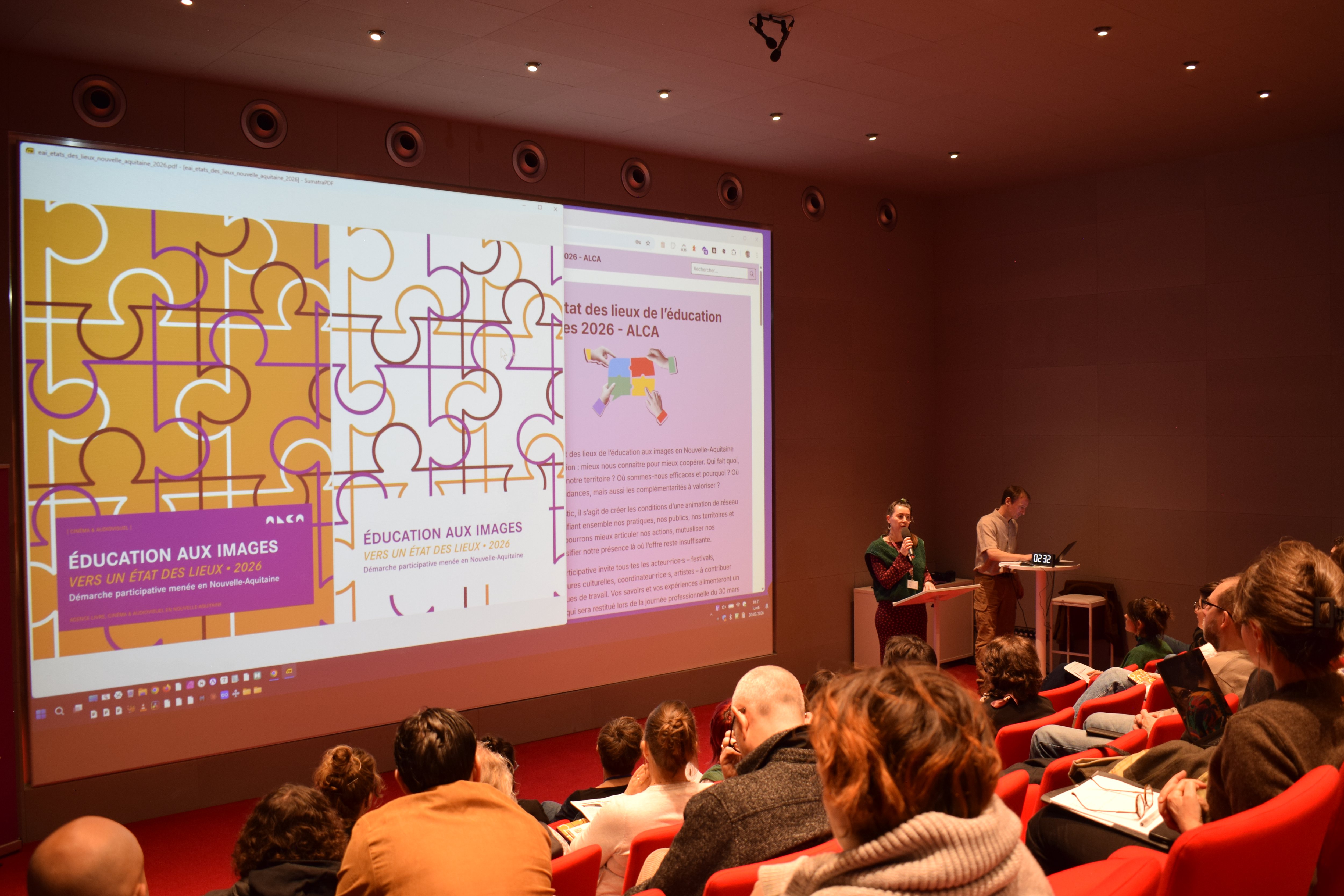
ALCA, Agence Livre, Cinéma et Audiovisuel en Nouvelle-Aquitaine, entrusted me with the methodological support for a collaborative assessment of screen literacy education across its territory. This project, carried out in cooperation with Aurore Schneekönig and Margaux Maillard from ALCA, brought together around twenty professionals over four months, produced an eight-chapter publication, and culminated in a presentation day on March 30, 2026 at the MÉCA in Bordeaux. I co-designed and co-facilitated the entire collective intelligence process, developed the collaborative digital platform, and co-wrote and co-edited the publication. The most important result is not the document: it is the process that was set in motion.
Genesis: a deep-seated need
When Aurore Schneekönig contacted me in the summer of 2025, she carried a concern I knew well, having encountered it in other territorial contexts: how, from a regional coordination position, do you facilitate a network of professionals you know both well and always insufficiently, across an immense territory, in a time of budget uncertainty and growing challenges for screen literacy education?
Aurore coordinates the regional screen literacy education hub within ALCA, covering the territory of the former Aquitaine region. She also coordinates the larger regional hub Imagi’NA, made up of ALCA, Les Yeux verts (Limousin) and FRMJC Nouvelle-Aquitaine (Poitou-Charentes). Nouvelle-Aquitaine is the largest metropolitan region in France: 84,000 km², the size of Austria, twelve départements, still shaped by the legacy of the merger between Aquitaine, Poitou-Charentes and Limousin. The network of screen literacy education practitioners is dense, composed of festivals, cinema operators, coordinators of school-based and extracurricular programs, cultural associations, and community education organizations, but the interconnections between these practitioners remained insufficient. Many did not know each other, or only by name.
The context made this initiative both urgent and delicate. Announcements from the CNC, the Geffray report on the expansion of screen literacy education, the ambition championed by the Ministry of Culture to increase from two to twelve million students reached by screen literacy education in France, the question of artificial intelligence in image practices, the mental health challenges linked to young people’s digital usage: all of this created a pivotal moment when it became essential for professionals in the territory to know precisely who does what, how, and with whom, in order to collectively envision the responses to be given.
It was in this context that I was entrusted with the mission: providing methodological support for structuring a territorial consultation, designing and developing a collaborative digital tool that I proposed to support collective intelligence, co-facilitating the consultation sessions, producing, writing and editing a shared assessment, then designing and co-facilitating a regional professional presentation day, itself also open to collective intelligence. The brief was ambitious and time was short: from September 2025 to March 2026.
The question of method
I have long worked on collective intelligence processes in the service of cultural policy. My experience, forged in very diverse contexts — Saint-Denis’s bid for the title of European Capital of Culture 2028, the Culture et jeunesse program in Fontenay-sous-Bois, the “Éducation aux images 2.1” research-action project in Île-de-France, professional days for Act’art in Seine-et-Marne, training at INSEAC, training and support for the Observatoire des Politiques Culturelles, and more — has led me to a strong conviction: you don’t produce collective intelligence simply by gathering people in a room. Collective intelligence is built through a rigorous methodological framework, precise tools, and constant attention to ensuring that every person can contribute fully, in their own way.
When I say “rigorous,” I don’t mean rigid. I mean attentive. Attention to the conditions that allow people who don’t know each other, or barely do, who don’t have the same ease of expression, who don’t occupy the same institutional positions, to all bring something valuable to the common work. This is a point on which I don’t compromise: in a consultation, it’s not the people most comfortable speaking who should take up all the space. Written, individual thought — framed but free — is an essential tool for ensuring that the diversity of experiences and perspectives is genuinely expressed.
For this assessment, we designed with Aurore and Margaux a multi-phase method that was refined as we went along, because good methodology is also a methodology that learns from itself — and this work confirmed that for me once again.
Eight working themes
The choice of themes was the subject of in-depth reflection. Initially, I would have preferred the themes to emerge from the participants themselves, during each session, so that the consultation would be fully bottom-up. But time constraints led us to propose eight themes, defined in advance with Aurore and Margaux, covering the entire field: definitions of screen literacy education, actions carried out in the territory, the territorial question itself, professional practices, audiences and beneficiaries, network facilitation, evaluation and recognition, and finally, training.
These eight themes were not in the original brief. They emerged from our preparatory methodological thinking, and they proved to be structuring: they allowed us to cover the subject systematically while leaving complete freedom to contributors regarding the content of their input.
We organized four two-hour video conference sessions between January and February 2026, covering two themes per session. Eight hours of collective work in total. That’s very little. And yet it was remarkably effective, provided the method is designed so that every minute counts.
The session protocol
Each session followed a precise protocol, which evolved over the course of the process, because we learned by doing.
The first phase, lasting about fifteen minutes, was an oral discussion that I facilitated while creating a mind map in real time, projected on screen. This mind-mapping served to frame the subject, to surface the key questions, and above all to inscribe each person’s words in a visible medium. Words didn’t just hang in the air: they were recorded, and this recording carries considerable importance. When someone sees their contribution appear in real time on a shared mind map, they know their words have been received, acknowledged, and that they are part of the common work under construction.
But this oral discussion was only preparation. The core of the contribution came next, in a second phase: about twenty minutes of individual written contribution on the digital platform I had developed. Each participant wrote their own contribution, drawing from their experience, in response to the framework of questions we had collectively defined during the oral phase.
This shift to writing is essential. It allows those who are less comfortable speaking to express themselves fully. It forces one to structure one’s thinking, to go beyond conventional formulations. It produces material that endures, that can be re-read, cross-referenced, synthesized. And above all, it places everyone on equal footing: on the platform, the contribution of a small rural association carries exactly the same weight as that of a major festival.
The digital platform: a tool that is not neutral
An essential point of my approach, which I have upheld for many years and which this project has once again confirmed: digital tools are not neutral. You cannot conduct a serious collective intelligence process with generic off-the-shelf tools — a Google Doc, a Padlet, a Miro. Not that these tools are bad in themselves, but because they are not designed for what you want to do with them. A collective intelligence tool must be built according to the method, the nature of the expected contributions, the territorial context, and participants’ level of familiarity with digital technology.
I therefore developed, based on the SPIP CMS that I have been using and adapting for twenty years, a fully bespoke digital platform for this consultation. This site, accessible at www.etatdeslieuxeai-alca.fr, allowed each participant to create publications directly from the front-office interface — that is, without having to go through the site’s technical administration interface. Each contribution was linked to the corresponding theme, accompanied by the ability to upload documents and images, and enriched with a system of cross-cutting keywords.
This keyword system — the tags — was an element that participants particularly embraced. Each person could create keywords, associate themselves with them, and thus create cross-cutting connections between contributions. These keywords acted as threads linking contributions from different sessions, from people who were not working on the same themes, yet shared common concerns. This is precisely the kind of connection, invisible in a conventional meeting, that a digital tool can reveal and materialize.
Developing this platform required a substantial investment of time and technical skills: PHP and SPIP coding, creation of display templates and forms, an auto-save system (automatic saving of contributions in progress), dynamic keyword integration, and ongoing adaptation based on user feedback. We spent a great deal of time, with Aurore and Margaux, testing, fine-tuning, and improving this tool. There is no magic tool: there are tools patiently built, designed in coherence with their intended purpose, and it is this coherence that produces effectiveness.
Writing as mediation
The platform was not the only textual tool in the process. In fact, the entire consultation rested on a conviction I hold strongly: text is an essential mediation tool, without which digital collaboration simply does not work.
Before each video conference session, we carefully drafted the framing texts for each theme. These were not bureaucratic texts or agendas: they were motivating texts that laid out the issues with precision, that made you want to think, that opened doors. Each text framed the questions in a way that engaged participants’ concrete experience, rather than their ability to produce theoretical or generalist discourse.
This is a point that seems underestimated in many participatory processes: the quality of the invitation text, the framing text, the follow-up text, largely determines the quality of contributions. A hastily written text, too vague or too directive, produces hasty, vague, or formulaic contributions. A careful, precise, and open text produces careful, precise, and open contributions.
Synthesis: a craftsperson’s work assisted by artificial intelligence
At the end of the four sessions, we had an enormous mass of material: the framing mind maps, the transcriptions of oral discussions, and above all the dozens of individual written contributions on the platform. How do you synthesize all of this in a way that is faithful, structured, and useful?
This is where artificial intelligence played a role that I want to explain transparently, because we chose to mention it explicitly in the publication. AI helped us cross-reference contributions, identify convergences and tensions, and structure the material into coherent chapters. But — and this is fundamental — AI did not replace human analysis. It augmented it. Every generated synthesis was re-read, reworked, enriched, and validated by Aurore, Margaux, and myself. AI made it possible to process a volume of data that we could not have cross-referenced manually in the time available, but the meaning, the nuances, the editorial and political choices, remained fully human.
This transparency about AI use seems important to me, because screen literacy education is precisely the field that must think through its relationship to technology. It would be paradoxical to produce an assessment of screen literacy education while concealing the use of technological tools in its own production. And it’s surprising to say, but AI helped us embody human encounter: by relieving us of part of the cognitive work of synthesis, it allowed us to devote more time to discussion, to the confrontation of ideas, to the fine-tuning of formulations, to our commitments in relationship with others.
The publication: a tool for action
The document produced, titled Vers un état des lieux de l’éducation aux images en Nouvelle-Aquitaine, is a 180-page booklet, laid out by graphic designer François Prothée, structured in eight chapters corresponding to the eight working themes, preceded by an introduction and followed by a conclusion.

The title matters: it says “towards an assessment,” not “an assessment.” This choice was prompted by a step back during a meeting with representatives from the DRAC and the Région. We had not realized the extent to which, delighted as we were with what we were doing, we needed to signal that this document is only a first step, based on a sample of twenty professionals, and not an exhaustive or definitive document. This is a necessary act of humility, but it is also an invitation: there is still a long way to go, and this path will be walked together. That was the whole purpose of the presentation day on March 30, 2026. And it reconfirmed for me how essential it is to have one’s work reviewed, to organize one’s schedule so as to allow time for maturation. AI helps with this, by saving time on repetitive tasks. Because we had a very tight schedule, between consultations in January-February and the presentation in late March.
Each chapter was written by faithfully synthesizing participants’ contributions, without ranking voices, reflecting the diversity of viewpoints including when they diverged. At the end of certain chapters, particularly those on evaluation/recognition and on training, I added a section of “avenues for exploration” signed with my name, in which I express my own perspective as a consultant and practitioner, in addition to the contributions. This addition responded to a collectively expressed wish: that the assessment should not merely be a mirror of contributions, but should also include the analysis of those who had facilitated the process.
On training, for example, I insisted on carrying a message that went against part of the views expressed during the consultation: the need to invest in remote working, not as a substitute for in-person work, but as a full-fledged working modality requiring its own methodology and specific tools. In a territory like Nouvelle-Aquitaine, where distances make in-person meetings costly in time and money, well-designed remote work is not a convenience but a requirement. And the proof was before our eyes: this assessment, produced entirely remotely, had worked precisely because we had given the necessary attention to method and tools.
What emerged: a territory, convergences
Beyond method, what did we learn? Many things, some predictable, others surprising.
We learned that screen literacy education, despite the diversity of its practitioners, rested on widely shared pillars: the triptych see-analyze-create, the collective dimension, and the emancipatory and civic purpose. These pillars are not mere principles: they translate concretely into dozens of different practices across the territory, from accompanied screenings at festivals to creative workshops in prisons, from youth juries to training programs for mediators.
We learned that the territorial network in Nouvelle-Aquitaine, particularly thanks to the extremely dense network of local cinemas (over 80% of venues have one or two screens), often run by volunteers, constituted an extraordinary resource for screen literacy education, still insufficiently leveraged in terms of cooperation.
We identified what Aurore termed the “convergence of practitioners”: the combination of a vast territory, a dense network, and weak interconnections between these practitioners pointed to a clear strategic horizon — better cooperation, not as an abstract ideal, but as a concrete necessity to avoid redundancies, fill gaps, and share resources.
Concrete models of cooperation already existed and were brought to light: the Capitaine Flux program, a three-year inter-festival journey for 18-25 year-olds led by FEMA and three other festivals; joint training organized between FRMJC and Ciné Passion; the shared steering committee of the Sarlat Film Festival, a space for horizontal dialogue between project leaders and funders. These examples showed that pooling resources was not a utopia but a practice, one that only needed to be extended.
March 30, 2026: the presentation day
The day of March 30 at the MÉCA in Bordeaux was the visible culmination of the process, even though, at a deeper level, it was not an endpoint but one more step in the process.
The morning was devoted to presenting the eight themes, delivered by the ALCA team — Aurore, Margaux, Sébastien Gouverneur, Maëlle Charrier, Pauline Lavallée, Juliette Segrestin — and by me for the themes of definitions and training. Presentations were timed at seven minutes each, with a timer visible to all — a simple device that imposes a healthy collective discipline. The institutional opening was delivered by Géraldine Arnoux, ALCA’s communications director, Luc Trias for the Région Nouvelle-Aquitaine, and Yves Le Pannerer for the DRAC.
I presented the overall methodology at the opening, emphasizing the principles of collective intelligence that had guided the process. I showed the digital platform, explained the individual and collective contribution process, and shared a personal assessment: I, who know these subjects well, learned a great deal, and found the material produced to be of a richness I would not have suspected. The fact that participants had invested their territory, in the strong sense of the term, struck me as a precious achievement. These were not abstract speeches about screen literacy education in general: this was concrete, situated work, anchored in the realities of Nouvelle-Aquitaine.
Aurore then presented the results of the process evaluation, conducted among participants. The results were remarkable: 7 out of 11 respondents rated the experience “very satisfactory,” 10 out of 11 wished to continue, 11 out of 11 appreciated the digital platform, with comments that were “almost rapturous,” in Aurore’s words. The facilitation and real-time mind-mapping were particularly praised. What was demonstrated is that the method works: it created a space of trust, produced findings deemed clear and usable, and helped people better know the regional network.
After the presentations, I facilitated a collective brainstorming session using mind-mapping to define the afternoon workshop themes. In about twenty minutes, five themes emerged from the room’s proposals: youth and transmission via the smartphone; representativeness and the network (departmental and regional scales); the relationship with institutions; funding; and resource pooling. Participants distributed themselves among these groups according to their interests, in a completely free manner.
The afternoon: the open forum, or autonomy in action
The afternoon was organized as an open forum: groups worked in complete autonomy for two hours, each with a self-designated facilitator and rapporteur. A member of the ALCA team was present in each group, but in a posture of listening and note-taking, not intervention. We had given them methodological guides, as an aid to their autonomy.
This format places participants in a position of responsibility. No one facilitates for them, no one tells them what to think. They must take ownership, and it is precisely this situation that builds networks. Because to be able to work together, you first have to discover each other, listen to each other, accept disagreements, and find common ground. This is exactly what we wanted to provoke.
The plenary feedback session, starting at 4:15 PM, was rich and at times intense. The group on representativeness delivered a constructive but firm critique: certain practitioners, particularly cinemas and departmental networks, had not been included in the initial consultation panel and felt rendered invisible by the document. The fact that eight festivals were represented but no cinema as such, that three départements were absent from the booklet, that the departmental level was underrepresented, generated frustrations that were important to hear.
I made a point, during the discussion that followed, of acknowledging this partiality — not apologizing for it, but fully recognizing it. The document says “towards an assessment”: it does not claim to be exhaustive; it accepts its nature as a first step. But the critique was fair, and it also revealed something valuable: the desire, the need even, to continue the process by broadening it.
The group on resource pooling, reported by Sandra Mourad, academic advisor in charge of cinema for the Rectorat de Bordeaux, formulated something simple and powerful: to pool resources, you first have to know each other. And knowing each other is not just knowing that the other exists: it means knowing their objectives, their constraints, their methods, in order to identify what connects us. This prerequisite of mutual knowledge was precisely the purpose of the assessment. The group on institutions and funding highlighted the crucial distinction between quantitative and qualitative evaluation, and the need for genuine dialogue with funders — not just top-down. The group on youth and the smartphone worked on intergenerational reciprocity: not treating the smartphone as an enemy, but combining past and present, working with young people’s practices rather than against them.
The result is the process set in motion
Aurore said it in her conclusion, with sincere emotion: “We had put quite a lot of pressure on ourselves about the result, and we realized that the experience of the process was just as, if not more important than the result.”
That is exactly right. And it is a message I carry in each of my engagements: the result is not reaching a fixed objective — it is setting a virtuous process in motion. The publication is a tool; it has its own value; it can be useful for professionals to argue for their projects, to better situate their work, to find new partners. But what has the most value is what happened between people: mutual discoveries, new connections, shared realizations, the feeling of belonging to a network that, even dispersed across 84,000 km², shares convictions and complementarities.
This process does not end with the publication and the day. The people who participated now know each other in ways they did not before. They have a shared vocabulary, common references, threads of interconnection that the platform’s tags had already materialized. They experienced a working space where their voice had value, where the diversity of viewpoints was not a problem but a richness.
The question of the symbolic third
If I try to articulate what, methodologically, made this consultation work, I always come back to the notion of the symbolic third. The external consultant, in this type of process, is not merely a meeting facilitator. This person occupies a particular symbolic position: they are outside the internal power dynamics, have no stake in the concrete outcomes of the consultation, and belong to none of the represented organizations. This exteriority creates a space of symbolic safety that allows participants to express themselves more freely than they would within an institutional framework.
But the symbolic third is not just the person of the consultant. It is also the tool, the methodological framework, the protocol. The mind map projected in real time is a symbolic third: it inscribes speech in a shared space that belongs to no one and to everyone. The digital platform is a symbolic third: it offers a writing space that belongs neither to the institution nor to a tech company, but is a space built for the occasion, in service of the collective. The timer visible to all is a symbolic third: it guarantees equity of speaking time without the facilitator having to play the thankless role of the person who cuts people off.
It is these multiple symbolic thirds, carefully arranged, that create the conditions for free and authentic contribution. And this is why it is so important not to use generic tools: a Google Doc is Google’s space, not the collective’s. A bespoke tool is the project’s space, and this sense of belonging makes all the difference in the quality of engagement.
Remote work as a tool for democratization
I mentioned the question of remote work earlier. I would like to return to it, because it has profound implications for a territory like Nouvelle-Aquitaine.
When people say “we need to meet in person,” they are obviously right. Physical meetings produce something that video conferencing cannot replace: the presence of bodies, informal exchanges, eye contact, the conviviality of shared coffee. All of this matters enormously. The day of March 30 amply demonstrated this.
But in the reality of Nouvelle-Aquitaine, meeting in person has a considerable cost for professionals: hours of train or car travel, hotel nights, days away from their workplace. For a small community organization in a rural area, attending a day in Bordeaux can represent two working days and several hundred euros. Well-designed remote work is not a convenience: it is an act of democratization. It allows the inclusion of people who would be excluded from an exclusively in-person process.
What our experience showed is that remote work functions when it is conceived as a full-fledged working mode, with its own requirements: short and intense sessions rather than long and diffuse ones, an adapted digital tool, specific facilitation protocols, an alternation between oral exchange and written contribution. The four two-hour video conference sessions produced a complete territorial assessment, and 11 out of 11 participants judged the format appropriate for the context.
This does not mean everything should be done remotely. It means that the complementarity between in-person and remote work, if thought through and properly equipped, allows you to go further than either alone. Remote work prepares in-person work — this is exactly what happened on March 30: the people who had participated in the online consultation already knew each other, had a common vocabulary, shared reference points, and could immediately work together in workshops. And conversely, in-person work reinvigorates remote work: after a physical meeting, online exchanges take on an entirely different depth.
Cooperation as a horizon
What struck me, in this experience as in others, is that cooperation is never a given, never spontaneous. It is built, prepared, nurtured. It requires conditions: mutual knowledge, shared vocabulary, spaces of trust, time, attention to tools and methods. It also requires accepting that disagreements and tensions exist — between art and citizenship, between regional and departmental levels, between quantitative and qualitative evaluation — and that these tensions are not problems to be solved but dialectics to be inhabited.
ALCA’s role, as it emerged through this process, is one of facilitation oriented toward the gradual empowerment of the network. Autonomy is not decreed: it is manufactured, equipped, accompanied. On the afternoon of March 30, when the groups worked in complete autonomy for two hours, something of this autonomy was already in action. Not fully — it was a first attempt, short, framed — but the movement was perceptible.
There is a deep coherence, which I like to emphasize, between this consultation process and the very subject of screen literacy education. In screen literacy education, it is often said that the creative process matters as much as the work produced. Here, in the same way, the consultation process matters as much as the document produced. And the technical tools we use — the digital platform, artificial intelligence, mind-mapping — are, like cameras and screens in screen literacy education, technologies that raise questions at the same time as they offer solutions.
Prospects
As I write these lines, several next steps are being considered. The synthesis of the afternoon workshops from March 30 is to be distributed to participants. An evaluation questionnaire for the day has been sent out. Avenues were formulated during the day: thematic working groups, regular in-person meetings, broadening the panel to new practitioners, alternating between assessment and forward-looking work, perhaps an annual thematic publication rather than a single document claiming exhaustiveness.
This experience confirms a conviction that only grows stronger with each project I support: professionals in culture, education, social work, care, and justice carry knowledge and experience of considerable richness, but this knowledge too often remains siloed, unshared, unrecognized. The role of methodological support, as I conceive it, is to create the conditions for this knowledge to meet, rub up against each other, enrich and mutually reinforce one another. It is not spectacular; it is deep, attentive, precise work. But it is work that, when done well, sets in motion dynamics that outlive it.
The movement — you have to live it and experience it together, to walk a real path.


Drawing on Benoît Labourdette’s 30 years of experience in the field of cultural innovation and his research and methodological work, the Benoît Labourdette production agency supports cultural policies in their need for innovation, better encounters with populations, use of digital tools and cooperation, definition of mediation strategies, and support for artistic teams, technicians and elected representatives. Our method is always based on collective intelligence, cooperation and empowerment of people and structures. We work with cities and other local authorities, national networks, institutions and associations.
-

What words do to cultural policy
My situated account of a week-long symposium at Cerisy, and of what I learned there.
For a week, at Cerisy, researchers, artists, elected officials and practitioners confronted their ways of thinking about cultural policy. I offer (…) -

Educating about images, organising disagreement
Practical concepts and tools for building a shared understanding through images.
A detailed account of the lecture given on 10 June 2026 at the Archives départementales de Loire-Atlantique, for the Grandir avec la culture (…) -

The White Paper on Cultural Decentralisation
Material for Dialogue and Self-Transformation.
In late March 2026, the Observatoire des politiques culturelles (the French Cultural Policies Observatory) published a White Paper compiling (…) -

Creating to think
A French-Finnish meeting at L’Alhambra in Marseille on 4 May 2026, as part of the Erasmus+ Visual Thinkers project.
On 4 May 2026, I facilitated a professional meeting at L’Alhambra in Marseille, organised by the Image Clé association as part of the European (…) -

The Book Archipelago
A proposal to elected representatives: making plural bookshops the backbone of territorial cultural policies.
Faced with the tensions running through the bookshop sector today, it is time to put an end to the sanctuary myth. Rather than seeking an (…) -

The photography workshop: creating, showing, looking together
Reflections on a hands-on workshop facilitated by Benoît Labourdette at the professional conference “Cinema, images and young people’s mental health”, held on 14 April 2026 in Romainville, France.
A workshop in nine small groups, fifteen minutes to produce a photograph, then a moment of collective viewing in which the authors remain silent (…) -

« Mental Health and Cinema »
Synthesis of the day “Young people, their images, their spaces: new paradigms” (14 April 2026)
Synthesis of a day of professional gatherings at the Le Trianon cinema in Romainville, bringing together the perspectives of professionals from (…) -

Mental health, young people, images: what are we talking about?
Text of Benoît Labourdette’s opening talk at the professional meetings held on 14 April 2026.
Before entering into projects, we need to pin down the words. Mental health, young people, images: three notions we often use together without (…) -

Transmitting cultural rights: a question of coherence
What facilitation methods reveal about our relationship with people.
How can we talk about cultural democracy within an authoritarian framework? How can we defend respect for each person’s culture while imposing a (…) -

Mental Health and Cinema - Experiencing the World Through Images
Two professional conferences in Romainville (April 14 and 15, 2026).
On April 14 and 15, 2026, ACRIF, as part of its coordination mission for Passeurs d’images in Île-de-France, is organizing two days of (…) -

Collaborative assessment of screen literacy education in Nouvelle-Aquitaine
Collective intelligence methodology, digital platform, and collaborative publication for ALCA (2026).
ALCA, Agence Livre, Cinéma et Audiovisuel en Nouvelle-Aquitaine, entrusted me with the methodological support for a collaborative assessment of (…) -

Media Literacy: Should We Judge or Guide?
Reflections based on the National Meeting of Regional Centers for Media Literacy (Rouen, March 16–17, 2026).
On 16 and 17 March 2026, Normandie Images organised in Rouen the national meeting of France’s regional image education centres (pôles régionaux (…) -

The Meaning of Mediation Methods in Arts and Cultural Education
When practice reveals what theory ignores.
Artists and professionals involved in arts education develop singular methods that most often remain implicit. I wish to lift the veil on the (…) -

Cultural Mediation as a Device for Symbolic Emancipation
Methodological Principles for a Horizontal Approach to Collective Creation.
Lived experience radically transforms our relationship to thought. Cultural mediation does not consist of transmitting knowledge but of creating (…) -

Evaluating Arts and Cultural Education from the Artist’s Perspective
Review of a course given at INSEAC: conceptual and methodological tools for cultural professionals.
On January 15, 2026, as part of the CNAM module EAC104 “Building tools to evaluate ACE projects: qualitative and quantitative survey methodologies (…) -

Developing Psychosocial Skills Through Artistic Practices
Methodological principles for an experiential approach.
Psychosocial skills (PSS) are now at the heart of public health, education, and child protection policies. The 2023-2027 intersectoral roadmap, (…) -

When thirty-five professionals discover their psychosocial skills through creative experience
A look back at the interprofessional seminar of January 12, 2026, in Limoges: a day where theory gave way to lived experience.
At the DRAC Nouvelle-Aquitaine, educators, teachers, caregivers, and cultural actors experienced together what it truly means to develop (…) -

Image Education and Citizenship: When Youth Professionals Rethink Their Practices
{{Reflections on the “Out-of-School Time” professional day that I co-designed with ALCA and the Gironde Departmental Council.}}
On December 2, 2025, around a hundred youth, animation, and culture professionals gathered at the MECA auditorium in Bordeaux to explore together (…) -

Art and Culture in the Service of Psychosocial Skills
Account of a founding seminar for professionals of the Judicial Protection of Youth in Limousin.
On November 27, 2025, the Limousin Regional Directorate of PJJ brought together its teams for a half-day of collective reflection on psychosocial (…) -

Youth and culture: for a radical change in posture
Giving young people the power to create, not just consume culture.
How can cultural institutions break out of their chronic failure with young people? By abandoning condescension to embrace a genuine cultural (…) -

Reinventing youth reception in cinemas
Remote training for cinema operators in Lot-et-Garonne.
How can we transform our cinemas into spaces for authentic encounters with 15-25 year-olds? This question guided an intense training session with (…) -

“Participatory creation as a laboratory for democracy?”
4th edition of the biennial festival of participatory creation - Les Rencontres de la Poudrerie - Théâtre des habitants - May 16 & 17, 2025.
Les Rencontres de la Poudrerie are a moment for reflection and co-construction, at the intersection of art forms and the practice of social life. (…) -

Pour une robustesse coopérative des projets culturels
Réflexion sur les modalités de coopération territoriale et d’évaluation.
Pour que les projets culturels puissent trouver pleinement leur sens social et devenir plus robustes face aux attaques politiques qui les jugent « (…) -

Design of a professional day on “Artistic and digital practices for young people”
Act’art, artistic and cultural action in Seine-et-Marne.
As part of its mission to promote collective intelligence by facilitating local think tanks, Act’art asked Benoît Labourdette to design, (…) -

OPC Media: “What if we changed our posture?”
How can we learn to consider the richness of teenage digital practices and avoid giving in to preconceived ideas?
How can we learn to consider the richness of teenagers’ digital practices and not give in to preconceived ideas? For Benoît Labourdette, if we (…) -

Itinéraire bis, the path of cultural rights
Action research conducted by the MPAA (Paris).
Accompaniment in the animation, production of traces and fabrication of the web platform resources of the research-action “Itinéraire bis, chemin (…) -

Helping young people and professionals to speak out: “Cultures and youth policies” national meeting
Observatory of Cultural Policies / Villeurbanne (TNP, May 11 & 12, 2023).
As part of the Rencontres nationales “Cultures et politiques de la jeunesse” (“Cultures and youth policies”), which brought the year of the French (…) -

"Culture, youth and digital: designing new modalities for cultural and educational projects
Sharing of methodological tracks and professional training.
Deconstructing preconceived ideas about digital transformation and developing projects adapted to young people.The cultural offer is sometimes (…) -

“Media College” platform for Périfééries
Creation of a digital collective intelligence tool.
To meet a need for creative, intellectual emulation and the production of ideas for one of the axes of the Saint-Denis (93) city’s bid for the (…) -

Giant digital brainstorming
Design and implementation of a digital collective intelligence tool.
Method of activating a vast contribution for the axes of a cultural project. The needIn the solidarity I had with the city of Saint-Denis’ bid (…) -

The Périfééries project’s heritage council of influence
Facilitating collective intelligence in a short space of time.
As part of Saint-Denis’s bid to become European Capital of Culture 2028, I led a collective intelligence session to collect proposals on the (…) -

Reinventing cultural projects with youth?
Proposal of questions.
While public cultural action aims to reach people in their great diversity, it is clear that it is often difficult to mobilize youth. However, (…)


-

Workshop “Tools, games and workshops for image education” - Images en bibliothèques A story of the session “How to run a video production workshop differently”, led by Benoît Labourdette.
Images en bibliothèques has launched a new course, designed by Florian Lecron, for professionals in the library, film, education and culture (…) -

Media and Information Education: Rethinking the Role of Journalists For a Critical Pedagogy Free from the Journalistic Lens.
Entrusting media education to journalists is like asking the manufacturer to evaluate their own product. This approach, which is widespread, (…) -
Image Education and Citizenship: When Youth Professionals Rethink Their Practices {{Reflections on the “Out-of-School Time” professional day that I co-designed with ALCA and the Gironde Departmental Council.}}
On December 2, 2025, around a hundred youth, animation, and culture professionals gathered at the MECA auditorium in Bordeaux to explore together (…) -
The Book Archipelago A proposal to elected representatives: making plural bookshops the backbone of territorial cultural policies.
Faced with the tensions running through the bookshop sector today, it is time to put an end to the sanctuary myth. Rather than seeking an (…) -

Systematize mutual discoveries between cultural players Removing obstacles to cooperation.
Common-sense proposal for better mutual understanding among cultural actors in the same territory. Why don’t we know each other well enough?In (…)
