Youth and culture: for a radical change in posture
How can cultural institutions break out of their chronic failure with young people? By abandoning condescension to embrace a genuine cultural democracy based on trust and creative autonomy. I was invited on October 17, 2025 to speak about youth as part of CHEC, alongside a group from the previous edition that had worked on the subject of youth. Here is a synthesis of the ideas I developed.
The Cycle of Advanced Studies in Culture (CHEC), supported by the Ministry of Culture, is an annual program of training and strategic reflection aimed at public officials, cultural actors, researchers and professionals from various backgrounds. Its seventh edition, in 2025-2026, under the theme “Reopening our futures”, proposes to rethink the role of culture in the face of major contemporary challenges (climate crises, technological mutations, political retreats) by reaffirming its capacity to imagine common and emancipatory futures. Structured in nine modules between September 2025 and October 2026, this session explores issues such as living spaces, knowledge transmission, work, freedoms, the relationship between culture and nature, and international openness. True to its spirit of decompartmentalization and co-construction, CHEC fosters dialogue between actors and the production of concrete ideas to renew cultural policies and strengthen the cultural field’s power to act.
The failure of a system that refuses to question itself
I started with a series of seemingly innocuous questions that I posed as a preamble to my CHEC intervention (everyone must stand up if the answer is yes, it’s very fun to do):
- Who has children?
- Who works directly with young people?
- Who thinks social networks are dangerous?
- Who spends more than 5 hours a day in front of screens?
- Who has the TikTok app on their phone?
- Etc.
This playful exercise immediately reveals the paradoxes that inhabit us: we are suspicious of young people’s digital practices while being immersed in these technologies ourselves. We claim to transmit legitimate culture while noting the growing gap with teenagers’ actual practices.
The fundamental problem lies in our posture. We come with our certainties, our supposedly superior culture, and we try to transmit it to young people who haven’t asked for anything. The artist arrives with their particular aesthetics, convinced they must educate. But maybe they won’t like it. Maybe it won’t speak to them. So what do we do? Do we force them? The French school system, one of the worst in the world according to the PISA report that repeats it every four years without anything changing, institutionally harasses young people. These young people arrive in our theaters, noisy, uncomfortable, and get called all sorts of names. Their cultural rights are not respected. We didn’t ask them if they wanted to come, we didn’t prepare them, and we’re surprised they consider theater as an annex of school, which disgusts them for life.
At MAC VAL for example, curators reproach young people for making too much noise at their own event. These resistances reveal issues of power and the very definition of what culture is.
Cultural rights: an ignored conceptual revolution
Cultural rights, inscribed in French law since 2015-2016, remain unknown to many cultural actors. They don’t concern culture in the elitist sense, that of works legitimized by institutions, but culture in its anthropological sense: what constitutes us, our languages, our practices, our references, our ways of life. Respecting cultural rights means recognizing the value of each person’s own culture, without hierarchy or value judgment.
Take the example of a child who speaks four languages fluently but poorly masters French. The school system considers them deficient, obscuring their linguistic richness that should be valued. This approach fundamentally distinguishes cultural democratization, which aims to provide access to legitimized works, from cultural democracy, which creates spaces for exchange and shared creation where each culture can express itself and be recognized. Cultural democratization proceeds from a top-down logic: legitimate knowledge is transmitted from top to bottom to supposedly ignorant audiences. Cultural democracy facilitates, accompanies, equips, trusts the intelligence and creativity of participants.
Camille Peugny, in his book “For a Youth Policy” (2022), methodically demolishes the illusion of a homogeneous youth with uniform cultural tastes. His research shows an extreme diversity of cultural practices among young people, directly linked to their sociocultural context. These preferences, far from being ephemeral, crystallize in adolescence to remain remarkably stable until about 65 years of age. The only trait truly shared by this generation? A diffuse concern about the future, a collective anxiety that transcends social divisions.
The symbolic third party and trust as foundations
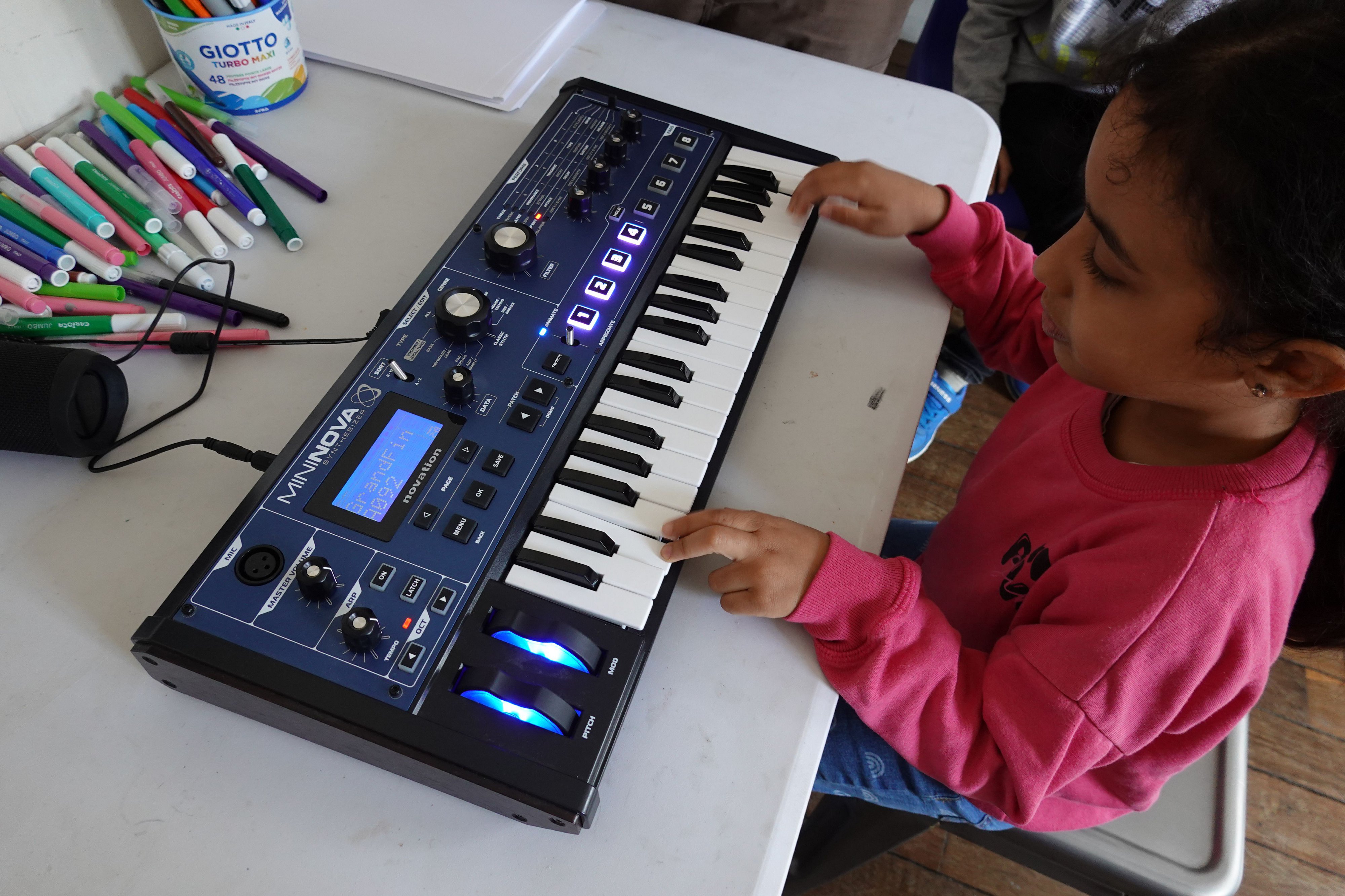
The psychoanalytic concept of the symbolic third party illuminates our failing pedagogical approach. In traditional cultural mediation, the relationship is often dual: a knower transmits to a learner in an implicit but omnipresent hierarchy. The symbolic third party introduces a mediating object that allows an authentic encounter. This object, drone, camera, microphone, table with papers and scissors, becomes the support for autonomous experiences that each can appropriate differently. The relationship is no longer vertical but triangular, each participant developing their own relationship to the object before sharing their experience with others.
I experimented with this approach in a neighborhood undergoing urban renovation for example. I arrive with a drone, I take it off in the middle of the housing project. In three minutes, fifteen young people are there. The first one who takes the controls sends it crashing into a wall. I know it can be repaired, and anyway, I have a second one. We repair it together. The young people film their neighborhood from the sky, discover their environment from an unprecedented angle, record sound commentary. Films are born from these explorations, sometimes technically clumsy but strikingly authentic.
This trust granted generates remarkable responsibility in return. I speak of “governing for the 3%”: this tendency to create complex security systems to guard against a tiny minority of problematic behaviors, to the detriment of the 97% who only ask to participate. Entrusting a 200-euro camera to a young person from a working-class neighborhood without guarantee of return, accepting that a drone breaks, letting participants completely transform the initial project: these calculated risks build authentic relationships and projects rooted in trust.
TikTok and artificial intelligence: tools for creative democratization
TikTok is not the dangerous monster we imagine. With 95 minutes of average use per day among young people, it has become the main social network. The average age is 27, and its main use is educational, not school education, but learning in the broad sense. The algorithm offers remarkable diversity, far from the filter bubble we imagine. And above all, it’s the only social network that allows immediate creation: film, edit, add filters by pressing a button. Trends are creative palimpsests where everyone reinterprets in their own way. When Jean-Luc Godard described the ideal tool for audiovisual creation and distribution, we now have it: it’s TikTok.
Artificial intelligence, far from being diabolical, is an accessible creation tool. At the Centre Pompidou, in the Studio 13/16 space, I set up workshops where young people create complete films in free time. They write scripts, generate images with AI, animate them with CapCut directly on their phone. I replicated this workshop for 350 young people from the TUMO school at the Forum des images, who participated in 2.5-hour workshops, producing 200 films on the theme of the future of artificial intelligence. AI is a major ecological catastrophe, certainly, but it’s also absolutely wonderful in terms of democratization. We gain skills we didn’t have, especially for young people stigmatized by spelling: they can finally send emails without mistakes, be less excluded.
At the Museum of the Great War in Meaux, a workshop on sport during the First World War takes on unexpected scope. The setup is simple: a table, reproductions of archives to cut out, glue, paper. The initial idea of twelve collective tableaux explodes: eighty tableaux are produced, each telling a unique story. Young people create, photograph, project, add music played on site. The supervisors end up sitting down and creating their own collages, abolishing the boundary between supervisors and participants.
Creative autonomy as an engine of transformation
In my interventions, I show how simple tools can produce professional results. An IPEVO VZR camera at 280 euros connected directly to a projector, without a computer: participants draw rockets, houses, flowers that they project on the walls. The wonder is palpable when the drawings come alive, deform according to angles. The simplicity of the device contrasts with the effect produced. A Fifine K670 microphone at 38 euros passes from hand to hand, each person whispering a secret. In a few minutes, a collective podcast exists, accessible via QR code right after the workshop. The sound quality surprises participants used to associating quality with high price.
This “low-cost” approach reveals its political dimension: it’s not simply about saving money but about making creation tools truly accessible. When a young person discovers they can make quality films with their phone and a free app, that a forty-euro microphone allows recording professional podcasts, that a small projector transforms any wall into a cinema screen, their whole relationship to creation changes. Pico-projectors at 300 lumens allow transforming the street into a cinema. At the War on Screen festival in Châlons-en-Champagne, high school students guide 150 spectators in a nocturnal wandering where they project their creations on ecology, an evening included in the festival’s official program.
In a so-called sensitive neighborhood, a community center had organized workshops but no young person had registered. Instead of canceling, I go out with my pico-projector and project Georges Méliès’ “A Trip to the Moon” on a low wall. Children approach, ask for Aya Nakamura. The next day, they return with their parents. The planned workshop transforms into a spontaneous meeting where roles are reversed: it’s the young people who educate me about their musical culture while discovering the origins of cinema.
Documentation and memory: essential traces
The question of documentation runs through all my reflection. In a context where cultural projects disappear without leaving traces, where websites are redesigned erasing years of history, where videos are delegated to YouTube at the risk of disappearing, the preservation of memory becomes a major issue. I advocate for cultural actors themselves to take back control of this heritage dimension, using their own servers as permanent spaces for preservation and sharing.
Documenting processes, not just sharing results, changes everything. Entrusting young people with taking photos, keeping a logbook: during restitution, we present the process AND the result, which “relaxes” everyone and makes everyone an actor, raising awareness of the paths taken. The artist is no longer judged on the final quality of production but on the richness of the journey. For young people too, this documentation helps them identify the value of the path they’ve taken. Bernard Stiegler spoke of “equipped memory”: we have the result but without documentation of the process, we no longer remember the steps taken.
The importance of the facilitator’s own participation constitutes a central pedagogical principle. I never just observe or give instructions: I draw, film, record with the participants. This personal involvement abolishes hierarchical distance and creates the conditions for a genuine encounter. When mediators at the Museum of Mankind create their own paper cut-out animation films alongside visitors, the relational quality is radically transformed. Albert Jacquard recounted this experience where a class of dunces, moved to another establishment and presented as excellent, saw half of its students actually become excellent. This question of the attribution we make to young people is fundamental.
Radically rethinking cultural institutions
Cultural institutions on social networks generally get it wrong. They try to invest these spaces with classic top-down communication and systematically fail. Institutional accounts accumulate content seen by a handful of people, usually colleagues. The fundamental problem is that social networks operate on disintermediation and direct relationships between people, while institutions seek to maintain their overarching position.
The solution is radical: rather than producing content for social networks, institutions should facilitate the creation of content by young people themselves. Provide a filming studio in the theater lobby, offer technical support to improve the quality of productions, provide copyright-free images and sounds that creators can appropriate. In some festivals, hundreds of small videos are created during workshops but participants struggle to retrieve their creations - that’s the real problem to solve.
This transformation requires humility, flexibility and genuine curiosity about others’ cultures. It implies accepting that our cultural references are not universal, that our institutional legitimacy doesn’t automatically make us right, that young people’s cultural practices have intrinsic value that deserves respect and interest. As professionals who experiment with this approach discover, when you’ve really tasted creative autonomy, you can no longer think of cultural mediation in the same way. In an era marked by social fractures and generational misunderstandings, these modest but transformative experiences open paths to rebuild the common around shared creation.
Summary of the day by the Ministry of Culture team
Cultural diversity and knowledge transmission - Review of module 2 of the 25-26 Session of CHEC
The task of closing this day fell to the working group “Young adult culture, what generational shifts in practices?” from the 24-25 session of CHEC, alongside filmmaker and consultant in cultural innovation and digital strategies Benoît Labourdette. The group reviewed the main conclusions and recommendations of its report (to be discovered in January 2026 on the Ministry’s website) — shift from a supply-based policy to a demand-based policy, consideration and trust towards young people who must be involved in the programming and supervision of cultural events — which resonated with Benoît Labourdette’s reflections from his field encounters with young people. For him, it is now a matter for artist-teachers to accept valuing the process by removing the requirement for results and positioning themselves no longer as leaders but as collaborators alongside learners.
A fine conclusion to this module intended to inspire participants in their reflection on better ways to transmit and promote tomorrow’s cultural expressions.

Drawing on Benoît Labourdette’s 30 years of experience in the field of cultural innovation and his research and methodological work, the Benoît Labourdette production agency supports cultural policies in their need for innovation, better encounters with populations, use of digital tools and cooperation, definition of mediation strategies, and support for artistic teams, technicians and elected representatives. Our method is always based on collective intelligence, cooperation and empowerment of people and structures. We work with cities and other local authorities, national networks, institutions and associations.
-

Creating to think
A French-Finnish meeting at L’Alhambra in Marseille on 4 May 2026, as part of the Erasmus+ Visual Thinkers project.
On 4 May 2026, I facilitated a professional meeting at L’Alhambra in Marseille, organised by the Image Clé association as part of the European (…) -

The Book Archipelago
A proposal to elected representatives: making plural bookshops the backbone of territorial cultural policies.
Faced with the tensions running through the bookshop sector today, it is time to put an end to the sanctuary myth. Rather than seeking an (…) -

The photography workshop: creating, showing, looking together
Reflections on a hands-on workshop facilitated by Benoît Labourdette at the professional conference “Cinema, images and young people’s mental health”, held on 14 April 2026 in Romainville, France.
A workshop in nine small groups, fifteen minutes to produce a photograph, then a moment of collective viewing in which the authors remain silent (…) -

« Mental Health and Cinema »
Synthesis of the day “Young people, their images, their spaces: new paradigms” (14 April 2026)
Synthesis of a day of professional gatherings at the Le Trianon cinema in Romainville, bringing together the perspectives of professionals from (…) -

Mental health, young people, images: what are we talking about?
Text of Benoît Labourdette’s opening talk at the professional meetings held on 14 April 2026.
Before entering into projects, we need to pin down the words. Mental health, young people, images: three notions we often use together without (…) -

Transmitting cultural rights: a question of coherence
What facilitation methods reveal about our relationship with people.
How can we talk about cultural democracy within an authoritarian framework? How can we defend respect for each person’s culture while imposing a (…) -

Mental Health and Cinema - Experiencing the World Through Images
Two professional conferences in Romainville (April 14 and 15, 2026).
On April 14 and 15, 2026, ACRIF, as part of its coordination mission for Passeurs d’images in Île-de-France, is organizing two days of (…) -

Collaborative assessment of screen literacy education in Nouvelle-Aquitaine
Collective intelligence methodology, digital platform, and collaborative publication for ALCA (2026).
ALCA, Agence Livre, Cinéma et Audiovisuel en Nouvelle-Aquitaine, entrusted me with the methodological support for a collaborative assessment of (…) -

Media Literacy: Should We Judge or Guide?
Reflections based on the National Meeting of Regional Centers for Media Literacy (Rouen, March 16–17, 2026).
On 16 and 17 March 2026, Normandie Images organised in Rouen the national meeting of France’s regional image education centres (pôles régionaux (…) -

The Meaning of Mediation Methods in Arts and Cultural Education
When practice reveals what theory ignores.
Artists and professionals involved in arts education develop singular methods that most often remain implicit. I wish to lift the veil on the (…) -

Cultural Mediation as a Device for Symbolic Emancipation
Methodological Principles for a Horizontal Approach to Collective Creation.
Lived experience radically transforms our relationship to thought. Cultural mediation does not consist of transmitting knowledge but of creating (…) -

Evaluating Arts and Cultural Education from the Artist’s Perspective
Review of a course given at INSEAC: conceptual and methodological tools for cultural professionals.
On January 15, 2026, as part of the CNAM module EAC104 “Building tools to evaluate ACE projects: qualitative and quantitative survey methodologies (…) -

Developing Psychosocial Skills Through Artistic Practices
Methodological principles for an experiential approach.
Psychosocial skills (PSS) are now at the heart of public health, education, and child protection policies. The 2023-2027 intersectoral roadmap, (…) -

When thirty-five professionals discover their psychosocial skills through creative experience
A look back at the interprofessional seminar of January 12, 2026, in Limoges: a day where theory gave way to lived experience.
At the DRAC Nouvelle-Aquitaine, educators, teachers, caregivers, and cultural actors experienced together what it truly means to develop (…) -

Image Education and Citizenship: When Youth Professionals Rethink Their Practices
{{Reflections on the “Out-of-School Time” professional day that I co-designed with ALCA and the Gironde Departmental Council.}}
On December 2, 2025, around a hundred youth, animation, and culture professionals gathered at the MECA auditorium in Bordeaux to explore together (…) -

Art and Culture in the Service of Psychosocial Skills
Account of a founding seminar for professionals of the Judicial Protection of Youth in Limousin.
On November 27, 2025, the Limousin Regional Directorate of PJJ brought together its teams for a half-day of collective reflection on psychosocial (…) -

Youth and culture: for a radical change in posture
Giving young people the power to create, not just consume culture.
How can cultural institutions break out of their chronic failure with young people? By abandoning condescension to embrace a genuine cultural (…) -

Reinventing youth reception in cinemas
Remote training for cinema operators in Lot-et-Garonne.
How can we transform our cinemas into spaces for authentic encounters with 15-25 year-olds? This question guided an intense training session with (…) -

“Participatory creation as a laboratory for democracy?”
4th edition of the biennial festival of participatory creation - Les Rencontres de la Poudrerie - Théâtre des habitants - May 16 & 17, 2025.
Les Rencontres de la Poudrerie are a moment for reflection and co-construction, at the intersection of art forms and the practice of social life. (…) -

Pour une robustesse coopérative des projets culturels
Réflexion sur les modalités de coopération territoriale et d’évaluation.
Pour que les projets culturels puissent trouver pleinement leur sens social et devenir plus robustes face aux attaques politiques qui les jugent « (…) -

Design of a professional day on “Artistic and digital practices for young people”
Act’art, artistic and cultural action in Seine-et-Marne.
As part of its mission to promote collective intelligence by facilitating local think tanks, Act’art asked Benoît Labourdette to design, (…) -

OPC Media: “What if we changed our posture?”
How can we learn to consider the richness of teenage digital practices and avoid giving in to preconceived ideas?
How can we learn to consider the richness of teenagers’ digital practices and not give in to preconceived ideas? For Benoît Labourdette, if we (…) -

Itinéraire bis, the path of cultural rights
Action research conducted by the MPAA (Paris).
Accompaniment in the animation, production of traces and fabrication of the web platform resources of the research-action “Itinéraire bis, chemin (…) -

Helping young people and professionals to speak out: “Cultures and youth policies” national meeting
Observatory of Cultural Policies / Villeurbanne (TNP, May 11 & 12, 2023).
As part of the Rencontres nationales “Cultures et politiques de la jeunesse” (“Cultures and youth policies”), which brought the year of the French (…) -

"Culture, youth and digital: designing new modalities for cultural and educational projects
Sharing of methodological tracks and professional training.
Deconstructing preconceived ideas about digital transformation and developing projects adapted to young people.The cultural offer is sometimes (…) -

“Media College” platform for Périfééries
Creation of a digital collective intelligence tool.
To meet a need for creative, intellectual emulation and the production of ideas for one of the axes of the Saint-Denis (93) city’s bid for the (…) -

Giant digital brainstorming
Design and implementation of a digital collective intelligence tool.
Method of activating a vast contribution for the axes of a cultural project. The needIn the solidarity I had with the city of Saint-Denis’ bid (…) -

The Périfééries project’s heritage council of influence
Facilitating collective intelligence in a short space of time.
As part of Saint-Denis’s bid to become European Capital of Culture 2028, I led a collective intelligence session to collect proposals on the (…) -

Reinventing cultural projects with youth?
Proposal of questions.
While public cultural action aims to reach people in their great diversity, it is clear that it is often difficult to mobilize youth. However, (…)


-

“On the ineffectiveness of our works in real life”. Commentary on the text by Eva Doumbia & Kader Attia (2023).
In July 2023, visual artist Kader Attia and director Eva Doumba published a text (in Analyse Opinion Critique) in response to the youth “riots” (…) -
Reinventing youth reception in cinemas Remote training for cinema operators in Lot-et-Garonne.
How can we transform our cinemas into spaces for authentic encounters with 15-25 year-olds? This question guided an intense training session with (…) -
OPC Media: “What if we changed our posture?” How can we learn to consider the richness of teenage digital practices and avoid giving in to preconceived ideas?
How can we learn to consider the richness of teenagers’ digital practices and not give in to preconceived ideas? For Benoît Labourdette, if we (…) -

OPC: “Culture, youth and digital” training Designing new modalities for cultural and educational projects. March 2022.
A new concept of internship for cultural professionals, in order to build an opening to the public who have deserted the public and associative (…) -

“Territorial approach, participation, youth and digital technology”: interview of Benoît Labourdette by Serge Saada (52’, 2021) Observatory of cultural mediation in the social field.
As part of the Observatory of cultural mediation in the social field, Serge Saada interviewed Benoît Labourdette on the impact of the (…)
