Reinventing youth reception in cinemas
How can we transform our cinemas into spaces for authentic encounters with 15-25 year-olds? This question guided an intense training session with professionals brought together by the Ligue de l’enseignement of Lot-et-Garonne.
A pedagogical architecture designed for distance learning
On October 14, 2025, I facilitated a training and exchange session for the Ligue de l’Enseignement of Lot-et-Garonne, bringing together mediators, cinema directors and cultural managers from the nine independent cinemas in the department. The videoconference setup, far from being a budgetary compromise, proved particularly suitable and was itself a space for experimentation. I structured these three hours into three distinct periods of approximately fifty minutes each, interspersed with active breaks where participants synthesized their reflections on paper before sharing them via QR code in a collaborative digital space, so that their contributions would be materialized and shaped by themselves.
This method concretely illustrated the approach I was advocating: rather than passively receiving top-down knowledge, participants became co-constructors of the moment. Everyone could express their synthesis, controversies and contributions. The digital tool used was not dependent on GAFAM, a detail that matters when working on young people’s digital practices. This pedagogical architecture allowed for direct experience of what we were exploring theoretically: how to create the conditions for authentic participation?
The context motivating this meeting was to deal with current challenges. As mentioned in the preparatory text co-written with Davina Brunot (coordinator of Ligue de l’enseignement 47), multiplexes capture attention with their YouTube partnerships or e-sports broadcasts (Inoxtag’s documentary on Everest achieved 340,000 admissions for MK2). But the independent cinemas of Lot-et-Garonne, often single-screen, have neither these means nor these commercial objectives. How can they “restore meaning to a cultural cinema experience for young people”? This question requires, in my opinion, rethinking our thought patterns, understanding the place from which we speak, as our initial text emphasized.
Cultural rights as a revolution of perspective
I opened the training with a participatory exercise: about ten questions answered by standing up or remaining seated. “Who has teenage children?”, “Who thinks social networks are dangerous?”, “Who has the TikTok app?”. This playful exercise immediately revealed the diversity of positions and created that sense of community necessary for all learning. It also identified everyone’s biases and representations, notably this tendency to consider certain cultural practices as intrinsically inferior.
I then introduced the concept of cultural rights, enshrined in French law since 2015-2016 but still too little known in the field. This approach, derived from the 2007 Fribourg Declaration, invites us to consider culture in its anthropological sense. It’s no longer just about the “great works of humanity” dear to Malraux, but everything that constitutes us: language, practices, references, modes of expression. Respecting young people’s cultural rights means recognizing the social value of their own culture so they can then contribute to the collective space. If their culture is not recognized, they cannot contribute because they don’t feel legitimate; and even in their own eyes, their own culture may seem illegitimate. Cultural rights aim to respect human dignity.
The example I gave particularly resonated I believe: young people arrive noisily in a cinema, brought by their teacher. If they are scolded by the reception staff and their teacher, we can say their cultural rights have not been respected! Rather than stigmatizing them, cultural rights invite us to understand that they may not have been accompanied in appropriating the codes of this space. A teacher confided to me that some young people think “cinemas are just for teachers”. This reading grid transforms our posture: we move from cultural democratization, top-down, from the knower to the ignorant, to cultural democracy, horizontal, where everyone enriches the other. It’s not relativism where everything is equal, but recognition that the other can transform us, make us evolve in our knowledge and representations.
TikTok and cognitive resistance: understanding without judging
I devoted time to analyzing digital practices, particularly TikTok. I know this network crystallizes fears, but I wanted to show another facet. TikTok natively integrates ultra-sophisticated and accessible shooting and editing tools, it’s the only social network that does this. By pressing a button, you access a complete audiovisual creation suite. This democratization recalls Jean-Luc Godard’s utopias, who dreamed of a cinema where everyone could “make films as they want, share them with friends”. I’ve even observed cinema screenings organized live on TikTok, where hundreds of people watch a Louis de Funès film together for example while commenting on it, a spontaneous reinvention of the collective experience.
Olivier Houdé’s work on cognitive resistance illuminates our relationship with young people. To learn or receive something new, you must be able to resist your thought reflexes, which requires a feeling of absolute trust. If I feel in danger, if I’m afraid of being judged, my brain activates reflex-thinking and blocks all learning. Young people suffer a lot of stigmatization, I showed participants Salomé Saqué’s book “Be Young and Shut Up” recalling that Hesiod in 720 BC already deplored an “unbearable, unrestrained” youth. Constant stigmatization blocks their learning process, at the neurological level.
Alice Miller, in her work on “the roots of violence in child education” (For Your Own Good, 1984), shows how suffered violence creates a violent society. France only banned ordinary educational violence in November 2022, we are the last European country to have done so... This violence, physical or symbolic, “completely derails people”. In our cinemas, we must create spaces of absolute trust, without judgment, so that encounters can happen and everyone leaves enriched.
The symbolic third party: overcoming the dual relationship
The psychoanalytic concept of the symbolic third party, which I introduced at the end of the first hour, offers an essential methodological key in my opinion. In a dual mediator-youth relationship, we easily fall into relations of domination, defensive authoritarianism. The symbolic third party, an object, a project, a common creation, allows the relationship to be displaced. I told about my experience in Choisy-le-Roi, in an urban renewal housing project. The young people had no reason to be interested in my proposal to film their neighborhood, why would they trust this parachuted artist?
I took out a drone in the middle of the housing project. In five minutes, fifteen teenagers surrounded me. “Do you want to pilot it?” The remote control changed hands, the drone crashed against a wall, we repaired it together. The emotion was palpable, because piloting a drone is emotionally very powerful. We had met around this object, creating the conditions for real collaboration. Some young people only spent an hour, others came back several days. The third object had allowed the encounter without anyone losing face.
This approach transforms our relationship to mediation. In Bordeaux, just last Saturday, I was facilitating a paper cut-out animation workshop on natural risk prevention. The large table with materials becomes the third object around which we meet, cooperate, dialogue. Autonomy becomes possible because the technique is simple and shared. It’s no longer “do this, do that” but a common exploration. And the mediators working with me had instructions to also make films themselves, not to be in a waiting posture, but in a creative posture too, which horizontalizes relationships: cultural democracy.
A proliferation of local initiatives
The second hour was planned to report on rich innovative experiences carried out in the territory. We had carefully prepared it, so that this moment would be rich, dense and lively, and that everyone had prepared a quick and complete synthesis. I noted everything that was said in mind mapping, creating a living cartography of initiatives. Vincent facilitates “Pocket Films” workshops where 90 young people per morning remake sequences with their smartphones. His other project, machinimas, transposes sweding into the Sims universe, a hybridization between cinema and video games. Arnaud begins his interventions by confiding to students that “life is not a straight line”, immediately creating complicity. His “Filming Work” project produces documentaries over an entire year, with young people writing directly in front of the screen, discussing each evolution.
Savannah organizes marathon “Halloween Nights” from 5pm to 3am, mixing screenings and werewolf games, as well as monthly Mario Kart tournaments. Alice explores cinema/video game bridges and runs a film club where young people program themselves. Théo from Le Plaza cinema in Marmande created a group of ambassadors, only high school girls, who actively participate in the cinema’s life. Laura raised a fundamental question: young people want to be considered as adults, with real technical means, not just phones. “They want to make real films with ambition, not ’little things’.”
These experiences reveal a simple but essential truth, which a participant formulated thus: “The fact of practicing sharpens their gaze.” This observation joins experiential learning theories: we better understand what we have experienced ourselves. The cinema becomes a laboratory, an experimentation space where young people are no longer just spectators but creators, programmers, mediators.
Towards an anthropological transformation
The third hour allowed us to deepen the implications of this paradigm shift. Today’s young people are no longer just spectators in their lives. With social networks, they can produce content. Whether they do it or not, they know it, and this awareness transforms their relationship to media. The cinema can no longer be conceived as at the time of its invention, when it was the only place for animated images. Its function necessarily becomes multiple, diversified.
Camille Peugny’s work, in his book “For a Youth Policy” (2022), confirms that there is no homogeneous youth culture. The diversity of tastes among 15-25 year-olds is immense. What unites them is rather a shared anxiety about the future - social, climatic, professional. This fragility, accentuated by the Covid period, forces us to rethink our support. Tastes formed around 15 tend to persist until 65, where there is a change.
I also mentioned my other experiences: the Pocket Films festival created in 2005 with the Forum des images, virtual reality projects, itinerant screenings. The lightness of modern equipment opens up possibilities unthinkable with traditional techniques. These “unexpected interventions in public space” reach audiences who would never come to a cinema, creating links in unexpected contexts.
A commons built together
This training, through its participatory format and three-stage progression, created the conditions for collective trust. Participants left not with ready-made recipes, but with a renewed understanding of the issues. The digital sharing space remains accessible, containing their syntheses, controversies and contributions, as well as the mind mapping and documentary resources. This is not simple archiving but a living commons that can continue to be enriched.
The dominant feeling at the end was having lived together what we advocated: a participatory experience where everyone contributes from their position, their knowledge, their questions. We had experienced cultural democracy, not just talked about it. The independent cinemas of Lot-et-Garonne face challenges, but they also have unique assets: their territorial anchoring, their programming freedom, their ability to create intimate spaces for encounters.
The issue is not to transform all cinemas into digital spaces or to mimic multiplex strategies. It’s about recognizing that the cinematic experience has diversified, that young people arrive with new skills and expectations. Our spaces can become these “places of experience” mentioned in our initial text, spaces where “an action, a gesture, a culture, identities, communities, and therefore, always, an intention, a ’going towards’, or even better an encounter” occur. This training will have been, I hope, the beginning of this transformation for the cinemas of Lot-et-Garonne.
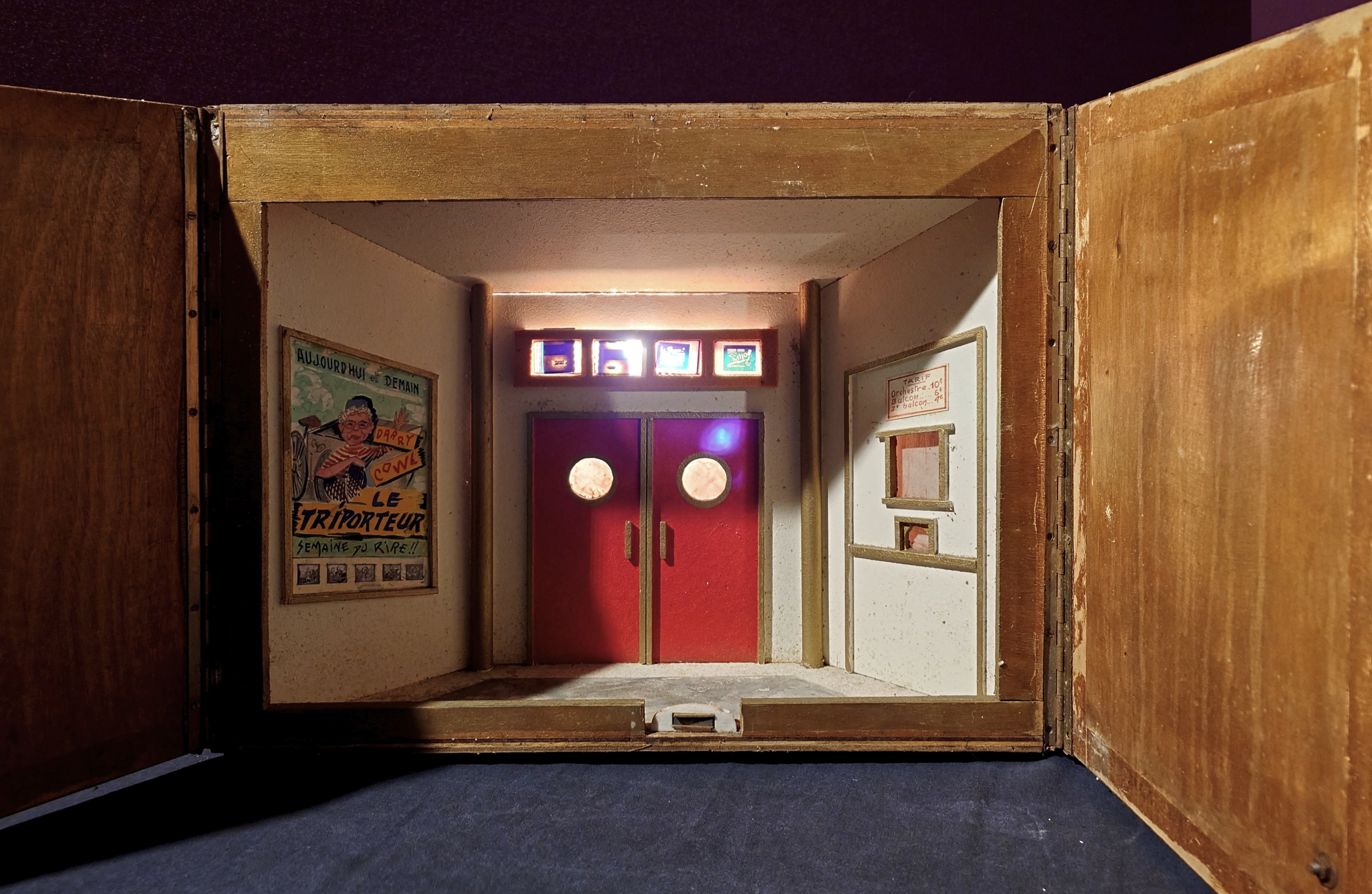
(photograph: model of a cinema entrance made as a child by Bruno Bouchard with his grandfather)
Basic text of the meeting
Co-written by Davina Brunot and Benoît Labourdette.
New content for a younger audience: what strategy for Art et Essai cinemas in Lot et Garonne?
In May 2023, the cinema operator MK2 announced a collaboration with the YouTube platform, with the creation of a YouTube Ciné Club label, to program several previews of videos created by YouTubers over the coming year. For example, Kaizen, the documentary made by Inoxtag about his ascent of Everest, allowed the operator to achieve more than 340,000 admissions. The previous year, in 2022, the CGR network had already announced a major change in its programming strategy by integrating, in addition to previews of content targeted at young audiences, live broadcasts of major e-sports events.
The ambition of these operators is clear: not to remain on the margins of new social phenomena concerning video content and trends, and to take advantage of the notoriety of certain creators or practices in order to rejuvenate the average age of cinema attendance, as the 15-25 age group is increasingly difficult to attract, especially since the rise of platforms like Netflix, Amazon Prime or even TikTok.
But this dynamic, highlighted in the media, is driven by private cinema chains that are characterized, among other things, by their multiplex structure, their operational and financial power, and their strategy focused on profitability and not always on cultural interest. But what about independent, associative cinemas, often modest in size (single-screen theaters are common in this category), which do not have the same objectives, and which cannot compete with these private networks and the means (both technical and economic) at their disposal, and which nevertheless find themselves confronted with the same question: how to attract young people to cinemas? But above all: how to restore meaning to a cultural experience in the cinema for young people? Indeed, so-called “local” cinemas, often classified as Art & Essai, are on the front line facing the aging of their spectators and, ultimately, the fall in their attendance levels.
In order to find possibilities for action, we must first question our own modes of operation, and first of all, our patterns of thinking and understanding of this multiple audience that constitutes “young people”. For caught in biases that channel our reasoning, we often lack perspective on our own situation, we lose sight of the place from which we think.
Similarly, before questioning programming choices and the possible editorial line of a cinema, would it be relevant to rethink the cinema first as a portion of space to invest, but also sometimes precisely to disinvest or shift, thus creating a breathing space and making possible the emergence, novelty, invention, cooperation with young people, essential to any renewal. For we know that a cinema is never neutral but always already connoted, marked, (r)attached, “understood as”. This approach would make it possible to understand what makes the cinema no longer simply as a space but as a place of experience, if we consider the place as a space invested with movement, a space in which an action, a gesture, a culture, identities, communities occur, and therefore, always, an intention, a “going towards”, or even better an encounter.
This training session, offered by the Ligue and led by Benoît Labourdette, a specialist in new content, should first of all enable reflection to begin, but connected to the reality of the cinemas, the people who run them and their way of operating. It is also about learning about innovations initiated in certain cinemas, sharing projects that have been completed, in progress, as well as impulses or intuitions for the future. Finally, it is about outlining the possibility of levers for Art et Essai cinemas in the territory, within their framework and constraints, so that they can become, for 15-25 year olds, an object of both geographical and cultural desire.

Drawing on Benoît Labourdette’s 30 years of experience in the field of cultural innovation and his research and methodological work, the Benoît Labourdette production agency supports cultural policies in their need for innovation, better encounters with populations, use of digital tools and cooperation, definition of mediation strategies, and support for artistic teams, technicians and elected representatives. Our method is always based on collective intelligence, cooperation and empowerment of people and structures. We work with cities and other local authorities, national networks, institutions and associations.
-

Creating to think
A French-Finnish meeting at L’Alhambra in Marseille on 4 May 2026, as part of the Erasmus+ Visual Thinkers project.
On 4 May 2026, I facilitated a professional meeting at L’Alhambra in Marseille, organised by the Image Clé association as part of the European (…) -

The Book Archipelago
A proposal to elected representatives: making plural bookshops the backbone of territorial cultural policies.
Faced with the tensions running through the bookshop sector today, it is time to put an end to the sanctuary myth. Rather than seeking an (…) -

The photography workshop: creating, showing, looking together
Reflections on a hands-on workshop facilitated by Benoît Labourdette at the professional conference “Cinema, images and young people’s mental health”, held on 14 April 2026 in Romainville, France.
A workshop in nine small groups, fifteen minutes to produce a photograph, then a moment of collective viewing in which the authors remain silent (…) -

« Mental Health and Cinema »
Synthesis of the day “Young people, their images, their spaces: new paradigms” (14 April 2026)
Synthesis of a day of professional gatherings at the Le Trianon cinema in Romainville, bringing together the perspectives of professionals from (…) -

Mental health, young people, images: what are we talking about?
Text of Benoît Labourdette’s opening talk at the professional meetings held on 14 April 2026.
Before entering into projects, we need to pin down the words. Mental health, young people, images: three notions we often use together without (…) -

Transmitting cultural rights: a question of coherence
What facilitation methods reveal about our relationship with people.
How can we talk about cultural democracy within an authoritarian framework? How can we defend respect for each person’s culture while imposing a (…) -

Mental Health and Cinema - Experiencing the World Through Images
Two professional conferences in Romainville (April 14 and 15, 2026).
On April 14 and 15, 2026, ACRIF, as part of its coordination mission for Passeurs d’images in Île-de-France, is organizing two days of (…) -

Collaborative assessment of screen literacy education in Nouvelle-Aquitaine
Collective intelligence methodology, digital platform, and collaborative publication for ALCA (2026).
ALCA, Agence Livre, Cinéma et Audiovisuel en Nouvelle-Aquitaine, entrusted me with the methodological support for a collaborative assessment of (…) -

Media Literacy: Should We Judge or Guide?
Reflections based on the National Meeting of Regional Centers for Media Literacy (Rouen, March 16–17, 2026).
On 16 and 17 March 2026, Normandie Images organised in Rouen the national meeting of France’s regional image education centres (pôles régionaux (…) -

The Meaning of Mediation Methods in Arts and Cultural Education
When practice reveals what theory ignores.
Artists and professionals involved in arts education develop singular methods that most often remain implicit. I wish to lift the veil on the (…) -

Cultural Mediation as a Device for Symbolic Emancipation
Methodological Principles for a Horizontal Approach to Collective Creation.
Lived experience radically transforms our relationship to thought. Cultural mediation does not consist of transmitting knowledge but of creating (…) -

Evaluating Arts and Cultural Education from the Artist’s Perspective
Review of a course given at INSEAC: conceptual and methodological tools for cultural professionals.
On January 15, 2026, as part of the CNAM module EAC104 “Building tools to evaluate ACE projects: qualitative and quantitative survey methodologies (…) -

Developing Psychosocial Skills Through Artistic Practices
Methodological principles for an experiential approach.
Psychosocial skills (PSS) are now at the heart of public health, education, and child protection policies. The 2023-2027 intersectoral roadmap, (…) -

When thirty-five professionals discover their psychosocial skills through creative experience
A look back at the interprofessional seminar of January 12, 2026, in Limoges: a day where theory gave way to lived experience.
At the DRAC Nouvelle-Aquitaine, educators, teachers, caregivers, and cultural actors experienced together what it truly means to develop (…) -

Image Education and Citizenship: When Youth Professionals Rethink Their Practices
{{Reflections on the “Out-of-School Time” professional day that I co-designed with ALCA and the Gironde Departmental Council.}}
On December 2, 2025, around a hundred youth, animation, and culture professionals gathered at the MECA auditorium in Bordeaux to explore together (…) -

Art and Culture in the Service of Psychosocial Skills
Account of a founding seminar for professionals of the Judicial Protection of Youth in Limousin.
On November 27, 2025, the Limousin Regional Directorate of PJJ brought together its teams for a half-day of collective reflection on psychosocial (…) -

Youth and culture: for a radical change in posture
Giving young people the power to create, not just consume culture.
How can cultural institutions break out of their chronic failure with young people? By abandoning condescension to embrace a genuine cultural (…) -

Reinventing youth reception in cinemas
Remote training for cinema operators in Lot-et-Garonne.
How can we transform our cinemas into spaces for authentic encounters with 15-25 year-olds? This question guided an intense training session with (…) -

“Participatory creation as a laboratory for democracy?”
4th edition of the biennial festival of participatory creation - Les Rencontres de la Poudrerie - Théâtre des habitants - May 16 & 17, 2025.
Les Rencontres de la Poudrerie are a moment for reflection and co-construction, at the intersection of art forms and the practice of social life. (…) -

Pour une robustesse coopérative des projets culturels
Réflexion sur les modalités de coopération territoriale et d’évaluation.
Pour que les projets culturels puissent trouver pleinement leur sens social et devenir plus robustes face aux attaques politiques qui les jugent « (…) -

Design of a professional day on “Artistic and digital practices for young people”
Act’art, artistic and cultural action in Seine-et-Marne.
As part of its mission to promote collective intelligence by facilitating local think tanks, Act’art asked Benoît Labourdette to design, (…) -

OPC Media: “What if we changed our posture?”
How can we learn to consider the richness of teenage digital practices and avoid giving in to preconceived ideas?
How can we learn to consider the richness of teenagers’ digital practices and not give in to preconceived ideas? For Benoît Labourdette, if we (…) -

Itinéraire bis, the path of cultural rights
Action research conducted by the MPAA (Paris).
Accompaniment in the animation, production of traces and fabrication of the web platform resources of the research-action “Itinéraire bis, chemin (…) -

Helping young people and professionals to speak out: “Cultures and youth policies” national meeting
Observatory of Cultural Policies / Villeurbanne (TNP, May 11 & 12, 2023).
As part of the Rencontres nationales “Cultures et politiques de la jeunesse” (“Cultures and youth policies”), which brought the year of the French (…) -

"Culture, youth and digital: designing new modalities for cultural and educational projects
Sharing of methodological tracks and professional training.
Deconstructing preconceived ideas about digital transformation and developing projects adapted to young people.The cultural offer is sometimes (…) -

“Media College” platform for Périfééries
Creation of a digital collective intelligence tool.
To meet a need for creative, intellectual emulation and the production of ideas for one of the axes of the Saint-Denis (93) city’s bid for the (…) -

Giant digital brainstorming
Design and implementation of a digital collective intelligence tool.
Method of activating a vast contribution for the axes of a cultural project. The needIn the solidarity I had with the city of Saint-Denis’ bid (…) -

The Périfééries project’s heritage council of influence
Facilitating collective intelligence in a short space of time.
As part of Saint-Denis’s bid to become European Capital of Culture 2028, I led a collective intelligence session to collect proposals on the (…) -

Reinventing cultural projects with youth?
Proposal of questions.
While public cultural action aims to reach people in their great diversity, it is clear that it is often difficult to mobilize youth. However, (…)


-

Dilapidation of resources in supply logic For a democratic revolution of cultural practices.
Faced with the crisis in the cultural sector, it is urgent to shift from a top-down supply logic to a culture of connection and listening, (…) -
Youth and culture: for a radical change in posture Giving young people the power to create, not just consume culture.
How can cultural institutions break out of their chronic failure with young people? By abandoning condescension to embrace a genuine cultural (…) -

Piracy: an unknown blessing for the audiovisual sector Legal, historical, technological, economic and political elements.
“Piracy is a danger for creation, infringers must be punished”: this is the commonly accepted discourse, which directs points of view, regulatory (…) -

Creating, thinking and writing screenplays today Guide to screenwriting (free digital book, by Benoît Labourdette).
In our world where artificial intelligences directly create films from the desires of their authors expressed in very few words, in this world (…) -
OPC Media: “What if we changed our posture?” How can we learn to consider the richness of teenage digital practices and avoid giving in to preconceived ideas?
How can we learn to consider the richness of teenagers’ digital practices and not give in to preconceived ideas? For Benoît Labourdette, if we (…)
