Mental health, young people, images: what are we talking about?
Before entering into projects, we need to pin down the words. Mental health, young people, images: three notions we often use together without defining them, and which cover realities far wider than everyday use would suggest.
A jointly built event
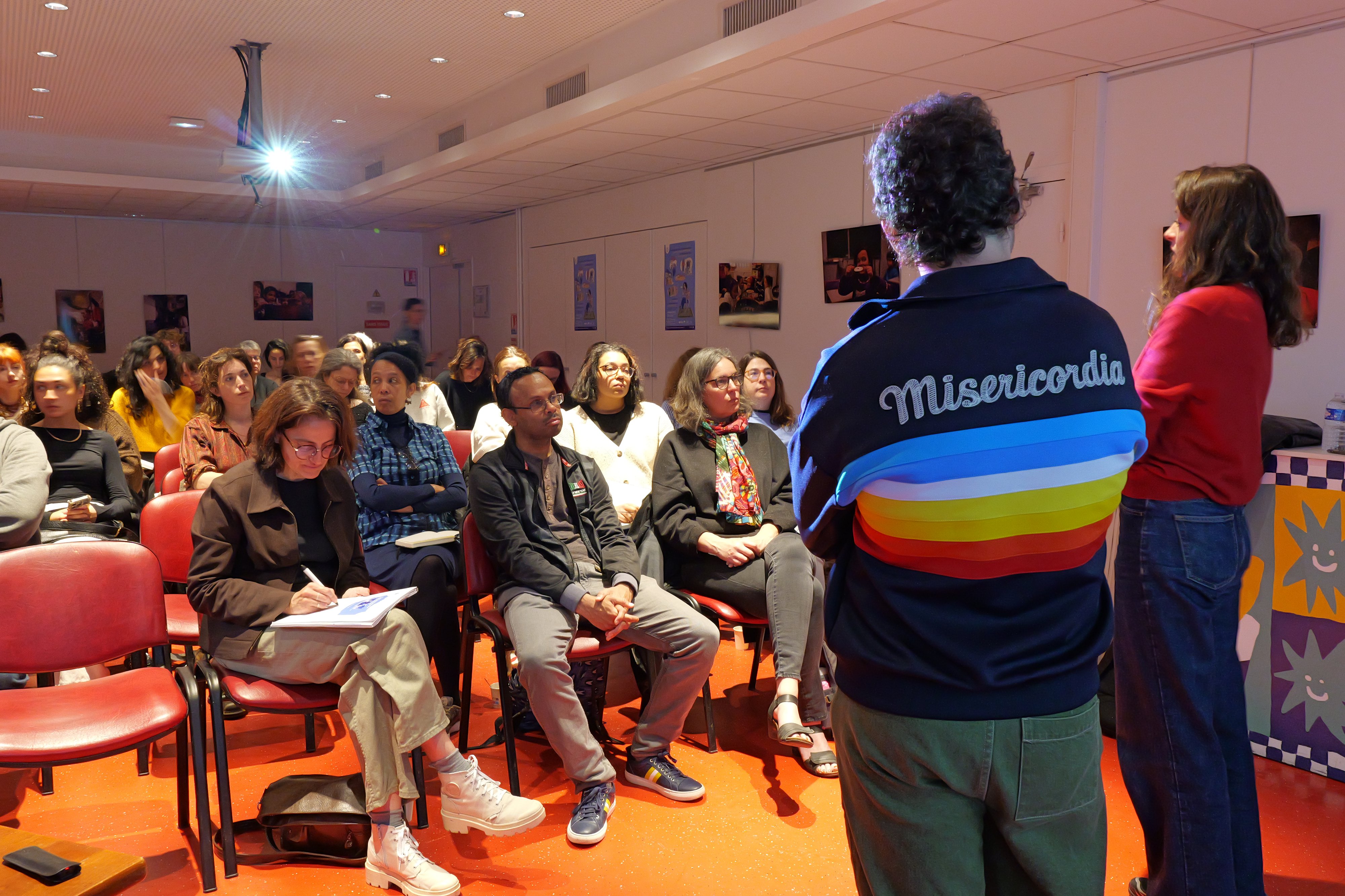
This text is the written, revised version of the talk I gave on 14 April 2026 at the Le Trianon cinema in Romainville, as the opening of the professional meetings “Cinema, images and young people’s mental health”. These two days, on 14 and 15 April 2026, were organised by the ACRIF as part of its coordination mission for Passeurs d’images in the Île-de-France region, with the second day co-organised with Cinémas 93. The initiative for this gathering came from Claudie Le Bissonnais, at that time coordinator of Passeurs d’images Île-de-France. I co-designed the first day with Diane Olivier, who succeeded Claudie in that role, and with Maxime Bouillon, cinema mediator at the ACRIF.
Two other articles on this site complement this one: the presentation of the two days and the summary of the first day. What follows has a simple aim: before entering into practice, pin down the words. Mental health, young people, images. Three notions that cover realities wider than everyday use suggests, and that are worth clarifying, otherwise we quickly end up talking past each other.
A tool to begin with: sit-or-stand questions
Before entering into definitions, I often open with a simple exercise I call “sit-or-stand questions”. The principle is as follows: I ask a series of questions out loud, and each person stands if their answer is yes, stays seated if it is no. It requires no equipment, and the effects are immediate.
First, you can read a group without anyone having had to speak. Within a few questions, you see who comes from which background, which families of practice are represented, where the zones of agreement or doubt lie. Second, it is already a form of expression: you expose yourself to others’ gaze, you reveal something of yourself, but without having to build a sentence or defend a position. For people who do not know each other, it is an accessible entry point.
My questions concerned very concrete things: how did you get here? Are you a parent of a teenager? Is “mental health” a notion you use in your work? Do you know what psychosocial skills are? Who has been to the cinema in the past month? Who is subscribed to Netflix? Who thinks social media are dangerous for teenagers. And so on.
In five minutes, everyone has a sense of who is in the room. The silences that follow are less heavy, and the discussion starts from something concrete. The tool is endlessly adaptable to different contexts and audiences. It was also taken up the following day by the ACRIF team, for the afternoon of the second day, when I was sitting in the audience myself. I was able to experience from within how immediately it brings empathy into the group.
Mental health does not begin where things go wrong
When we hear “mental health”, we spontaneously think of pathologies and of people in need of care. The association is understandable, but it narrows reality considerably. Santé publique France (the French public health agency) distinguishes three spaces, and this distinction is genuinely useful in my work:
- The first space is what is called positive mental health: flourishing, well-being, the capacity to act. We have every right to speak of mental health when talking about people who are doing well. It is a logic of prevention, or, to avoid staying within an overly medical vocabulary, of promoting “getting better”. We can act to feel well, even when we are not particularly unwell.
- The second space is reactive psychological distress: the difficulties linked to life events such as a bereavement, a break-up, violence suffered. They are not necessarily long-lasting, but they have a real impact. For anyone working with audiences, this changes something concrete: when someone is not paying attention in a workshop, it may not be indifference. They may be going through something. This dimension deserves to be taken into account in any relationship of support.
- The third space covers psychiatric disorders that require medical care. This is what we most often mean by “mental health” in everyday language, even though it is only one of the three spaces.
The mental health of institutions
There is one angle we often forget in our sectors: mental health does not concern only individuals. Institutions, too, can be ill. In the field of care, this is a familiar idea. In the cultural field, the question is raised far less often. “Is my organisation working in a healthy way?” is nonetheless a real question, and the symptoms exist.
I will mention a recent news item in this regard: for the first time in France, a teacher has been given a one-year suspended prison sentence for harassment towards a student who died by suicide. I do not mention this to cast a stone at this person, but because it shows that the question of mental health concerns professionals as much as the public they serve. The lack of support, the isolation in front of the class, the absence of training in pedagogy in the career path of secondary school teachers: all of this produces situations in which people act without awareness of the impact of what they do. Bad will is not at issue: what is missing are tools and time to think about what we are doing.
Psychosocial skills: a tool for everyone
Psychosocial skills, or PSS, were defined by the WHO in 1993 as the set of abilities needed to cope with the demands of everyday life. Santé publique France updated this classification in 2022, distinguishing three dimensions: cognitive (self-awareness, self-control, decision-making capacity), emotional (managing stress, regulating emotions, avoiding one-track reactions to a group in a tense situation) and social (communication, constructive relationships, conflict resolution). In practice, it is often the emotional dimension that causes the most difficulty.
These questions arise at two points in our work. On the side of the audience first: working on projects with images does contribute to the development of young people’s psychosocial skills. But PSS also concern us directly, us professionals, before they concern the people we support. How we lead a project has an impact on the participants. If our own capacity to regulate our emotions, or to understand what is happening in a group, falls short, there are concrete consequences for the participants. This is a point I insist on, because it is often glossed over.
One sometimes hears the objection: “I’m not a psychologist.” That is precisely why we need to train ourselves and to equip each other. Professional isolation is itself a risk factor. Secondary school teachers are perhaps the most visible case: little trained in pedagogy, little supported, and often very much alone in front of their class.
Empathy, sympathy, compassion
These three notions deserve attention, because they are often confused, and that confusion creates real problems in practice:
- Empathy is the capacity to put oneself in someone else’s place, to understand their experience without living it for them.
- Sympathy is emotional fusion: I feel what the other person feels, I am overwhelmed by their emotions.
- Compassion is the affective response to another’s suffering: I am moved, and I want to act.
These three stances do not produce the same effects. What concerns us professionally is the work on empathy, the capacity to understand without losing oneself. Serge Tisseron and Marie-Noël Clément have written extensively on this, with far more nuance than I can convey here.
Images are not to be ranked, they are to be distinguished
I want to approach images not from an aesthetic point of view, but from the point of view of their functions: what they do to people, what they produce. And I want to begin with something that seems structuring to me: there is no hierarchy between amateur images and professional images.
The semiologist Roger Odin worked extensively, during the 1970s and 1980s, on what he called private cinema: home movies, amateur films. His thesis is that these images are not inferior to professional films. They have different functions. Home movies build our identities, our personal and collective memories. Professional films entertain, inform, make us think. These are different roles, which do not call for a ranking between them.
Why do I insist on this? Because in our practices, especially with young people, we often start from the a priori that what they do with their phones, the images they create, watch and share, is worth less than what we are going to show them at the cinema. That stance is condescending, and it closes down dialogue before it begins. I am not saying that everything is equivalent: watching a film in a cinema is not the same thing as watching a Reels on Instagram. They are different experiences, with different functions. But to take them seriously, we first need to ask young people what they actually do, rather than assume it.
The arrival of camera phones, which is the reason I created the Pocket Films festival back in 2005, brought about anthropological changes. These devices changed our relationship with the world and with others. With artificial intelligence, we are now living through a new wave of these transformations. Denying the reality of these changes, or dismissing them wholesale, means cutting oneself off from the reality of the people we are working with.
What images do
If I had to summarise what images do that seems relevant to our practices, I identify three functions:
- Symbolising. When we create an image, we place something at a distance from ourselves, and that distance in turn constitutes us. To symbolise is to build oneself. All the more so when the image is seen by others: their gaze reinforces the construction of the self. This is why I prefer the word “construction” to the word “valorisation”, which we hear so often in discourses about artistic practice workshops. Valorising presupposes a prior devaluation. It sets up a hierarchy that is potentially destabilising. Constructing is something else: I made something, it came out of me, it constitutes me.
- Sharing. This is the strength of cinema, and of everything that is lived in common around images. Showing images to others, being recognised in another’s gaze: these are collective experiences that have become rare in our era dominated by solitary uses. Cinemas offer something singular in this respect, which deserves to be cultivated and claimed as such.
- Acting. Making images is acting. Watching images is too: it is a practice in its own right, one that can be learned and developed.
Young people are not a single category
We say “young people” as if it were a homogeneous group. The sociologist Camille Peugny has clearly documented in his recent work that there is no homogeneity in the tastes of young people, which vary according to social class, territory, and individual history. Saying “we’re going to do something young people will like” means next to nothing.
What we can cultivate in the field of culture and art is expression, which by definition is singular and different from others’. And what we seek to develop is critical thinking. But critical thinking is not a soft, comfortable skill. To think for oneself is sometimes to exclude oneself from the group, or to be excluded from it. It requires a disposition to otherness and a tolerance for symbolic conflict that have to be actively maintained in our practices.
Image education and media literacy: two distinct things
Between image education (EAI, in French) and media and information literacy (EMI, in French), some argue that no distinction should be made. I think, on the contrary, that there is real value in distinguishing them.
Media and information literacy centres on information, on the media, and on journalistic practices. Its main aim is to develop critical thinking about media content. Image education centres on art, on creation, on expression and on symbolisation. It works more on process than on judgement. These are not the same gestures, and conflating them can lead to serious misunderstandings about what we are actually doing with young people.
Allow me a personal remark here. I have a critical view on the way media literacy is often delivered, because it is frequently delivered by journalists, and journalists are both judge and party. They defend their profession, and cannot bring a genuinely critical eye to journalistic practices themselves. For a truly critical media literacy, we would need sociologists, anthropologists, psychologists. Pierre Bourdieu was not kind to journalists on this point, and the distance he called on them to take on their own practice is precisely what is missing in many media literacy programmes.
I am not saying this to pat ourselves on the back. But I do believe that going through art is often more open. There is no stake in who is right, no truth to defend, simply expressions that enrich one another. It is also a path towards critical thinking, perhaps less direct, but less strained.

Drawing on Benoît Labourdette’s 30 years of experience in the field of cultural innovation and his research and methodological work, the Benoît Labourdette production agency supports cultural policies in their need for innovation, better encounters with populations, use of digital tools and cooperation, definition of mediation strategies, and support for artistic teams, technicians and elected representatives. Our method is always based on collective intelligence, cooperation and empowerment of people and structures. We work with cities and other local authorities, national networks, institutions and associations.
-

Creating to think
A French-Finnish meeting at L’Alhambra in Marseille on 4 May 2026, as part of the Erasmus+ Visual Thinkers project.
On 4 May 2026, I facilitated a professional meeting at L’Alhambra in Marseille, organised by the Image Clé association as part of the European (…) -

The Book Archipelago
A proposal to elected representatives: making plural bookshops the backbone of territorial cultural policies.
Faced with the tensions running through the bookshop sector today, it is time to put an end to the sanctuary myth. Rather than seeking an (…) -

The photography workshop: creating, showing, looking together
Reflections on a hands-on workshop facilitated by Benoît Labourdette at the professional conference “Cinema, images and young people’s mental health”, held on 14 April 2026 in Romainville, France.
A workshop in nine small groups, fifteen minutes to produce a photograph, then a moment of collective viewing in which the authors remain silent (…) -

« Mental Health and Cinema »
Synthesis of the day “Young people, their images, their spaces: new paradigms” (14 April 2026)
Synthesis of a day of professional gatherings at the Le Trianon cinema in Romainville, bringing together the perspectives of professionals from (…) -

Mental health, young people, images: what are we talking about?
Text of Benoît Labourdette’s opening talk at the professional meetings held on 14 April 2026.
Before entering into projects, we need to pin down the words. Mental health, young people, images: three notions we often use together without (…) -

Transmitting cultural rights: a question of coherence
What facilitation methods reveal about our relationship with people.
How can we talk about cultural democracy within an authoritarian framework? How can we defend respect for each person’s culture while imposing a (…) -

Mental Health and Cinema - Experiencing the World Through Images
Two professional conferences in Romainville (April 14 and 15, 2026).
On April 14 and 15, 2026, ACRIF, as part of its coordination mission for Passeurs d’images in Île-de-France, is organizing two days of (…) -

Collaborative assessment of screen literacy education in Nouvelle-Aquitaine
Collective intelligence methodology, digital platform, and collaborative publication for ALCA (2026).
ALCA, Agence Livre, Cinéma et Audiovisuel en Nouvelle-Aquitaine, entrusted me with the methodological support for a collaborative assessment of (…) -

Media Literacy: Should We Judge or Guide?
Reflections based on the National Meeting of Regional Centers for Media Literacy (Rouen, March 16–17, 2026).
On 16 and 17 March 2026, Normandie Images organised in Rouen the national meeting of France’s regional image education centres (pôles régionaux (…) -

The Meaning of Mediation Methods in Arts and Cultural Education
When practice reveals what theory ignores.
Artists and professionals involved in arts education develop singular methods that most often remain implicit. I wish to lift the veil on the (…) -

Cultural Mediation as a Device for Symbolic Emancipation
Methodological Principles for a Horizontal Approach to Collective Creation.
Lived experience radically transforms our relationship to thought. Cultural mediation does not consist of transmitting knowledge but of creating (…) -

Evaluating Arts and Cultural Education from the Artist’s Perspective
Review of a course given at INSEAC: conceptual and methodological tools for cultural professionals.
On January 15, 2026, as part of the CNAM module EAC104 “Building tools to evaluate ACE projects: qualitative and quantitative survey methodologies (…) -

Developing Psychosocial Skills Through Artistic Practices
Methodological principles for an experiential approach.
Psychosocial skills (PSS) are now at the heart of public health, education, and child protection policies. The 2023-2027 intersectoral roadmap, (…) -

When thirty-five professionals discover their psychosocial skills through creative experience
A look back at the interprofessional seminar of January 12, 2026, in Limoges: a day where theory gave way to lived experience.
At the DRAC Nouvelle-Aquitaine, educators, teachers, caregivers, and cultural actors experienced together what it truly means to develop (…) -

Image Education and Citizenship: When Youth Professionals Rethink Their Practices
{{Reflections on the “Out-of-School Time” professional day that I co-designed with ALCA and the Gironde Departmental Council.}}
On December 2, 2025, around a hundred youth, animation, and culture professionals gathered at the MECA auditorium in Bordeaux to explore together (…) -

Art and Culture in the Service of Psychosocial Skills
Account of a founding seminar for professionals of the Judicial Protection of Youth in Limousin.
On November 27, 2025, the Limousin Regional Directorate of PJJ brought together its teams for a half-day of collective reflection on psychosocial (…) -

Youth and culture: for a radical change in posture
Giving young people the power to create, not just consume culture.
How can cultural institutions break out of their chronic failure with young people? By abandoning condescension to embrace a genuine cultural (…) -

Reinventing youth reception in cinemas
Remote training for cinema operators in Lot-et-Garonne.
How can we transform our cinemas into spaces for authentic encounters with 15-25 year-olds? This question guided an intense training session with (…) -

“Participatory creation as a laboratory for democracy?”
4th edition of the biennial festival of participatory creation - Les Rencontres de la Poudrerie - Théâtre des habitants - May 16 & 17, 2025.
Les Rencontres de la Poudrerie are a moment for reflection and co-construction, at the intersection of art forms and the practice of social life. (…) -

Pour une robustesse coopérative des projets culturels
Réflexion sur les modalités de coopération territoriale et d’évaluation.
Pour que les projets culturels puissent trouver pleinement leur sens social et devenir plus robustes face aux attaques politiques qui les jugent « (…) -

Design of a professional day on “Artistic and digital practices for young people”
Act’art, artistic and cultural action in Seine-et-Marne.
As part of its mission to promote collective intelligence by facilitating local think tanks, Act’art asked Benoît Labourdette to design, (…) -

OPC Media: “What if we changed our posture?”
How can we learn to consider the richness of teenage digital practices and avoid giving in to preconceived ideas?
How can we learn to consider the richness of teenagers’ digital practices and not give in to preconceived ideas? For Benoît Labourdette, if we (…) -

Itinéraire bis, the path of cultural rights
Action research conducted by the MPAA (Paris).
Accompaniment in the animation, production of traces and fabrication of the web platform resources of the research-action “Itinéraire bis, chemin (…) -

Helping young people and professionals to speak out: “Cultures and youth policies” national meeting
Observatory of Cultural Policies / Villeurbanne (TNP, May 11 & 12, 2023).
As part of the Rencontres nationales “Cultures et politiques de la jeunesse” (“Cultures and youth policies”), which brought the year of the French (…) -

"Culture, youth and digital: designing new modalities for cultural and educational projects
Sharing of methodological tracks and professional training.
Deconstructing preconceived ideas about digital transformation and developing projects adapted to young people.The cultural offer is sometimes (…) -

“Media College” platform for Périfééries
Creation of a digital collective intelligence tool.
To meet a need for creative, intellectual emulation and the production of ideas for one of the axes of the Saint-Denis (93) city’s bid for the (…) -

Giant digital brainstorming
Design and implementation of a digital collective intelligence tool.
Method of activating a vast contribution for the axes of a cultural project. The needIn the solidarity I had with the city of Saint-Denis’ bid (…) -

The Périfééries project’s heritage council of influence
Facilitating collective intelligence in a short space of time.
As part of Saint-Denis’s bid to become European Capital of Culture 2028, I led a collective intelligence session to collect proposals on the (…) -

Reinventing cultural projects with youth?
Proposal of questions.
While public cultural action aims to reach people in their great diversity, it is clear that it is often difficult to mobilize youth. However, (…)


-
« Mental Health and Cinema »
Synthesis of the day “Young people, their images, their spaces: new paradigms” (14 April 2026)
Synthesis of a day of professional gatherings at the Le Trianon cinema in Romainville, bringing together the perspectives of professionals from (…) -
Mental Health and Cinema - Experiencing the World Through Images
Two professional conferences in Romainville (April 14 and 15, 2026).
On April 14 and 15, 2026, ACRIF, as part of its coordination mission for Passeurs d’images in Île-de-France, is organizing two days of (…) -
The photography workshop: creating, showing, looking together
Reflections on a hands-on workshop facilitated by Benoît Labourdette at the professional conference “Cinema, images and young people’s mental health”, held on 14 April 2026 in Romainville, France.
A workshop in nine small groups, fifteen minutes to produce a photograph, then a moment of collective viewing in which the authors remain silent (…) -

Leaving the house in the presence Reflections on collective presence after lockdowns.
The lockdowns of 2020 and 2021 ultimately revealed our vital need to go out and share collective moments. This experience questions the meaning of (…) -

Dilapidation of resources in supply logic For a democratic revolution of cultural practices.
Faced with the crisis in the cultural sector, it is urgent to shift from a top-down supply logic to a culture of connection and listening, (…)
