Letting autistic children make images
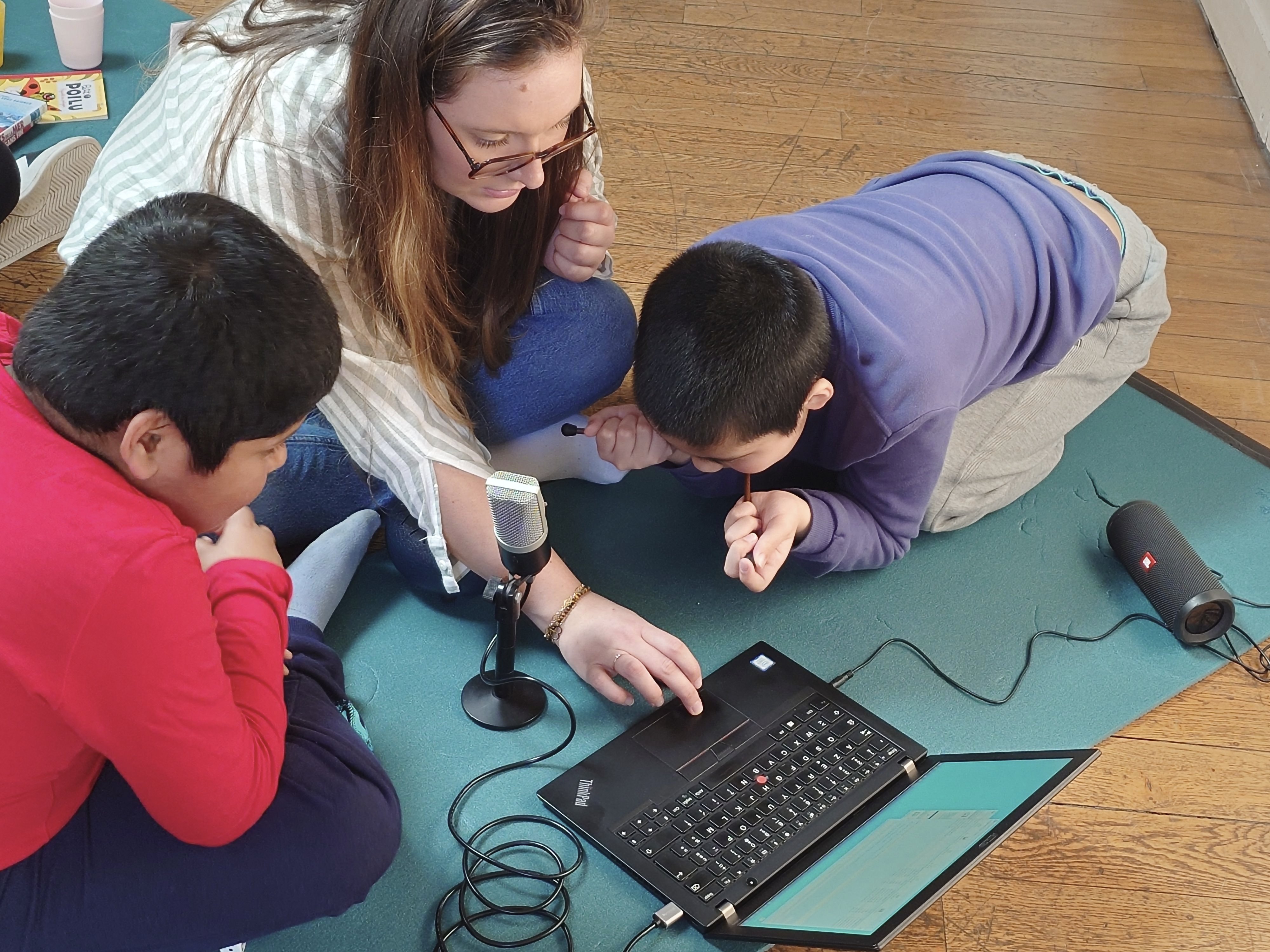
Over a period of several months, I led a video-creation workshop in a day hospital that cares for autistic children. I want to give an account of it, session by session, and then draw from it a reflection on my own practice. The choice to let children make images rather than to show them images shifts everyone’s place, and the rest follows from there: a frame that authorises rather than forbids, a creation that starts from the material before the intention, a way of looking at oneself made possible by the image, a process that ends up mattering more than the object produced. What I tried to understand there is how a technical device can become a space in which autistic children build themselves.
A day hospital that also heals through the making of images
The workshop I am describing took place at the André Boulloche day hospital for children, part of CEREP-Phymentin, a Paris association working in care, training, teaching and research in child and adolescent mental health. This day hospital, directed by the psychiatrist Marie-Noëlle Clément, takes in children with psychic and neuro-developmental difficulties, a large majority of whom fall within the autism spectrum. It is a place of care that is open to psychoanalysis, where the team has chosen to run cultural and artistic projects on a regular basis, because they hold that creation can have a function within care.
This attention to images is no accident. In 2024 Marie-Noëlle Clément founded an association, AUTISMAGINE, which works on the place of images, both still and moving, within the field of autism, starting from a clinical intuition. For autistic people, for whom direct immersion in the world can give rise to considerable sensory anxiety, a technical intermediary such as a still or video camera offers a way of being in the world while remaining slightly behind the tool. Temple Grandin, who has written about her own autistic functioning, says that she thinks in pictures. And there is an imbalance the association seeks to redress, between the many images produced about autistic people, in films and documentaries, and the far rarer images they make themselves. This video workshop is part of that research, which is why it also has a dimension of study, and not only of facilitation.
The video workshop did not arrive on its own; it followed a photography workshop run a few months earlier by Mary Jampy Baron, which had ended with an edit of the images and a small exhibition for families and staff. The idea behind the whole project was to move from photography towards video, that is, to introduce, after the work on the still image, the narrative dimension that the moving image allows. The team had steered the children with the most access to language towards photography, and those with less or none towards video, while also taking account of their appetite for video. The group, around eight children, stayed the same from one session to the next.
I call it a video workshop out of habit, but it was in fact a multidisciplinary digital workshop. We did animation, fiction shooting, sound, drawing, and the whole thing ended with a photographic exhibition in the hospital’s corridors. I had originally proposed a sequence of five sessions, but the actual project drifted away from the written one, and that is part of what I want to recount. Editing on an app, for instance, I gave up on from the very first session, because I understood it would not suit. Other forms were born along the way that I had not planned. This plasticity is not a failure of preparation; it belongs to the method itself.
Everything we produced is online, accessible through a QR code, and this putting-online, which I will come back to, is an integral part of the approach.
Facilitating and reflecting at the same time, and turning that reflection into a text
My work, in this workshop, held together two gestures carried out at once. I was leading the sessions, and at the same time I was reflecting on my practice, on what was at stake, on what worked and what did not. What you are reading here is that reflection, not an activity report. It took shape in several ways that fed one another. First in the work itself, with the children, where one understands things by doing them. Then in the thinking carried out during the work, and in the preparation of each session, which was never the mere application of a programme but the fruit of everything the previous session had taught me.
To this is added a support I hold to. After each session I kept a journal, in which I noted my inner movements, my doubts, what had shifted me. It is on this journal that I draw today in order to write. These days, in other contexts, I sometimes work in a more ethnomethodological way by recording the sessions themselves; here it was a journal kept afterwards. Finally, I presented this work within AUTISMAGINE, before clinicians and people from the world of images, and that oral presentation, with the questions it raised, helped me see more clearly what mattered. It is all of this, the work, the journal, the preparation, the presentation, that led me to the form of this text.
Session 1, cut paper and the cinema room
For this first workshop I had built the session in two phases that bear no resemblance to one another. A first phase of exploration, with all the material laid out and available, music, paper to cut, where each child plays, discovers, goes off in every direction. It is a disorderly moment, and it is very good that it should be, because it is my way of setting the frame, of sending a message of welcome. Then a break, and after the break something quite different, focused and collective, in which each child cuts out a character, comes in turn to place it under the camera, then goes to sit in the cinema room, which a few simple chairs are enough to stand for.
What struck me was the passage between these two phases. In the first, each child had taken hold of the tool in complete freedom. In the second, there was no problem of understanding or of discipline, the calm was Olympian, the instruction was understood, the waiting for one’s turn to come under the camera was respected. I had a microphone problem along the way, the first third of the participants had not been recorded, and I told them so. We redid those passages, and it caused no difficulty at all, because they had already felt, through their own experience, the exactness of the device, its workings, its constraints, its strength. The activity had become organic, a part of life itself.
During the first phase, I had casually placed three compact cameras on a piece of furniture. I had not introduced them, I did not know whether they would be picked up or not, they were in a slightly hidden corner, yet still a little visible, available without anyone quite knowing whether they were. And at one point they came out. Three children took hold of them and filmed, photographed what was happening, in their own way, with no instruction. That children should thus become, of their own accord, the reporters of the moment, by taking hold of something that belongs to the adult without anyone telling them to, is for me a real component of the device. They authorised it for themselves.
Leaving that first session, I already knew certain things for what would follow. Video editing on an app would not work. Films in which they would themselves be the actors, yes, but only on condition of inventing simple devices. I had to go on inventing them.
Session 2, the shooting studios and the film of the “I”
I had asked myself a great many questions before this session, about how to bring it so that it would really suit the children. I had arrived at the idea of setting up two shooting studios in parallel, with two video projectors, two computers, lamps, two genuinely distinct sets, one camera per studio, and the cinema room still clearly identified as such. The idea was no longer to make animation films but films in which one films oneself and sees, live, what one is filming.
While I was preparing, I came across some small dinosaurs and small cars that I had had for years and had never used. I understood that I would bring them, and the idea for the start of the session came to me then: to suggest they choose a dinosaur and a car, and write their first name, which was in fact the name of their dinosaur. It is proof that things are built step by step, through iterations.
They arrived, they began to repurpose their dinosaurs in a way different from the one I had imagined, and one after another they came before the camera, we improvised, and I filmed what was unfolding. One boy, very quiet, slightly turned the camera towards the video projection, which set his own image within itself, and it had a great beauty of rhythm. I chose to film what was happening, because it was not the official shoot, it was an experiment of which I kept the trace. In the other studio, in parallel, they too had turned the camera to make an image within the image, but more sophisticated still, with one directing the other. No one had asked them to do anything.
After the break, I proposed a collective film. With my three cameras I did a live edit, and each child came forward to say their first name. At one point the idea of the collective came to me; I asked everyone, myself included, to say in turn “I am” followed by their first name, one after another, starting very quietly and growing louder, then, partway through, to say just “I”. We all said “I”, “I”, very loudly, and it was exhilarating. The film lasted thirteen minutes, and what astonished me was that it was not laborious to watch at all. Watching it, we relived the pleasure we had had in making it. Since the film is the trace of its own process, if the process was a pleasure, that pleasure is what makes up the film, and watching it again renews that pleasure.
Session 3, sound, the recording studios and the drawings
This session was the first I genuinely co-built with the team, during a meeting at CEREP. We decided to work on sound. I had planned to set up several stations with a microphone, a computer and a speaker, with material for producing sound. The initial idea was that they would move from station to station, but just before the session Hélène rightly pointed out that this moving around would be confusing for them. So we changed it: each child settles in one studio and stays there, and we listen afterwards. That is the protocol we chose together.
On arriving, I did not yet have the tables I had planned, but there were yoga mats, and I thought taking over the floor would be good. Everyone, quite naturally, took off their shoes, and it gave a different energy. I too was on the floor, like them. Towards the end of the first half-hour, everyone was fully in it. At my studio, I showed them how to record and play back, I accompanied them very little, and they were the most productive group, because there was no mental brake to slow the gesture. In a short half-hour they had created a quantity of fascinating little sound sequences. That is where I understood that this was the moment of creation, that there was nothing more elaborate to wait for, in the sense that we, as adults, understand it.
At the end of the recording, I put the sounds online in the QR-code sharing space, from the four stations, and then we looked at that link exactly as they will do themselves, on their own. Then, rather than continue with sound, an idea came to me as an obvious step, to move to drawing on the basis of the sounds we had heard. I had brought a great deal of beautiful material, fine papers, pastel, charcoal, surprising felt-tips, noble materials not found in everyday life, and they took to drawing with great autonomy. What we did there was not video, it was images, but video is not only video, it is images in relation with sounds, and that is exactly what we produced.
Because of a difficult connection, I could not transfer only the photos of the drawings, so I copied everything, all the photos of the day, including those of the activity in the making. And it was much better, because what we looked at together was not only the drawings, it was us, in the act of doing the activity. They saw themselves, recognised themselves, recognised what they had just lived. At the end of that moment, one girl repeated what she had already said, that she wanted to make a real film next time, with actors and stories. I said yes, that we had to prepare for it by bringing costumes, because in preparing a costume one prepares one’s ideas at the same time. The costume is that object outside ourselves that acts as a third party and allows us to build ourselves.
Session 4, the shoot, the costumes and the long take
The first part was a shooting studio with light projectors and a video projector that let us see, live, what we were filming. When they arrived, Hélène made a very good remark, that we should not have them put on the costumes straight away, but begin by writing their first names on sheets of paper. This calmer writing activity made for a better start. Each child came before the camera in turn, and we watched the result on the big screen. The protocol changed completely from the previous sessions, since here, by placing yourself before the camera, you see what it gives, you control your own image. You put yourself on stage, not out of narcissism, but to register your own existence on screen.
Then each child chose a costume, and we shot scenes following a very official shooting protocol, where I said “action” and the others, as spectators, kept silent. Thanks to this protocol, they really played a part, becoming altogether different from their usual behaviour. After the break, I had prepared the room with a filter on the camera, thinking we would play with it. When they arrived, they took it off. I put it back, they took it off again. Not one child wanted it. There was a very clear collective assertion there, and my role was not to hold on to my idea, it was to welcome theirs.
One of them told me he wanted all the images at once, the image within the image; I set it up, and they began to play with it. Then one of them went to the microphone and started to sing while the others played with the nested images. At first I found it a pity, then it inspired me, and the idea of the music video came back, because they were dancing to what the one at the microphone was singing. I suggested they dance for that person, they agreed, and it was the one singing the song very softly who steered the movement of all the others. I noticed, in fact, that the microphone volume had been turned down so the sound would not saturate, and this mastery of the tools surprised me.
I want to dwell on the most accomplished film of this session, because it left a deep impression on me. It unfolds in a single long take and passes through several registers. At the start, a classic fiction playing out before us. At one point, some characters had to be put in prison, but the prison was off-screen, which led me to move the camera to go and find it, and we then discovered the projectors and the device. Next, while we were still inside the fiction, the actors themselves came to move the camera, they became camera operators, which completely changes their status. Finally, the story ended and we left the fiction to find ourselves in what one would call the making-of. Three different registers, in a single crossing, without anyone having planned it.
Session 5, the exhibition in the corridors
The fifth and last session was the exhibition workshop. I had had about three hundred photos printed: stills from films, photos the children had taken themselves, photos I had taken of the activity as it took place. I had made four folders, one per workshop, each bearing the title of the workshop and an image to represent it, because the fact that things were named mattered a great deal to them. And I had set up the room as always, with the table and the felt-tips, the video projector, the screen, the same zone where we gather.
We took out all the images, workshop by workshop, and each child selected a few. I had thought they would enter passionately into these images of themselves, but not so much. They had already seen them, and reclaiming the image was not as intense as I had imagined. It was a less dense activity, which is no bad thing, because not every activity has to be equally intense, and this one, at the end of the journey, drew on another energy, that of the giving-back. Even less dense, something was at play in it. In rediscovering their images, in picking them up and putting them down, the children were looking back over what they had done, and so over their own existence in echo.
Then we went into the corridor to take down the previous exhibition to make room. Taking things down is a particular energy; they were a little wound up, which was normal. I had noticed that the previous exhibition was held up with tape that did not hold, and I had brought sturdier double-sided tape, which I had tested. And there something happened that I had already observed elsewhere. For the children, what was at stake was not choosing which image to put next to which, it was that it should hold. They reapplied the double-sided tape several times to be sure. The same thing had happened to me the year before at the Museum of the Great War in Meaux, where I had planned to have twelve large collages made and where there were eighty, which stayed up for six months, because the children’s only aim had been that they should hold. Choosing one image over another is our concern; theirs is the concrete gesture of hanging, in that corridor they would then go and visit, and it is that gesture that mattered.
While I was in the corridor helping with the hanging, I had displayed on the screen the names of the four workshops, what was to be copied out to make the labels, and Chloé managed the passage between the room and the corridor. It is this margin built into the device that allowed some children to draw the whole workshop while others were hanging the images, and the video projector, which I was not sure I would use, to make possible the autonomy needed to produce the labels. At the end, I asked each child what they could tell someone who came to visit, so that words of mediation could be prepared. Then we said goodbye, we took a group photo, and I shook each one by the hand, very seriously, in deeply invested roles.
Letting children make images, rather than showing them any
These five sessions confirmed a number of things for me about the method, and that is what I now want to draw out. The first choice, the most decisive, is that in this workshop we do not watch films, we make them. Video has been part of our daily life for almost twenty years; everyone has a camera in their pocket, it has become as ordinary as writing. The question is therefore no longer access to images, it is what we do with them. And what I propose is that the children be the ones who make the images, who decide, and not those to whom images already made by others are shown.
This choice shifts everyone’s position. Once it is the child who makes, the adult is no longer the one who knows and transmits, but the one who accompanies what is being made. My role is not to make in their place, nor to get the child to mimic my gesture. It is to give tools, and when the child discovers for themselves, in the handling, the desire to create, then I can be there for them, give them confidence when they are anxious. Not to hold their hand, but to give them what they need when they need it.
A frame that authorises, not a frame that forbids
If I had to sum up my method, I would say that I try to build a frame that authorises rather than a frame that forbids. This is the most important point, and it is also the one that demands the most work.
We often confuse the frame with discipline; we believe that setting a frame amounts to setting prohibitions. It is the opposite. The frame of the analytic cure, that very strict device of the couch, the duration, the rhythm of the sessions, has a single function, to authorise a speech that could not risk itself anywhere else. In my workshops, the constraints of duration, of protocol, of technique are not restrictions, they are conditions of possibility. They hold the space so that people dare to engage in it. Donald Winnicott called this holding, the capacity of an environment to be reliable enough for a subject to explore without fear of collapsing, and discreet enough not to saturate them with its presence. For autistic children, whose relation to the sensory world and to the predictable is so particular, this reliability of the environment is decisive.
The difference between a frame that authorises and a frame that forbids I have felt many times, here and elsewhere. Institutions, and the educators who work in them, are often anchored in prohibition, out of fear. I have seen, elsewhere, knitting needles become forbidden in a hospital because one day a patient did something with them, and from then on they were banned for everyone. The institution’s fear becomes a prohibition for the patients, and that prohibition protects no one, it reproduces domination. At CEREP, during the shoot, the children took hold of the small cameras I had left available, and the educators did not always know how to react, because they remained somewhat within prohibition. The same with the cut paper, where the fear of scissors is strong, whereas with blunt-tipped scissors and a little attention there is no problem. One has to work on one’s own fears so as not to confuse one’s emotion with the framing one is meant to provide. My work is precisely to hold a frame in which this gesture of taking hold of a camera is not a transgression but a taking of one’s place.
Preparing the place, each time, as a place of welcome
This frame that authorises, I do not set it once and for all. I make it at each session, and it begins very concretely, with the preparation of the place. I always arrive a good hour early, I set up on my own, in complete autonomy, expecting nothing from the hospital in terms of equipment. This is no detail, because a relaxed facilitator is an available facilitator, and because I turn the room into a real studio, with identified zones, light, sets. The projectors, for instance, are not always necessary, there is often enough light in the room, but I set them up to signify symbolically the place where we are going to make images.
Above all, from one session to the next I maintain a permanence of the place. There is always the same zone where we gather, where we sit, which I call the cinema room and which, at first, a few simple chairs are enough to stand for. There is always the video projector, the screen, in the same place. When the children arrive, they find a space that resembles itself, they know what they will find there. For autistic children, this sameness of the space with itself, session after session, is a considerable support; it is part of the holding.
Within this permanence, I always leave room for something else. There is always a table with graphic material, fine papers, felt-tips, so that work can be done alongside the main activity, at any moment, for the children as much as for the educators. I almost always bring more material than I expect to use. This is what I call an over-framing device, where the main frame holds but leaves margins in which other things can happen. During the last session, it was this margin that allowed some children to draw the whole workshop while others were hanging the exhibition.
Starting from the material, not from the intention
Here is a point of method that holds well beyond autism. Most of the time, when we want to create, we begin by thinking about what we want to do, then look for the means to carry it out. The intention first, the material afterwards, which must bend to it, and if the material does not match what we had in mind, we are in failure, frustrated.
I propose the reverse. We begin with the material. We handle, we cut, we explore, we look at what we find, and then we see what we can make of it. In this sense, the intention is built in contact with the material, which takes us to places that prior thought could never have reached. This is not a mere notion. André Leroi-Gourhan showed that the hand is not a simple executor of the brain’s orders, and that it is by doing that the human learned to think. Tim Ingold extended this by showing that the potter does not think the gesture before making it, that they discover it in shaping the clay, which resists and which proposes. Thought does not precede action, it is worked out along with it, and neuroscience confirms this, Alain Berthoz having shown that the brain that acts does not function like the brain that plans.
This is exactly what makes these workshops possible with autistic children. What strikes me at each session is the immediacy of their appropriation. They take hold of things and they do, at once, without that long mental time one so often observes elsewhere, that time in which one thinks before daring. In the sound session, as I have recounted, the group I had accompanied the least was the most productive of all, precisely because there was no mental brake to slow the gesture. The idea that one would have to elaborate more for it to be good is a belief that reassures us; it is not a lack for creation.
The device must therefore be conceived to welcome this immediacy, and it is a kind of squaring of the circle, to find a device simple enough and an instruction easy enough for appropriation to be self-evident, and at the same time open enough for an unforeseen appropriation to remain possible.
Letting go of mastery, welcoming the unforeseen
This openness to the unforeseen is the condition of everything else, and it is no doubt what demands the most work on myself. I am a filmmaker, and I can state that mastery, in creation, does not exist. No director fully controls what they produce; there is always a share of accident, of material that resists, of world that imposes itself, and it is very often in that uncontrolled share that the most interesting thing is found. Great artists know this and work with the accident.
So I conceive devices made so that people appropriate them and do with them things I had not imagined. In the studio session, I had wondered whether to fix the cameras with gaffer tape so they would be exactly as I wanted. Then I understood that fixing them meant freezing the device, taking away its capacity for invention. I did not fix them, and it is precisely because they were mobile that a boy could slightly turn the camera towards the video projection and create that image of his own image within itself that I recounted. My work, at that moment, was to press the button to keep the trace of what was happening.
This availability to objects calls for a condition I believe to be central, not being afraid for one’s equipment. My computers are good quality but bought second-hand, sturdy; my microphones are excellent but cost fifty euros; the studio camera was not a real camera, it was a small object taped to a stand, which the children themselves had turned towards them. If one of them falls, I feel no stress, because these objects are there for that. This absence of fear is no detail of logistics, it is what makes appropriation possible, because a device one protects is a device one freezes.
This does not mean I have no demands. My demand simply shifts. It no longer bears on the conformity of what is produced to my expectations, but on the rightness of what is being sought in what the children produce. What I have to let go of is not my knowledge, it is the idea that my knowledge exhausts what is possible.
Seeing oneself doing
There are, in my device, two moments of equal importance, and that is its whole concept, we make and we watch. The moment when we watch what we have made is no less important than the moment when we make. At each session there is therefore a time of return, when we project together what we have just produced. These are very calm moments, with great concentration, and often great, very sincere laughter at what one or another has dared to do, with no mockery at all.
What I understood, above all in the sound session, is that this return is not only a return on the objects made. The real subject of that moment is to look at oneself, in the act of doing the activity. When the difficult connection forced me to copy all the photos of the day, including those of the activity in the making, it was much better, because in seeing themselves doing, the children recognised themselves, recognised the activity they had just lived. There is in this an instance that comes to validate the value of what has just been lived.
This moment touches on something profound. Winnicott showed the role of the mirror in the building of the infant, who forms a first image of themselves by seeing themselves reflected in the mother’s face, in the way she welcomes and names their states. The collective gaze on the images mobilises, at another age, an analogous function. Others do not return an exact reflection to us, they return a reading, and it is in that gap, between what I thought I had put in the image and what comes back to me, that something of oneself is discovered. For autistic children, this work of looking at oneself, mediated by others and protected by the screen, seems to me especially precious.
The process is the film, and it belongs to them
One idea was confirmed as the sessions went on, and it is at the heart of my method in a therapeutic setting. What is built in these workshops is not a film external to us that we would manufacture, it is the experience itself. The films that remain are at once results, objects one can watch, and traces of the processes, both at once. This is why I also film what is not the official shoot, the experiments, the moments when something is happening. And it is why I shoot in a single take, all of a piece, with no editing afterwards.
This choice is not technical, it is ethical. If the workshop provides for editing, it is almost always the facilitator who will do it, alone, afterwards, in front of their screen, and in editing they will improve the film, cut what is not good, keep what is good. At that moment the film ceases to belong to the participants, it becomes the facilitator’s, made out of their material. The single take avoids this slippage; we see the film at once, together, with its imperfections, which are the traces of the process, and it belongs to those who made it.
The single take has another effect, which I saw operate spectacularly with the most accomplished film of the shooting session. Since each one does their best for the take to hold to the end, each one lets go, without realising it, of their usual attempts at mastery, for lack of time to consult that inner censor who says what is done and what is not. And when that censor fades, something very true can express itself. This is how that film passed, in a single take, from classic fiction to the moment when the actors became camera operators, all the way to the making-of in which one saw the device.
The QR code, a giving-back that does not hide
Everything we produce is put online, session after session, in a sharing space accessible through a QR code, and this is not a gadget. I handed it out to the children from the very first session, telling them they could show it to their parents, and I spoke of it again each time. It was the symbol of the link and of the trace of this workshop. I hold to one thing: I put the productions online in front of them, from the workshop’s computers, and we consult that space exactly as they will do afterwards on their own, at home, with their parents or their educators. What they see on the screen during the workshop is precisely what they will see alone. There is no hidden, mysterious giving-back that would escape them.
This point matters to me for a simple reason. Often, in workshops, what people are made to do ends up escaping them, because it is the facilitator who takes it back, who edits it, who circulates it. Yet today, in their daily lives, these children make images all the time, images that belong to them. It would be strange if, in a setting meant for their emancipation and their expression, they had less freedom than in their ordinary lives. The tool is shown as it is. Its mastery comes from me, I do not claim that everyone could do it, but in use we all operate it the same way, and from session to session it becomes our common tool, because we operate it together. The giving-back belongs to them as much as to us, even if we are not in the same place in relation to the workshop.
Showing, and not instrumentalising what has been made
This question of the giving-back opens another, more delicate one, which the team and I discussed at length. Showing what one has made is not at all self-evident for these children. It touches on what is most difficult for them, putting oneself in the other’s place, imagining what a visitor will see, feel, understand. And showing one’s production, even made as a group, can be experienced as a kind of tearing away of oneself, something almost intrusive. It is a dimension we had not entirely anticipated, and that is worked on, beforehand, with them, on their fears and their apprehensions.
There is a balance to hold here. On one side, showing is precious, as we see with the end-of-year giving-backs of the theatre workshops, which are moments the children love enormously, even if their anxieties have to be accompanied beforehand. On the other, one must take care not to instrumentalise what has been produced. Many projects begin in a therapeutic setting and drift little by little towards an institutional project, where one starts exhibiting the children’s work for partners, funders, communication. I have in mind a partnership, some years ago, where an outside committee decided which of the photos taken by young people were good enough to appear in a book and which were not. What was meant to be their expression had become someone else’s object, and the young people felt it, to the point of remaking their own book with all their photos.
This is exactly what the QR code seeks to avoid. Whether it is used or not, it exists outside us, anyone is free to go to it, and no one appropriates the circulation in the children’s place. They have no less power than we do to show and share what they have made. What always returns, in these situations, are questions of domination, and the way one gives back engages the therapeutic aim itself. It is also why I hold that consent to exhibit should be thought through from the start, and that everyone keeps the right to no longer agree at the end.
What this method asks of the facilitator
All this calls for a work of reception. To put oneself in a state of receiving what the other brings into being, without knowing what it will be, without judging it, and to be able to give back to them what one has seen as precious in it, even if it is not what one expected. This work is exhausting. I sometimes find myself drained at the end of a workshop day, with an almost physical tiredness, when in appearance I have not done much. I have not made, I have not directed, I have received. It is this fact of having put oneself in a position to receive that builds the other.
And this work transforms us. When I let go of my criteria, when I welcome a gesture I would not have imagined, I learn something, my field of vision widens. Emancipation, here, is not the gift of a freedom by the one who would hold the power to grant it, it is a process in which everyone is transformed, myself included. The professional who believes they can remain unchanged, above it all, reproduces domination even as they ward it off. Freire called this co-education, where no one educates anyone, where no one educates themselves alone, where human beings educate one another through the medium of the world. It is the same in care. People build themselves together, through the medium of the objects, the images, the spaces we place between them.
I will add one thing, because it matters in the way this project evolved. The first two sessions I conceived alone, from my own reflection only. From the third on, I worked with the team, Hélène and Chloé, who know the children, their needs, those who speak and those who do not. It was a remark by Hélène, just before the sound session, that made me give up moving them from station to station, in favour of a device where each one settles in and stays. It was a remark by Hélène again that made me begin the shooting session with the writing of first names rather than with the costumes. These adjustments, which seem minor, changed the quality of the sessions. The method is never that of a facilitator alone, it is co-built with those who carry the place.
At the very end of the last workshop, once the photos were hung, we said goodbye, we took a group photo, and I shook each one by the hand, very seriously, in deeply invested roles. We were not in the same place, they and I, but we were each one fully an actor in what we had crossed together.


Creativity is essential in all fields of life and activities, as a relationship to oneself, a discovery of one’s abilities, and then daring to share and express oneself. Thus creativity workshops can be useful in all types of contexts: professional, academic, artistic...
-

Letting autistic children make images
An account of a video workshop at the André Boulloche day hospital.
Over a period of several months, I led a video-creation workshop in a day hospital that cares for autistic children. I want to give an account of (…) -

The creative unconscious, a method for collective creation
When letting go becomes method. For a Taoist approach to audiovisual creation.
How can we explain that a group of people can produce a coherent cinematographic work in a short time without a script? A method that shows the (…) -

Participatory reverse photography workshop
A method for deconstructing relationships with images.
Pedagogical method that transforms the phone into a tool for collective creation to question our relationship with images, democratize the (…) -

Digital technology, a tool for mediation and cultural democracy
Webinar on Monday, October 9, 2023 from 10am to 1pm.
Restitution of the “Digital Workshops” project by Cultures du Cœur and Benoît Labourdette Production, offered as part of the Été culturel program (…) -

Cultural summer 2023 with Cultures du coeur: “The machine that travels into the future”
Account of the first workshop of a tour of digital creation workshops in the social field.
During the summer of 2023, Cultures du cœur is proposing to eight social structures in France that their beneficiaries participate in the creation (…) -

Sound poetry creation workshops
Poets’ Spring Festival - Arthur Rimbaud’s house - House of Elsewhere (Charleville-Mézières).
As part of the Printemps des poètes festival, installed in Arthur Rimbaud’s house, at the suggestion of the museum team, I designed and ran sound (…) -

Calligram workshops for children
As part of the poetry biennial “Les ailleurs” in Charleville-Mézières.
Creative calligraphy workshops, using graphics, movement, writing, music and digital technology, for two elementary school classes in (…) -

Cultural summer 2022 with Cultures du coeur: “Changing horizons”.
Tour of film-making workshops in the social field.
During “l’été culturel 2022” (French Ministry of Culture), Cultures du cœur offered nine social structures around France the opportunity to take (…) -

“Cultural Class” : creation of a photographic exhibition with a CM2 class
Lille Institute of Photography.
As part of the City of Lille’s “Classe Culture” program, I accompanied a class of 5th graders to the Institut pour la photographie to create, (…)


-

Artificial Intelligence as confidant: beyond the idealization of human relationships The critique of therapeutic uses of AI masks a denial of ordinary violence in human relationships.
The growing use of artificial intelligence as a confidant raises sometimes virulent criticism. It is denounced as a simulacrum, a dependency, an (…) -

“Territorial approach, participation, youth and digital technology”: interview of Benoît Labourdette by Serge Saada (52’, 2021) Observatory of cultural mediation in the social field.
As part of the Observatory of cultural mediation in the social field, Serge Saada interviewed Benoît Labourdette on the impact of the (…) -

The Eye in the Hand Why the same tool produces a radically different experience depending on the frame you give it.
We all have a camera in our pocket. We use it dozens of times a day, without thinking, for countless purposes. It has become so much a part of us (…) -

Audiovisual Workshop in Therapeutic Mediation Elements of a Course in the University Diploma in Arts and Therapeutic Mediations (Paris 7 – Université Paris Cité
How ordinary audiovisual tools — the phone, the camera — become therapeutic mediators: an account and analysis of a pedagogical practice in (…) -

Creating with people Methods of cultural mediation for shared creation.
This text brings together the principles that underpin my approach to cultural mediation. They are not rules. They are reference points, shaped by (…)
