The place of teenagers in cultural life
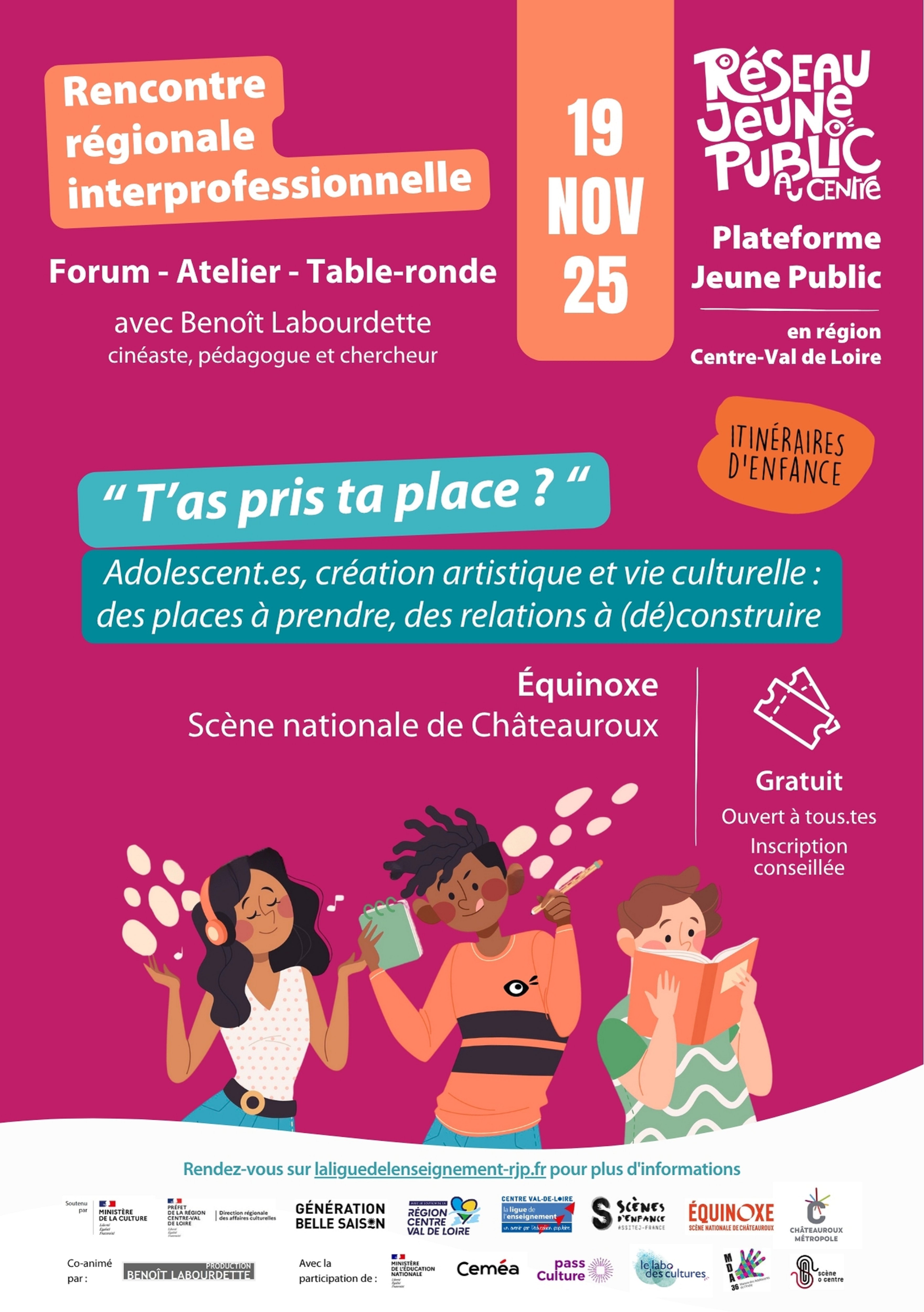
How can we create connections with adolescents in our cultural institutions? The question of their “place” reveals our power relationships and challenges our capacity to recognize their cultures.
Beyond the Myth of a Homogeneous Youth
There is a recurring subject for cultural sector professionals: we want to “reach” young people, we want them to benefit from our offerings. This is very important for multiple reasons, and it even relates to the legitimacy of public funding for culture, one of whose major missions is to serve youth.
But how do we do it? Why is it so difficult? What are the deeper issues at stake? The question of young people’s “place” constitutes a fairly effective, fairly concrete angle of vision for working on this subject and the evolution of professional practices, which are obviously the only possible space for action to make things change.
I co-designed and participate in facilitating a regional interprofessional meeting day on this subject, open to the public, initiated by the Réseau Jeune Public au Centre, in partnership with Équinoxe – Scène nationale de Châteauroux and the Réseau Culture de Châteauroux, on November 19, 2025: “Have You Taken Your Place?” Adolescents, Artistic Creation and Cultural Life: Places to Take, Relationships to (De)construct.
This question of young people’s “place” in cultural life, adolescents in particular, reveals in negative space the power relationships that structure institutions, the mechanisms of cultural legitimization and, fundamentally, our collective capacity to recognize “youth cultures” as legitimate and meaningful, which is a prerequisite for being able to create connections.
“Taking one’s place” means simultaneously occupying a physical, symbolic and political space. For adolescents, it’s a crucial process in their development, in the dialectic between the need for belonging and the desire for differentiation. We must therefore, it seems to me, as professionals, work to create spaces, both real and symbolic, that will allow young people to take their place in them.
Let’s immediately deconstruct a persistent misconception: “young people” do not form a homogeneous group. The work of sociologist Camille Peugny demonstrates this. Reality reveals, on the contrary, an extraordinary diversity of cultural practices and tastes. The adolescent passionate about Pink Floyd today (they still exist) will probably still be so in twenty years, just as their classmate who is a fan of Maître Gims will continue to appreciate this artist. This persistence of individual cultural tastes, observable up to age 65 according to Peugny, invalidates any monolithic approach to youth. For example, seeking to create a project that will “please young people” is nonsensical, both practically and anthropologically. The only common denominator among young people, identified by Camille Peugny, is a shared feeling of fragility about the future, a fear of precariousness, which transcends socio-cultural diversity.
All Spaces of Cultural Life Are Concerned
This subject of “place” (that of professionals too) must therefore be addressed everywhere that cultural life takes place. In educational establishments, of course, where artistic and cultural education oscillates between institutional prescription and genuine emancipation. In cultural venues too—theaters, media libraries, contemporary music venues, art centers—which still struggle to transform their relationship with young people to move from a top-down democratization logic to genuine horizontal co-construction.
Also in popular education spaces, youth centers, community centers, associations, which historically carry this democratic ambition but face permanent challenges of resources and recognition. And finally, in public space itself, where young people invent their own forms of cultural expression, often made invisible or stigmatized by adults.
Obviously, no one has a ready-made solution to answer these questions. Neither researchers, nor institutions, nor artists, nor educators. The complexity of the issues, the diversity of contexts, the uniqueness of each adolescent, make any universal recipe illusory. What is certain for me, however, is that the only possible path goes through collective questioning and sharing of experiences. It’s by confronting our practices, by accepting to deconstruct our professional postures together, by truly listening to what young people have to tell us, that we can collectively advance our understanding and our ways of doing things.
Cultural Democratization Versus Cultural Democracy
This transformation implies, in my view, clearly distinguishing two approaches:
- Cultural democratization, inherited from Malraux, which posits a top-down supply logic: institutions hold the legitimate culture that they must transmit to the people. It is primarily about participation.
- Cultural democracy, on the other hand, recognizes the plurality of cultures and promotes their horizontal dialogue. It is more often about cooperation.
This distinction is not merely intellectual; it has practical implications, of which here are two examples:
- In the first case, what we have the power to do is to bring, via school, “captive audiences” of young people to shows they haven’t chosen. Predictable result: an often negative experience that can lastingly discourage them from subsidized culture.
- In the second case, we co-construct spaces where everyone can bring their references, their practices, their questions. We recognize that cultural expertise is not the prerogative of professionals but is distributed throughout the entire social body.
The Necessary Professional Letting Go
I advocate moving from a posture of vertical transmission to a dynamic of horizontal elaboration, abandoning the position of “the one who knows” to embrace a posture of authentic curiosity. This implies accepting a certain loss of control over discourse and content, which is never comfortable for us professionals, accustomed to holding legitimate expertise.
But it’s precisely this “letting go” that allows, in my view, the emergence of new cultural forms, carried in cooperation with young people themselves and which concern them deeply, enriched by the connections we have authorized to be woven.
This transformation also involves a change in perspective on adolescents’ digital practices. We must move beyond the sterile opposition, in my view, between “real” and “virtual,” which still too often structures our judgments, as well as the notion of “screen time” (because what matters is what we do with screens).
The Digital as a Milieu of Existence
For generations born with the Internet, the digital is not a separate space but a milieu of existence, just like the air we breathe, the earth we walk on, or the language we speak. Inventing languages, particularly audiovisual ones, practicing interactions, radically changing position in the author-spectator paradigm, discovering and working in specific artistic practices, developing unprecedented neural connections, etc.: this is what young people do with digital technology.
Far from being simple passive consumers, they develop knowledge that we, adults, struggle to understand and even less to value.
Recognizing the legitimacy of adolescent cultures is essential to be able to even think about projects and ways of working that are useful to young people in their unique paths to emancipation, so that we too can find our place in order to share with them what we are rich in and what they also need. The need for trustworthy and empathetic adult role models is all the more necessary today as young people have great autonomy in digital spaces.
Placing Experience at the Center
And finally, we must place experience at the center. Art is not the work itself but the lived experience in encountering it. This approach, conceptualized by philosopher and educator John Dewey at the beginning of the 20th century, places the person at the center of the cultural process.
Faced with digital giants who have perfectly understood this principle by creating hyper-personalized experiences, cultural institutions can no longer be content to offer a standardized and “quality” offering while hoping that young people will come. We must invent spaces where each adolescent feels recognized, welcomed and supported, where their unique experience is legitimate.
It’s precisely in this spirit that we co-constructed the regional interprofessional meeting “Have You Taken Your Place?” Adolescents, Artistic Creation and Cultural Life: Places to Take, Relationships to (De)construct, a regional interprofessional meeting day initiated by the Réseau Jeune Public au Centre, in partnership with Équinoxe – Scène nationale de Châteauroux and the Réseau Culture de Châteauroux, on November 19, 2025.
A Necessary Process of Breaking Down Silos
The co-construction of this day has represented in itself a genuine transformation process. Bringing together around the same table actors from the cultural sector, national education, popular education, the artistic world, mental health, research, local authorities, is already creating the conditions for a necessary breaking down of silos.
These different actors often work with the same young people but struggle to meet and collaborate, due to lack of time or mutual knowledge. This meeting aims precisely to create this space for dialogue.
And it’s this movement, this circulation of ideas and experiences, that we must, in my opinion, always cultivate, to remain open, to avoid fixing our practices in comfortable but sterile certainties.
Program for November 19, 2025
09:30 AM: Coffee welcome
10:00 AM: Opening
10:30-10:50 AM: Sociology and anthropology of youth and culture, toward a common language, by Benoît Labourdette.
10:50 AM-12:30 PM: Circulating forum to discover 8 to 12 inspiring projects (youth cultural committees, artistic residencies, artistic and cultural projects in schools, etc.). Participants circulate freely to exchange with those who lead these initiatives.
12:30-1:30 PM: Lunch cocktail
1:30-2:00 PM: Flash collective creation workshop to concretely experiment with participatory creation tools, by Benoît Labourdette.
2:00-4:00 PM: Round table “What place for adolescents in artistic creation and cultural life?”. Cross-perspectives on professional practices, to rethink positions in light of cultural rights. Contribution and moderation: Benoît Labourdette. With six participants: Margot Bareyt and Nanou Goguel-Gross (Labo des cultures), Irène Bastard (Pass Culture), Anne-Marie Peslherbe-Ligneau (National Education), Alban Cozler (CEMEA France) and Émilie Paris-Robin (psychologist at the Maison des adolescents de l’Indre).
4:00 PM: Collective summary and closing
If you wish to participate in this meeting, registration is recommended. You can register and find all practical information (access, detailed schedule, etc.) on the Réseau Jeune Public au Centre website: www.laliguedelenseignement-rjp.fr or by contacting the team directly by email at reseau.jeunepublic laliguecvl.org or by phone at 06 51 70 75 34.


Cultural offerings are sometimes brutally questioned by the “young” audience. A challenge that manifests itself notably through indifference towards the prescriptions of cultural institutions, or even through disinterest in cultural venues. Over 15 years, digital technology has also revolutionized young people’s, and everyone’s, relationship to time and private space. The very definition of culture and its mode of access have been transformed.
To become capable of rethinking projects adapted to the real needs of contemporary youth, which falls under the mission of cultural policies, I believe we must first deconstruct our preconceived ideas, the judgments we may have without knowing. This involves taking the measure of new representations of the world and new cultural practices closely linked to digital technology.
How to do this? I believe that going through “doing,” precisely, is a very rich path for professionals. Experiencing through one’s own experience the stakes of cultural practices in the digital era, by participating in workshops with young people, by “playing” with digital technologies, by exploring new cooperation mechanisms, etc., with the aim of surpassing one’s usual criteria, in order to be enriched by youth’s ideas and uses. This is not about demagogy, but about weaving connections, which enables mutual transformation, creative hybridization.
Action-research on cultural policies for youth has always been one of the main areas of work for Benoît Labourdette, in cooperation with numerous actors from the cultural, educational and social fields. We propose here methods, accounts of actions and training, which we hope will be inspiring for actors from the cultural, social and educational fields at all levels. To offer an analysis of the stakes, as well as sociological, psychological, cultural foundations, to create solid supports in service of public service missions for youth.
-

Place as an Operative Concept for an Emancipatory Cultural Mediation
Taking one’s place is not about occupying a position, it’s about being able to move.
“What place for young people?” The question is wrongly framed. Place is not a position to occupy, it is the capacity to move within a relational (…) -

Making Room for Adolescents: Rethinking Our Approaches in Cultural Action
From democratisation to cultural democracy.
Cultural action and mediation with adolescents challenge the foundations of our practices: between framework and transgression, between physical (…) -

When Cultural Professionals Question Their Approaches to Adolescents
Reflections on a day of professional cross-fertilization.
An interprofessional day organized by the Réseau Jeune Public au Centre at Équinoxe, Scène nationale de Châteauroux on November 19, 2025, which I (…) -

The place of teenagers in cultural life
From cultural democratization to cultural democracy: rethinking our professional postures.
How can we create connections with adolescents in our cultural institutions? The question of their “place” reveals our power relationships and (…) -

Youth as a power relationship
Deconstructing infantilization to liberate potential.
Youth is not an age but a role we are made to play. Between infantilization and resistance, how can we rethink our intergenerational relationships (…) -

Youth and culture: for a radical change in posture
Giving young people the power to create, not just consume culture.
How can cultural institutions break out of their chronic failure with young people? By abandoning condescension to embrace a genuine cultural (…) -

Immersion VR: launch of an educational project, between collective creation and virtual reality
Three middle school classes are about to explore the narrative possibilities of 360° immersive cinema.
On October 15, 2025, at the Canopé workshop in Lyon: the start of a unique creative adventure, having three middle school classes create a virtual (…) -

Reinventing youth reception in cinemas
Remote training for cinema operators in Lot-et-Garonne.
How can we transform our cinemas into spaces for authentic encounters with 15-25 year-olds? This question guided an intense training session with (…) -

The value of cultural practices for young people
Towards a coherent, cross-functional youth culture policy.
Cultural practices, whether traditional or digital, are essential to young people’s development. It seems important to me to open up reflection on (…) -

Towards renewed cultural mediation for young people
Cultural rights and the digital age.
Digital practices of youth: legitimate cultural expressions for rethinking mediation and building a renewed cultural democracy. A necessary (…) -

Rethinking youth culture
From democratization to cultural democracy.
Cultural institutions often fail to reach youth. To reverse this trend, we must move from cultural democratization to cultural democracy, (…) -

Helping professionals design new types of projects adapted to the needs of young people
Laboratory for an original training and project development program.
In the face of young people’s indifference toward institutional culture, I propose exploring an innovative training framework aimed at helping (…) -

Conference: “EAC and cultural rights: convergences to be identified and implemented”
Dans le cadre des Rencontres territoriales “Artistic and cultural education & Territorial cultural projects” (Foix, February 5, 2025).
How can cultural rights be a tool for better implementation of artistic and cultural education projects? And how we can identify convergences (…) -

Tumo x IA - Creative journeys to the heart of AI
Film-making workshops in collaboration with A.I. by teenagers from TUMO Paris.
Large-scale creative experience for 350 teenagers, to raise awareness of the challenges of Artificial Intelligence, and equip them for critical (…) -

“Involving young people in summer cultural projects: issues, avenues of work, proposals”
Webinar hosted by Benoît Labourdette (Thursday, March 21, 2024, 9am-10am).
“Young people” are the main target of summer cultural projects in towns, villages and suburbs. And yet, professionals in the cultural, educational (…) -

“CinémA.I” in Studio 13-16 at the Centre Pompidou
Workshop on creating films in collaboration with artificial intelligence, led by Benoît Labourdette.
Film-making workshop in collaboration with artificial intelligences, for teenagers at the Centre Pompidou’s Studio 13-16. Creative proposal (…) -

Website: Artistic and digital practices for young people
Web resource platform for Act’art (Seine-et-Marne cultural agency).
Advice, development and support for the appropriation of a web resource platform for cultural professionals in the Seine-et-Marne department. (…) -

Design of a professional day on “Artistic and digital practices for young people”
Act’art, artistic and cultural action in Seine-et-Marne.
As part of its mission to promote collective intelligence by facilitating local think tanks, Act’art asked Benoît Labourdette to design, (…) -

OPC Media: “What if we changed our posture?”
How can we learn to consider the richness of teenage digital practices and avoid giving in to preconceived ideas?
How can we learn to consider the richness of teenagers’ digital practices and not give in to preconceived ideas? For Benoît Labourdette, if we (…) -

Helping young people and professionals to speak out: “Cultures and youth policies” national meeting
Observatory of Cultural Policies / Villeurbanne (TNP, May 11 & 12, 2023).
As part of the Rencontres nationales “Cultures et politiques de la jeunesse” (“Cultures and youth policies”), which brought the year of the French (…) -

"Culture, youth and digital: designing new modalities for cultural and educational projects
Sharing of methodological tracks and professional training.
Deconstructing preconceived ideas about digital transformation and developing projects adapted to young people.The cultural offer is sometimes (…) -

“Creative digital practices and critical thinking training”: conference by Benoît Labourdette
Atelier Canopé 86 - Poitiers. Study and training day “EAC at the service of the development of critical thinking”.
Participative conference to illustrate how the training of critical thinking can effectively pass by the means of artistic creation. To inaugurate (…) -

Reinventing cultural projects with youth?
Proposal of questions.
While public cultural action aims to reach people in their great diversity, it is clear that it is often difficult to mobilize youth. However, (…) -

OPC: “Culture, youth and digital” training
Designing new modalities for cultural and educational projects. March 2022.
A new concept of internship for cultural professionals, in order to build an opening to the public who have deserted the public and associative (…) -

Tutorials for doing video activities with your children
Podcast by Benoît Labourdette (1’37s, 2020).
Very simple tutorial (1 minute 30) to conduct two creative audiovisual activities with your children.During the confinement period in (…) -

DRAC and DAAC Pays de la Loire: “Learning to see and hear, a collective experience”
A professional training to collectively invent projection devices in order to build a greater intimacy with the material of the image. Then draw (…) -

Growing up with culture : “The contribution of digital technology in cultural mediation”
Conference by Benoît Labourdette about cultural mediation with digital tools, on the example of the travelling projections within the framework of (…) -

Vatos Locos Video: “Designing and implementing artistic practice projects to combat racism and discrimination”
Vocational training for leaders, teachers and managers of social and cultural structures. Video as a Tool for Citizenship.The association Vatos (…)


-

Art and Culture in the Service of Psychosocial Skills Account of a founding seminar for professionals of the Judicial Protection of Youth in Limousin.
On November 27, 2025, the Limousin Regional Directorate of PJJ brought together its teams for a half-day of collective reflection on psychosocial (…) -
"Culture, youth and digital: designing new modalities for cultural and educational projects Sharing of methodological tracks and professional training.
Deconstructing preconceived ideas about digital transformation and developing projects adapted to young people.The cultural offer is sometimes (…) -
Helping professionals design new types of projects adapted to the needs of young people Laboratory for an original training and project development program.
In the face of young people’s indifference toward institutional culture, I propose exploring an innovative training framework aimed at helping (…) -
Design of a professional day on “Artistic and digital practices for young people” Act’art, artistic and cultural action in Seine-et-Marne.
As part of its mission to promote collective intelligence by facilitating local think tanks, Act’art asked Benoît Labourdette to design, (…) -

France Culture french channel : Radio show “E-artist” (L’Atelier de Création) Press reviews
In early 2013, Maylis Besserie, producer at France Culture radio french channel, asked me as she prepared a program about creation with (…)
