Multidisciplinary photographic exhibition creation workshop
Animation of the latest annual, hands-on image education training session for teachers, offered by the Institut pour la photographie as part of the program “Awakening the eye”..
Teachers have been supported every year since 2022, as part of this training program, which consists of 3 sessions + help with running an in-class workshop, and documentation of the work on a web platform. This program is the result of a co-construction in which I was involved from the outset, along with Alice Rougeulle, Christophe Cognet, Noé Kieffer and several mediators and teachers. I also set up the project’s web documentation platform, so that pedagogical lessons could be drawn from it.
This year, I led the final session of this training course, the aim of which was to open up the teachers to concrete pedagogical applications. Over the course of two days, I guided them towards the creation of a multi-disciplinary photographic exhibition. They created a large number of concrete objects, all of which were gradually uploaded to a digital sharing space, from which they created a real, ephemeral exhibition at the Institut pour la photographie.
Here’s an outline of the two-day workshop.
The entrance

At the entrance, a large number of books on the subject of photography and education are laid out on a table. Participants are invited to browse through the books that interest them. From the outset, it’s a moment for oneself, a time for encountering different thoughts and approaches. The aim of the training program is to enable each participant to build up valuable, personal tools for thinking and working. Autonomy in discovery is part of this, and is proposed from the outset.
I then gave a methodological introduction to the spirit of these two days: to have enriching experiences, and then to understand the methods, so as to be able to use them with students. This was followed by a “sit-stand” exercise, in which I formulated a list of questions, which we answered by standing up and saying yes: it’s a playful way of building community, and sometimes we’re surprised.
Taking ownership of the subject through experience
Afterwards, we push the chairs, move around the space, and at “top”, we stop and pair up with the person closest to us. In 2.5 minutes, we explain why image education is important, then switch roles. This exercise ensures that everyone has a chance to speak, so it’s a way of building confidence and giving everyone a real place.
Next, we present the web platform and what it means to keep a record of all this work. Teachers will be invited to write reports on the workshops they host in their classes.
And finally, at a very important and seminal moment, we discuss the expectations of all concerned:

A creative photographic exercise using an atypical method

I then propose an exercise: each person takes a photograph with his/her phone, according to precise instructions, and posts it online in the sharing space, then we look at the photos together, in full screen mode: the person who took the photo is not allowed to speak, and the others give feedback on how they feel about this image, what they see in it, what they understand about it. This reverses the usual system of “restitution”, in which each person has to justify him/herself, explain what he/she has done; here, on the contrary, thanks to the gaze of others, we understand better what we have done, we discover it, we give it value, and above all, we realize that an image doesn’t have just one meaning, which would be the right one, but multiple meanings, depending on who is looking at this image. This is an important foundation for building a critical mind, and one that in the method goes against the grain in the school context.
We also realize that in a very short space of time, when people work in parallel with a clear set of instructions, there can be a high quality production. And the time it takes to look at the images is longer than the time it takes to make them; this is also a very important idea: practice is also the practice of looking, and it’s at this stage that things become anchored and take on meaning. The practice of looking at things collectively must therefore be invested in (often, it is given little space in favor of the practice of making).
Playing with artificial intelligence

I suggest that teachers discover the Capcut video-editing application, which is very important because it offers profound and powerful audiovisual creation possibilities in a very ergonomic way. You can really use it for teaching purposes. This application also contains filters for transforming images using artificial intelligence, which we’re all experimenting with in our own way, by transforming images made in the morning.
Collective image soundscapes

I divide the trainees into 3 groups: each group will create a sound ambience for one of the chosen images, using musical instruments I’ve brought along. The use of microphones, improvised musical practice by non-musicians, the path to producing rich, enriching sounds, and thinking about the image-sound relationship are all invested in this exercise.
Cut-out paper animation films


Starting with a large corpus of papers, magazines and posters, participants get together in small groups to start cutting out, letting themselves be inspired by the images and making them their own. It’s a very effective way of “getting into the images”, because there’s no blank page. The images are immediately inspiring. This works very well with students or people with difficulties, as it captures attention and is very gratifying in terms of the result.
You let yourself be inspired by the images, without any specific goal in mind. Then, after a while, you start to build a narrative, for a film in “animated cut-out” style. Finally, we shoot in sequence, in one go, using a “title-bench” camera connected to a computer, with a microphone to record live sound. The shoots are moments of great intensity, because everything has to work together. They are repeated several times until a satisfactory result is achieved.
The following morning, the day begins with a viewing of the three films, and a methodological review.
Creating soundscapes

On the eve of the second day, I asked all the participants to create a sound ambiance, simply recorded with their mobile phones and put online. These soundscapes, each at least 5 minutes long, could be played in a loop in an exhibition. They can also be used for many other things, and together we’ve built up a valuable collective sound base. We listen to the first minute of each ambience. The moment of listening is invested.
Book reproduction


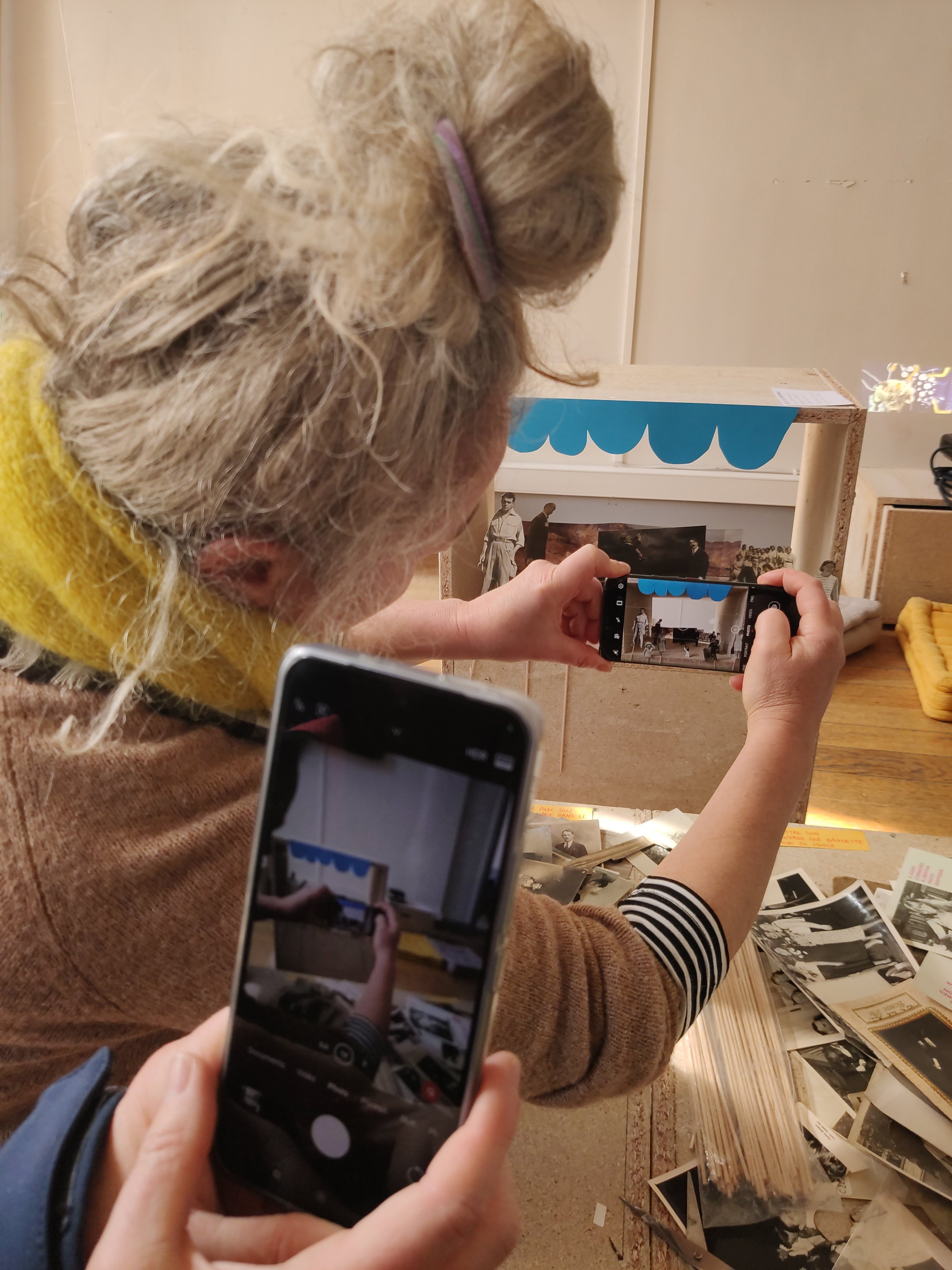
One of the needs expressed by the teachers was the lack of a quality corpus of photographs. So, we’re in the right place, we have a large library of photography books at our disposal, and so I propose that we do a “reprography” session: we take photos of the books, in a structured way (with good file naming) and above all by finding the way to frame well, to avoid reflections, to produce the best possible reproduction. It’s a requirement, and everyone finds their own technique for doing it, exploring the making of this type of image, with the shared aim of creating tools that can be useful to everyone in the future.
Micro-publishing

Marie Usaï (visual arts teacher at Collège Boris Vian (Croix) and commissioned by the DAAC - Lille to work with the Institut pour la photographie) presents her “micro-edition” techniques: creating objects, books, displays and more. Each participant will create an object to showcase his or her photographs. It’s a way of making creations concrete, tangible and valuable.
Technical point


I answer technical questions, which are part of the skills to be acquired, and we go over the tools used. This is an essential step.
Exhibition set-up

At last! With the many creations produced, each person chooses a “mission” to set up the exhibition: video, displays, labels, soundscape, scenography and so on. In less than an hour, and we’d been so prepared, a photographic exhibition worthy of the name, varied, interesting, participative, questioning, existed. A few visitors (from the staff of the Institute for Photography) come to see it. It’s impressive to be able to achieve such a high quality of result, as if things had “magically taken care of themselves”. This is the reason for writing this methodological report: this “magic” can only happen at the end of a creative process in which, from the outset, each person is invited to create, and in which the supervisor’s role (in this case, mine) is to organize the autonomy of each person, to create a framework that will go completely beyond what he or she could have imagined. In short, to set up a cooperative process. This is possible with students, and works very well, as demonstrated by the « Cultural class » project I led two years earlier at the Institut pour la photographie.

Photos taken by the two children


As this training course took place during the school vacations, Alice Rougeulle’s two children were present, and I had given them the task of being the “journalists” of the course, taking photographs of it from artistic points of view. They also helped set up the exhibition.
Presentation of the “Awakening the eye” training program
Awakening the eye: an experimental training program
Launched in 2022, the “Awakening the eye” training program, supported by the Institut pour la photographie, is designed and developed for future and/or young volunteer teachers at all levels of education. Its aim is to support teachers in their understanding of the image as a language in its own right, and as a tool for dialogue between different fields and areas of learning.
Beyond artistic questions alone, the program aims to understand the still image in its various production and distribution contexts, to better grasp its cultural, social and civic implications.
Adapted to different cycles and teaching levels, this trans-disciplinary program is unique in that it combines, throughout each training period, the implementation of in-class activities (image-reading workshops, practical photography workshops, meetings, etc.) to support teachers and students in a shared discovery of a medium open to multiple possibilities.
Moonlight click (Isabelle, Camélia, Elise, Elise)
Gluttons (Marie, Nathalie, Isabelle)
The digital sharing space
Thanks to a QR Code, participants were able to easily upload their productions to this digital sharing space.
https://www.benoitlabourdette.com/_docs/projets/2024/2024_institut_photo_eveiller_le_regard/



Design and delivery of professional training in the field of image education, for teachers, facilitators, responsible for educational facilities, cultural and social, and cinema theater directors.
With the new technology tools, to “connect” with the practices of youth and enlighten.
-

Participatory reverse photography workshop
A method for deconstructing relationships with images.
Pedagogical method that transforms the phone into a tool for collective creation to question our relationship with images, democratize the (…) -

Multidisciplinary photographic exhibition creation workshop
As part of the Awakening the eye training program (Institut pour la photographie).
Animation of the latest annual, hands-on image education training session for teachers, offered by the Institut pour la photographie as part of (…) -

Workshop “Tools, games and workshops for image education” - Images en bibliothèques
A story of the session “How to run a video production workshop differently”, led by Benoît Labourdette.
Images en bibliothèques has launched a new course, designed by Florian Lecron, for professionals in the library, film, education and culture (…) -

“The use of screens at the heart of child protection”: conference / training by Serge Tisseron and Benoît Labourdette
Proposed by the Federation of the sunbeams of childhood and the IRTS PACA - Corsica.
Training day for 80 social actors of the child protection, to equip the professionals with the good use of the images and the digital in an (…) -

DRAC and DAAC Pays de la Loire: “Learning to see and hear, a collective experience”
A professional training to collectively invent projection devices in order to build a greater intimacy with the material of the image. Then draw (…) -

House of the image, Appointments of the image #6: “Intimacy, images, social networks. Existing and living together in the digital age”
Training day and co-construction of educational tools to work on self-image, designed in collaboration between theMaison de l’image (Noémie Rubat (…) -

Pocketfilms-Empathy
Project to support psychosocial and pedagogical practices around the empathy clinic and using images. By Serge Tisseron and Benoît Labourdette, (…) -

CNPFT: Training on uses and educational projects around digital technology with young people and children from 12 years old
Training in digital image education at the CNFPT (Centre National de la Fonction Publique Territoriale)..The objective of this 4-day training (…) -

Ciné Lab # 6: “New usages, digital cultures. What (R) evolution for cinemas?”
Day of reflection and common development of innovative projects, for cinema operators and mediators.The ACRIRA and the GRAC (Rhône Alpes (…) -

Vatos Locos Video: “Designing and implementing artistic practice projects to combat racism and discrimination”
Vocational training for leaders, teachers and managers of social and cultural structures. Video as a Tool for Citizenship.The association Vatos (…) -

Observatory of Cultural Policies: “Territorial Projects and Cooperation”
Territory, digital, culture, participation, participation, creativity... keys to understanding and methodologies for relevant and innovative (…) -

Image’Est : Images education facing everyday image practices
As part of the Festival of documentary films “The real in sight”, Image’ is, business education to the images in Lorraine, proposed on 18 November (…) -

East image: Cover images that make violence happen
Training on how to teach about violent images.East Image, Regional Centre for Arts Education and Training in Cinema and Audiovisual, organized (…) -

National Meeting of coordinators School and Cinema: “Image education 2.0”
Benoît Labourdette Conference and workshop on the development of image educational practices in the digital era.Each year the association (…) -

Region Poitou-Charentes : Digital Practices Training
Cross Training to digital practices for mediators and teachers.With Red Pixel image pole of the Poitou Charentes region, we have provided (…) -

Ciclic - Training Passeurs image 2015 : The Pocket Film
“Pocket Films” trainging for social workers and street educators - Central France Region.Ciclic Regional Pole for the moving image, the book (…) -

Embassy of France in Spain: Pocket Films Training for teaching French as a foreign language
Filmmaking techniques using cell phones for teaching French as a foreign language in Spain.The linguistic and educational Cooperation (…) -

Speaking Cinema Association : Pocket Films Training
Learning Workshop in filmmaking with mobile phone.The Speaking Cinema Association in Angers (France), which is involved since a long time in (…) -

Poitou-Charentes Region : “Pocket Films Training” for teachers
Red Pixel image pole of the Poitou Charentes region, proposed as part of “Lycéens in cinemas”, that one of the features of the program be replaced (…) -

Tell me your technologies contest - Pocket Films training
Train mediators who will lead filmmaking workshops.The association Les atomes crochus offers since 2013 the contest “Tell me your (…) -

Video Les beaux jours : Mashup workshop
To make animated films from cut paper. The meetings of image education in AlsaceAs part of the meetings of image education in Alsace, organized (…) -

Association Hors champs - Formation Pocket Films
Transmission d’outils pédagogiques innovants pour l’éducation à l’image.L’association Hors Champs à Niort, organisatrice du Festival Takavoir (…) -

ECLA Aquitaine : 1st Regional Forum on Education in the image - Conference and Workshop
The agency ÉCLA, Pôle régional aquitain d’éducation artistique et de formation au cinéma et à l’audiovisuel, held Tuesday, December 10, 2013 the (…) -

“Image carriers” Brittany - Training “portable cinema”
At the invitation of the UFFEJ Britanny (Laurence Dabosville), I proposed a day of training for project managers “Smugglers images” of the (…) -

“Pocket Films” training for facilitators (Savigny-sur-Orge, France)
Peggy Nacitas, host video MJC Savigny-sur-Orge (and former coordinator of Imag’Essone Festival), having suggested that I host this year’s (…)


-

“Awakening the eye” web platform
Lille Institute of Photography.
Development and appropriation of a web platform for creating teaching resources and documenting the experiences of the “Éveiller le regard” image (…) -

“Cultural Class” : creation of a photographic exhibition with a CM2 class
Lille Institute of Photography.
As part of the City of Lille’s “Classe Culture” program, I accompanied a class of 5th graders to the Institut pour la photographie to create, (…) -

CCAS: Filmmaking workshops in holiday centres Open Creative workshops
Filmmaking workshops in holiday centres.Holiday centres CCAS traditionally offer holidaymakers many quality cultural activities. In the summer (…) -

“Artificial Intelligence: stop or yet?” - Workshop for the creation of an exhibition Master 2 Audiovisual and Digital Media - Grenoble Alpes University.
Facilitated a multimedia workshop to help a group of students take an in-depth look at the challenges of Artificial Intelligence through their own (…) -

Media and Information Education: Rethinking the Role of Journalists For a Critical Pedagogy Free from the Journalistic Lens.
Entrusting media education to journalists is like asking the manufacturer to evaluate their own product. This approach, which is widespread, (…)
