Montpellier 3 université : exploration of drone. Drone as a creative tool ?
Thoughts
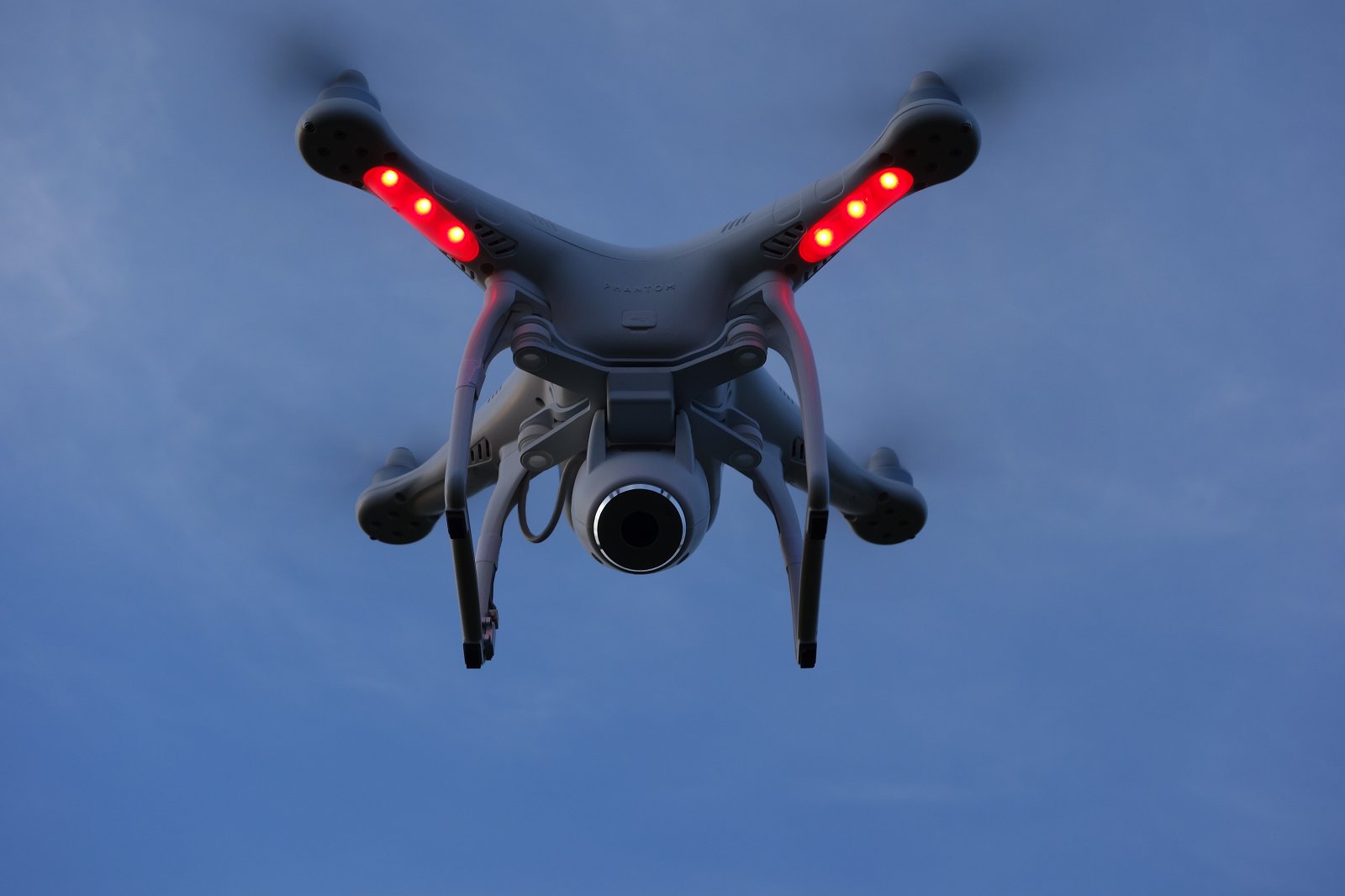
Recently, drones equipped with cameras are accessible to the public. Ie the flying camera, previously reserved for seasoned professionals or army becomes “democratic.” This camera can produce images of the sky views and movements that no other camera could do.
We last few years of daily users images seen from above, the interactive map that accompanies us (Google maps on phones and others), offering us an augmented experience of reality. Moreover, within videos and virtual worlds (Second Life, Minecraft...) games, we handle a flying camera, which allows us to see the action from multiple angles.
This flying camera , the drone, is now in the real world. She is now at its prehistory, but it’s there. Is she going to bring us to see reality differently? A look at the real world as we look at virtual worlds ? This view superhuman , now available, will it invite us to new forms of representation, visual as well as narrative, themes? New topics of films are they born?
It is, of course, go beyond the anecdote aerial image, the beautiful landscape seen from above, but consider the aerial image at all heights. And to consider the political dimension of the appropriation of a type of perspective previously prohibited by technical limitations. Moreover, to put it simplistically, the law allows to fly drones, but not drones equipped with cameras !
Beginnings
I came to thinking applied to these “Identified Flying Objects” accompanied by the artist Agnès de Cayeux instigator of acts, thoughts and writings internet and virtual worlds, which explicitly asks these machines.
Questions
Similarly in 2005, founding the Festival Pocket Films, I proposed at the edge of a new technology, the camera in the phone, a reflection acts on its potential, it seems to me just as essential today to question the camera in the drone in action.
Work
In September 2013 I had the students work in the audiovisual Designer Pro License Director on audiovisual creation with mobile phone. I returned in January 2014 to continue work on the potential of digital. A few days earlier, Agnès de Cayeux acquired the last manufactured drone DJI Phantom 2 Vision, we have learned to fly, for the purposes of her explorations and projects.
So I asked these questions to students. We made a first test shoot, then strong viewing these first images, into four groups, they designed projects uses drone to projects, shot and edited their films, as well as produces a thought from their work.
First productions
Here are six films and their accompanying form of PDF texts : the four films of the four groups, an additional film of a student after arrival, and a movie that I did.
- Point and Line to Plane. Floriane Davin, Jean-Sébastien Colas, Simon Kounovsky, Gaël Rezé. Choreography air of a man - machine.
- Labyrinth. Alexandra Oudin, Mossi Soltan, Jean-Damien Gros, Julien Barque. A man and a woman trying to get lost in a vertical maze.
- Kluh. Emilie Georget, Clément Dumais, Pierre Bellanger, Thibaut Lozenguez. The son of Hulk at the University.
- Disembodied. Coralie Puyau, Emilie Soumah, Jéremy Stadler, Iskander Benlachtar. A soul journey through space and time.
- Here and there. Melanie Peyriat. Essay on violence under general supervision.
- I’ve seen you. Benoît Labourdette. Intimate moment in the hollow of the sky.
The first film productions and elaborations are exciting. To my knowledge, this is the first time that this type of image is questioned beyond the effect of specific style in its background, ie its potential capacity to bring to rethink audiovisual expression.
Désincarné
Ici ou là
Kluh
Labyrinthe
Point et ligne sur plan
Resources
- The army of drones: Excellent article from Annick Rivoire (Poptronics) on the economy and the political dimensions of drones.
- Agnès de Cayeux: Artist in the web and virtual worlds. Instigator of content work with drones. Large creative and conceptual foundations are laid in her works.
- Heliomicro: Site handy, especially on legislative issues.
- DIY Drones Community Site (in English) for drones, founded by Chris Anderson (former editor of Wired magazine, who invented the concept of “long tail”).
- I’ve seen you (MPEG4)
- Désincarné (MPEG4)
- Ici ou là (MPEG4)
- Kluh (MPEG4)
- Labyrinthe (MPEG4)
- Point et ligne sur plan (MPEG4)



Benoît Labourdette designs and leads professional training courses for new media, within training centers (CEFPF, INA Expert, Universities) as well as directly for companies or professional networks (ARTE, Forum des images, Documentaire sur Grand Ecran, Altermédia, Drôle de Trame, SCAM, NAAIS, CFI...).
The digital revolution consists in these new technologies which populate our daily life and modify the uses, the produced contents, the channels of diffusion, the economic models, the relations, the working methods...
The training allows the appropriation of these new languages, technologies and practices, in a perspective of professional construction: discover, experiment and appropriate tools, strategies, creative techniques, based on solid conceptual foundations. The goal is to equip oneself to be able to build the future of the audiovisual field in a concrete, open, innovative and economically viable way.
You will find here a few examples of internship processes, as well as downloadable deliverables.
-

Reflections on a professional training session at ESRA for camera operators (OPV).
Retour sur une formation professionnelle à l’ESRA pour des OPV (Opérateur·ice·s de prise de vue).
Moving tables to shift perspectives: the story of a day where we browsed, photographed, and created together to question what technologies do to (…) -

New Media Professional Training (ESRA)
Practice to prepare for tomorrow’s challenges.
A Sector Linked to InnovationThe ESRA, a private film school established in 1972, also offers professional training programs. I led a session (…) -

“Cultural rights” creative writing seminar
Master Arts du Spectacle, université de Caen Normandie 2021-2022-2023-2024.
A practical seminar on digital writing, with the theme of cultural rights. Students approach writing in the contemporary sense of the term, (…) -

CEFPF : Formation « Concevoir, réaliser, financer des contenus pour les nouveaux médias »
Stage de 5 semaines (formation en présentiel, à distance ou mixte).
Cette formation approfondie proposée par le CEFPF, dont le formateur référent est Benoît Labourdette, permet l’appropriation des nouveaux (…) -

CEFPF :“Designing, producing and financing interactive transmedia content” training course
Vocational training on technologies and strategies for developing transmedia projects.For the eighth year, I am the referent trainer of this (…) -

SCAM : “Workshop about Digital Media Diffusion : basics and best practices”
Express Training about the basics and best practices of digital video, for the authors of the SCAM.The SCAM (Civil Society of Multimedia (…) -

University of Picardie: “New media, new writing, new funding”
Training new media in Picardy. Course open for registration.The training “New media, new writing, new funding” proposed by the University of (…) -

Montpellier III University : Transmedia strategies, encoding and creativity
5 day course : technical basis, strategy and creativity for new media.The students of the “Licence Pro audiovisual designer director” (…) -

CFI : Digital Training for teachers editors (AFDA - South Africa)
Expert training to technology and digital video workflows, for editing teachers from several schools in the African continent. At AFDA, (…) -

Forum des images : Film and digital video training
The Forum des Images cultural institution in the city of Paris, is a cultural place of film programming, offers a collection of films about Paris (…) -

Montpellier 3 université : exploration of drone. Drone as a creative tool ?
ThoughtsRecently, drones equipped with cameras are accessible to the public. Ie the flying camera, previously reserved for seasoned (…) -

CEFPF : “Training”Design, build, finance content for new media"
Since four years, I coordinate and I run a large part of this training of five weeks, which aims to provide skills into the multidisciplinary (…) -

Documentary on Big Screen : Digital Cinema Training
I led the team for the association Documentary on Big Screen a two-day training on technologies “Digital Cinema”.Documentary on Big Screen is (…) -

ARTE - Training manufacture of a multimedia work
The Franco-German channel ARTE is, like all TV channels, changing the very nature of its activities. ARTE pioneered early on the web (with ARTE (…) -

CEFPF : Introduction to web documentary and transmedia
As part of a course “Producing for TV” in CEFPF (European Center for Production of Films), I gave a half-day introductory course on topics “web (…)


-

The Company, place of creation in Marseille : drone workshop Film workshops with drones
Inventing art forms, filmed with drone.The Company, place of contemporary art in Marseille, led by Paul-Emmanuel Odin, invited me to offer to (…) -

Wave Length Festival : “Drones listening” (masterclass and performance) Conferences
The drone as a tool for sound creation.The Wave Length Festival 12th Festival of the radio and listening (Brest - France), invited me as part (…) -

UPOPI : “Drones : Embedded gaze” Articles
Article on the site Popular University of Pictures (UPOPI). On the representation of the world that drones are changing.The Popular University (…) -

The men on camera A film by Benoît Labourdette (4’45s, 2015).
Visual composition, music and sound, from a noisy flying camera, referring to the movie “The Man with a Camera” (Dziga Vertov, 1929). -

Flowers from the grave, video/organic installation, Garden Festival of Chaumont sur Loire Artistic installation
Video-vegetal installation.Into the International Garden Festival of Chaumont-sur Loire, the landscape architect Jean-Philippe Poirée-Ville has (…)
