OPC: “Culture, youth and digital” training
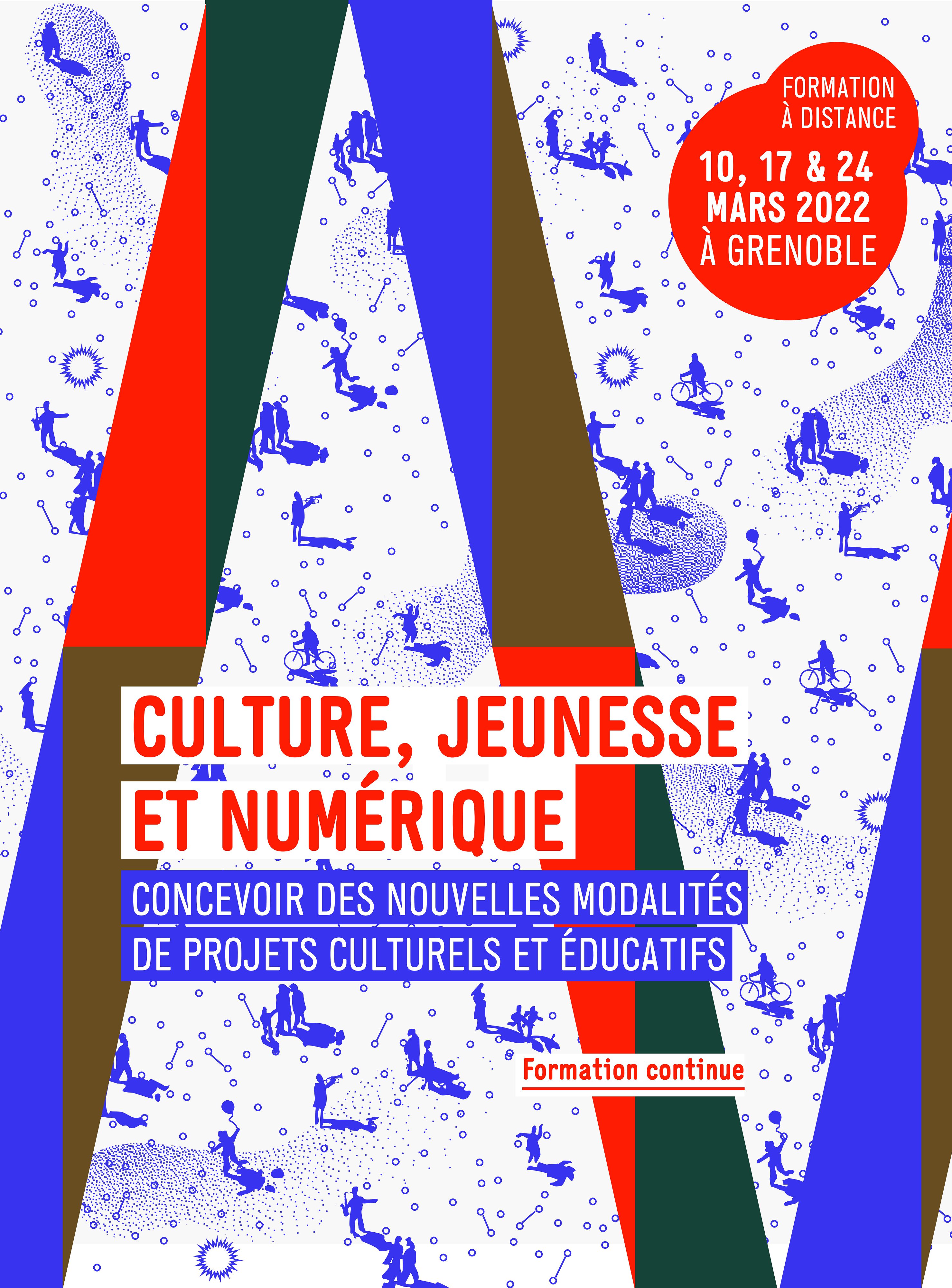
A new concept of internship for cultural professionals, in order to build an opening to the public who have deserted the public and associative offer. By the Observatoire des Politiques Culturelles. Course led by Benoît Labourdette.
Trainee feedback
- “I think I can say that this is the first time I have come out of a training course so satisfied, both with the content I came for (the amount of resources brought and shared is impressive) and with the values shared. Benoît Labourdette’s posture is incredible in its benevolence and generosity. Super pedagogue. I feel very lucky to have been able to take part in this training. THANK YOU AGAIN!”
- “I will recommend it to anyone working in the cultural sector! The strength of this training is that it works on the philosophy and coherence of the projects, encourages peer exchange, and proposes alternatives. Whatever the subject, everyone can find something to do with it.”
Translated with www.DeepL.com/Translator (free version)
Introduction to the course
The cultural offer is sometimes questioned in a brutal way by the “young” public. A questioning that manifests itself in particular by an indifference towards the prescriptions of cultural institutions, or even by a disinterest in cultural places.
In 15 years, digital technology has changed the relationship of young people to time and private space. The very definition of culture and the way it is accessed have been transformed.
The “Culture, youth and digital” training course proposes to deconstruct the preconceived ideas linked to the digital transformation. It aims to take the measure of the new representations of the world and the new cultural practices closely linked to digital technology. The course aims to equip learners to be able to reinvent adapted strategies and relevant proposals that will enable them to rethink the meaning of public action for youth.
The pedagogical device involves the participants in a creative process intended to make them experience tools and an experience of “doing”. The training is conducted in a contributive spirit, facilitated by a dedicated digital platform. Its facilitation is purposely proposed remote, to consider, within the group, reinvented forms of cooperation.
The multidisciplinary pedagogical approach allows to appropriate complex notions, especially on digital technologies and their uses.
This training will be of interest to professionals and elected officials in the cultural, social and educational fields, whether or not they are familiar with digital issues.
Objectives / skills targeted
- To analyze the use of new technologies by young people.
- Design strategies, projects and cultural services for youth by working in a transversal and intersectoral manner.
- To accompany the practices, uses and rights of children and adolescents, notably by developing mixed face-to-face/distance proposals.
- Build arguments to present a project and defend it to partners, elected officials and collaborators.
- Evaluate the results of one’s action by mobilizing qualitative and shared indicators.
Contents
Knowledge and analysis
- Technologies and digital uses.
- Philosophical and political issues in the digital world.
- Psychology and sociology of youth.
- Cultural practices from childhood to adolescence.
- Cultural rights.
Methods and tools
- Mediation issues and artistic and cultural education projects.
- The proper use of digital tools and the web.
- Mobilization of young audiences.
- Dynamics of cooperation.
- Public devices and project methodologies.
- Putting cultural rights into practice in working methods.
Projects and good practices
- Studies and sharing of case studies.
- Mixed face-to-face/remote projects.
- Dialectic between mediation and creation projects.
- Project development.
- Project evaluation methods.
Audiences
- Professionals in the fields of culture, youth, education and social work.
- Managers and project managers in public authorities.
- Mediators and animators.
- Specialized arts teachers.
- Artists and speakers.
- Elected officials...
Group of 20 people maximum.
Pre-requisites
No diploma required.
Professional experience required.Pedagogical methods and means
Organization, pedagogy
- Acquisition of knowledge, methodological knowledge and professional know-how.
- Practical case studies.
- Online group workshops and individual creative work (photo, web, video).
- Editing of a free contributive platform.
Trainer
Benoît Labourdette is a filmmaker, educator, expert in new media and cultural innovation. He founded the Pocket Films Festival with the Forum des images and the National Short Film Festival for the CNC. He shares numerous methodological resources, case studies, publications and works on the website www.benoitlabourdette.com .Follow-up and evaluation
- Personal productions before and between days.
- Follow-up by the trainer to accompany the acquisition of knowledge and skills.
Hardware and media
- Stable internet connection.
- Windows, Mac or Linux personal computer (preferably with rights to install software).
- Webcam and functional microphone for videoconferencing.
- Documentary file upstream and transmission of documents downstream.
Practical information
Dates and location
Thursdays, March 10, 17 and 24, 2022 in remote.
Schedule: 9am-12:30pm / 2pm-5:30pm.
Work is to be done before and between each day.Cost of the training
800 € TTC of educational costs for 3 days, that is to say 21 hours of training.Recruitment method
On application form, to be filled on our online platform at the latest on February 28th, 2022, see on the site: www.observatoire-culture.net .
Applications will be examined according to motivation and order of arrival. Confirmations of registration will be sent within a maximum of 5 working days.Accessibility
If you have a disability, requiring technical or pedagogical adaptations, please let us know by contacting us before sending the application form.Information / Information
Tel. +33 (0)4 76 44 95 05
formations observatoire-culture.net
www.observatoire-culture.net
Qualiopi certified process.
Observatoire des Politiques culturelles
Both a force of proposal and analysis, the OPC has acquired since its creation, in 1989, a unique know-how and a recognized expertise on cultural public action in France and in Europe. The Observatory is supported by the Ministry of Culture, the Auvergne-Rhône-Alpes Region, the Isère Department, the City of Grenoble and Sciences Po Grenoble. In addition to the Culture and Youth Workshops, the Observatory offers other continuing education courses on the management of cultural projects, digital issues, cooperation and cultural rights.
1, rue du Vieux Temple 38000 Grenoble
formations observatoire-culture.net
Tel: + 33 (0)4 76 44 95 05
www.observatoire-culture.net
Link to the presentation page of the course on the website of the Observatoire des Politiques Culturelles:
www.observatoire-culture.net/rep-formations_edito/ido-77/concevoir_des_nouvelles_modalites_de_projets_culturels_et_educatifs.html

In the digital age, cultural policies, whatever their field, must in my view take digital images and their uses into account by citizens, especially the younger ones.
Digital has put the image at the center of our lives. With these tools, thought and implemented in a lucid, innovative and adapted way, it is possible to invent new strategies to mobilize, give meaning and make appropriate the cultural proposals by the public.
-

Evaluating Arts and Cultural Education from the Artist’s Perspective
Review of a course given at INSEAC: conceptual and methodological tools for cultural professionals.
On January 15, 2026, as part of the CNAM module EAC104 “Building tools to evaluate ACE projects: qualitative and quantitative survey methodologies (…) -

Working with Artists in the Social Field
An account of a training session for Cultures du Cœur on setting up artistic workshops in collaboration with artists.
How can artistic practice and social support be combined? This question drives social work professionals seeking to integrate culture into their (…) -

Conference: “EAC and cultural rights: convergences to be identified and implemented”
Dans le cadre des Rencontres territoriales “Artistic and cultural education & Territorial cultural projects” (Foix, February 5, 2025).
How can cultural rights be a tool for better implementation of artistic and cultural education projects? And how we can identify convergences (…) -

"Culture, youth and digital: designing new modalities for cultural and educational projects
Sharing of methodological tracks and professional training.
Deconstructing preconceived ideas about digital transformation and developing projects adapted to young people.The cultural offer is sometimes (…) -

OPC: “Culture, youth and digital” training
Designing new modalities for cultural and educational projects. March 2022.
A new concept of internship for cultural professionals, in order to build an opening to the public who have deserted the public and associative (…) -

OPC : The digital transition in professional and amateur cultural practices
Master 2 “Management of cultural projects” (Science Po Grenoble - OPC)
The digital practices of citizens are changing the meaning of cultural proposals, both public and private. The paradigm of access to culture has (…) -

ALCA and FRAC Aquitaine: Encountering audiences and a neighbourhood: co-constructing and experimenting an itinerant screening
Documentary on training, directed by Théo Rulin (3’18s, 2020).
Professional training through the concrete implementation of a cultural action rooted in the challenges of a territory, over two days (February (…) -

Nantes métropole: “Cultural and digital mediation in common” meeting
Animation by Benoît Labourdette of a day of sharing digital mediation tools for cultural and digital mediators in the city of Nantes. September (…) -

Haute Savoie Department: “Digital technology and artistic and cultural practices through a pedagogical approach”
How to raise awareness in a very short time and in an active way about the creative potential of digital technology? FrameworkTh eDSDEN of (…) -

Institut Français: Innovating in cultural policies for cinema and the relationship with the public, in the light of digital practices
Training for the Institut Français Region East Europe
To take into account the evolution of the use of moving images, in order to conceive adapted cultural proposals, motivating for the public, and in (…) -

Growing up with culture : “The contribution of digital technology in cultural mediation”
Conference by Benoît Labourdette about cultural mediation with digital tools, on the example of the travelling projections within the framework of (…) -

Ciné Lab # 6: “New usages, digital cultures. What (R) evolution for cinemas?”
Day of reflection and common development of innovative projects, for cinema operators and mediators.The ACRIRA and the GRAC (Rhône Alpes (…) -

IPM PACA: “Creative potentialities and conquest of new audiences with digital”
Conference on the creative potential and the conquest of new audiences that digital allows, in the context of the launch of the call for projects (…) -

Vatos Locos Video: “Designing and implementing artistic practice projects to combat racism and discrimination”
Vocational training for leaders, teachers and managers of social and cultural structures. Video as a Tool for Citizenship.The association Vatos (…) -

Observatory of Cultural Policies: “Territorial Projects and Cooperation”
Territory, digital, culture, participation, participation, creativity... keys to understanding and methodologies for relevant and innovative (…) -

Autumn Festival in Normandy Hybridations # 2 - New creative ways (web conference)
Roundtable / lectures on the issues of creation in the digital age.Rouen, 2 December 2014. I participated in the roundtable / lectures as an (…) -

Gaîté Lyrique : mobility and creation seminar
Benoît Labourdette’s conference (full video) : “The mobile audiovisual creativity: challenges and opportunities.” (36 minutes)Introduction of (…) -

French Institute: “Training for new digital challenges”
Benoît Labourdette’s lecture on the benefits of cultural initiatives with pocket cameras.In May 2012, the Institut français proposed 3 days of (…) -

9th Forum of the look: “What is digital ?: The stakes of the new screens”
Animation of a conference by Benoît Labourdette on the issues of the new screens, October 8, 2010.“What is digital ? : The stakes of new (…)


-

Reinventing cultural projects with youth?
Proposal of questions.
While public cultural action aims to reach people in their great diversity, it is clear that it is often difficult to mobilize youth. However, (…) -
"Culture, youth and digital: designing new modalities for cultural and educational projects Sharing of methodological tracks and professional training.
Deconstructing preconceived ideas about digital transformation and developing projects adapted to young people.The cultural offer is sometimes (…) -

Helping professionals design new types of projects adapted to the needs of young people Laboratory for an original training and project development program.
In the face of young people’s indifference toward institutional culture, I propose exploring an innovative training framework aimed at helping (…) -

Balance and supports A method for the sustainability of projects.
Based on the way the human body balances itself, for a sustainable approach to project management.Observation of nature is often very good (…) -

Artistic creation in a digital environment Commentary on the report commissioned by DRAC Bretagne (August 2023).
A study on the subject of digital and artistic creation reveals, through its unquestioned biases, the unconscious desire not to move the lines of (…)
