The drone, a creative tool
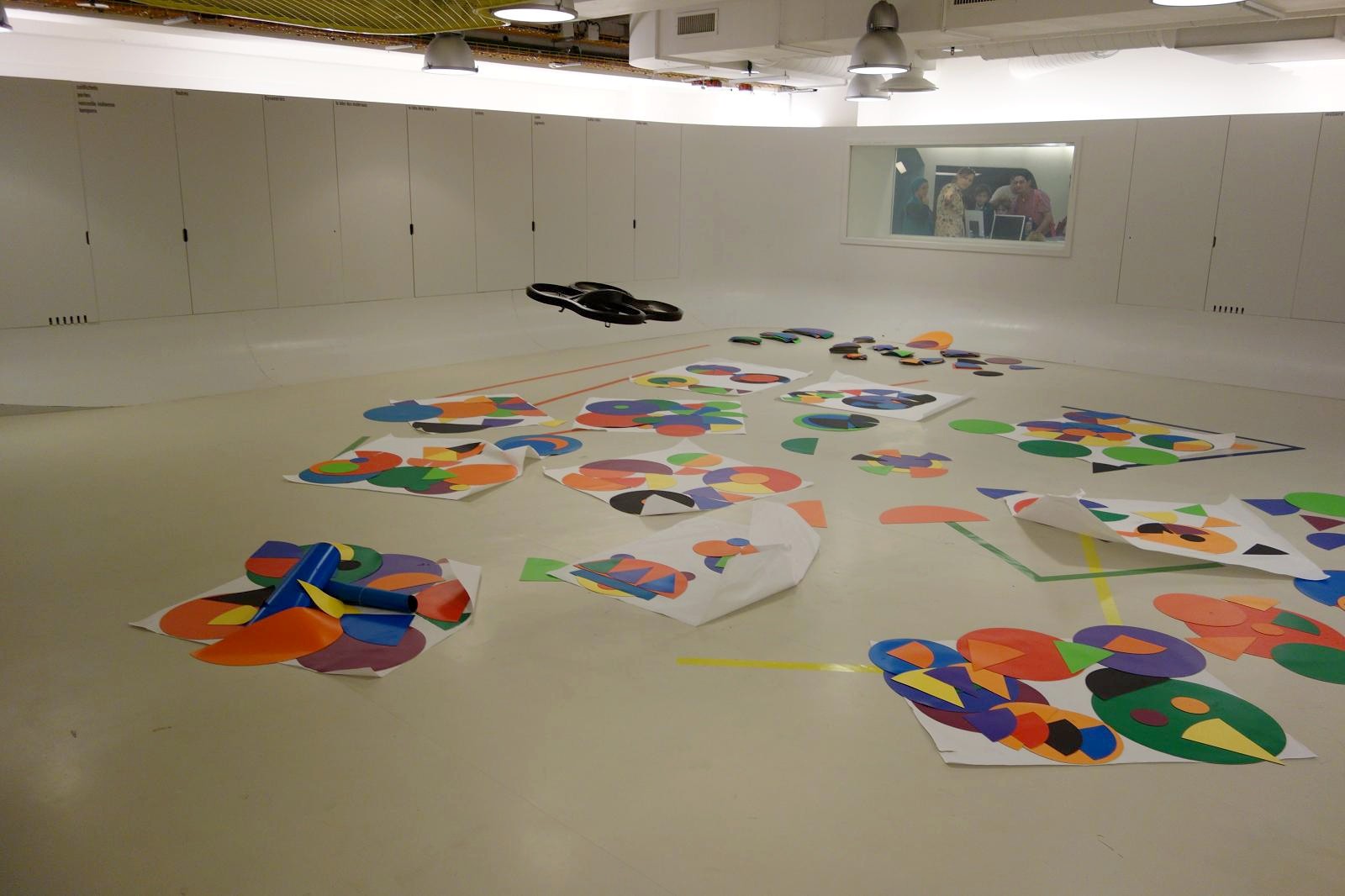
How can a drone be a tool of cinematographic creation at the service of an artistic and political project, and no longer be considered as a neutral technical tool, which it absolutely is not? Theoretical argument based on creative experience. Article reread and corrected by Roger Odin, published in Théorème 29 : “Mobiles : enjeux artistiques et esthétiques” (2016).
Drones, which are increasingly accessible to the general public, are automated objects equipped with cameras. These cameras are used on the one hand to feed the positioning algorithm (alongside GPS, accelerometer, altimeter, sonar, presence sensor, etc.) and on the other hand to produce images, which can be surveillance (military, police, cartographic, archaeological, ecological, ...), personal (perhaps the future of the selfie) or creative (low-cost aircraft views, fluid travellings, etc.).
The images produced by drones will thus be increasingly present in our representations. But who’s watching? What is the point of view behind these machine-operated images? Without a doubt, the increasingly frequent production and distribution of such images will change the way we represent the world.
As a filmmaker, from the moment that drones arrived massively in the general public (Christmas 2013), I’ve been preoccupied with interrogating this new technology, in the same way that I had done since the appearance of cameras in cell phones (2005) through the creation of the Pocket Films Festival and artistic production. So, since the beginning of 2014, I’ve been experimenting with the drone as a tool for audiovisual creation. Because I’m convinced that theory isn’t enough and that we need to confront objects very concretely, through artistic projects, to be able to grasp their issues and work on them in depth.
I’d like to take you through some of my cinematic experiences with drones, each revealing a facet of the issues involved in artistic practice with these objects. All the films I discuss are available online.
I’ve seen you
4’09s, 2014.

Just a few days after purchasing the “DJI Phantom 2 vision”, a medium-sized drone (of the type that has flown over nuclear power plants, with a range of two kilometers), I was invited to speak at the transmedia professional degree course at Montpellier’s Paul Valéry University, and suggested that the students explore the specificities of audiovisual language on drone. Six films were made. “Je t’ai vue (I’ve seen you)” is one of them.
The first thing that struck me was that, with the camera soaring high in the air, there was a sense of reappropriation of the world as seen from above. French law forbids citizens to fly over cities, which is understandable in terms of safety (but in the long run, will drones be more dangerous than cars on the ground?), but poses a problem in political terms, since Google and the army are taking the right without any law authorizing them to do so. Based on this real-life awareness that the image is a political weapon for regaining power, among all the shots produced in various ways, I chose an ascending shot, framed downwards, in which we see the drone’s reflection in the windshield of a car at the start, then a man walking mechanically, and finally an elevation high above the buildings (the image becomes cartographic). The film shows the same shot twice: the first time, the shot is heavily cropped, so we see the reflection, the figure and the elevation, but the frame is very tight, so the elevation effect is hardly visible. The second time, the shot is full frame, we see the reflection in the windshield, and then the elevation shows us that we are in fact much higher than the physical sensation we had with the first shot. It’s a striking image, because it’s superhuman in the literal sense of the word. For me, the effect of surprise was real. Staging the discovery of the miracle of being able to film with a drone. It’s the same feeling you get when you discover a new camera (I had the same feeling with the cell phone in 2005).
And this led me to the subject of the film: distance. The soundtrack is divided into two movements synchronized with the images: a remix of a Beethoven violin concerto, followed by machine music recorded at a funfair. The culture, the past, then the future of machines, ending, when the camera is very high up, with a little rhyme that these images evoked in me and which is repeated three times: “This is far from me. This is far from you. This is far away. A final moment in which one senses a feeling of nostalgic love. This technology, which allows you to raise your gaze above your body, is basically a poetic and nostalgic experience.
Chaosmos
8’51s, 2014.

My aim here was to see if these flying machines could help our representations evolve beyond the airplane view. I’d already explored the airplane view, but I wanted to go further, by situating myself at man’s height, to try and reinvest what, a priori, doesn’t need to be filmed by a drone, what can be filmed with a “normal” camera. So I asked the painter Richard Texier to film one of his paintings, using a drone... a seemingly absurd proposition: to film a static, flat object like a painting, you don’t need a drone...
Richard Texier, who is open to many experiments (and who was only a little anxious about all the dust raised by the drone in his studio), had prepared a large triptych (three paintings instead of one...), set up vertically, and had placed “accessories”, a sort of small set. Through the future presence of the drone, the film to come was constructed in a different way: I was no longer the filmmaker who came to watch, I was the “man with the camera” who came to propose making a film together. That’s my creative philosophy: I believe that you don’t make a film about a subject, you make a film with its subject. Because the presence of the camera changes reality, the staging device is not something you place on top of the world, it’s something you build with the world. So I filmed a lot of rushes with the drone, advancing, retreating and rotating towards the paintings, the set, the studio... and also the paintings themselves. Then I asked Richard Texier to speak, but there was no question: he improvised a text. He talked about the title of his triptych, “Chaosmos”, and the link between this artistic project and the concepts of Gilles Deleuze.
I therefore had a lot of images, which were complicated to make, because with the wind, the drone would inexorably move backwards as soon as it got too close to a painting, and sometimes it would go up or down on its own, without my control, thanks to a flow of hot air in a certain part of the studio... it was impossible to make a fixed shot, in short, I had an extremely fluid, constantly moving material. In the end, Texier’s abstract paintings were not so far removed in their essence from the movement of these images. But editing was impossible: these shots were impossible to cut, no reason, no necessity presided over the cutting. Of course, I could have forced the cuts, but then the film would have been false, which would have been antithetical to his project, which was a documentary. Fortunately, Deleuze was there, in the title of the picture and in Richard Texier’s words, and all of a sudden, his philosophical concept of the “plane of immanence” (What is philosophy) came to the fore. I quote: “Concepts are like multiple waves that rise and fall, but the plane of immanence is the single wave that winds and unrolls them”. What came to me unconsciously, the link to the concept being made later, was the idea of not cutting any of these shots, but of superimposing them all, not in a classic overlay, where the luminosity of each is reduced according to the number of shots superimposed, but by adding the numerical values of the pixels, each shot thus being full and whole. These shots have different durations, so they all start at the same time, producing an almost white image of the works filmed, barely revealed by the drone’s rotations in front of them. Then there is a sort of successive decanting of the images, the works and the device set up in the studio, offering the viewer a real interior adventure in the material of the painting.
In this way, because the drone offered me rushes that were impossible to edit using conventional chronological techniques, I was led to rethink the very function and technique of montage, enlightened by the painter’s words and Deleuze’s concepts, which is no longer there to tell the story, but to reveal, if I may say from the inside, the “truth” of Richard Texier’s abstract pictorial works.
Trio
7’26s, 2015.

With a much smaller drone, this time the “Parrot Bebop”, I wanted to continue exploring the way in which the drone modifies our relationship to editing, by shooting with two actors in an empty apartment. The film’s title is “Trio”, referring to the presence of a third actor.
A very particular dimension of drone movement is lateral movement: it’s an extremely mechanical movement, quite abrupt, even if we try to slow it down, and above all it’s an excessively voluntary movement: we give the order to the machine, which is very autonomous, to turn on itself, and it carries it out. In this movement, you can clearly feel the mechanical presence of the machine: it’s not the gaze that turns, it’s the body carrying this gaze which, making a sudden rotation on itself, makes us see something else.
I took an empty apartment, entirely white (rooms, doors, windows, walls). I chose to superimpose the same shot-sequence four times, launched in a staggered manner, as in the musical figure of the canon. The sequence of camera movements is like a montage created by the drone. A real montage in the sequence shot, through the confrontation with itself in the temporal shifts.
The sudden lateral movement of the drones is not a movement, it’s a cut in the gaze, it’s editing, already present in the shot, as this film clearly shows. This film therefore explores the editing proposals that the machines’ gaze makes to us, due to the constraints of movement in enclosed spaces.
Prosopopoeias
3’47s, 2016.

Arcadi-Ile de France, founder of the “Nemo” contemporary art biennial, was organizing an exhibition at Le Cent Quatre in Paris entitled “Prosopopées, quand les objets prennent vie”, and asked me to make a documentary memory of the exhibition, using this object that looks at objects: the drone... So I spent three days filming these works and this place, using the Parrot Bebop drone. There were so many electromagnetic waves present in this place that the drone was very difficult to control, often moving against my will. Three times, without my permission, it flew into walls, blowing up its front-mounted camera (the shoot cost a lot of money in camera replacements...). The result was a very large number of rushes, which I had to make my own. I had to learn to understand these images, which were produced by the camera’s algorithm rather than by my piloting, and learn to take in what they had to say about the film’s subject. And I believe that the film, once edited, is just in relation to its subject. The dialogue between the machines, in which I discreetly interfered, enabled me to tell something about the presence of machines among us.
Brahim’s backpack
5’04s, 2016.

As part of a collective drone filmmaking workshop (Rencontres Passeurs d’images, 2015), I invited a group of teenagers to race the drone. I set the machine’s speed to maximum, and the race was on. When a drone moves forward, it leans forward, and when you’re far from it, it’s hard to perceive its exact position, which is why, very often, the drone “crashes”. In this case, I was sure it would crash, as it came closer and closer to the ground, but no, it skimmed the ground without accident. Such a plan would be impossible to pull off if we decided to do it. So it stayed in my head for a long time. And on the day of the shoot, I was in the throes of a very violent love affair. Some time later, the two things came together, and the extreme imbalance of the image, which could not have existed without the fragility of the drone’s camera, suddenly resonated deeply with my moral imbalance, prompting me to write a fictional voice-over.
Richard Texier at work
9’54s, 2014.

After filming painter Richard Texier’s “Chaosmos” with a drone, I also suggested filming him at work. Filming an artist’s work is a challenge if ever there was one, because the creative process is, by its very nature, invisible. So, precisely, with the camera on a drone, with a different viewpoint, a non-embodied viewpoint, perhaps we could reveal something else about the creative process.
Richard Texier said to me: “The object is going to film me, and I’m going to look at the object as if it were you, I’m going to talk to it, even if it doesn’t record sound”. In the editing process, I kept the entire sequence, highlighting the device with subtitles that appear at the beginning to invite the viewer to enter into this “experience”: an ontology of the drone image, making us feel what this camera, in its hesitations, in the “defects” in shooting that it entails, has an in-depth effect on our gaze and our senses. I then associated these images with improvised music, which I played on a “prepared piano” (a piano inside which foreign objects are placed) to make it “sound” differently. This improvisation was then counterpointed by synthesizer work on “rotating” music, evoked by the drone images.
I believe that this film invites the viewer to become part of a new, very singular “body”, at once small and large, changing shape and silhouette, very near or very far, in front or behind, on top or underneath... it is perhaps, in the end, the inscription in physical reality of our experiences of perception with the Internet: close or far from one moment to the next, inside or outside a subject, very very quickly... the drone invites us to film the world as we experience it when we’re behind our screen. This brings a richness, a new depth perhaps, to a reality thus penetrated by the singular movement of the virtual.
Laongo
3’39s, 2015.

This film is a documentary about sculptures made by artists from various countries, gathered in Burkina Faso’s Laongo Park. It’s a sequence shot: the camera moves from one sculpture to another, pauses to look briefly “in the face”, then moves on to another sculpture. I shot this film with a “classic” handheld camera, with no sophisticated stabilization system. Yet some viewers genuinely believed the film was shot with a drone. And then ... what had to happen happened: our shots, even with old-fashioned tools, are influenced by the aesthetics of images made by robots. We can look at this with humor, with disenchantment, but we can also find in it a richness, an opening in the “grammar” of cinematographic language.
We now have in our palette an autonomous, living camera, mobile in three dimensions, no longer attached to the ground. We can put ourselves, and the viewer, in a new body, one that allows us to see the world differently, to move our gaze around in a way that no human being can do with his or her traditional body.
Today’s drone images open up a new poetic space for the gaze and representation, through the evolution of the body carrying the camera. This infuses the whole process and devices of writing and audiovisual creation. To grasp this, to risk it in practice, to listen to what robots have to show us, is not to submit to them, but to begin to know them, to understand them, in order to found our future freedom of vision, in a context where images will be of an essentially different nature from what they were before.

Le drone, cette caméra volante qui arrive parmi nous, soulève, pour un cinéaste, des questions importantes. Objet militaire, objet de surveillance et de mort, objet d’ubiquité cartographique des multinationales, et bientôt objet commercial, objet de livraison. Interdit du regard vu du ciel, objet filmeur des mondes virtuels qui arrive dans le monde réel, oeil sans corps pour le tenir, objet soumis aux vents, à l’air chaud ou froid, sensible aux mouvements invisibles de la nature, caméra qui volète autour de nous... Ces changements de points de vue questionnent notre vision du monde. Lieux nouveaux de regard à explorer, à questionner, à détourner, à investir d’imaginaire et de créativité. Prendre de la distance avec les objets technologiques qui nous soumettent. Des questions d’écriture.
-

Promenade en forêt
Extraits (1’24s) d’un film de Benoît Labourdette (59’, 2020).
Film de relaxation destiné aux personnes hospitalisées. Une douce promenade en forêt de Fontainebleau, tournée avec un drone, illustrée par une (…) -

Des arbres, une femme
Un film de Françoise Simpère et Benoît Labourdette (6’38s, 2020).
Une promenade, un dialogue intime avec soi-même et avec la nature, un chemin pour se retrouver, être au monde. Un film né d’un dialogue entre des (…) -

EP7 La guinguette numérique
Projection sur les dix écrans d’EP7 - La guinguette numérique (Paris, Bibliothèque Nationale de France) d’une sélection de films de Benoît (…) -

Roaalysieovtfadnn
Un film de Benoît Labourdette (3’09s, 2019).
Hommage vu du ciel à l’œuvre de Victor Vasarely. -

Festival « Le joli mai » : Atelier de réalisation de films avec drone
Réalisation de films collectifs avec drone en deux heures ! Première édition du festival « Le joli mai »Dans le cadre du premier festival « Le (…) -

Un papillon chez Picasso
Un film co-réalisé par Alain Fleischer et Benoît Labourdette (18’01s, 2016). Musique : Benoît Labourdette.
Un drone volète dans le Musée Picasso juste avant sa réouverture en 2014. Une visite insolite dans un lieu tel qu’on ne le verra jamais plus. Et (…) -

Ville de Clermont de l’Oise : Réalisation d’un film avec drone
Atelier de réalisation de film avec drone pour un groupe d’adolescents à Clermont de l’Oise.L’ACAP (Pôle Image Picardie), dans le cadre du (…) -

Ville de Mitry-Mory : atelier drone au collège Paul Langevin
Tournages collectifs de films avec drone dans le cadre de la fête de fin d’année du collège Paul Langevin à Mitry-Mory.A Mitry-Mory en région (…) -

Ville de Niort : Réalisation d’un film avec drone par des adolescents
Création, écriture, réalisation, interprétation d’un film entièrement tourné avec un drone, piloté par des adolescents.Sur deux samedis (…) -

Ville de Choisy-le-Roi : atelier drone dans un quartier
Atelier audiovisuel avec drone pour de jeunes habitants de la cité des Navigateurs à Choisy-le-Roi, dans le cadre d’un projet artistique (…) -

Le drone, outil de création
Article paru dans la revue Théorème 29 : « Mobiles : enjeux artistiques et esthétiques » (2016).
Comment un drone peut-il être un outil de création cinématographique au service d’un projet artistique et politique, et non plus considéré comme (…) -

Prosopopées
Un film de Benoît Labourdette (3’47s, 2016). Produit par Arcadi Île-de-France.
Documentaire sur l’exposition « Prosopopées, quand les objets prennent vie ». Le regard d’une machine, le drone, sur des objets doués d’autonomie. -

Le sac à dos de Brahim
Un film de Benoît Labourdette (5’04s, 2016).
Une course effrénée, pour faire le deuil du départ de l’être aimé. -

Gaîté Lyrique : Images de drones
Conférence sur la création artistique avec drones. Images de dronesConférence-débat à l’auditorium de la Gaîté LyriqueJeudi 9 juillet 2015, à (…) -

L’art filmique et les drones
Article de Benoît Labourdette.
Filmer avec un drone change singulièrement le regard sur le monde, et peut-être l’écriture cinématographique, dans les dimensions à la fois (…) -

Digifest : conférence et masterclass de création avec drone
Conférence sur la créativité avec drone et masterclasse de réalisation de film avec drone.Dans le cadre de l’édition 2015 du Festival Digifest (…) -

Trio
Film expérimental de Benoît Labourdette (7’26s, 2015). Avec Marta Zielinska et Senghte Vanh Bouapha.
Un couple de « vivants-fantômes » émane des murs, des sols, des fenêtres, d’un ancien appartement. -

UPOPI : « Drones : le regard embarqué »
Article sur le site Université Populaire des Images (UPOPI) sur la représentation du monde que les drones sont en train de modifier. (…) -

Festival Infilmement petit : workshop drones adolescents
Explorer et questionner l’imaginaire du drone en actes par la réalisation d’un film collectif. Festival Infilmement petitDans le cadre de la 4e (…) -

Les hommes à la caméra
Un film de Benoît Labourdette (4’45s, 2015).
Composition visuelle, musicale et sonore, à partir d’une caméra volante bruyante, en référence au film « L’homme à la caméra » (Dziga Vertov, 1929). -

Festival Longueur d’ondes : « Drones à l’écoute » (masterclass et performance)
Le drone comme outil de création sonore.Le Festival Longueur d’ondes, 12e Festival de la radio et de l’écoute (Brest), m’a invité dans le cadre (…) -

Centre Pompidou : performance à six mains et un drone
30 minutes de performance avec un drone, pour un cinéaste, un performeur et un compositeur. Benoît Labourdette, Gabriel Beckinger, Philip (…) -

ECLA Aquitaine : « Game of drones ». Le drone, outil pédagogique, outil de création ?
Atelier de réalisation avec drone pendant une semaine pour un groupe d’adolescents, pour faire des clips musicaux, et autres...ECLA Aquitaine, (…) -

Territoire imaginaire
Oeuvre vidéo numérique. Benoît Labourdette (5’51s, 2014).
Formes abstraites, couleurs d’enfants, vues du ciel. -

La Compagnie, lieu de création Marseille : workshop drone
Inventer des formes artistiques, filmées avec drone.La Compagnie, lieu de création contemporaine à Marseille, dirigée par Paul-Emmanuel Odin, (…) -

Richard Texier au travail
Un film de Benoît Labourdette (9’54s, 2014).
Un mystère de l’acte de peindre, dévoilé avec Richard Texier. -

Centre Pompidou : atelier « Drone altitude »
Explorer les enjeux des images faites par les drones, dans le cadre d’ateliers pour des enfants.Le 27 septembre 2014, dans le cadre de la (…) -

Chaosmos
Un film de Richard Texier et Benoît Labourdette (8’51s, 2014).
Filmer la peinture de Richard Texier avec un drone... -

Université Paul Valéry Montpellier 3 : « Le drone-caméra, la déportation du regard » (conférence)
Filmer avec un drone change singulièrement le regard sur le monde, et peut-être l’écriture cinématographique, dans les dimensions à la fois (…) -

Je t’ai vue (I’ve seen you)
Un film de Benoît Labourdette (4’09s, 2014).
Où est notre corps ? -

Université Montpellier III : Exploration du drone. Le drone, outil de création ?
PenséesDepuis peu, les drones équipés de caméras sont accessibles à tout public. C’est à dire que la caméra volante, auparavant réservée aux (…)


-

Theorem 29: “Mobiles: artistic and aesthetic issues”
Under the direction of Laurence Allard, Laurent Creton and Roger Odin.
Publication by Benoît Labourdette of the article « The UAV, a creative tool » in the collective book “Theorem 29:”Mobiles: artistic and aesthetic (…) -

Roger Odin Musique instrumentale, 2023, par Benoît Labourdette (2’32s).
Un morceau au souffle fragile, que je joue pour te rendre hommage, ami qui vient de partir. -
Film art and drones Article by Benoît Labourdette.
Filming with a drone singularly changes the way we look at the world, and perhaps the way we write film, in both political and sensitive (…) -

“Image and mobility” Interview of Benoît Labourdette by Guillaume Renoud-Grappin (MCD n°78 “La conjuration des drones” - 2015).
For several years, Benoît Labourdette, director and teacher at La FEMIS, has been pursuing creative (experimental films) and educational (…) -

Is science immoral ? A film by Benoît Labourdette (5’11s, 2014).
The myth of scientific progress. According to Albert Bayet.
