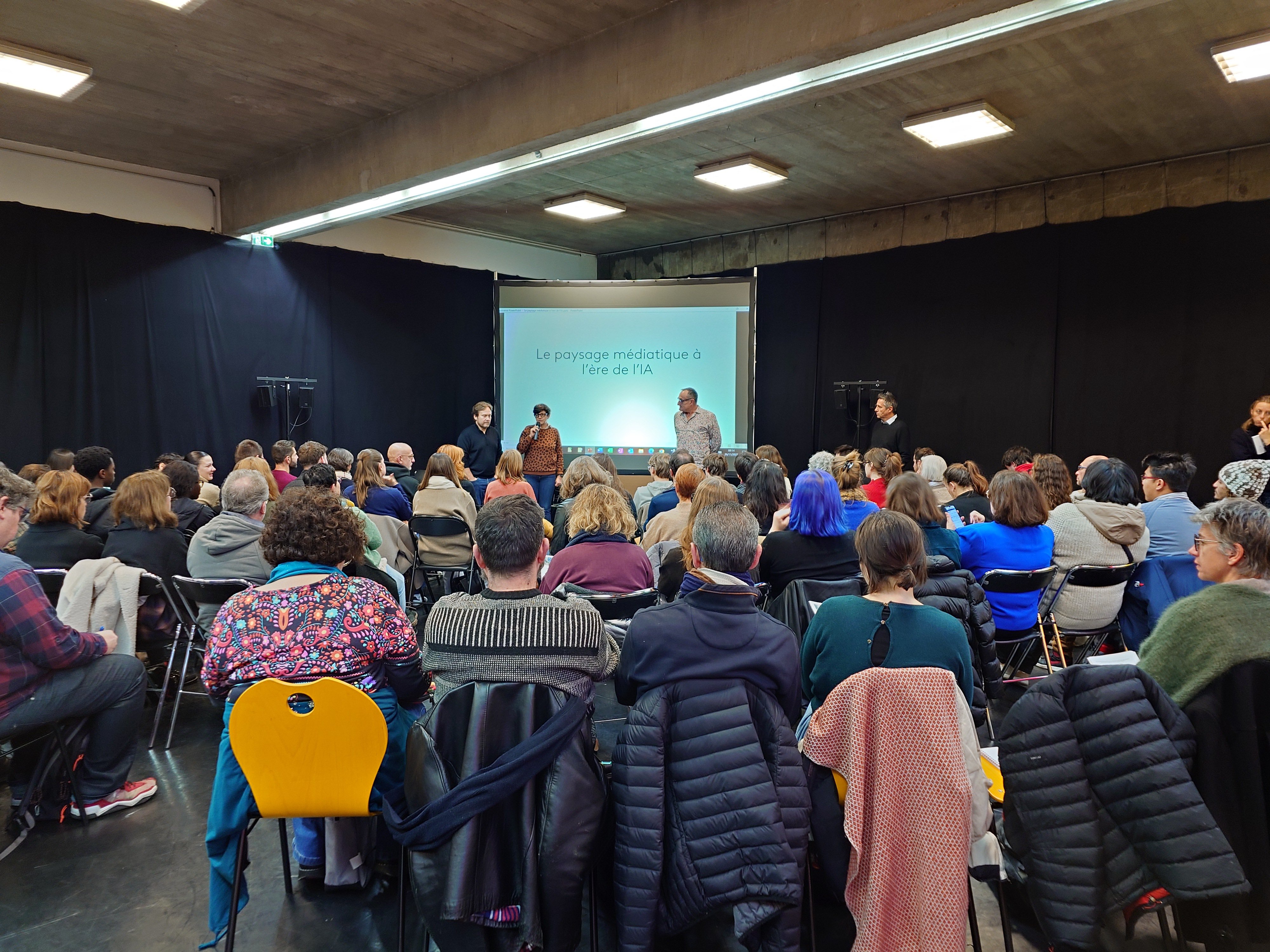
On November 26, 2025, in Reims, around sixty education professionals gathered for a training day entitled “Training Eyes in the Age of AI.” I contributed to its design and led an afternoon conference and workshop to enrich critical thinking pedagogy around Artificial Intelligence. Here is an account of this day with concrete elements, from my perspective.
An Institutional Foundation Serving Image Education
This training day was part of the missions of Blackmaria, the regional center for image education in Champagne-Ardenne. Structured around three complementary entities – La Pellicule Ensorcelée in Charleville-Mézières, Télé Centre Bernon in Épernay, and Saint-Ex Culture Numérique in Reims – this center has been working for several years to transmit a critical perspective on images and media. The event received support from the CNC, DRAC Grand Est, and the Grand Est Region.
The choice of venue, Saint-Ex Culture Numérique, was deliberate. This Reims space dedicated to digital culture offers a setting conducive to technological experimentation and reflection on contemporary transformations in imagery. Participants, coming from across the region, represented a diversity of profiles: secondary school teachers, librarians, cultural mediators, youth organization facilitators, and young people in civic service engaged in popular education missions.
Florence de Talhouët, coordinator of Blackmaria, had designed a program combining theoretical contributions and practical experiences. The stated objective was twofold: to equip professionals to face the transformations brought about by generative AI, while allowing them to experience creative situations themselves that they could then adapt to their own intervention contexts.
The Morning: A Classic Approach to Media Education
The morning was devoted to a lecture by journalist Pascal Doucet-Bon, entitled “Media Transformations in the Age of AI,” followed by a workshop on “fake news” and decoding tools. This presentation followed a classic approach to media and information literacy (MIL), centered on distinguishing true from false, source verification, and detecting misleading content.
This approach is not the one I practice, because I consider that journalists are both judge and party on the subject of media and information literacy. In my view, they are the least well-placed in terms of critical thinking on the subject, as they defend their profession above all else. I situate myself more within the field of image education, which starts from a different premise: every image is a construction. It is not so much about distinguishing the “true” from the “false” as understanding how images are made, by whom, for what purpose, from what position. I take a sociological rather than corporatist stance. The afternoon would allow me to develop this complementary perspective. This diversity of approaches is precisely the richness of a day like this, as people form their own point of view.
My Conference: AI and Culture, Current State and Perspectives
The afternoon began with my conference “AI and Culture: Current State and Perspectives.” I wanted to develop a viewpoint rooted in my practice as a filmmaker, educator, and researcher. Rather than approaching artificial intelligence from the angle of threat or technological wonder, I proposed situating it within a longer history of relationships between humanity and machines, between creation and technique.
I had brought numerous books that I had arranged on a table accessible to participants, and presented on screen via a camera. This ephemeral library included texts by philosophers such as Vanessa Nurock and Mark Alizart, anthropologists such as Tim Ingold, and neuroscience researchers such as Olivier Houdé. The intention was to show that reflection on artificial intelligence benefits from varied disciplinary contributions, and that the questions it raises—about intelligence, consciousness, creativity—are not new but find renewed relevance with these technologies.
Critical Thinking as a Posture of Humility
I opened my conference with a preamble on what seems to me to constitute the true challenge of media education: the question of critical thinking and its intrinsic difficulties. Critical thinking, as I conceive it, is above all the capacity to think for oneself. Yet this autonomous thinking paradoxically represents a social risk, as it can lead to disagreement with the group, with dominant opinion, with what seems self-evident.
Hannah Arendt, in The Crisis in Culture (1972), already emphasized that critical thinking implies a form of withdrawal from the common world in order to better return to it. This difficulty is not reserved for learners: it concerns educators just as much. I shared with participants my conviction that those who, in the field of media education, believe they hold the right message to transmit, are precisely those who would most need media education themselves! For they find themselves, without realizing it, at the opposite of the democratic values they claim to defend.
To illustrate this demand for openness, I took the example of TikTok, stating to participants that this social network constituted a “wonderful” space. I knew this statement went against the dominant opinion in educational and cultural circles. That was precisely my intention: to take the opposite view of a received idea to collectively invite us to question our own prejudices. If we are not capable of opening ourselves to what disturbs us, how can we claim to accompany others in developing their critical thinking?
What AI Changes About Our Humanity
Part of my presentation addressed what artificial intelligence changes in our very conception of humanity. For a long time, intelligence constituted the distinctive criterion of the human species compared to other animals and machines. Cognitive superiority seemed to guarantee our singular place in the order of living things. Yet contemporary artificial intelligences, three years after the public appearance of ChatGPT in November 2022, are calling this certainty into question.
I mentioned the concept of “singularity” developed by Ray Kurzweil from the 1990s, which postulates that within a few decades, the very conditions of life could be transformed by machine intelligence. Mark Alizart, in Celestial Computing (2017), proposes considering that machines, far from opposing nature, seek to reproduce its deep logics: is DNA not itself a code?
Faced with these upheavals, I suggested that what defines us as humans may no longer be intelligence but empathy, connection, the capacity to cultivate relationships of listening and mutual respect. The question then becomes: how can we avoid behaving like machines ourselves, how can we welcome the other in their singularity, how can we work as a team? These questions connect with the concerns of anthropologist Tim Ingold, who proposes rethinking education as a shared journey rather than a top-down transmission of knowledge.
Image Education Rather Than Media Education
I developed the distinction that seems fundamental to me between media and information literacy on one hand, and image education on the other. While the former is concerned with “source reliability” and “fact-checking,” the latter is more rooted in sensory experience and creation. Image education starts from a different premise: every image is a construction. There is no “objective” image that would be a transparent reflection of reality.
Therefore, the question is no longer about distinguishing true from false, but about understanding how images are made, by whom, for what purpose, from what position. This approach allows for a true emancipation of the gaze. It does not say “here is what you must believe,” it says “here is how to look at what you are being shown.” I suggested that the approach through creation offers a more relaxed space, where diversity of viewpoints can be expressed without the tension inherent in debates about true and false.
I mentioned John Dewey and his conception of art as lived experience rather than external object, a philosophy that runs through the new pedagogies from Célestin Freinet to Paulo Freire. The latter wrote in Pedagogy of the Oppressed (1968) that “no one educates another, no one educates themselves alone, human beings educate each other, through the world”. This sentence summarizes the spirit of what I seek to transmit in my interventions.
My Creation Workshop: Making a Film with AI
After this conference, I led one of the four workshops offered to participants: “AI Video Workshop.” This workshop uses a methodology I have developed for over two years, first at the Centre Pompidou as part of Studio 13-16, then at the Forum des images with Tumo Paris school. More than 500 teenagers have already participated in this experience of cinematographic creation in collaboration with artificial intelligences.
The principle is simple but demanding: in pairs, participants create a short film using tools accessible on phone. The workshop begins with a collective reflection on what distinguishes a film from a simple video: intention, narration, staging, aesthetics, characters, sets, eras. This initial discussion establishes that cinematographic creation cannot be reduced to the use of technical tools, but engages a process of meaning construction.
From Script to Image: The Stages of Creation
I transmitted to participants some elements of screenwriting technique, notably the concept of “suspense” developed by Alfred Hitchcock in his conversations with François Truffaut. Suspense rests on an information gap between what the viewer knows and what the characters know. This technique, omnipresent in contemporary cinema, helps us understand that making a film is first and foremost scripting the viewer’s emotion. The main character of a film, as Hitchcock said, is not the actor but the viewer themselves.
The creative process I proposed unfolds in several stages. The first consists of developing a very short script that can be summarized in three sequences or three shots. Participants are invited to use a conversational artificial intelligence, chosen from the aggregator Poe.com, to help them structure their idea. The imposed theme concerned artificial intelligence itself: its risks, its promises, what it changes in our lives, future professions. This mise en abyme seems particularly fruitful to me for developing critical reflection.
Once the script is defined, participants generate images using tools like Playground or others via the Poe.com application. This stage immediately reveals the characteristics and limitations of generative AI: difficulty obtaining exactly what you want, tendency to reproduce certain aesthetic stereotypes, problems of visual coherence from one image to another. These “flaws” become subjects for critical reflection on algorithmic biases and on the very nature of these technologies.
The still images are then imported into the CapCut application, where they can be animated using integrated artificial intelligence effects. Editing allows assembling sequences, adjusting durations, adding transitions. I always insist on one point: recording a human voice to accompany the images. This embodied voice rehumanizes the film and creates a meaningful contrast with the machine-generated images. It reminds us that behind every creative process, there are intentions, emotions, sentient beings.
Screening and Dialogue: Key Moments of Learning
The screening of the films created constitutes a moment I consider as important as the creation itself. Too often, image education workshops focus on production and neglect distribution. Yet it is in confrontation with the gaze of others that learning is truly constructed. Participants discover the incredible diversity of films produced from the same instructions and the same tools. Each pair explored different aesthetic and narrative directions, revealing that human creativity remains at the heart of the process.
This diversity becomes the support for a collective discussion on what the experience has revealed. Questions emerge naturally from practice: where do AI-generated images come from? What are the copyright issues? What is the ecological footprint of these technologies? How do these tools format our creativity? These questions were not imposed from outside but arose organically from the creative process itself. This, it seems to me, is where the strength of the creation-based approach lies.
A Day of Exchanges and Transformations
Participants left with new technical skills: using conversational AI for writing, generating images with accessible tools, video editing on phone with CapCut. These know-how can be directly mobilized in their respective professional contexts. But I especially hope they have integrated a posture, an ethics of image education that places humility and dialogue at the center of practice.
The workshop methodology is designed to be adaptable. Duration can vary from thirty minutes to several hours, depending on objectives and audiences. Themes can evolve according to current concerns. The tools themselves change rapidly; what works today may be obsolete tomorrow. What remains is the pedagogical intention: to allow participants to construct their own critical thinking on the subject of artificial intelligence, through the experience of creation.
Then at the end of the day, the group gathered in plenary, to briefly share with others the contributions of the five afternoon workshops.
In my opinion, our role, as media and image educators, is not to transmit certainties but a demand. The demand for openness to others. The demand for questioning our own prejudices. The demand for complex thinking that refuses ready-made answers. This is the price at which image education can truly contribute to forming citizens capable of navigating our new world, where artificial intelligence transforms our ways of creating, communicating, and understanding.


