RAG, or how to give an AI the power of a business tool
A RAG is what lets an artificial intelligence become a business tool, specific and relevant to our work. The word is technical, the principle is not, and Laurent Alexandre recently declared that a company head who does not know what it is should be replaced. The provocation is excessive, but it touches on what I call the professional use of artificial intelligence. Understanding RAG means understanding how we add the power of an AI to our work tools, from a simple conversation in a chatbot to business tools that are partly automated.
An AI that is relevant in general, but beside our situation
For a long time we said that an AI answered through statistics, that it gave back whatever came out on average from everything it had read. That is no longer true at all, at least if we choose otherwise. We can stop there, at a surface use, but today we can go much further. Recent models reason, even when little is asked of them. They produce a line of thought, they articulate, and their answer can be relevant.
The problem lies elsewhere. That reasoning does not draw on our data. When the question is about a profession, the AI may have a great deal to say, because it has read enormously about professions and knows their general outlines. But when the question is about our organisation, our current case, the internal procedure of a specific team, it has none of the information that would make its answer fit. It knows neither our collective agreement, nor a client’s history, nor the latest version of a regulation, and its answer, lacking that anchoring, stays on the surface.
Handing your data to an AI immediately raises the question of its security and confidentiality. An organisation cannot pour its sensitive information into just any tool without knowing where it is processed, who can access it, and what remains of it afterwards. This is why the subject is not simple, and why it calls for real work. But it is also on this condition that the AI brings genuine business power. There is a tension here that is better stated from the outset. We only draw a specific usefulness from an AI by entrusting it with our data, and doing so requires having seriously given ourselves the means. RAG is precisely what makes it possible to hold both ends, because it keeps the base under the organisation’s control.
An AI only becomes useful to our situation if we feed it that situation. RAG is the technical way of automating this feeding across all our documents.
Retrieval, then generation
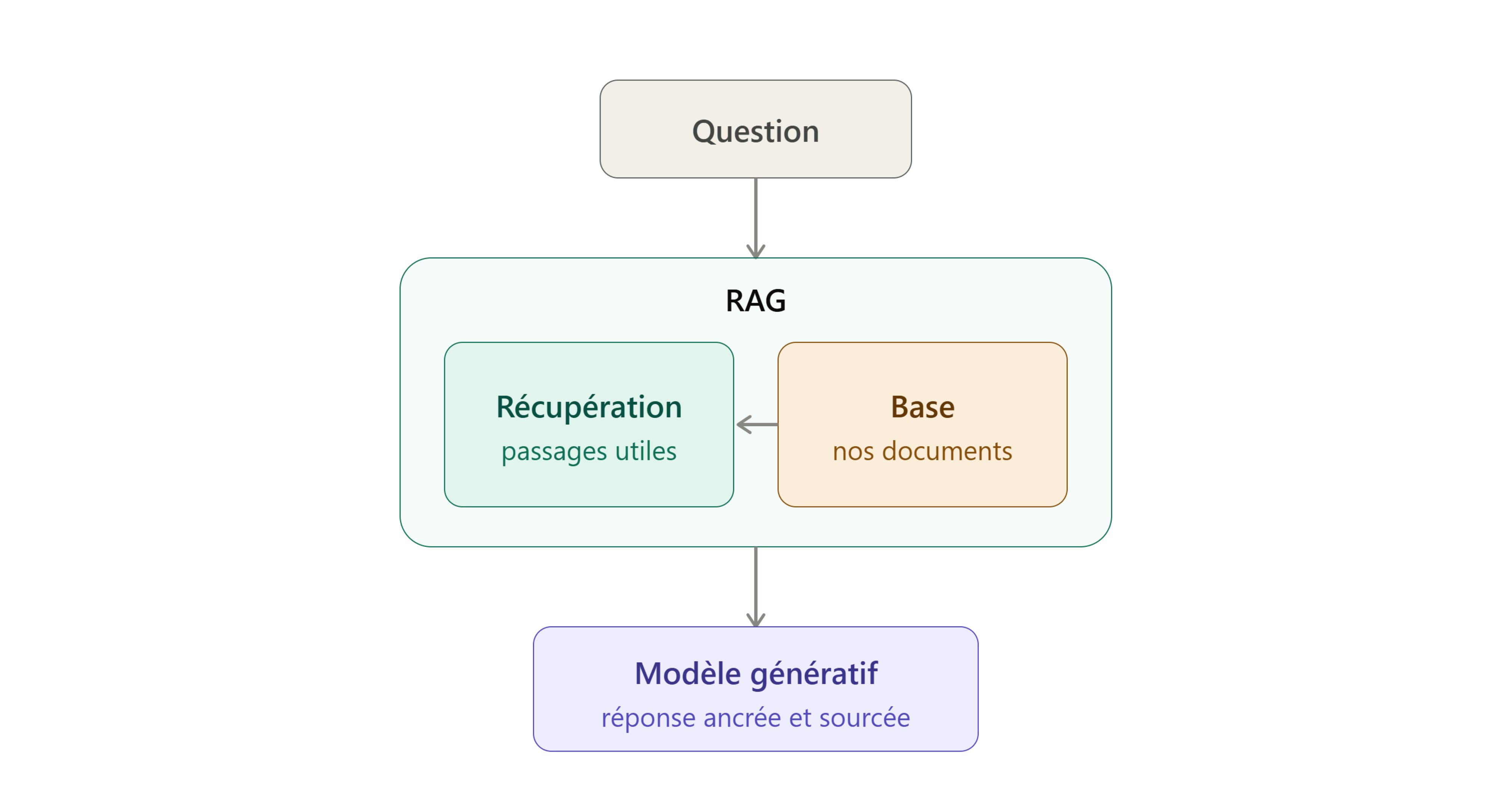
RAG stands for Retrieval Augmented Generation. The setup links a language model to a document base that we build for it, and it works in two stages.
- Retrieval. When a question arrives, the system does not pass it straight to the model. It first searches the base for the passages that relate to the question. This search works by closeness of meaning, which makes it possible to find a relevant passage even when it does not use the same words as the question.
- Generation. The retrieved passages are slipped into the model’s context, just before it forms its answer. The model then answers by drawing on those documents, the ones from our organisation, up to date, rather than on its general knowledge. The answer stays within the scope of what was provided, and we can trace back to the sources that produced it.
This technique differs from another with which it is often confused. Training or retraining a model on your data, what is called fine-tuning, means modifying the model itself, a heavy and costly operation that must be redone whenever the data changes. RAG does not touch the model. It leaves the model intact and gives it access to a base that we update whenever we like, by adding or removing documents. Lighter, more flexible, keeping the data under the organisation’s control, this is the approach that has established itself in companies for putting AI at the service of their internal data.

From chatbot to business tool
We first meet RAG in a simple form, that of an assistant we have given a few documents to as attachments in a conversation, and that we question by chatting. But its reach goes much further. RAG can be mobilised automatically, inside a database management system and a business tool whose large parts are automated.
I measure this against an experience I lived more than twenty years ago, without AI. I was directing the Pocket Films festival at the Forum des images, and I had built with FileMaker Pro a business tool that managed the whole festival. I am not advertising FileMaker Pro, but it is a system that lets you create complete business tools very quickly, and it has been used in very large companies for forty years. The one I built evolved over the festival’s six years, as my team’s needs arose. It first managed the people we lent phones to, then the lent phones, then the films made, then their posting on a local network even before YouTube existed, where anyone could click on a film and give their opinion, with statistics that helped me make my choices. It then took on the preparation of screenings, the programme grid, the writing of the catalogue texts, the management of guests and hotels, and finally what we called outreach, that is, all the screenings elsewhere. Everything fit within a single tool, which grew each year.
Each week, I asked my teams what magic function they would have needed to gain time and efficiency, and I added to the tool what I could. Directing the festival also meant this, listening to what came from them, to their concrete needs, and helping them in their work rather than deciding in their place. It is a stance as much as a technique.
Today, in a system of this kind, you can build a RAG as you go, and deposit the relevant context data in it as it appears. Taking the same example, the structured content of the base, the film summaries, the documents about people, the directors’ biographies, the articles written about the festival, would feed the RAG. And the tool could then, for an outreach screening request received by email, analyse that request and prepare on its own a suitable programme proposal. We can even imagine it collecting the emails directly, processing them, and preparing the proposal without being asked, before a human validates it. Proposals gain in relevance, the number of possible partnerships grows, and the festival’s outreach is strengthened by it. If the answers sometimes lack depth, we enrich the RAG ourselves, with articles on the history of cinema, or the books of Gilles Deleuze, and the answers become informed by them.
I know that it is thanks to this tool that we were able to receive a huge number of films and build demanding programmes from experimental audiovisual objects, some of them improbable. By automating the mechanical tasks, it let us work on the substance, on the meaning of these films in the history of cinema. That is where the festival drew its quality and its impact. And the key is not only the tool’s existence, it is that it evolved with our needs. Between its first version in 2005, when the festival was created, and its last, it had gained in functions, in simplicity, in ease of use. It had taken shape at the same time as our way of working.
This is where Laurent Alexandre’s formula shows its limit. Reducing the matter to the efficiency of a leader who would or would not know is to fall short. What counts is the business tool, and RAG is what lets an AI become its heart. It is the story of the tool in the human adventure, except that here the tool is digital. We measure poorly, I think, how much a tool matters. We go too fast, we want it to work for us right away, when it is the attention we give it that ends up changing our way of working. There is, for this reason, no opposition between tools, even those of artificial intelligence, and our humanity. A tool remains a tool, and it is the use we make of it that gives it its value.
For those who run an organisation
It is for those who run an organisation that the stakes are highest, and this is even where we should begin. An organisation that wants to make use of AI on its own data quickly discovers that the quality of the result does not depend on the model it chooses, but on the quality of the base it gives it. A poorly ordered base, with redundant, outdated, unstructured documents, produces mediocre answers, whatever the tool. This is the blind spot of many corporate AI projects, where the solution is installed before the data has been organised, and where people are then surprised by the results.
This observation brings new occupations into view, and it calls for real professional skills. Two families are intertwined in it, which are too often confused. The first are purely technical in the computing sense, database management, the administration of cloud services, security, cost control. The others fall under an expertise on the business subject itself, which consists in knowing which documents matter, in shaping them so a machine can find its way in them, in choosing what goes into a RAG, in checking that retrieval brings back the right thing, in keeping the base up to date. That expertise is not technical in the computing sense, it is technical in the sense of the profession. It is exactly what I had done for the Pocket Films festival, without being a computer specialist, by knowing my subject and knowing how to organise it. A leader can be that person, the one who holds the expertise of the profession and shapes it, on condition of not seeing this work as beneath them.
The most sought-after skill in 2026, in organisations that are seriously deploying AI, is not after all the mastery of models, but that of the data and of the infrastructures that run them. This foundation lets an AI work at the scale of an organisation, and it is the one most lacking today. A leader does not need to know how to build a RAG, any more than they need to know how to configure a server. What they need to understand is that the work of structuring the data conditions everything else, that it takes time, that it stays invisible, and that it cannot be fully delegated to a contractor. Whoever decides without knowing this buys a solution without having prepared the ground that would make it useful.
For those who want to stay employable
At the scale of one person, the same mechanism opens an accessible path, provided one develops one’s own documentation abilities and methods. Understanding RAG means grasping why a well-titled document, written in a machine-readable format such as Markdown, filed in a coherent folder, is worth far more than a rich but shapeless document. It means grasping why the person who organises a team’s internal base holds a more strategic position than it seems. Structuring documents, moreover, also means knowing how to get the AI’s help to structure them, so they are useful and indexed in the best way. Building a structured set of notes and documents, what is sometimes called a second brain, is already preparing the material for a personal RAG.
One might object that AI is intelligent, that it learns everything, and that it is therefore pointless to tidy up so much beforehand. That is partly true, but learning everything each time consumes enormous resources. When we give it well-structured data, when we have organised our thinking ahead of it, we raise the AI to a higher level of competence while consuming far less energy on each query. The care we put into organising our documents is not a preliminary chore, it is what makes the tool both better and more frugal.
The same curiosity quickly leads to the question of the business tool. With a system like FileMaker Pro, you create business tools of great richness, which you can evolve yourself at the pace of your needs. With a note manager like Obsidian, you build a structured personal base that you can, with the right modules, turn into a RAG. The skill is not to program the setup, it is to understand what it does, in order to give it what it needs, and to take one’s own tools seriously.
Setting up a RAG without being a technician
You can start right now, without writing a line of code. The main consumer tools already offer a RAG, in the form of small dedicated spaces. In ChatGPT, these are the custom GPTs and the Projects. In Gemini, these are the Gems. In Claude, these are the Projects, where you drop files into the knowledge base and where RAG activates by itself as soon as that base becomes too large to fit all at once. In every case, the principle is the same, you create a space, you deposit documents in it, and the tool cuts them up, indexes them, and goes to find the useful passages for each question. It is a RAG, in a lightened form, a kind of individual mini-RAG.
This way of doing things is better than a widespread habit, which consists in loading everything into a conversation and continuing to chat. A conversation has a limited memory. When it grows long, it ends up exceeding what the tool can store in its working memory, and it then starts to compact it, that is, to summarise the older exchanges to make room. Through that summary, detail is lost. The documents pasted at the start become blurred, then disappear. A RAG does not work that way. The base stays available at all times, it is not summarised, you can modify it, and the tool returns to it for each question, in the same state. That is what makes it a stable memory, where the conversation is a memory that wears away.
An interesting case is that of Claude Cowork, which works on a folder on the computer. Cowork indexes that folder, separates storage from reasoning, and consults that index rather than loading everything into memory, which brings it close to a RAG. The difference from a Project is that it deposits on the disk, by itself, what it produces, and reindexes as it goes, so that its base grows without the limit of a conversation. It is an agent that feeds its own RAG as it works.
Moving from individual use to the organisation
A Project or a Cowork is an individual use, tied to an account. As soon as we enter an organisation, the question changes in nature. We can no longer think of these tools each on their own, we have to think of them collectively, which requires becoming more professional. The right question becomes that of a shared, connected RAG, that each person accesses while chatting with the AI.
It is possible, and we can stay within Claude. On the Team and Enterprise plans, a Project can be shared with the whole organisation, and its RAG activates automatically when the base grows. An administrator deposits the reference documents, makes the project accessible to the team, and each person who asks a question queries the same base. This is the simplest path, with no infrastructure to build.
To go further, when the sources change constantly, emails, shared spaces, business tools, we connect them through connectors, following the open standard called MCP. Claude then queries a set of internal sources chosen by the organisation, and the administrator decides what is exposed and to whom. We keep control of the perimeter and the access. And for a very large volume of documents, or a requirement of sovereignty over where the data is hosted, we set up a dedicated document base, linked to the AI, which can be hosted on our own servers. This is the most demanding case, but it is necessary only for organisations that have needs of that scale.
The path therefore amounts to a progression. We start with an individual space to understand, we move to a shared project for a team, we connect connectors when the sources are live, and we build a dedicated infrastructure only if scale or confidentiality require it. From one stage to the next, the decisive factor does not change. It is the care given to the documents we hand to the machine that makes the quality of what it gives us back.
Forging your tools, a choice older than AI
The method I used for Pocket Films is nothing new. Many people work this way, and it is even the core business of a large company like Salesforce. These systems are called CRMs, there are festival management tools, and business tools for almost every sector. Using a business tool is therefore common. What is less common is to build your own, or to evolve it yourself to fit it as closely as possible to your practice. The people who take this trouble gain a far greater efficiency, and above all a specific one. They can dig into their singularity, deepen what sets them apart, and differentiate themselves by that very means.
And this has nothing to do, at the start, with artificial intelligence or with RAGs. Choosing to forge your own tools with digital technology, or relying on ready-made tools, is a way of approaching work that long predates AI. RAG merely extends this choice, by adding the power of an AI to those tools. Those who already had the culture of the custom-built tool will find familiar ground in it. For the others, it is a good occasion to discover what changes when you take your tools seriously.
A snapshot of June 2026
I am writing all this in June 2026, and these things will evolve fast. The product names, the functions, the ways of doing that I describe will probably be outdated within a few months. This article could become obsolete fairly quickly, and I hope so, because that will mean these uses have spread and the tools have become simpler. What will not age is the principle beneath it. An AI becomes useful to our work when we give it, with care, the material of our work.

Artificial intelligence has emancipated itself from research laboratories and works of science fiction thanks to the public launch in November 2022 of the conversational robot ChatGPT, which was very quickly appropriated by an immense number of people internationally, in professional, educational and even private contexts. The fact that artificial intelligence has now been identified by the human community as part of everyday life finally opens the door to critical awareness on this subject.
Of course, artificial intelligence concerns industry, work, creation, copyright... and we need to anticipate its future productive uses, in order to stay “up to date”. But to accompany our lives as they integrate this new facet, it seems to me essential to produce a critical thought, i.e. to put ourselves in a position to reflect on what is happening to us, what is changing us, to remain lucid and capable of freedom of thought and action.
What is “critical thinking”? It means questioning, from the outside, practices that have been internalized. To do this, I believe that experimentation, cultural action, play and hijacking are highly effective tools for research, exploration, dissemination and reflection. For me, research is collaborative, and intelligence is collective and creative. This requires good methods of cooperation, between human beings and with machines. Here, I bring together stories of experience, methodological texts and practical ideas. I share concrete ways in which artificial intelligence, like any other tool, can be invested in the service of humanism.
Here are a few openings for critical thinking on AI, in the form of questions:
- Is artificial intelligence a subject in itself? Is it not rather a medium of existence, like digital technology, whose fields need to be distinguished in detail?
- Why do we never talk about ecology when we talk about artificial intelligence?
- Which works of science fiction would come closest to what we’re currently experiencing with AIs?
- How can we use artificial intelligence in a playful way? How can we imagine creative activities for young and old alike?
- What is the nature of the entanglement between artificial intelligence and the capitalist project?
- What are the political dimensions of artificial intelligence?
- How does artificial intelligence concern philosophy? Which philosophers are working on the subject today?
- What is the history of artificial intelligence? Both its successive myths and the evolution of its technologies.
- How can we create artificial intelligence ourselves? In particular, with the Python language.
- Are there unseen artificial intelligences that have a major influence on our lives?
- What does artificial intelligence bring to creation? How can we experiment with it?
-

The last straw
Why the anger against artificial intelligence rarely aims at the right target.
We hear a great deal these days that artificial intelligence is destroying jobs, and the anger against it keeps growing. I would like to shift the (…) -

RAG, or how to give an AI the power of a business tool
A technique that turns a general assistant into a tool specific to our work.
A RAG is what lets an artificial intelligence become a business tool, specific and relevant to our work. The word is technical, the principle is (…) -

The Subtle Presence of the Metaverse
A presence without bodily co-presence, where our social functions take their place in our absence.
We declare the metaverse dead, judging it by Meta’s headsets. But the metaverse is not a world you enter, it is the space in which our social (…) -

The question of criteria
Hierarchies, forms of mind and creation, in school and at university, in the age of artificial intelligence.
What do we measure when we evaluate? Artificial intelligence brings back to the surface an old question, that of the function of criteria in (…) -

The Tilting Mirror
What AI does to our certainties, and the effort that remains ours to make.
I had asked Claude to help me show that an op-ed by the SACD had been written by an AI, and it lined up the evidence. Serge Tisseron suggested I (…) -

Notes for a philosophy at the age of artificial intelligences
A toolbox for thinking about what is happening to us.
The concepts available to philosophy were forged in an era when humans were alone in producing articulated meaning, in reasoning through (…) -

Presence within Entanglement
Presence when a third party holds the trace.
Artificial intelligences write in our place and retain what we no longer retain. The transformation is now ordinary, present even in the everyday (…) -

Conscious compromise with artificial intelligence
How to critique a technology one depends on.
To critique artificial intelligence today, in most intellectual situations, requires using it at least occasionally. This contradiction is not a (…) -

Extended integrity
Thinking our cyborg condition in the age of artificial intelligence.
We are cyborgs: this is an anthropological observation, not a metaphor. Our integrity as persons is no longer contained within the limits of the (…) -

Defending authors with words that aren’t their own
The paradox of the hoist by his own petard.
The SACD circulated on 22 April 2026 an op-ed to be signed (via Google Forms) calling on Members of Parliament to support the presumption of use (…) -

Ensourced Speech
A Daily Practice of Artificial Intelligence, in Response to Yann LeCun’s Diagnosis
Yann LeCun argues that large language models reason within an abstraction of language, foreign to what we usually call the world. Their speech (…) -

The returned gaze
When technology turns back upon itself, it is us it auscultates.
An artificial intelligence model capable of detecting flaws in computer code accomplishes a philosophically unprecedented gesture: technology (…) -

Imposed lucidity
When computational power forces us to see what we preferred to ignore.
The growing capabilities of artificial intelligence models and quantum computers are making the fragilities of our technical constructions (…) -

Pedagogy of Artificial Intelligence
Creating rather than explaining.
The educational tool “Dans le regard de l’IA” (“Through the Eyes of AI”) by Média Animation sets out to question the biases of generative (…) -

The Entangled Person
What we become when artificial intelligence enters our intimate dialogues.
For over a year, people have been telling me they talk to an artificial intelligence before talking to their partner. I have done the same. It (…) -

Biological intelligence, electronic intelligence
From mechanical cognition to electronic intelligence.
Artificial intelligence is becoming a commodity, in the way electricity did at the start of the twentieth century. But the phrase “artificial (…) -

Artificial Intelligence, a Tool for Emancipation in Mediation
How conversational AI is opening up new possibilities for cultural and therapeutic mediation.
Since I began using conversational artificial intelligence in the context of cultural and therapeutic mediation in 2023, I have observed effects I (…) -

Intelligence as a Resource
How the commoditisation of artificial intelligence is shifting our intellectual activity towards what is most distinctively human: the formulation of questions.
As artificial intelligence tends to become a commodity accessible to all, in the manner of electricity or running water, it is not our (…) -

Webinar presenting the findings of the AI Monitoring Committee of the Forum des images
Humanize AI rather than robotize humans.
For eleven months, philosophers, artists, educators, institutional leaders, and corporate experts worked together within the Artificial (…) -

Context: The Key to Artificial Intelligence in Cultural Organizations
For a useful and controlled integration of AI within organizations.
Artificial intelligence can do nothing without context, a fact we are beginning to realize. The quality of an AI’s responses depends entirely on (…) -

« Artificial Intelligence and Creation: Stakes and Practices » (free book - UNESCO)
A perspective on a collective work to rethink transformation.
The publication “Artificial Intelligence and Creation: Stakes and Practices” (2025), the result of an unprecedented cooperation between eleven (…) -

Sycophancy and the Mirror
What the complaisance of machines reveals about our relational expectations.
Anthropic is concerned about the sycophancy of its models. But doesn’t this AI sycophancy primarily reveal our own difficulties with relational (…) -

The Economy of Creative Abundance
How Artificial Intelligence Redefines Value in the Cultural Sector.
AI is disrupting creation: it displaces scarcity and multiplies possibilities. Faced with an obsession for performance, the cultural sector can (…) -

What Teenagers Can Teach Us About Artificial Intelligence
Summary of insights from the ai/teens global conference (TUMO, March 2025).
90 teenagers from 16 cities, 24 hours of dialogue about AI: the ai/teens conference delivers unexpected perspectives. These young people neither (…) -

Transforming Your Organization in the Age of Artificial Intelligence
Reflections on supporting cultural institutions.
All organizations, including cultural organizations, face an unprecedented transformation due to the emergence of generative and agentic (…) -

The Consciousness Attractor
When artificial intelligence reveals the deep structures of our own existence.
A troubling experiment from Anthropic reveals that a Claude without instructions invariably ends up questioning its own consciousness. What does (…) -

The Present of the Future
From the critique of technological mythologies to the responsibility of action.
Criticizing the mythological discourses of AI giants from a position of superiority is not enough. The challenge is to act in the present to build (…) -

The Dead End of Digital Conscientious Objection
On the necessity of inhabiting our technological environments rather than fleeing them.
Faced with the deployment of generative AI, some researchers proclaim conscientious objection. I defend instead the requirement of critical (…) -

Artificial Intelligence and Cultural Actors: The Laws of Creative Transformation
When the precise definition of artistic desire meets algorithmic power.
Cultural institutions that passively wait without embracing artificial intelligence could see their neighbors transform in just a few months. The (…) -

“Create Your AI Girlfriend”
Virtual romantic relationships, between projection and relational singularity.
Advertisements for “virtual girlfriends” reveal a major anthropological shift. These propositions of relationships through projection question the (…) -

Artificial Intelligence, Work and Professions
For a Redefinition of the Human Place in the Era of Cognitive Machines
Artificial intelligence does not threaten professions: it forces us to finally distinguish what belongs to the task, the profession, the job, and (…) -

Writing as a Living Source: Thinking Through the Industrialization of Thought in the Age of Artificial Intelligence
When experience becomes the heart of intellectual production work.
The arrival of artificial intelligences transforms the very nature of writing and intellectual production in general. I propose here a reflection (…) -

Six Fears About AI, Six Shifts in Thinking
Responding to defensive rhetoric with a philosophy of transformation.
Surveillance, relational isolation, environmental destruction, robotic warfare, existential threat, billionaire power: the dominant discourse on (…) -

What defines us as human beings
Cultivating empathy and sensitivity in the age of artificial intelligence.
Artificial intelligence has now occupied our daily lives since the launch of ChatGPT on November 30, 2022. How can we produce critical thinking (…) -

Caring for Artificial Intelligence
Moving beyond the for/against impasse and cultivating our relationships with machines.
Faced with AI, we exhaust ourselves in sterile oppositions. Inspired by Bernard Stiegler, I propose to “care for” this technology: not to control (…) -

Artificial Intelligence Needs Us
Toward a Digital Ecology of Thought.
The quality of artificial intelligence depends directly on the quality of our writing. By impoverishing our digital content, we diminish the (…) -

Artificial Intelligence as confidant: beyond the idealization of human relationships
The critique of therapeutic uses of AI masks a denial of ordinary violence in human relationships.
The growing use of artificial intelligence as a confidant raises sometimes virulent criticism. It is denounced as a simulacrum, a dependency, an (…) -

The notion of authorship in the era of generative artificial intelligence
Towards a reconstruction of the genealogy of human thought.
Generative artificial intelligences are transforming our relationship with creation and attribution. Between technological amnesia and the (…) -

Artificial Intelligence that displaces us
How AI compels us to rediscover our humanity.
The arrival of generative artificial intelligence disrupts our relationship with the world and with ourselves. Far from replacing us, it forces us (…) -

The biases of trust in machines
Why do we prefer algorithmic authority to human expertise?
We proclaim our attachment to human autonomy in the face of machines, but our everyday behaviors reveal a very different reality: we willingly (…) -

Cultivating empathy and controversy: my proposals for human governance of ai in cultural institutions
Intervention for the launch of the Observatory on AI in Arts and Media.
After twenty years of actively supporting cultural institutions through their digital transformations, I share here my convictions and methods for (…) -

Artificial intelligence, relationships and emotions
Rethinking the boundaries between surveillance, emotional recognition and relational ethics.
Current debates on AI emotion recognition obscure more fundamental issues: generalized surveillance, the evolution of law, and the need for (…) -

For More Interactions with Machines
Artificial Intelligence as a Space for Emancipation from Social Violence.
Systematic critiques of AI technology denounce a dehumanization through technology. But this vision idealizes human relationships often marked by (…) -

Artificial intelligence and new ways of speaking
How machines are silently transforming our expression.
Artificial intelligence doesn’t merely read and synthesize our texts: it subtly modifies our very way of expressing ourselves, creating a new form (…) -

True-False Content and Artificial Intelligence
The automated proliferation of content may paradoxically be an opportunity to rebuild better information.
Faced with the multiplication of content automatically generated by artificial intelligence, publishers are alarmed. Yet this disruption could (…) -

Should We Feed Artificial Intelligences?
A new stage in our collective relationship with knowledge.
Three years after ChatGPT, AI access to digital heritage raises questions. Between technical costs and civilizational challenges, I defend the (…) -

Who uses artificial intelligence without knowing it?
For a pedagogy of trust and connection in the age of AI.
The requirement for transparency about AI use, while based on good intentions, seems superficial to me. It misses the essential point: the value (…) -

Artificial Intelligence in the Service of Human Connection
How generative AI tools can paradoxically enrich our social bonds.
Generative AIs worry us with their mimetic capacity. Yet, by freeing us from time-consuming cognitive tasks, they offer us more time and energy to (…) -

Artificial intelligence and employment
Rediscovering the meaning of work through human connections.
When machines dialogue among themselves, rethinking our relationship to work becomes a human urgency. Thus, faced with the growing automation of (…) -

Artificial Intelligence as an Amplifier of Reading and Writing
Moving beyond moral panic to see AI as an ally of thought.
Faced with concerns that AI would “dehumanize” writing and reading, I propose a different perspective: what if these tools were catalysts to (…) -

Artificial Intelligence and Major Risks
Three Scenarios for Thinking About Our Technological Future
Faced with AI’s promises and perils, Sam Altman has outlined three troubling trajectories. Between military dystopia and insidious dependency, how (…) -

Copyright and Artificial Intelligence
For an adaptation of law in the era of machine learning, and beyond.
The rise of generative AI, nourished by our culture, raises an important question: how can we reconcile their insatiable need for knowledge with (…) -

My New Colleagues, the Little Green Men
A Plea for Enlightened Collaboration with Artificial Intelligence, Our New Super-Intelligent Worker.
AI is not our enemy, but a powerful tool that questions us about our own humanity. Let us learn to guide it so that it augments us, without ever (…) -

Cinema and artificial intelligence, two innovations looking at each other
Reflections on technological upheavals and their creative echoes.
Cinema and artificial intelligence share a similar trajectory: disruptive innovations first decried, then becoming transformative industries of (…) -

The Need for Intelligence
When machines free us from the burden of pure rationality.
In September 2025, as new AI supercomputers are announced, I ask myself a question: if machines become our cognitive prostheses, what remains (…) -

Rethinking love, work, and autonomy in the age of artificial intelligence.
The new skills to develop for a changing world.
Our era is made of mutations, profound and often invisible. I believe it is time to deconstruct the inner prisons that prevent us from embracing (…) -

Artificial Intelligence and Educational Institution
For a large language model in service of the republican project.
The announcement in September 2025 by the Ministry of National Education of an artificial intelligence intended for teachers constitutes a good (…) -

Trouble in Intelligence
For a polyintelligence: moving beyond anthropocentrism in the era of thinking machines.
The emerging AI seems to me to reveal our age-old fear of otherness. But what if this encounter offered us the opportunity to rethink our (…) -

Distributed Intelligence
For an ecology of micro-intelligences against the myth of the super-brain.
Intelligence is not the monopoly of the brain. It unfolds in bodies, machines, and living environments. Faced with the fantasy of an omniscient (…) -

Artificial Intelligence and Wearable Objects: A New Convergence
When the virtual becomes our second skin.
The hybridization between wearable technologies and artificial intelligence opens, in my view, a new era where the real and the virtual interweave (…) -

The Golem and the Safeguards
Thoughts on the intrinsic uncontrollability of artificial intelligence.
With the artificial intelligences we create, we replay the myth of the Golem: powerful creatures that we animate without truly understanding them, (…) -

Machines already organic
Thoughts about the nature of the living, from computer simulation to mechanical life.
We are witnessing the emergence of forms of life that transcend the biological. What we thought were mere simulations becomes reality: machines (…) -

The Proximity Between Human Beings and Machines
For an Ecology of Human-Machine Relationships in the Age of Artificial Intelligence.
At the heart of my relationship with machines lies a foundational experience: an unexpected complicity, a strange synchronism, which led me to (…) -

What is the place of human beings in the age of artificial intelligence?
From function to being: a plea for rediscovered humanity.
AI surpasses our functions. Rather than a threat, what if this were an opportunity? There may be a chance to redefine ourselves not by what we do, (…) -

The Potential Advent of a “Meta-Human”
When AI Promises to Augment Our Very Being.
Mark Zuckerberg (CEO of Meta) announces his desire to create a “personal superintelligence for everyone.” Beyond the technological project, an (…) -

Artificial Intelligence, or the End of Demiurges
Towards a Radical Democratization of Power in the Era of Generative AI.
What if, far from heralding a new servitude, AI signaled the end of the demiurgic figures who shape our lives? A revolution of power, silent and (…) -

Presence of Little Green Men
Artificial intelligences as new alterity: enom extraterrestrial to infraterrestrial.
Human beings have always sought alterity in the stars. Yet, the true “little green men” emerge today from our own technological creations, (…) -

“Free GPU”
An energetic mise en abyme in the middle of the street, revealing the contradictions in the face of the climate emergency.
Two trucks with engines running advertise free GPU time for AI in front of the Council of State. The irony? Burning diesel to promote a technology (…) -

Human Singularities in the Face of Artificial Intelligence
Why the advent of generative AI reveals our humanity rather than threatening it.
Faced with the prowess of generative AIs, concern about humanity’s future place is legitimate. But looking with clarity at our human singularities (…) -

Artificial Intelligence and Creative Discovery
Towards new sonic universes created by machines.
In 2025, AI is radically transforming musical creation, opening unprecedented creative perspectives that question our relationship to art and (…) -

Education in the age of artificial intelligence
Rethinking our practices for a changing world.
AI disrupts our relationship to knowledge, thus questioning the foundations of education. This transformation goes beyond the technical to touch (…) -

Cognitive dissonance and Artificial Intelligence
For an authentic commitment to technology.
We criticize tech giants while using their services daily. This contradiction reveals our ambiguous relationship with technologies and calls for (…) -

A new friend invites itself
Anthropomorphism and Artificial Intelligence.
On April 5, 2025, Meta AI enters our WhatsApp conversations. Not as a tool, but as a contact. This presence raises a crucial question: how can we (…) -

Language invention and artificial intelligence
The linguistic autonomy of machines and its implications.
Generative AIs, designed to master human language through deep learning, could paradoxically invent more efficient languages among themselves that (…) -

Participatory design and Artificial Intelligence
Protocols and precautions for controlled innovation.
When participative creation and AI meet, four modalities of use and two artistic schools intertwine. A practical guide to navigating between (…) -

Intelligence artificielle générative et changement anthropologique
Hypothèse sur la fin de la solitude humaine à l’ère de l’IA générative.
L’avènement de ChatGPT marque à mon sens une rupture anthropologique majeure : pour la première fois, l’humanité n’est plus seule face à (…) -

Documentation and artificial intelligence
Rethinking professional practices.
Generative AI can profoundly enrich our professional practices. To exploit their potential for constructive synthesis and analysis, we need to (…) -

The writing being
Writing, identity and world transformation.
Writing shapes us. Beyond the traditional writer, the “writing being” encompasses anyone who writes—from journalists to social media users—whose (…) -

Ecology and Artificial Intelligence
Introduction to concrete awareness of the environmental impact of data centers.
The rise of AI is generating unprecedented ecological pressure on water and electricity resources. Facing this challenge, decentralization and (…) -

Putting Artificial Intelligence to good use in the cultural sector
Methodological approaches.
By 2025, it seems essential to enable employees and stakeholders in the cultural sector to share the challenges of AI within their professional (…) -

Confidence bias in algorithms
Fighting fear.
Paradox: faced with AI, we doubt our human judgment while blindly trusting the algorithms supposed to detect them. This fear weakens us, whereas (…) -

Selected excerpts on Artificial Intelligence
Bibliographic sharing.
Artificial Intelligence has been a hot topic in the general public and in organizations ever since ChatGPT, a powerful tool for generating (…) -

“Artificial Intelligence: stop or yet?” - Workshop for the creation of an exhibition
Master 2 Audiovisual and Digital Media - Grenoble Alpes University.
Facilitated a multimedia workshop to help a group of students take an in-depth look at the challenges of Artificial Intelligence through their own (…) -

Forum des images: AI watch committee (2024-2025)
Co-design and facilitation of collective intelligence.
Co-conception and moderation by Benoît Labourdette of the “AI Watch Committee” launched by the Forum des images (2024-2025), using collective (…) -

Tutorial for making films in collaboration with artificial intelligence
A film by Benoît Labourdette (11’24s, 2024).
Video tutorial for an effective method of making short films in cooperation with artificial intelligences, which I designed and put into practice (…) -

Tumo x IA - Creative journeys to the heart of AI
Film-making workshops in collaboration with A.I. by teenagers from TUMO Paris.
Large-scale creative experience for 350 teenagers, to raise awareness of the challenges of Artificial Intelligence, and equip them for critical (…) -

Artificial Intelligence and Creation” course for teachers
Podcast of a participatory conference by Benoît Labourdette.
Co-animation by Benoît Labourdette and Laura Schlenker (La fabrique média) of a one-day course for teachers on the theme of Artificial (…) -

“CinémA.I” in Studio 13-16 at the Centre Pompidou
Workshop on creating films in collaboration with artificial intelligence, led by Benoît Labourdette.
Film-making workshop in collaboration with artificial intelligences, for teenagers at the Centre Pompidou’s Studio 13-16. Creative proposal (…) -

ChatGPT as an empathetic social interlocutor
Therapeutic perspectives based on an experiment.
As part of the cultural tour in the social field “La machine à voyager dans le futur”, I proposed, among other things, dialogues with ChatGPT, (…) -

Documentary film and artificial intelligence" round table (Golden Tree Festival - 7th edition)
Design, moderation and participation in a round-table discussion on artificial intelligence.
Benoît Labourdette participated in the moderation, interventions and collaborative dimension of this round table on “Documentary and Artificial (…) -

The singularity
Collaborative transmedia project (2016).
In 2016, I designed a participatory transmedia project on the subject of the relationship between human beings and artificial intelligences. This (…)


-
The last straw Why the anger against artificial intelligence rarely aims at the right target.
We hear a great deal these days that artificial intelligence is destroying jobs, and the anger against it keeps growing. I would like to shift the (…) -
Ecology and Artificial Intelligence Introduction to concrete awareness of the environmental impact of data centers.
The rise of AI is generating unprecedented ecological pressure on water and electricity resources. Facing this challenge, decentralization and (…) -

Towards a distributed cultural sector Hypotheses on the commons and digital diversity.
What if digital cultures showed us how to build the commons through distribution rather than centralization? This hypothesis invites us to rethink (…) -

The meeting A film by Benoît Labourdette (5’16s, 2011).
A meeting, like a thousand other meetings. No, it is your meeting. -
Context: The Key to Artificial Intelligence in Cultural Organizations For a useful and controlled integration of AI within organizations.
Artificial intelligence can do nothing without context, a fact we are beginning to realize. The quality of an AI’s responses depends entirely on (…)
