Algorithms are regularly criticized as tools that supposedly lock us into “filter bubbles.” We must free ourselves from them, we are told. Yet when we use a music streaming platform like Spotify or Deezer and it offers us effortless musical discoveries, we no longer speak of an algorithmic problem. We simply say we are listening to music. This asymmetry in our perception deserves examination: it reveals that algorithms, far from being inherently alienating, can constitute powerful tools in service of cultural rights.
In this article, I propose the concept of “relational navigation” to describe this form of circulation through cultural content enabled by metadata indexing and recommendation algorithms. This relational navigation stands in opposition to traditional hierarchical navigation and constitutes, according to my thesis, a vector for cultural democracy.
The Paradox of the Appreciated Algorithm
When a piece of music is suggested to us after another on a streaming platform, we discover a musical style, an artist, an era, in a way that feels organic. Thanks to algorithms, we continuously enrich our musical knowledge. This experience differs radically from what we knew in media libraries or record shops. Back then, discovery often depended on a chance encounter with an album cover, the availability of a recently returned record, or a seller’s recommendation. Prior listening always constituted an obstacle, because one had to take out the disc, ask permission—one simply didn’t do it.
Today, we are in contact with a musical diversity incomparably vaster than before, and it is precisely thanks to algorithms. Algorithms thus serve as convenient scapegoats: when they serve us well, we don’t name them as such! I make this observation to invite us to move beyond simplistic criticism and examine what these tools actually enable, in anthropological and legal terms.
On Facebook, Instagram, or dating apps, we appreciate when algorithms surface content relevant to us: messages from people we like, subjects that concern us. The primary benefit (the pleasure of discovery, the ease of connection) masks the underlying algorithmic mechanics. This invisibilization testifies to a successful integration of algorithms into our daily experience.
TikTok’s algorithm particularly illustrates this phenomenon. Its popularity rests precisely on its capacity to continuously propose new discoveries, to make us encounter otherness while respecting our affinities. It is moreover this quality that makes the platform “addictive,” because it enriches us. Serendipity—those discoveries that seem to occur by chance but arise from the intersection of countless informational traits—becomes a daily experience.
The Real Filter Bubbles: Before the Digital Age
The myth of the algorithm as a “filter bubble” constitutes a construction that, while containing a grain of truth, primarily stems from a simplistic critical imaginary about digital technology. For filter bubbles were not invented with algorithms. In a media library, for example, they came from librarians’ editorial choices—their purchasing decisions, however well-intentioned regarding diversity.
Let’s take a concrete example. If I found myself in the rock music section, the classical music section on the other side of the room remained a territory I might never visit. I had no chance of encountering a classical music record that might have ended up by accident in the “rock” section. The physical separation of genres constituted a material, inflexible filter bubble.
Filter bubbles were thus paradoxically larger before than they are today! Access to diversity was in fact much more difficult in the analog world. Today, this access is potentially unlimited. As Eli Pariser himself points out—the inventor of the “filter bubble” concept (The Filter Bubble, 2011)—the problem is not the algorithm as such but the lack of awareness of its existence and its criteria. Now, music platforms make this awareness possible: we can observe, modify, and circumvent recommendations.
This observation aligns with Bernard Stiegler’s reflection on “technologized memory” (Technics and Time, 1994). Technical tools, including algorithmic ones, constitute supports for memory and orientation in the cultural world. Their democratic quality depends less on their technical nature than on their design and use.
The Mechanism: Metadata and Indexing
To understand how algorithms can serve cultural rights, we must examine their technical functioning. Algorithms are based on data, more precisely on metadata. Take an MP3 file: it contains the “essence”—the music itself—as well as metadata inscribed in its header: track title, year of production, composer, performer, lyrics, genres, album affiliation, and a quantity of other information.
If we navigate through a personal music library organized in hierarchical folders (genres, artists, albums), we reproduce the model of the physical media library. This hierarchical navigation presents the same limitations: to discover a lesser-known record, it takes several clicks, an effort of will. We are in a moment of pleasure, seeking pleasure, so we go toward what we already know.
Algorithmic indexing works differently: an indexing engine scans all files and creates a relational database: next to the word “rock,” it lists all files corresponding to that genre; next to the word “classical,” likewise; and so on for each piece of metadata. The same file can appear in multiple places in this indexing, because it can belong to several genres, be part of an album while also being performed by a particular artist.
This indexing constitutes the first level of algorithmics. It enables what I call “relational navigation”: when we listen to a track, we see the genres it corresponds to, the album, the year, the performer. If we click on the performer’s name, we immediately access all their tracks. If we click on the genre, we see everything corresponding to it. If we click on the year, we discover what was produced during that period. Discoverability becomes immense.

Relational Navigation as Cultural Democracy
This logic of circulation through content, enabled by indexed metadata, gives much more importance to the depth of content than to the hierarchy of classification. This transcendence of hierarchy constitutes precisely the achievement of horizontal cultural democracy. This is what is called transversal navigation, made possible by relational databases.

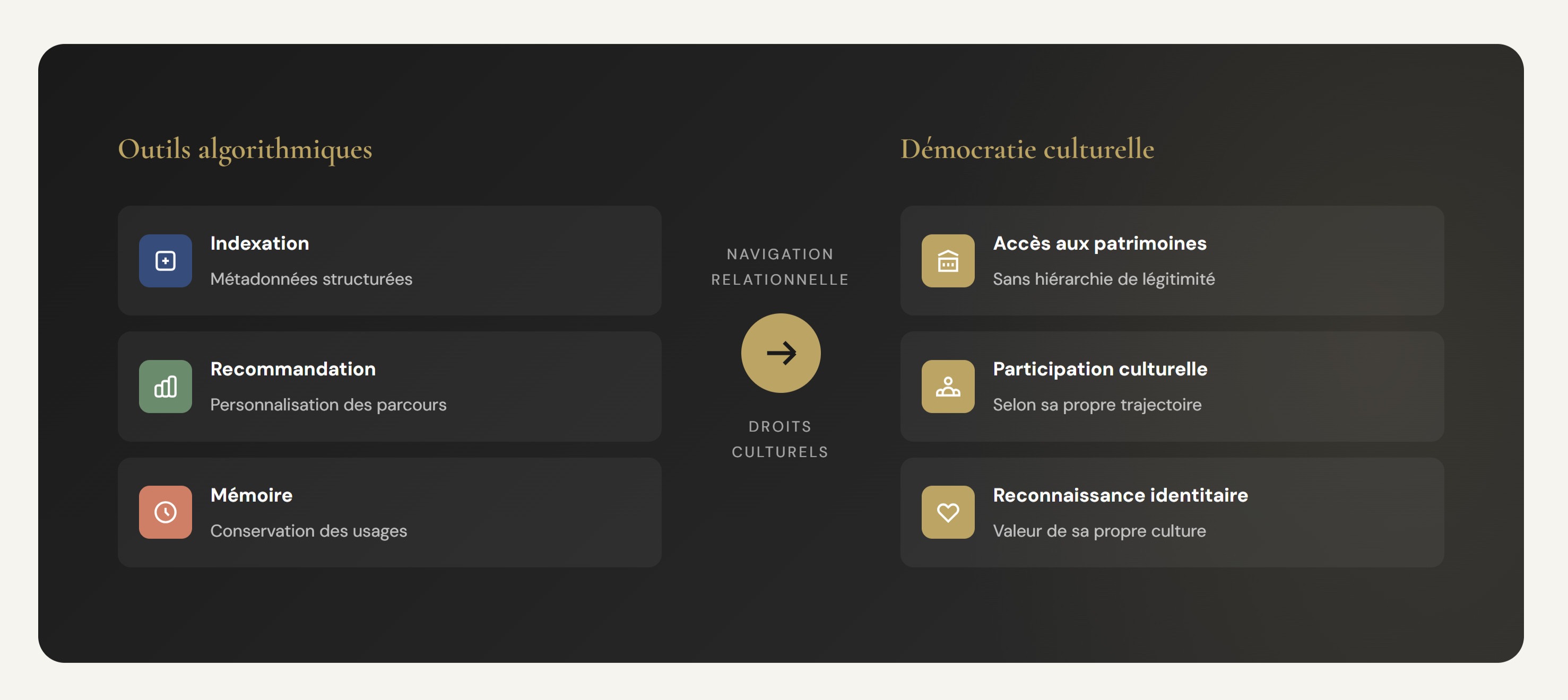
Cultural rights, as formalized by the Fribourg Declaration (2007), notably affirm each person’s right to “access cultural heritages” and to “participate in cultural life.” Relational navigation responds to these requirements in several ways:
- First, it respects access to heritage through indexed patrimonialization of art: works become accessible not according to their place in a hierarchy of legitimacy, but according to their intrinsic characteristics and their relationships with other works.
- Second, it recognizes the singularity of each person’s experience. Through the recording of uses and recommendation algorithms, the machine enables, better than any human being, exploration both in diversity and in our singular passions. As Patrice Meyer-Bisch recalls in “Clarifying the Cultural Meaning of Human Rights” (Nectart, 2025), cultural rights aim precisely to “fight against forms of assignation,” and the personalized algorithm, paradoxically, can contribute to this by avoiding the reduction of each person to a predefined category.
John Dewey already formulated in 1927 that democracy is first and foremost « a mode of associated living, of conjoint communicated experience » (The Public and Its Problems). Well-designed cultural algorithms apply this pragmatist principle: they make culture not a good to be distributed vertically, but a process to be lived according to one’s own trajectory.
The Patrimonialization of Experience
The fact of preserving a trace of everything we have listened to, of potentially linking it to certain events in our life if we cross-reference this data with our calendar, constitutes a form of self-recognition. If we wish, we can access a posteriori the way we listened to music at such and such a moment in our life, and thus reconnect with ourselves.
This function creates a personal heritage: it patrimonializes our cultural experiences. In doing so, it helps us recognize them as cultural experiences in their own right, memorize them, and thus recognize the value of our own culture. Now, this recognition constitutes one of the pillars of cultural rights: that each person can “give value in their own eyes to their personal culture,” as I wrote in a previous article.
These traces of cultural processes that machines allow us to constitute—our purely human memory cannot accomplish as well. The digital tool extends and augments our memorial capacity, in line with what Bernard Stiegler called “tertiary retentions”—those technical supports that externalize our memory and enrich our relationship to time.
The algorithm thus appears as a tool in service of cultural rights, allowing them to express themselves with a force and depth that humans alone cannot achieve. It is not a matter of replacing humans but of offering them new capacities for navigation, memory, and discovery.

The Contribution of Artificial Intelligence
Algorithms can evolve and be enriched by artificial intelligence, which allows for different and even more qualified circulation through our data. The main contribution of AI lies in indexing based on recognition of the content itself: fine analysis of musical pieces (instruments used, rhythms, notes, arrangements), and no longer solely the metadata provided by humans.
One can imagine that the creation of metadata from an indexing of the content itself will allow unprecedented indexing refinements, and thus an improvement of discovery capacities and cultural pleasures. This is already how Netflix operates, proposing projects likely to interest its users in a relevant and profound way, without diminishing the creative work of artists.
AI also enables better knowledge of the person’s uses, an analysis and transformation of these uses into data. This refined knowledge opens to serendipity: discoveries that seem linked to chance but arise from the intersection of a considerable quantity of informational traits, and which allow us to grow in our humanity.
This is not a naive utopia. Algorithms can also be designed to manipulate, confine, surveil. But their democratic potential exists, and it is this potential that must be consciously cultivated. As the UNESCO Convention on the Protection and Promotion of the Diversity of Cultural Expressions (2005) recalls, “cultural diversity constitutes a common heritage of humanity.” Relational algorithms can contribute to the constitution, preservation, and enrichment of this heritage.
Relational Navigation as a Concept
I therefore propose the concept of “relational navigation” to describe this form of cultural circulation enabled by metadata indexing and recommendation algorithms. This concept stands in opposition to traditional hierarchical navigation, where access to content depends on its place in a pre-established classification, whether physical (the media library section) or symbolic (institutional legitimacy).
Relational navigation rests on three principles:
- first, the linking of content by their intrinsic characteristics (metadata) rather than by their hierarchical position;
- second, the personalization of discovery according to the singular uses of each person;
- third, the patrimonialization of individual pathways as recognition of each person’s own cultural value.
These three principles correspond to fundamental cultural rights:
- access to heritages,
- participation in cultural life,
- recognition of cultural identity.
Relational navigation thus constitutes a vector for cultural democracy in the sense John Dewey understood it: not a fixed institutional system, but « a mode of associated living, of conjoint communicated experience », in perpetual experimentation.
Algorithms, well designed and well used, are not obstacles to cultural democracy. They can be its privileged instruments, provided that ethical vigilance is maintained over their design and use. I propose the concept of “relational navigation” to offer a conceptual framework for thinking through this vigilance and orienting the development of these tools toward effective respect for the cultural rights of each person.


