Architecture of artistic venues and cultural rights
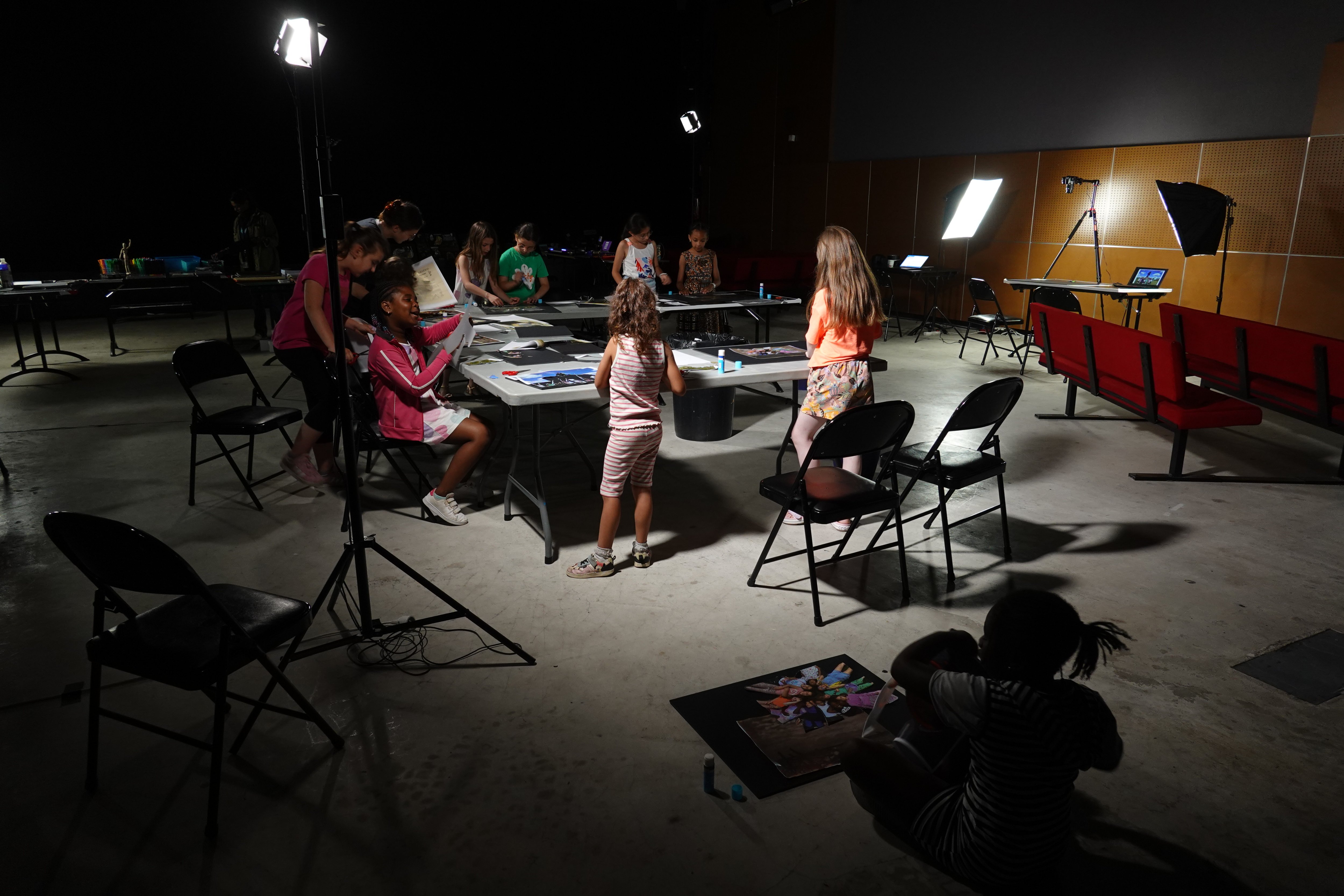
The architecture of cultural venues shapes roles and often limits participation. An approach inspired by digital spaces would enable cultural democratization that respects everyone’s rights.
An Architecture That Fixes Roles
Architecture—meaning both the construction of buildings and their form, as well as the way this construction organizes how humans function within these spaces—naturally has a profound human impact. This is entirely logical.
In the cultural sphere, take a theater, for example: How do you enter? How are you positioned to receive what’s presented? Where are the offices? How are the technical areas visible or hidden? What is the placement of the stage relative to the audience? Where are people seated? All these bodily positions, in relation to what is expected of them, inherently program—or rather, frame—the practices that can unfold there.
We can analyze, for instance, spatial volumes: How much space is allocated to participants? (I don’t say spectators, I say participants.) And how much is reserved for hosts? What are the shared spaces? Are people behind a counter or in a communal area?
Over the years, we’ve seen non-cultural spaces evolve in surprising ways. Take post offices, for example: they used to be highly administrative, with glass counters, queuing systems, and customers assigned to regulated herd-like positions. Stores, too, like self-service shops, have completely transformed how customers are positioned relative to professionals.
Consider a newly built theater. You’ll notice that the way people enter the spaces permitted to them enforces a strict separation, making it nearly impossible for visitors or spectators to participate in any way other than passively—or at least, solely as receivers.
Thus, the architecture itself enforces a division of roles: participants as receivers, creating a radical opposition between emitters and receivers. Physically, upon entering, you’re assigned to that role. This is a deliberate architectural choice, whether conscious or unconscious.
Today, with digital tools or social media, for example, you can be a receiver, but you also have the means to become a content producer. This has been possible since the advent of Web 2.0 (around 2004–2005). It’s a form of democratic possibility in digital spaces that is far less attainable in physical cultural spaces—where democracy is simply less possible.
I’m not judging this: if people choose to simply be spectators at a show or a movie, that’s their choice, and it offers a singular experience compared to social media—which is perfectly fine. Being a spectator is a pleasant and constructive role. The problem arises when it’s the only role available, and we’re barred from occupying another if we wish.
On social media, you can be a passive spectator, but you can also, if you choose, become an active contributor. What I’m highlighting here is that the way cultural spaces are built affects and entirely shuts down the possibility of stronger participation from people, should they desire it. They know they don’t have the right or the status to do so—it’s social and even legal (e.g., insurance policies forbid it).
Try this experiment: if you go backstage in a theater as a non-professional, you’ll be poorly received because your transgression will be seen as intolerable—unless, of course, you’re invited (but then, you’ve crossed into the professional side). As a spectator backstage, you’ll immediately be viewed as a potential threat: maybe you’ll steal something, commit an attack, or who knows what?
At Ariane Mnouchkine’s Théâtre du Soleil, the approach is slightly different: you can glimpse the dressing rooms, suggesting an attempt at something else. Moreover, the staging isn’t confined to the stage—the entire space is scenographed to match the show’s theme. So, it’s a small step in another direction.
Drawing Inspiration from the Cultural Democracy of Digital Spaces
I believe that artistic venues should draw inspiration from the democratic dynamics of digital spaces and open themselves to people’s creativity in evolving ways, as happens online. Their very architecture should allow for functional flexibility in all aspects, including the workspaces of professionals, which should be adaptable—perhaps remaining in one place for a long time, but with the possibility of change.
This is also how professionals can more concretely envision shifts in their own roles. Because spaces assign specific social postures and positions to people, who then perceive themselves in rigidly defined roles.
Of course, it’s not just about architecture: it’s also about how people inhabit it. For example, a movie theater in India might resemble a French one, but people are allowed to talk, eat, etc. The films are much longer, and the spaces function as different social environments—even if they look similar from the outside.
Architecture remains crucial. I’m not saying everything should be wide open—some structures are necessary for functionality. But take this example: managing door access can be an incredibly complex gymnastics. Even mediation professionals in museums, who don’t have the same hierarchical status as curators, may struggle to get a door opened. You have to ask a staff member (who resembles a police officer) to do it—you’d never get a badge to open it yourself. The reasons for this are often fantastical.
So, it’s both the architecture (with its closed doors) and how we use it. Whether rethinking an existing space or designing a new one, we must consider cultural democracy—meaning respect for the cultural rights of all involved: professionals, audiences, artists. With all the fluid boundaries and overlaps that should increasingly blur these roles.
This way, cultural spaces can continue to fulfill their role without becoming frozen traditions that, architecturally, function as spaces of exclusion, rigid assignment, and limited possibility—unlike digital spaces, where possibility is far broader and more open.
The IKEA Example
At IKEA, for example, there’s no longer a separation between the stockroom and the store. Or rather, the stock is no longer hidden. There are two spaces: the showroom, and then you retrieve your packages from the warehouse yourself.
This design, which might seem purely functional and economic (cutting labor costs by making customers work), actually assigns people a different role. At IKEA, you buy flat-pack furniture to assemble yourself. The very experience of the store involves co-construction: you fetch items from the warehouse. So, you’re cast in the role of building your furniture in cooperation with the store. And IKEA assigns you this role through the layout of its spaces.
That’s why IKEA isn’t just about flat-pack furniture. It’s a holistic experience that begins in the store. The furniture may be standardized, but you’re given an active role. Moreover, the assembly instructions are extremely clear. Thanks to professional designers, the kits are designed so anyone can assemble them if they follow the steps. This is a social role, a form of empowerment that even changes your relationship to your home. It’s not just “cheap” stuff—it’s anthropologically much deeper. And it starts with the in-store experience.
That said, at IKEA, certain services (like communications or accounting) aren’t accessible to the public. But the public doesn’t demand access. My point isn’t that everyone should do everything, that rules and boundaries should vanish into total anarchy. Rather, within established rules, participants should be granted a more democratic role than before.
Paradoxically, this generates immense capitalist wealth—contrary to what one might expect. Another paradox: IKEA was founded by a Nazi. As Johann Chapoutot documents in *Libres d’obéir*, the Nazis understood that empowering people made systems more efficient. It’s chilling to realize this, and Chapoutot explains how Nazism influenced post-WWII corporate HR systems, boosting efficiency. So, this seemingly tangential reference highlights how a more democratic system emerged from figures who, tragically, harnessed efficiency for absolute destruction.
This is crucial: greater efficiency and democracy must serve ethics. Because efficiency can also manipulate people—as happens in some digital spaces and social media, where censorship is strong and algorithmic manipulation powerful, even as users believe they’re in a democratic space.
But the flexibility of digital spaces should teach us much. We must never forget—hence the Nazism example—that these systems must always serve ethics.

The “cultural rights”, which derive from the Universal Declaration of Human Rights, are a concept developed and defended by researchers, sociologists, philosophers, political leaders and actors of the cultural world. Present in a certain number of articles of law since 2001, the cultural rights aim at highlighting and formalizing, in order to be able to make them operative, the principles of a “cultural democracy”. To summarize it quickly, it is a question of each person being able to give value to his or her personal culture, in order to be able to exercise his or her citizenship: to express himself or herself, to defend his or her point of view, to create, to develop his or her practices, to have access to a cultural diversity, etc. Cultural rights operate in a much wider field than that of the strict cultural sector.
The notion of “cultural rights” is present in France in the laws NOTRe (2015) and LCAP (2016). It is carried by a delegation of the Ministry of Culture (General Delegation for transmission, territories, since January 1, 2021).
Paradoxically, cultural rights are difficult to implement in the cultural sector, which is traditionally rather attached to “cultural democratization”: one often defends the idea of the transmission to the public of works of art of the best possible quality, according to a principle of hierarchy of “cultural values”. Thus, the cultural rights can be lived by certain professionals of the culture as a dangerous dynamics for the Art, a tendency towards the amateur practices, which is not the case.
In my point of view, which is that of a practitioner/researcher in the cultural field, cultural rights are above all a practice, an exercise of democracy in the very methods of organization of the work, of the relation to the other and of the place of each one, the choices of programming, the methods of mediation and animation of workshops, the mode of territorial inscription of the cultural policy, etc.
I propose in this section concrete working methods for good practices of implementation of cultural rights, based on my field experiences, as well as a sharing of more theoretical reflections, in the framework of my own research on cultural rights.
I place myself in the filiation of thinkers like John Dewey. But cultural rights cannot be presented without mentioning Patrice Meyer-Bisch, Jean-Michel Lucas, Christelle Blouët, the “Fribourg Declaration”, etc.
-

Transmitting cultural rights: a question of coherence
What facilitation methods reveal about our relationship with people.
How can we talk about cultural democracy within an authoritarian framework? How can we defend respect for each person’s culture while imposing a (…) -

The political dimension of organisational frameworks
When forms contradict intentions: organising cultural democracy.
We talk about cultural democracy, horizontality, cultural rights. But the concrete frameworks we put in place often tell a very different story. (…) -

Will Heritage Still Be Part of Our Lives in 2045?
Digitising collections is not enough: the challenge is to enable their appropriation by citizens.
Cultural practices in 2045 will be as different from ours as ours are from those of 2005. At that time, YouTube did not exist, no one had a (…) -

The Representation of One’s Cultural Role
What the Association of French Mayors survey reveals about the cultural imaginary of local authorities.
What do we presuppose when we speak of “audiences distant from culture”? The AMF survey, read as an anthropological document, unveils the (…) -

Algorithms and Cultural Rights
How algorithms, far from confining us, implement cultural rights through democratic discoverability based on metadata.
Algorithms are regularly criticized as tools that supposedly lock us into “filter bubbles.” We must free ourselves from them, we are told. Yet (…) -

Domination at the Heart of Culture
How laudatory terms mask power relations in the cultural sector.
The praise we bestow upon “great artists” reveals, beneath its flattering appearances, a structure of domination. Behind admiration lies the (…) -

Making Room for Adolescents: Rethinking Our Approaches in Cultural Action
From democratisation to cultural democracy.
Cultural action and mediation with adolescents challenge the foundations of our practices: between framework and transgression, between physical (…) -

Symbolization as a tool for mobilization
When the collective and digital traces build cultural engagement.
Faced with an abundance of digital cultural practices, cultural venues struggle to mobilize “audiences.” I argue here that this difficulty does (…) -

Legitimate participation as the horizon of cultural events
From legitimacy to participate: how cultural rights transform our practices.
Cultural rights are often misunderstood. Their strength lies in their capacity to transform our practices: moving from a top-down programming (…) -

The Accelerated Eye
Manifesto for a new ecology of the gaze.
What if speed were not the enemy of culture, but the instrument of a new form of sensitive intelligence? A radical reappropriation of our right to (…) -

Authorizing Creation
For a radical democratization of the creative act.
How can artistic creation become a political act of collective emancipation? By carrying within itself, in its form and process, the authorization (…) -

Creative Freedom and Cultural Rights
A dialectic at the heart of cultural policies.
French cultural policy today finds itself at the crossroads of two fundamental principles, both enshrined in law: creative freedom and cultural (…) -

Cultural Rights in Light of Personal History
At the beginning of my journey as an engaged cultural actor.
The question of cultural rights has long shaped my commitment, well before the term came to light. Through my story, I attempt to show how a (…) -

Cooperative Narratives
Creating polyphonic narrative devices to transform academic knowledge into living and operative knowledge.
How can we overcome the limits of academic narrative to create truly shared knowledge? A concrete experience of collective writing devices that (…) -

The myth of recognition through cultural democratization
Rethinking artistic value beyond systems of domination.
Artistic recognition is less about talent than about a social game that some refuse to participate in. A reflection on alternative paths to (…) -

Cultural Rights and Digital Discoverability
For a cultural policy adapted to digital spaces.
Faced with the failure of many institutional digital cultural strategies, cultural rights and its corollary cultural democracy seem to me to be (…) -

Freedom and Cultural Rights
A renewed approach to democratic dignity, through the contribution of two new rights.
Cultural rights, seemingly guarantors of human dignity, are emptied of their meaning when they fail to forcefully articulate the question of (…) -

Cultural Rights and Digital Technology
Rethinking digital tools in service of cultural democracy.
How can digital technology become a lever for cultural emancipation rather than an instrument of dependence? I propose a digital implementation of (…) -

The specter of the other
From anxious dehumanization to confident recognition.
How can the other, a subject of rights, become a threatening figure? A reflection born from a confrontation with reality, beyond the fantasies and (…) -

Cultural data and cultural rights
For an inclusive heritage democracy in the digital age.
Citizen cultural data is tomorrow’s heritage. Their recognition and preservation constitute a major democratic challenge for building a (…) -

Corporate memory at the service of cultural rights
Rethinking the relationship between cultural venues and people.
Cultural institutions, through their failure to collect and care for data, forget those they welcome, denying their dignity. This amnesia (…) -

Cultural rights and preservation of digital heritage
Bernard Stiegler’s technical philosophy sheds political light.
Have you ever tried to find a video you loved on YouTube from ten years ago? A blog post that made an impression on you? Your friends’ photos on (…) -

Artistic Legitimization, Cultural Rights, and Construction of the Individual
Between horizontality and the need for recognition.
Artistic legitimization, between traditional hierarchies and new digital forms, questions individual and collective recognition. By intersecting (…) -

Cultural rights and the “fight” against the far right
How to rebuild democracy in our cultural spaces.
How the discourse of “fighting against the far right” stigmatizes voters, compromises democratic dialogue and becomes hate speech. It would be (…) -

Architecture of artistic venues and cultural rights
The impact of location on social roles.
The architecture of cultural venues shapes roles and often limits participation. An approach inspired by digital spaces would enable cultural (…) -

Strategy, design and technical implementation of the “Azimut” platform
The resource portal for artistic practices.
I am supporting and leading, on behalf of the MPAA, in its current phase, the strategy, design, and technical implementation of this platform, (…) -

Synthesis of the seminar: “What pedagogy by and for cultural rights?”
Organized by UFISC, Opale, Réseau Culture 21, Observatoire des politiques culturelles, Laboratoire des droits culturels and Ligue de l’enseignement (February 6, 2025).
Workshop to find out what stage the partners had reached in their work on the “cultural rights” certification referential project in the context (…) -

Conference: “EAC and cultural rights: convergences to be identified and implemented”
Dans le cadre des Rencontres territoriales “Artistic and cultural education & Territorial cultural projects” (Foix, February 5, 2025).
How can cultural rights be a tool for better implementation of artistic and cultural education projects? And how we can identify convergences (…) -

Cultural rights and professional postures
Tools for the concrete implementation of cultural rights.
Cultural rights, stemming from the Fribourg Declaration (2007), represent a major advancement for cultural democracy. However, their practical (…) -

“Cultural rights” creative writing seminar
Master Arts du Spectacle, université de Caen Normandie 2021-2022-2023-2024.
A practical seminar on digital writing, with the theme of cultural rights. Students approach writing in the contemporary sense of the term, (…) -

“On the ineffectiveness of our works in real life”.
Commentary on the text by Eva Doumbia & Kader Attia (2023).
In July 2023, visual artist Kader Attia and director Eva Doumba published a text (in Analyse Opinion Critique) in response to the youth “riots” (…) -

Artistic creation in a digital environment
Commentary on the report commissioned by DRAC Bretagne (August 2023).
A study on the subject of digital and artistic creation reveals, through its unquestioned biases, the unconscious desire not to move the lines of (…) -

Digital technology, a tool for mediation and cultural democracy
Webinar on Monday, October 9, 2023 from 10am to 1pm.
Restitution of the “Digital Workshops” project by Cultures du Cœur and Benoît Labourdette Production, offered as part of the Été culturel program (…) -

Itinéraire bis, the path of cultural rights
Action research conducted by the MPAA (Paris).
Accompaniment in the animation, production of traces and fabrication of the web platform resources of the research-action “Itinéraire bis, chemin (…) -

Raising awareness of cultural rights - Nantes métropole (September 30, 2022)
Co-design and co-hosting of a one-day event for Nantes’ cultural players.
Taking ownership of cultural rights concepts and approaches through cooperative creativityA small group of cultural players from Nantes, led (…) -

Analyze your project using the Fribourg Declaration
Working method
How to set in motion an approach open to cultural rights, that is to say, to put more democracy in the projects and the relationship with the (…) -

John Dewey : an inspirer of cultural rights?
Sharing my interest in an inspiring personality.
The notion of “cultural rights” is increasingly present in the debates within the cultural sector. They are seen by many as being at the heart of (…) -

Professional meeting “Public participation”: presentation by Benoît Labourdette
Interview of Benoît Labourdette by Jean-Yves de Lépinay (11’37s, 2020).
Sharing examples of audiovisual creation workshops conducted in the spirit of cultural rights: moving from “participation” to “interaction.” (…) -

“Cultural participation”: interview with Benoît Labourdette.
Interview with Benoît Labourdette (4’39s, 2020).
Video presentation of Benoît Labourdette’s approach to the democratic dimension of cultural action. -

Research-action “Image Education 2.1”
Collaborative action-research project led by Benoît Labourdette production in 2018 and 2019, to develop the synergy between teenage cinema (…)


-

Authorization Regime and Freedom Regime When the confusion between authorization and freedom reveals a deep democratic crisis.
The management of the Covid-19 crisis revealed a fundamental confusion in our societies: we have overwhelmingly accepted to call “freedom” what (…) -

Art bleeds Calligrams
-
Freedom and Cultural Rights A renewed approach to democratic dignity, through the contribution of two new rights.
Cultural rights, seemingly guarantors of human dignity, are emptied of their meaning when they fail to forcefully articulate the question of (…) -

For a Political Consciousness of Digital Technology When our technological choices shape tomorrow’s world.
Every click, every application used, every digital service adopted constitutes a political act that participates in building our collective (…) -

The Non-Institutional Cultural Institution For a citizen reappropriation of creation.
Rethinking culture beyond institutional walls: how spontaneous practices redefine our relationship with creation and question established cultural (…)
