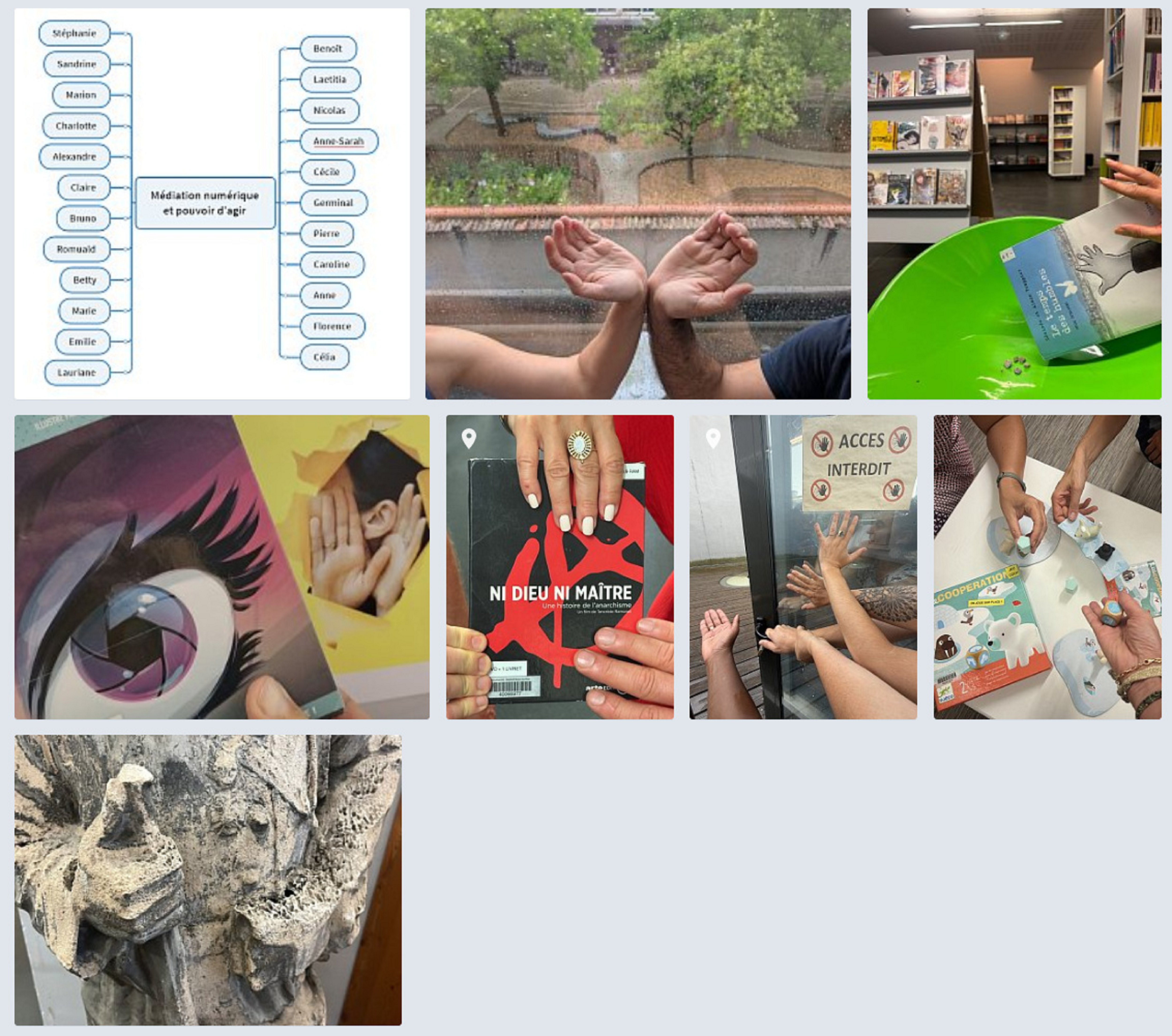
I led these two workshops on 1 July 2026, as part of the “Developing the power to act” module of the training course for organisers of cultural rights local groups. Invited to represent the power to act in photographs, the teams produced many images of prohibitions and of their crossing. From this I draw the lesson I develop here: what blocks the power to act is not primarily a lack of ability, it is a feeling of illegitimacy, and the first task of cultural rights is to build frameworks that authorise.
A module for experiencing the power to act, at the start of an eighteen-month cycle
Réseau culture 21, led by Christelle Blouët et Anne Aubry, has been leading the Paideia programme (“education” in ancient Greek) since 2012, in partnership with the Fribourg Observatory of Diversity and Cultural Rights. This action research collectively analyses how fundamental rights, and cultural rights in particular, are taken into account across all public policies, whether cultural, social, educational, environmental or health-related, and works on their operational translation. It notably takes the form of an action-training course for “organisers of cultural rights local groups”, six three-day modules spread over a year and a half, at the end of which the participants will themselves lead cultural rights dynamics in their own territories. Fourteen groups have already been supported; they have organised more than a hundred days of activity and introduced more than seven thousand people to cultural rights. The third season (2026-2027) brings together Bordeaux, Villeurbanne, the Marseille Metropolis, the Rouen Metropolis, Grigny, Grand Paris Sud and Pontarlier.
The second module of this season, “Developing the power to act”, took place from 1 to 3 July 2026 at Le Rize in Villeurbanne. Its starting point lies in an observation carried by the Paideia programme. The power to act depends to a large extent on people’s capacity to claim and exercise their fundamental rights, whereas the approach of public policies remains mostly based on needs to be met and on prescription. And this capacity-building intention is not enough when merely stated; it calls for active methodologies. The Wednesday afternoon therefore brought together the testimonies of four practitioners from different fields, Hélène Balazard for research on community organizing, Jean-Pierre Chrétien-Goni for shared creation in contexts of vulnerability, Christophe Jibard for community social work, and myself for digital mediation. Each participant chose two workshops out of the four; I therefore led the same workshop twice, first with about ten people, then with about twenty, most of them professionals from local authorities, cultural institutions or associations.
One should measure what this moment represents for these people. They are a group of fifty, this is their second meeting, they are only beginning to know one another, and they are committing together to an eighteen-month journey. The power to act that the programme speaks of is also at play right there, in the strength of the bond and in the trust being established between them, and a shared creation workshop, so early in the journey, contributes precisely to nourishing that bond through an experience lived in common.
Fifteen minutes to create, much longer to look
Rather than explaining my practice, I proposed to live one, in compressed time, because the power to act, in my view, is not transmitted as a concept, it is experienced. This choice begins even before the participants arrive. I had come early and spent three quarters of an hour setting up the room, trying out layouts, moving chairs, because the care taken in welcoming people is part of the method; a prepared space tells the people who enter that they were expected. This might seem superfluous, and most speakers use rooms as they are given to them, which is consistent if the point is only to convey information. But if the point is to live an experience, the place itself is an agent, and it must therefore be attended to carefully.
The protocol is that of a photographic creation workshop I have been using for years and have already described elsewhere on this site. In teams of two or three, the participants had fifteen minutes to create a photograph on the theme of “developing the power to act”, with a single formal constraint, the presence of at least one hand in the image. Each team put its photo online autonomously, via a QR code, and signed it with the first names of its authors. We then looked at the images on a large screen, one by one, with an unusual rule, the authors being forbidden to comment on their own photo, while the others told them what they saw in it, what it evoked for them, what it did to them. “It’s very frustrating, I know, I admit it, but that’s the game.”
The workshop thus reverses the usual proportions of artistic practice projects, where almost all the time goes into the making and the final presentation comes as a bonus. Here the making was short and autonomous, and most of the time was given to the shared looking, lived as a genuine practice in its own right, one that takes the participants through real emotions. For the essential time of this workshop was not the methodological elaborations I offered afterwards; it was what the participants lived together, the creation of the photos, then what they gained from one another by bringing their own gaze to the images of the others.
Half-open doors, forbidden entrances, instruments under lock
This moment of looking had an intensity that delighted me. We laughed a lot, we were surprised, we played at interpreting. In front of two open hands set against a perspective of paths and trees, someone said “love is an open path”, and the phrase travelled around the room. In front of adults photographed in the middle of a cooperative board game, we wondered whether they were “children in adult bodies”. In front of pebbles carefully lined up on a picnic table by two hands shaking, we hesitated between a ritual of alliance and “the resolution of a pebble conflict”. And in front of musical instruments held by their anti-theft brackets, which the group read as instruments “under someone’s grip”, inaccessible, a participant finally revealed, amid laughter, that she herself designs the communication materials of that media library, where these instruments can be borrowed free of charge.
Beyond this joy, what the photographs showed struck me by its consistency, from one group to the other. A door half-opened onto a restricted area, promising to reveal the other side without showing it. Another door, marked “no entry”, this time opened by a multitude of hands, where the group read that the collective legitimises transgression, that together we have the right to go where entry is forbidden. Three hands laid on a DVD case entitled “Ni Dieu ni maître” (“Neither God nor master”), turned by the gazes into an oath, almost a ritual. A public bench covered with inscriptions claiming an “owner of the bench”, and the question of whether one may sit on it.
No one had agreed on anything beforehand, and yet, invited to represent the power to act, the teams produced many images of prohibitions and of their crossing. This body of images says something that the discussions then confirmed. Spontaneously, we imagine the power to act as an infraction, as taking what has not been given to us. A participant in the first group in fact put her finger on the limit of this representation, remarking that if the power to act can only be acquired through transgression, the message becomes confining. Her remark points to the very stake of the module. If acting is experienced as transgressing, it is because we do not feel authorised, and developing the power to act then consists less in providing abilities than in moving the line of what is experienced as a transgression.
“Making the effort to receive”
This feeling of illegitimacy, the participants experienced it in the exercise itself, and this is what gives the protocol its pedagogical value. Making a creative photograph when one is not an artist does not go without saying. One may tell oneself that what one produces is merely “socio-cultural”, not serious, that real creation happens elsewhere, among professionals, and by this reasoning one deprives oneself of one’s own power to act. Several people told me of the unease they felt when their photo appeared on the big screen, that impression that one’s own is the weakest of all, the fear of what the others will say. And when the gazes settle on the image and see things in it that one did not put there, one may want to protest, “we didn’t put all that in our photo!”. In an assembly, what prevents people from moving into creativity is not a lack of ability, it is the fear of judgement. And this fear has deep roots, for thinking for oneself, creating in one’s own way, is potentially not doing as others do, and therefore risking exclusion from the group, which, for a gregarious species like ours, counts among the greatest dangers.
The silence imposed on the authors works on this point in a way I truly understood that day, even though I designed this workshop nearly four years ago and have practised it very often. Being deprived of the right to explain forces one to make the effort to receive, and receiving what the other brings us is perhaps the most difficult thing there is, far more difficult than giving. One would like to answer, to justify, to put one’s intention back at the centre. Instead, one discovers in one’s own image riches one had not put there and that the others nevertheless saw. A participant who reviews cultural project applications within a Cité éducative (a French priority-education programme) drew a lesson from it for her own profession, saying how funny it was to hear what the group had seen, “because we hadn’t asked ourselves that many questions”, and how much this gap between what the artist wants to convey and what people actually receive would deserve to be thought through when designing cultural programmes.
What the community thus gives back to each person legitimises their work, and through it a little of their identity. The gaze of others institutes me and teaches me, and my gaze does the same for them; it is because there is a community that one can build one’s own identity, for it is recognised, and even named, by the community that comments. No aesthetic judgement is passed, and none can be, since a creation is, in the etymological sense, something new, for which criteria do not yet exist; the twenty-two million people in France who have an amateur artistic practice are no less legitimate than professionals. The first names written down at the start of the session, the signed photos, the trace kept online and archived are all part of the same movement, anchoring each person in the value of what they do; this is heritage (patrimoine/matrimoine) taking shape concretely, all the more so as these creations will remain online, on my own servers, which do not depend on the tech giants. This is the first foothold of cultural rights, the value each person can give to their own culture, and one can see that it is not a declaration of principle, it is an experience that a given set-up can produce or prevent.
The framework is not made of prohibitions, it is what authorises
It remains to understand why such a constrained framework, an instruction, an imposed theme, fifteen minutes, a compulsory hand, the silence of the authors, produces freedom rather than obedience. The answer lies in what psychoanalysis calls the third element (le tiers). A relationship between two people, the one in which I give an instruction and the other carries it out, is what is called a “dual” relationship, a power relationship, whatever the good intentions. The object placed between the people, here the QR code and the photographic instruction, unties this dual relationship, since each person makes their photo as they see fit and the only thing that matters to me is that there be one photo per team, whether the instructions were followed or not. The framework, in this conception, is not made of prohibitions, it is what authorises, what allows people to feel entitled to act, and they experience it through what they live: they really were free to make their photo, then to say what they wished about the photos of the others. We therefore lived an experience of building the power to act through framing itself. This method is, I hope, inspiring and reproducible in its logic. And I always bring more material than I have planned for, so as not to be the prisoner of a single protocol if the group takes the project somewhere else.
This conception rests on a philosophical tradition from which cultural rights inherit. John Dewey writes in Art as Experience (1934) that art is not an object, that it is the experience lived by human beings. If we follow Dewey, artistic rigour does not reside in the quality of the final product, it resides in the quality of the bond, and more exactly in how much power to act we demand for the people involved; my experience confirms that when this bond is cared for, the artistic productions reach a quality beyond compare. Jacques Rancière says something close in The Ignorant Schoolmaster (1987), where explaining something to someone already amounts, through the very device, to assuming they are incapable of finding it on their own. A very concrete consequence follows for shared creation projects, which are so often judged, at the moment of final presentations before funders and supervisory bodies, on professional aesthetic criteria, which pushes artists, in order not to lose their legitimacy, to intervene over the creations of the people they work with. This takes projects towards the opposite of what was intended. Presenting the process rather than the result, documenting it all along with photos, logbooks and narratives, and entrusting the final presentation to the participants themselves, makes it possible to escape this trap. Cultural rights having been enshrined in French law since 2015 and 2016 (the NOTRe and LCAP acts), this approach now has legal texts that legitimise it against the injunction of results.
Professionals too need to feel authorised
The mechanism I am describing does not only concern the publics, it also runs through professionals. In the workshop before mine, Jean-Pierre Chrétien-Goni spoke of his work in prisons, of his choice not to show a play before creating with the inmates, because a model prescribes and inhibits, and of those final presentations where an elected official absent from the whole project arrives at the last moment, delivers a four-minute speech and leaves, which the participants receive as an aggression. Participants in my second workshop made the connection themselves between his testimony and mine. We describe, each from our own field, he from theatre in prison, I from digital mediation, the same institutional symptoms, the prescription that inhibits and the presentation that dispossesses.
For the great majority of participants, what I perceived of these two workshops was discovery and joy, the joy of allowing oneself something one did not grant oneself. A few people also expressed resistances, and these are precious, because they obey the very logic the photographs had already shown. The people following this training work with generosity and conviction in the institutions whose symptoms we describe, and a discourse that questions the usual frameworks of cultural democratisation can be heard as questioning the people themselves. The objections made to me were in fact often fair, on the distinction between competence and hierarchy, which is first of all a matter of stance, on groups that ask for a framework when left to a “do whatever you want”, on relational competence as a competence in its own right. Changing one’s professional stance, questioning habits one’s institution expects, is also a form of acting that is first experienced as a transgression, and professionals need, as much as the publics, frameworks that authorise them. A training course like this one is such a framework, provided the controversy can unfold without anyone having something to defend, neither the witnesses their practice, nor the participants their institution.
What cultural rights activated there, in practice
To conclude, I propose to reread this workshop as a miniature demonstration of how cultural rights operate, not as principles to be recited, but as tools that structure a set-up. They can be grouped into three families of powers (Anne Aubry’s typology):
- The power to exist. Identity is taken care of by the first names written down at the start of the session and by the signing of the photos, because identity is the most fragile thing there is and respect for the dignity of persons is the foundation of cultural rights. Diversity is taken care of by the polysemy of the gazes, since on almost every image opposite readings coexisted, all legitimate, with no single truth prevailing. Heritage is taken care of by the trace, for the photographs are kept, archived, and belong to those who made them. Community is what legitimises the whole, since it is the gaze of others that institutes the value of what each person has made.
- The power to know and to make known. Education and information pass through the time of methodological debriefing, through putting words, together, on what has just been lived, and through the documentation of the process, which then makes it possible to recount and transmit it.
- The power to organise. Participation and cooperation are inscribed in the set-up itself, autonomous teams, an upload done by the people themselves, a presentation carried by the whole group, and trust is the guiding thread.
This is the grammar the participants will take back to their territories, since the very principle of Paideia is that they then organise their own dynamics locally. In my view, artistic creation can take its full place at the heart of these logics of cooperation, provided we hold on to what this afternoon made us experience, that artistic rigour resides in how much power to act we demand for the people involved. The photographs created during these two workshops remain online, together with the recordings and summaries of the exchanges. They belong to those who made them.


