Building a critical thinking of the stakes of Virtual Reality (360°) films, through practical application and creativity.
This article was originally published in 2020 in « Les cahiers de Louis Lumière n°13 ».
Virtual Reality has been presented for a few years as the figurehead of innovation, if not the future of audiovisual creation, which would involve the complete immersion of the viewer in an image that is no longer flat but spherical. We postulate an evolution of the cinematographic language, because this new technology seems to conceal great commercial opportunities, which reveal themselves until now more fantastical than real.
Perhaps it would be useful, in the field of thought, to approach this subject with an ethnological glance, a minimum of critical distance, in order to build thoughts freed from the stakes of the trade. To consider this technology and its uses in the history of the techniques and the philosophy of the image is a first step. The second step, in the spirit of John Dewey, consists in experimenting this technology oneself, in order to build one’s thought through practice: one discovers there fascinating artistic and conceptual openings.
The violence of Virtual Reality
The “Virtual Reality” (VR) is a technology that allows to watch a movie, linear or interactive, or to use games or computer applications, in a 360° space around oneself, simulated thanks to a helmet that comes to replace completely the vision by two screens in front of the eyes. On these screens, the image is moved according to the movement of the viewer’s head, simulating a visual sphere around him. Contrary to the rectangular screens, from which one can turn away, Virtual Reality proposes us always and everywhere an image, following the example of the character of Alex in the film Mechanical Orange (Stanley Kubrick, 1971), to whom one imposes to see images of violence thanks to ocular spreaders. At the same time, he is inoculated with substances that give him nausea. This will provoke in him conditioned reflexes of disgust of the violence; the goal is to program his docility.

Note that the term “Virtual Reality” is an oxymoron: these two words have opposite meanings. The name given to this technology implies that it will create images that will replace our reality. The project thus aims at the disappearance of the representation. However, it is the proper of the art to propose us representations, in order to share a vision of the world, this sharing being at the base of the construction of the taste, the critical spirit, the political thought, the culture in general. This re-presentation, as its name indicates it, places the object at a distance of us, and it is in this distance that resides the space which allows the emergence of our singular thought in front of the artistic object of which we are spectator. Peter Brook, in The Empty Space has some words about theater that I find illuminating.
Distancing is cutting, interrupting, bringing something to light and making us see it again. Distancing is above all a call to the spectator to undertake his own research and become increasingly responsible, to accept what he sees only if he is convinced of it.
Peter Brook, The Empty Space, Paris, Le Seuil, 1977.
The infatuation of a professional sector for Virtual Reality was, in my opinion, a fashion effect, still sensitive in 2023. This technology has set audiovisual producers on fire, as it seemed to promise future opportunities to produce and sell new types of audiovisual content. It is a fantasy of commercial windfall. Discourses, more or less theoretical, have emerged about the development of a “new writing”, of a “new narrative” to be invented. One also insists on the radical transformation of the framing of the image, insofar as it is not any more bound to a rectangle which faces the spectator, but is conceived in relation to a sphere which surrounds it.
In my opinion, all these elaborations testify in reality to a very partial vision of the subject, which would deserve, according to me, to be crossed with precise studies on the uses of Virtual Reality and with a philosophical and historical reflection on the stakes of this technology, in the present, and in the perspective of the evolution of technical devices. This is why I invite here thinkers, ethnologists, philosophers, economists, critics, historians, psychologists, artists, etc. who can help, by the solid theoretical supports that they offer us, to build a lucid thought on the stakes, philosophical, political, aesthetic, of this oxymoron that constitutes the “Virtual Reality”.
A long history
The project of the immersion of the spectator has existed for a long time, but it has never produced perennial devices. As Jean-Jacques Gay points out in his contribution to this issue of Cahiers de l’École Louis Lumière (For a spectator-worker at the center of the work: reception and creation postures of an ultra-contemporary spectator in search of disappearance), there are almost no traces left of past “immersive” experiences. All that is thus mainly still of the order of the fantasy. The fantasy is moreover often the source of many financial investments, since capitalist thought is in no way rational, contrary to the image it wishes to give itself: a virtual reality, in the primary sense of the term, which produces a world based on the principles of domination and destruction, a very fragile world, as attested to by the unprecedented fall of economies at the global level, to the benefit of a few multinationals, in the year 2020 (the so-called “Covid-19” crisis).

Photograph from the short film “The Collector” by Ronan Fournier-Christol (1990) for which I was the director of photography. At the time, we were already very concerned by the stakes and potential dangers of Virtual Reality.
Annie Le Brun’s words resonate in the face of the commercial will of audiovisual industrialists, who promote Virtual Reality as a supposed new field of creation.
The use of the same managerial language to evoke the treatments reserved for realities as distant as the book, the cell or a work of art, gives the measure of a violence in the process of imposing its redundant order on the sources of thought as well as of life
Annie Le Brun, Du trop de réalité, Paris, Stock, 2000.
Transgression to be able to think, the “side step”
It seems to me that there is a great need for creativity, invention, amusement, transgression, concrete experimentation, in order not to find ourselves prisoners of capitalist thought, which is always very effective in its way of recovering the notions of art, work, creation, while its project is quite the opposite: it is about commercial domination, through the use of technologies, Virtual Reality constituting one of the latest avatars. In this respect, the book Contrôle, comment s’inventa l’art de la manipulation sonore by Juliette Volcler (2017) offers a fascinating analysis. She shows that the development of mechanical sound reproduction techniques in the twentieth century, and in particular its dissemination in the public space, was one of the great tools for the development of mass capitalism, through the incomparable manipulative power of sound (in which we are “immersed”, in factories to imprint the rhythms, in stores to influence purchases, etc.).
When a rainstorm comes to the kingdom of Disneyland, thousands of loudspeakers broadcast the joyful reassuring melody of ’Singing in the Rain’ and thus transform the imponderable of natural phenomena into a programmed fantasy for the spectators. [...] Sound was used to signify a property in a given space, to indicate prescribed uses and expected emotions, to designate desirable or undesirable persons. Making sound in a public place had become a roundabout way of stating its informal rules.
Juliette Vocler, Control, how the art of sound manipulation was invented, Paris, La Découverte/Cité de la musique-Philharmonie de Paris, 2017.
The fact of being thus inscribed, when equipped with a VR helmet, in a virtual reality, from which one cannot escape, and from which there is no possible distance, ontologically undermines the possibility of exercising an independent and free thought. Of course the experience is fascinating, but the use by professionals of this power of fascination, without the critical distance which is (or should be) the characteristic of a true practice of artistic creation, can only send back, by the figure of the confinement in a world with intangible rules to which the device invites, to the fascinating researches of Stanley Milgram. The latter’s words, in Submission to Authority could indeed be read from the perspective of someone who would have chosen to remove his VR helmet during a projection.
The cost of disobedience, for the one who resolves to do so, is the corrosive feeling of having been guilty of disloyalty. Even if he has chosen to act according to the norms of morality, he is still troubled by the idea of having deliberately upset a definite social situation; he cannot chase away the feeling that he has betrayed a cause he was committed to serve. It is not the obedient subject, but he, the rebel, who feels the painful consequences of his action.
Stanley Milgram, Submission to Authority: An Experimental Viewpoint, Paris, Calmann-Levy, 1974.
And indeed, removing one’s VR helmet along the way is experienced either as a transgression or as a social incapacity, in short, an exclusion because one has not been able to submit to the rules. In this sense, Michel Foucault specifies the political stakes and the dangers of domination linked to devices, a fortiori to new devices.
I said that the device was essentially strategic in nature, which implies that it is a certain manipulation of power relations, a rational and concerted intervention in these power relations, either to develop them in a certain direction, or to block them, or to stabilize them, to use them. The device, therefore, is always inscribed in a game of power, but always linked also to one or several terminals of knowledge, which are born from it, but, just as much, condition it. That’s what the device is: strategies of power relations supporting types of knowledge, and supported by them.
Michel Foucault (Dits et écrits, Volume III, p. 299) quoted by Giorgio Agamben, Qu’est-ce qu’un dispositif?, Paris, Payot / Rivages, 2006.
Art is an experience
Virtual Reality productions fall within the field of artistic creation and have been massively funded as such in France by the Centre National du Cinéma et de l’image animée since 2015 - to the detriment, moreover, of support for other forms of innovation. As we have just seen, the deliberate absence of thought in terms of the political philosophy of this technology - no technology is politically neutral, as Bernard Stiegler points out - is a real stumbling block.
The American pragmatist philosophy of the beginning of the XXth century is a very useful tool of comprehension in my opinion to approach the artistic stakes of the contemporary devices of Virtual Reality. John Dewey defines the spectator-actor as follows:
The work of art is usually identified with the building, the book, the painting, or the statue whose existence is on the margins of human experience. Since the real work of art is in fact composed of the actions and effects of this product on experience, this identification does not promote understanding. [...] We must arrive at a theory of art by taking a detour. Because the theory is interested in the comprehension, the penetration, and not in the cries of admiration and in the stimulation of this access of emotion which one often qualifies as appreciation. [In order to understand aesthetics in its accomplished and recognized forms, one must begin to look for it in the raw material of experience, in the events and scenes that capture man’s auditory and visual attention, arouse his interest and give him pleasure. [... The reader should be drawn forward, not by an impatient desire to reach the ultimate end, but by the journey, which is a source of pleasure in itself.
John Dewey, Art as Experience, Paris, Folio/Gallimard, 2010 (ed. Initiale 1934).
Art is thus a practice and a path, a way of symbolizing the real, that is to say the process for the human being which consists in creating his own representation of the world (cf. the contributions of Serge Tisseron, who showed that the process of symbolization was done as much by the production of words as by the production of images). The very term Virtual Reality, in its easy and seductive proposal (in the logic of consumption), refers to a major risk of escape in the construction of the real, well illustrated by the philosopher Clément Rosset in The Real and its Double.
Nothing is more fragile than the human faculty of admitting reality, of accepting without reservation the imperious prerogative of the real. [...] This refusal of the real can take on naturally very varied forms. [...] Paradoxically, my present perception and my previous point of view coexist. This is not so much an erroneous perception as a useless one.
Clément Rosset, Le réel et son double, Paris, Gallimard, 1976,
Finally, Laurent Cauwet, in The domestication of art expresses in a very clear way the way in which the capitalism of State recovers to its profit the notions of artist and art, by perverting them irreparably.
What is asked of the artist is no longer to produce critical gestures, but to obey the injunction to produce critical gestures. It is no longer to give free rein to one’s sovereignty, but to respond to the criteria of freedom set forth by domination. It is not any more to produce art, but to produce the simulacrum of art, to value forms of artistic expression which feed the discourse of the domination.
Laurent Cauwet, The domestication of art: politics and patronage, Paris, La fabrique, 2017.
The important needs of financing for the projects of Virtual Reality can only register them, in majority, in this logic of domination, which aims the opposite of an art which is factor of emancipation.
Vertages of creativity: living a shooting in Virtual Reality
Following the example of André Leroi-Gourhan (Libération de la main, Revue Problèmes numéro 32, 1956), who postulated that the thought of the human being developed in an essentially different way from the moment when his hand began to manipulate and then improve tools, we can only note, that we do not think in the same way if we are acting with our hand, manipulating the material reality, or if we are only manipulating words with our mind.
This is why, since 2016, I have been offering Virtual Reality workshops in film schools (la Fémis for example), media libraries (BPI, city of Paris, city of Biarritz...), movie theaters, festivals, etc.
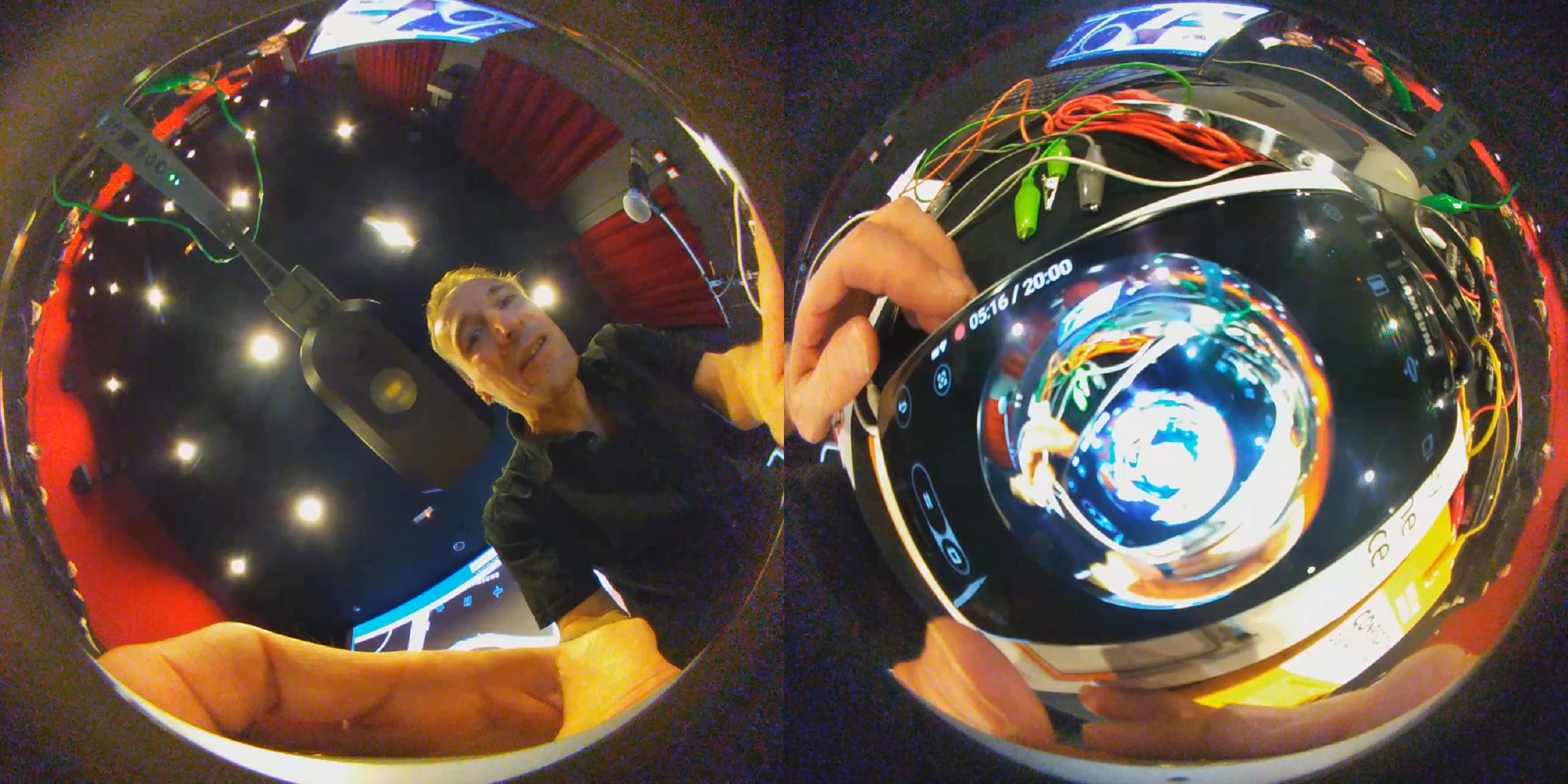
Thus, during the Colloquium at the ENS Louis Lumière « Forms, experiences and devices : audiovisual production facing »immersive« technologies » in April 2019, I proposed an experience of shooting a collective film in Virtual Reality, which seemed to me to be an invitation to a way of thinking different from the one that would have had only the help of words.
Let’s go back to the concrete. Here are two types of filming devices in Virtual Reality:

On the left is a classic “RIG” for a professional Virtual Reality shoot, and on the right is the Virtual Reality camera we used for the collective film shoot. One can immediately imagine that what will be produced by the shooting device will be essentially different.
The experiment I proposed has two main objectives: on the one hand, to think differently about Virtual Reality by acting on it with one’s hand; on the other hand, to become aware that the technical tool opens up unsuspected creative potentials if one had not experienced it.
It is possible to see the film online here :
www.benoitlabourdette.com/_docs/projets/2019/2019_colloque_technos_immersives
For this article, I made a selection of screenshots of the film, in its two “states” (the original binocular rushes, and the final “planisphere”, after stitching (transformation of the original images of the several cameras into a single spherical image, which is integrated into the VR headset), which, it seems to me, allow one to easily project oneself into the situation, and almost to live it “as if one were there”. I could even say that this sequence of still images allows you to “immerse” yourself in the situation better than watching the film itself. Why is that? Because, from the images, we have much more space to “project” ourselves, by mentally recreating the context. We fully appropriate it, we immerse ourselves in it in the mental sense of the term, we find ourselves inside.
In the same way that I proposed to the participants to live an experience in order to then have the space to build their own thought, informed by this experience, I propose to you to immerse yourself in these images, to build your own thought. So I let you think for yourselves by immersing yourself in these images.


With regard to these images, each person will, of course, have constructed his or her own thoughts, his or her own point of view, which is the purpose of my proposal. I also share in conclusion my own lines of thought following my personal experience of this experiment, which will undoubtedly find to be connected to yours, to confirm them or to oppose them in a productive dialectic:
- First of all the omnipresence of the hand in the images, which is not without evoking the discovery of André Leroi-Gourhan on the intelligence of the hand. We can quote his heir Jean-Pierre Poitou:
There is thus indeed objectification of psychic functions in the tools, the material and the places, in short in the apparatuses of production. [...] Human intelligence proceeds just as much, if not more, from the tooling, than the latter proceeds from it.
Jean-Pierre Poitou, Technology and psyche, Proceedings of the colloquium: The social control of technology, University of Lyon, 1991.
- Moreover, these images, because of the 360° captation, cannot make the economy of the presence of the filmer. Thus the shooting with a Virtual Reality camera offers us from the outset a form of freedom of gaze, as a spectator, very unexpected, due to the fact that the filmer can not hide (it can be, by the remote control, but it was not in our experience).
- We perceive in these images, the deep joy of the sensation of “discovering the image for the first time”: the “look” of this camera produces images so singular, so unusual to our eyes, that there is this immense pleasure of the discovery, a kind of jubilation to discover the images produced by this new machine. This can give rise to the desire to use these surprising images as such, to create poetic, distorted images, with juxtaposed points of view, perhaps even without wanting to broadcast them in a VR headset. The desire therefore to go (see) elsewhere.
- The fact of going through the “doing” allowed us to discover this unexpectedness: we can divert this camera to do something other than what it was intended for, exactly as the Cinématographe in 1895 had been diverted from its first function of “tableau vivant” (Lumière) to become a tool of creation of imagination and tricks grand guignol (Méliès).
- Finally, on a personal level, Virtual Reality seems to me to be a much richer “playground” than the simple production of linear or interactive audiovisual content intended to be viewed in VR headsets. These technical tools can take us, if we take the trouble to appropriate them through practice, to unsuspected places and just as much if not more exciting.
I will conclude by inviting the reader, ready to take the risk, to take a 360° camera to continue this first sketch of experimentation made within the framework of this conference. And to feed the inner fire that gives desire, this creative energy that often finds its engine in the feeling of revolt, I will end with these words of the philosopher Marie-José Mondzain:
To serve the strategies that want to exhaust the power of our turbulence, two weapons have been sharpened: the manipulation of images and the confiscation of words
Marie-José Mondzain, Confiscation of Words, Images and Time, Paris, Les Liens qui libèrent, 2017.
Let us therefore seize in our own way these new tools of image making that are Virtual Reality technologies, to give them the chance to become tools of emancipation, rather than domination.


