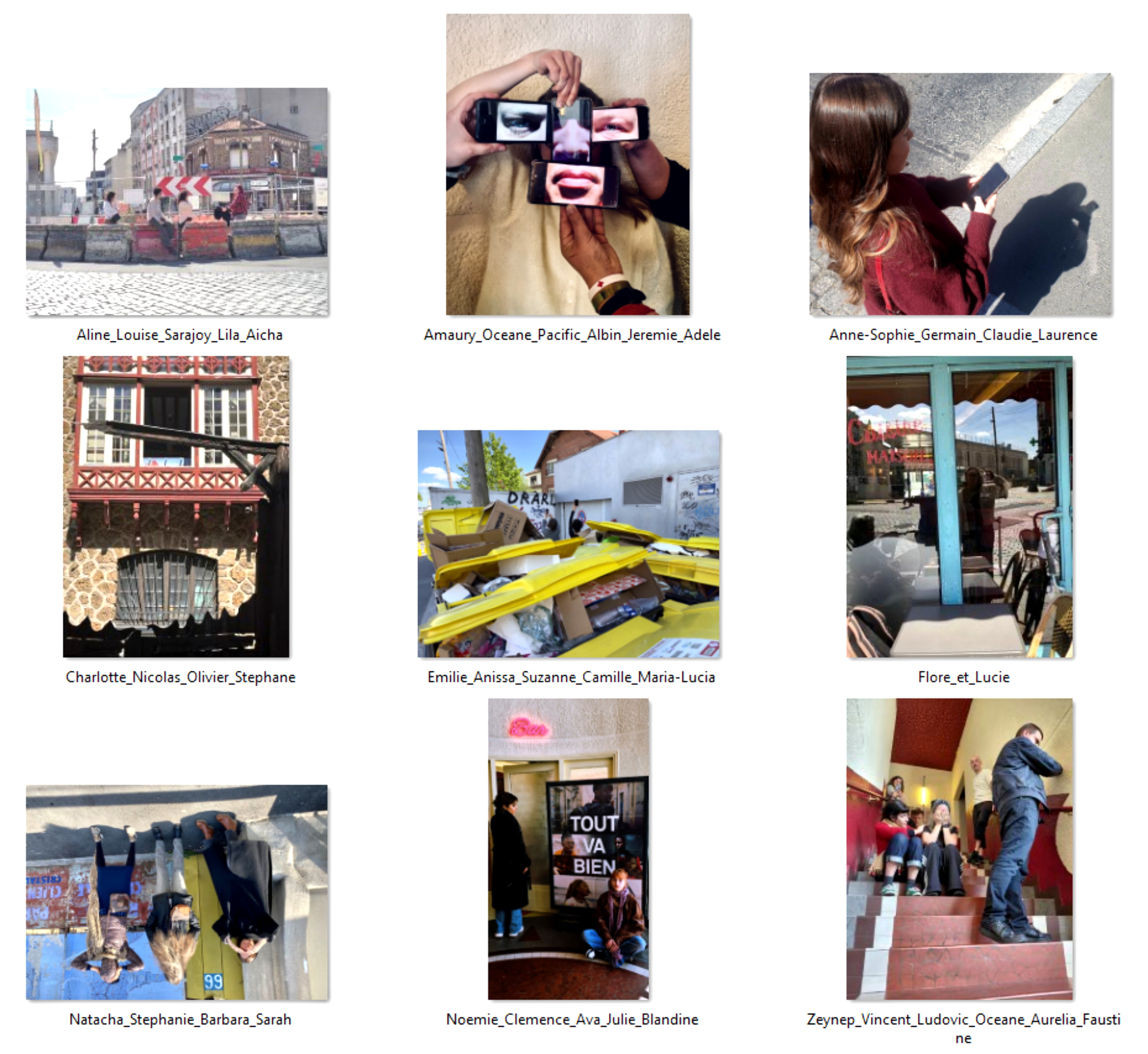
A workshop in nine small groups, fifteen minutes to produce a photograph, then a moment of collective viewing in which the authors remain silent and the others speak of what they see.
The context: an afternoon at the 14 April 2026 conference
This article recounts the photography workshop I facilitated on the afternoon of 14 April 2026, as part of the professional conference “Cinema, images and young people’s mental health”, held on 14 and 15 April 2026 at Le Trianon cinema in Romainville. The two days were organised by ACRIF within its coordination of Passeurs d’images in the Île-de-France region, the second day being co-organised with Cinémas 93. The initiative for these encounters came from Claudie Le Bissonnais, then coordinator of Passeurs d’images Île-de-France. I co-designed the first day with Diane Olivier, who has since taken over the regional coordination from Claudie, and with Maxime Bouillon, cinema mediator at ACRIF.
Two other articles published on this site accompany this one: the overall presentation of the two days on the one hand, and the text of my opening talk on the notions of mental health, young people and images on the other. I refer readers to those articles for the general framework and the basic definitions. The present text focuses on a single moment: the hands-on workshop that opened the afternoon. It is intended as a working document for professionals who might want to re-use this format, or simply to understand from the inside what it produces.
After a dense morning of definitions and a round-table discussion, the afternoon opened with a practical workshop. I had announced the principle that morning: it is not enough to reflect on images, one has to live them. The workshop, in its form and its progression, would put into practice several of the ideas developed in the morning talk.
A simple setup, a few structuring principles
The setup itself was straightforward: nine groups of four to six people, one staged photograph per group, fifteen minutes to produce it in the streets and spaces around Le Trianon, and then a time of collective viewing of the images that had been made.
The instructions were given briefly, but they carried precise intentions.
The first instruction concerned the starting point. Do not begin with the concept. Find a setting first, a place that inspires, and let the place guide the photograph, rather than looking for a setting to match a preconceived idea. This reversal, which consists in moving toward the unknown rather than confirming what one already knows, is an invitation to the unexpected.
The second instruction concerned the subject. The theme was that of the conference: mental health, images, young people. But it was not a commissioned illustration. As I said to the groups: “We’re not in school. The goal is not to explain something, but to create something.” An abstract photograph can be perfectly fitting, and it even happens that a photograph that is not entirely explicable turns out to be richer than a didactic one.
The third instruction was about signature. Each photograph would be titled only with the first names of the people who had made it. No anonymity. This insistence on signature carries a conviction: expression only holds its value if it is claimed. Hiding is more comfortable, but it means renouncing one’s existence in the common space.
The fourth instruction, this one implicit, concerned the distribution of roles. Everyone participates in their own way. Some will be in front of the lens, others behind, others still will bring props or ideas. There is no hierarchy of contributions.
Fifteen minutes outside
The groups headed out into the streets of Romainville with their phones. Le Trianon sits right next to a major urban renewal site linked to the Grand Paris Express project: orange and red construction barriers, broken pavements, temporary signs, places in transformation. Participants moved through this environment at once familiar and unsettling, looking for a setting that spoke to them.
Some groups chose to stage themselves. Others worked with objects, reflections, unexpected angles. One group photographed yellow bins in front of a piece of graffiti. Another leaned over a bridge to create an upside-down image. A third found a restaurant window and played with the reflections in the glass.
The photographs were uploaded to a shared platform via QR code, titled with the participants’ first names alone, and displayed on the projector in the room.
The collective gaze: looking without explaining
This is where the protocol took its full meaning. When the time came to look at the photographs, I set a rule that I have used for a long time and that always throws people a little at first: the people who made the photograph are not allowed to speak. It is the others, those who did not make the image, who describe what they see in it, what they feel in it, what it reminds them of.
The reversal is deliberate. In most workshops, the sharing moment is the one in which people explain what they were trying to do. Here, the opposite happens. One discovers what others see in what one has created, and it is sometimes very far from what one had in mind.
Why this setup? Methodological commentary
After we had looked at the nine photographs together, I took a few minutes to spell out the rationale behind the format. These remarks help one understand what lies under the tool, and how it can be re-used in other contexts.
Collective expression as protection. Being in a group enables something that individual expression makes difficult: daring to show something to others. In a group, one takes part in something shared, one is not alone in being exposed. This matters particularly in the field of mental health, where each person has different capacities, notably with regard to the emotional and social dimensions of the psychosocial skills I spoke about in the morning. In this kind of protocol, each participant contributes as they can, without any hierarchy of contributions.
The autonomy of the groups. There is one instruction, but the groups are then entirely autonomous. The facilitator is not “above” them: he too discovers the images. They are not the product of a guided co-fabrication, but of a genuinely autonomous creation. It is not a biased situation in which the facilitator would hold the participants’ hand and then say “what you did is great”. What has been created really came from the groups.
Starting with action: meeting the person before the pathology. There is a dimension of this workshop that only becomes fully apparent to me in retrospect, and that bears directly on the subject of the conference. In the room, both in the morning and in the afternoon, several of the people who had taken part in the short film to be screened in the second half of the afternoon were present. They are people living with psychic disorders. They were there without a label, simply as participants on the same footing as everyone else. I myself did not know precisely, in the morning, who in the audience had come to present that film; I had not realised how many of the people directly concerned were actually in the room. During the photography workshop, the groups formed naturally, without sorting: cultural professionals, care workers, social workers and people with lived experience found themselves together around the same task, producing a photograph in fifteen minutes. One of the participants wrote to me the next day to tell me that she had only realised, in the second half of the afternoon when the film was presented, that some of the people who had been in her group during the workshop were living with a mental health condition. She had not suspected anything until then. She had met them first as people.
This point is not incidental. It says something about what collective creative action can do on the question of stigmatisation. Starting with an action that has a third object, in this case a photograph to be made together, is to give oneself a point of departure that is not the pathology. Attention is directed elsewhere, toward the setting to find, toward the staging to imagine. People meet one another as people, through what they do together, and not through what they suffer from or what they work on professionally. This is precisely one of the essential stakes of a sound approach to mental health issues: to come back to the person, to who they are, without reducing them from the outset to their pathology. Pathologisation, when it takes up all the space, is dehumanising, and it closes off the spaces of construction in which the person might otherwise exist.
A nuance needs to be made clear, because it is easy to miss. Meeting the person before their pathology does not mean denying that pathology, or acting as though it did not exist. The participants in the film said as much themselves during the afternoon discussion: naming the pathology matters, and for several of them the psychiatric diagnosis had been a relief, the end of a wandering, the possibility at last of putting a word on something that had been there for a long time. One of them used the expression coming out, and the expression was fitting. What is at stake in the format we put in place is thus not the erasure of the pathology, but its placement in context. There need to be spaces in which the pathology can be named, shared, accompanied, and this is precisely what the film and the discussion that followed made possible. There also need to be spaces in which the subject is not the pathology, in which the person exists as a person, among others, around an activity that is not about them. The coexistence of these two kinds of space, within a single day, is what gave the programme its strength. The one would not have worked without the other.
The silence of the authors. When one explains what one intended to do, one reduces the creation to its intentionality. Yet artistic creation exceeds us. The gaze of others allows us to understand better what we have done: it opens, whereas explanation closes. One sees things in one’s own image that one had not put there, and sometimes one realises that others see superb things in an image one considered mediocre. There is something here of recognition and of discovery. It is constructive in the strong sense of the term.
Reception as an experience of construction. There is a point I would like to underline, because it seems to me often underestimated: reception is not a secondary moment in relation to creation. It is in itself an experience of symbolisation, and of self-construction. I recalled in the morning the three functions images can fulfil in our practices: to symbolise, to share, to act. The workshop allows one to experience concretely what “to share” means. Someone who has created an image will in fact meet it in several moments. First there is the encounter with one’s own image, the moment one sees it appear on the screen, having crossed over to the side of the gaze: this is already an event, often unexpected. Then there is the encounter with that same image in a social space, when others are looking at it and saying things that do not necessarily coincide with what one saw there oneself. This gap is not a problem, it is a resource: it opens, it enriches, it shifts. And then there is what one experiences in looking at the images of others, in discovering their poetry, their depth, their social dimension, even though one watched those images being made alongside one’s own. These three moments accumulate within a single experience, and this is why I say that the gaze of others is constructive, and even constitutive. One does not build oneself only by creating. One builds oneself just as much by looking, and by being looked at in what one has made.
Polysemy as a resource. We saw, in the readings of each photograph, how different the gazes were, sometimes opposed. No one was wrong. An image does not have a fixed meaning. To say that diverse gazes all have their place and their value, that there is not one truth but as many truths as there are singular gazes, is a lesson that goes beyond the workshop. In a world of images where powerful actors claim that images have a single meaning (their own), to say that this is false is a political gesture.
The question of sharing the work. An often neglected point in practice-based workshops: when one shows the “result”, the film, the photographs, to partners or to funders, one enters a register of judgement. Is it good? Is it good enough? This can push facilitators to “improve” the participants’ productions for the final showing, which betrays the process. This is also one of the reasons why, in the vocabulary of practice-based artistic workshops, I prefer the word “construction” to the word “valorisation” one hears so often: to valorise presupposes a prior devaluing, and this sets up a hierarchy that can undermine people. One alternative consists in sharing back not only the result, but the process: the stages one went through, what was built, what encounters took place. This shifts attention from evaluation to discovery. And it requires documentation as one goes, of what happened along the way: session photographs, a logbook, various traces.
One spends more time looking together than making: it is there that the image takes on its existence in the social space. It is at the moment of looking together that it becomes something for each person.


