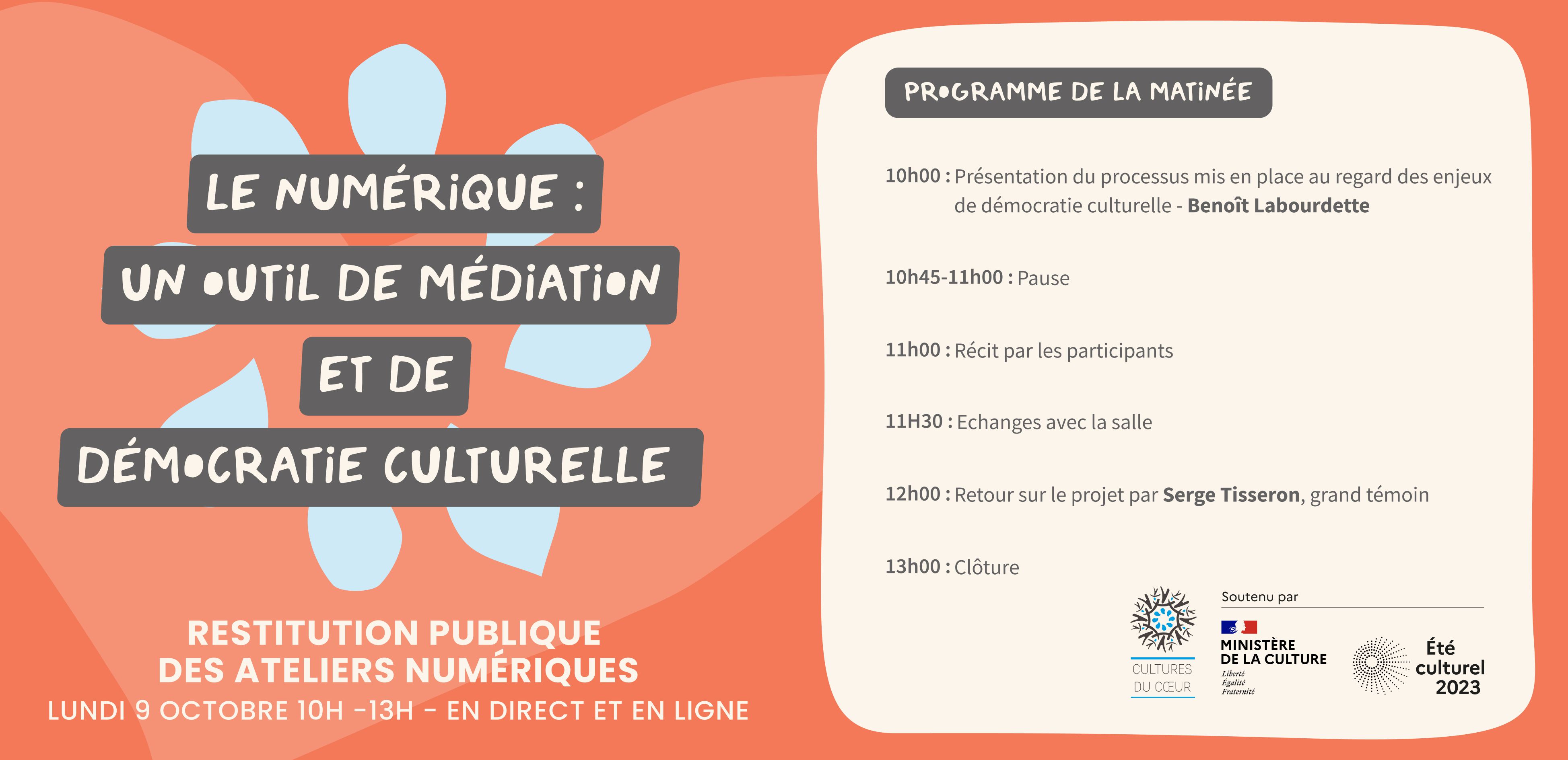
Digital technology, a tool for mediation and cultural democracy

9 October 2023. Published by Benoît Labourdette.
  2 min
 |  Download in PDF

Restitution of the “Digital Workshops” project by Cultures du Cœur and Benoît Labourdette Production, offered as part of the Été culturel program with the support of the French Ministry of Culture.

For the past 2 years, Cultures du Cœur, in partnership with Benoît Labourdette Production, has been organizing workshop cycles within social structures, offering mediation methods using a variety of digital tools to encourage creativity and free expression among participants. These workshops have met with great interest from social referents and the people they support, with almost 200 participants.

The diversity of the participants’ profiles and their strong involvement in the project demonstrated that it is possible to overcome the apprehension sometimes associated with digital media (complexity, technicality, coldness...) and exploit their potential in terms of mediation and individual or collective participation, as long as a suitable process and framework of appropriation makes this possible.

This experience, which we propose to report on, invites us to consider the place that can be given to the tools and uses of digital technology in the exercise of cultural democracy, and the role that social and cultural players can play through the mechanisms they create with people: what modes of cooperation are induced? What changes are taking place in the practice of “working together”? What new spaces for the expression of cultural diversity and individual emancipation? How can artistic creation be redefined?

Discover the content of the digital workshops :
https://www.ateliersnumeriques-culturesducœur.org/2023/

Discover the content of the digital workshops:
www.ateliersnumeriques-culturesducœur.org/2023/

Read about one of the workshops:
www.benoitlabourdette.com/action-culturelle/ateliers-de-creativite/ete-culturel-2023-avec-cultures-du-cœur-la-machine-a-voyager-dans-le-futur

Discover how the website - a digital mediation tool - was built:
www.benoitlabourdette.com/technologie/sites-web/site-web-la-machine-a-voyager-dans-le-futur

Morning program

October 9, 2023 - 10am-1pm

  • 10am: Introduction by Serge Saada (Cultures du cœur).
  • 10:15am: Presentation of the process in terms of cultural democracy - Benoît Labourdette.
  • 11 a.m.: Stories from participants and professionals.
  • 11:30am: Break.
  • 11:45am: Review of the project by Serge Tisseron.
  • 12:15pm: Discussion with the audience.
  • 1pm: Closing session.
- 1 - Introduction by Noël Corbin, General Delegate of the General Delegation for Transmission, Territories and Cultural Democracy at the French Ministry of Culture

  • Cultural democracy means getting away from the “It’s not for me” mentality.
  • Getting away from the amateur-professional distinction.
  • Use digital technology as a vehicle for cultural democracy.

General Delegation for transmission, territories and cultural democracy

- 2 - Introduction to the project framework by Céline Abisror, General Secretary of Cultures du coeur

A cultural project proposed throughout France in eight social structures, as part of the cultural summer. The project is horizontal, written but very open, and participation is free.

- 3 - Introduction to the project by Serge Saada, Head of Training at Cultures du coeur

  • The difference between cultural democratization and cultural democracy.
  • Enabling people to use digital tools to express themselves.
  • The evolution of the project between 2022 and 2023. How to give people a place and bring about an encounter, with the artist, so that something more is born.
  • The journey is more important than the destination.
  • We’re all vulnerable, we all have incredible creative potential.
  • The digital tool was what made it possible to have a relationship.

- 4 - Project presentation by Benoît Labourdette

  • Presentation of activities in this project, from the perspective of cultural rights.
  • Definition of cultural rights.
  • Presentation of the website, a mediation tool for participants, created during the workshop.
  • Presentation of the workshop concept, of open participation, of the central tool, in the manner of Célestin Freinet, and then of the “why” question, in the manner of Jean Oury.

- 5 - A cultural rights perspective on the project, by Benoît Labourdette

  • Respect for people’s identity: mediation on the moment, and the symbolic existence of people in the website.
  • Implementation of respect for cultural diversity, through substantive links between content.
  • Creation of a shared heritage and ensuring that people have access to it.
  • The right to refer to a cultural community, by respecting and considering everyone’s cultural diversity, through the multiple activities and dialogue skills of ChatGPT. A framework is something that authorizes, not constrains. Moodboards, identity tools.
  • Respect for the right to participate, thanks to the multiplicity of proposals.
  • Respect for the right to cooperation: openness to participants’ contributions to modify workshop content. Always more material to accommodate changes. Research as you go along. Work means constantly redesigning things.
  • Respect for the right to information, for collective validation of what is transmitted on the site.
  • Respect for the right to education, through a pedagogical system. Pedagogy is about living an experience, through which you learn something unique. The tools were authorized. What we advocate is the encounter with others, and this must be put into practice.

- 6 - Prospects for future democratic forms of artistic creation, by Benoît Labourdette

  • Research and development time and new skills are essential for an agile, democratic project.
  • The practice of artistic encounters can be envisaged with the highest artistic standards (this is not amateur patronage practice).
  • We can envisage cooperative projects in the sense of cultural democracy (following the example of TikTok): artistic production teams could work much more cooperatively with audiences, and be enriched by it too, rather than remaining in a hierarchical posture.
  • There’s huge potential, as we’ve experienced, for renewing artistic creation by putting cultural democracy into practice.

- 7 - Feedback from mediator Loussiné Villelegier

  • 105 people, in eight different locations, each with its own unique life story.
  • Adaptation and movement, intrinsic to this workshop.
  • The question of place: finding a place for each person, for oneself and for others.
  • It’s a setting in which anything is possible.
  • Feeling secure is essential, because you’re giving something of yourself.
  • Marvel at everything.

- 8 - Back to the fundamentals of the project, by Serge Saada

  • The freedom to try and allow oneself.
  • Social actors are delegated cultural mediators.
  • Participants make extraordinary efforts to create works of art, which may not be seen from the outside.
  • The right to dream, to things that seem unthinkable, and which become possible.
  • The confidence to be unaccountable, to go beyond the culture of results. Opening a breach.
  • Balance between the devices proposed and people’s freedom.

- 9 - Serge Tisseron’s contributions on self-construction through free creation

  • Digital is just a new material. Each tool will mobilize different brain functions.
  • Digital images of creations add a layer of creation and enable dissemination.
  • Example of Mike Kelley, multidisciplinary artist.
  • What we gain from decompartmentalization: when we give free rein to ourselves, we develop many capacities that will be useful in social life, these are executive capacities:
    1. Remember what you’ve done before, so you don’t forget what you want to do next.
    2. Controlling what you do.
    3. Flexibility: as you go along, you change your mind. You change yourself profoundly when you’re involved in a creative activity.
  • Thinking / healing: creative activity allows you to heal your wounds. Socialization function, extimacy. It’s not as ephemeral as the spoken word.
  • You’re an actor: you change the way you represent yourself. You go from being the one who suffers to the one who acts.
  • Digital tools make creation accessible to all.
  • Reaffiliation with the human community and nature.

- 10 - Testimonial from the Fondation des Amis de l’atelier

  • Jérôme and Fernanda, job coaches, and Léo, workshop participant.
  • Job coaching for disabled people.
  • Culture is a prerequisite for employment: develop self-expression skills.
  • This workshop gave them the tools to create new free self-expression workshops, which they will find highly effective.
  • Léo has difficulty with group activities and is not creative. He felt out of place at first. The trigger for him was the discovery of ChatGPT. He discovered a new tool, and can produce and create with it. He created a story, in collaboration with ChatGPT. A band created music to illustrate the tale.

- 11 - Testimonial from Adoma’s HUDA in Dreux

  • Aline Thebault, social worker in a HUDA for asylum seekers, and Pauline Kendeck, participating asylum seeker.
  • Culture is not the most important thing in our missions.
  • The workshop was very free, which is unusual.
  • Kindness was essential.
  • Very rich sharing of a whole day together: communication, emotions...
  • What happened that day was very different.
  • Since the workshop day, she feels that culture should be considered even more than before, especially in the future school project.
  • Pauline wasn’t motivated to come at first. But she really enjoyed it. It was a first for her, especially the appropriation of musical instruments. That day, she discovered a lot about other cultures, which enriched her.
  • Telling her story, using the paper cut-outs: a little difficult at first, and expressed herself on the trip. An unforgettable experience. Play, fun, like children. It did her good.

- 12 - Testimonial from the PASTT association

  • Inès Messaoudi, director of the PASTT association.
  • Welcomes trans people who suffer from a combination of precariousness factors.
  • Association created in the 90s by Camille Cabral, who worked at Saint Louis Hospital, particularly for people in prostitution situations.
  • Accompaniment: day care, CPAM services, French language courses.
  • Beneficiaries are far removed from culture: no housing, no resources, precariousness...
  • Many things were appreciated by the beneficiaries: creating a little bubble, to talk, to create...

- 13 - Discussions: how did the project spread throughout the region?

  • Céline Abisror.
  • Cultures du coeur has 34 regional structures, covering 50 départements, which are in direct contact with their “social relays”, who are used to working on accessibility to culture. Agility, thanks to knowledge of the social relays.

- 14 - Discussions: isn’t the short duration of the workshops frustrating? Digital technology doesn’t seem to be central, just one tool among others?

  • Virginia Goltman-Rekow, Benoît Labourdette, Céline Abisror, Serge Tisseron and Margot Lubin Coste.
  • In fact, it’s a long temporality in the social field: a whole day is a very long time.
  • To use ChatGPT properly, you have to tell stories to the machine and wait for it to respond to our stories. It’s a paradigm shift.
  • On the contrary, digital technology was central, because it was the website tool that was at the heart of mediation in its present form. That’s what allowed us to deepen the construction of our identity within this framework.
  • Digital art is often confused with digital art.
  • Digital art was at the heart of these workshops. Without digital technology, the experience wouldn’t have gone so far. It changed everything in terms of the relationship with the productions and their symbolisations.
  • The digital tools were easy to use, and required a lot of investigation.
  • The narrative produced by ChatGPT alone was not very rich.
  • ChatGPT is designed so that we always agree with what it proposes: it is consensual with regard to what is asked of it, so as not to shock anyone.

- 15 - Exchanges: the Library of Babel. Digital is central, but not very visible

  • Serge Saada, Céline Abisror, Virginia Goltman-Rekow, Benoît Labourdette.
  • How, in the social field, every cultural project is transformed.
  • Central in the trace, we didn’t emphasize film extracts.
  • The trace is made with people during the workshop, and validated with them.
  • Choice not to show results, but to evoke the process. You can see the results and go and get them if you want.

- 16 - Discussions: digital technology, children and cultural rights

  • André Fertier, Céline Abisror, Serge Tisseron.
  • Teaching coding to kindergarten children. How will they appropriate digital technology when they grow up?
  • The right to experiment, already enshrined in the texts on Artistic and Cultural Education.
  • Free creative activities. Spirit: in line with the foundations of popular education.
  • In what framework can this type of activity be developed?
  • Cultural rights: let’s not forget some fundamental elements:
    • Justiciable rights.
    • Debt rights (which oblige States and local authorities to make rights effective).
    • Part of the constitution.
    • Public cultural service, with principles of equal access, continuity and adaptability.
    • Because cultural rights have been poorly taken into account: accessibility is a legal requirement.
    • To mark a turning point so that local authorities respect cultural rights, legally speaking.
    • The question of the human community is not mentioned in the Fribourg Declaration.
    • Above all, the legal enforceability of cultural rights must not be overlooked.
  • Equality is essential: cultural venues must be accessible to all. This is their basic DNA.
  • Cultural rights must be taken as a whole, indivisible. You can’t isolate individual elements.

- 17 - Discussion: what next?

  • Virginia Goltman-Rekow, Céline Abisror, Aline Thébault.
  • A follow-up with the Cultures du coeur network.
  • This workshop raised awareness of the need to improve the way culture is taken into account in the social field.
  • On the territories, same approach: proposal of a cultural and digital itinerary. Discover three cultural sites, and a digital initiation workshop.
  • Children take on the role of cultural mediators for their parents.

- 18 - Discussions: quantitative vs. qualitative evaluation?

  • Isabelle Altounian, Serge Saada, Céline Abisror.
  • Progress on new indicators?
  • Original indicators: smile again, halve alcohol consumption...
  • Ability to invent new ways of getting involved.
  • Everyone has their own expectations.
  • What people do in their own way with the cultural proposals made to them.
  • Through free appropriation, expectations can evolve.
  • We can compare initial expectations (a priori, apprehensions) and modes of appropriation (with singularities).
  • Intermediate evaluation during the course of work, carried out cooperatively.
  • Pay close attention to the artist’s instrumentalization of people.
  • Evaluation is a research theme.
  • Evaluate in terms other than insertion. What’s important is to bring the human element into the evaluation.
  • Difficult to create an email address: it was created for information on shows, and has enabled social integration.
  • Ability of the public to help the project evolve into something else.

- 19 - Discussions: the question of resources and changing attitudes

  • Benoît Labourdette, Virginia Goltman-Rekow.
  • Cost of this type of activity.
  • This is an experiment.
  • Democracy is not held by the State, but by citizens.
  • Work differently, especially in the cultural sector: there are a lot of resources for cultural production aimed at a very specific type of audience. The system of cultural democratization has met certain expectations. Today, to “reach young people”, we can’t apply the old model of professionals working together to produce something for spectators. If we carry on like that, we’ll cut ourselves off from young people.
  • We can’t go back to the old way and try demagoguery. How do we do it? How can we be more cooperative?
  • Jobs are changing.
  • When we do things differently, we always come out enriched, which implies a change of attitude.
  • Practices are changing, they’re not monolithic. More and more, local residents are being invited to take part in cultural programming. This is starting to happen in the performing arts. It’s been going on for a long time in media libraries. Youth Council at the Théâtre National de Chaillot.
  • L’été culturel has enabled experimentation, thanks to funding.
  • Concept of cultural health, which continues throughout life. Going to the museum on prescription!
  • Culture creates links and can do good.

- 20 - Discussions: building collective memory

  • Serge Tisseron.
  • Building the memory of major events that affect communities.
  • Institut pour l’histoire et la mémoire des catastrophes.
  • The consequences of disasters affect everyone.
  • Conclusion by Céline Abisror.

- 21 - Complete podcast of the October 9, 2023 meeting
Download

Video and audio recordings, documents, abstracts, of conferences that I run in different contexts.


QR Code for this page
qrcode:https://www.benoitlabourdette.com/les-ressources/conferences/podcast-le-numerique-un-outil-de-mediation-et-de-democratie-culturelle