Jean-Jacques Gay:
Benoît Labourdette had set up a collaboration with Le Fresnoy and Alain Fleischer back in 2006, as part of the “Pocket Films Festival”, in which Le Fresnoy was very involved. This is what you founded, Pocket Films. There was a market, or at least a creation of films made with pockets, with phones, with cameras that fit in pockets. And you, Benoît, are always filming with new objects: a drone, a cell phone... I also saw you filming in VR at a conference... you always worked on the most “performative” camera you could find. Performative, I mean that engages your body, the body.
Benoît Labourdette :
We can indeed see it that way. You have put things into historical perspective, I agree with you: the camera appeared in cell phones at the end of 2004. In 2005, with the Forum des images in Paris, we created a festival, which lasted six years, dedicated to the creation of films with cell phones. We called it “Festival Pocket Films”, we found this name there, we found that it was rather good! And it became a kind of common name.
What interested me most, actually, was not just the way of filming, it was the fact that in 2005 the camera appears in cell phones, ok... at that time, it seemed completely incongruous a camera in cell phones. I don’t know if you remember, but for people who were of a canonical age like us... So people thought it was a bit ridiculous... except for people like Alain Fleischer who are always interested in experimentation. What concerned me was "In 10 years: 2005, in 2015. In 10 years, there will be cameras in all phones, so that means that everyone will have a camera in their pocket all the time. You might think it’s a detail, that it’s anecdotal, but it’s not! Maybe nobody would have ever used the camera of his phone, but I felt that it was not going to be anecdotal at all, so what seemed interesting to me, was to experiment what we can do with it, knowing that the projects of cell phones and cameras, they are purely commercial projects, they are industrialists who sell their soup, it is not something else than that. As a result, we, in the field of culture, education, teaching and research, felt that it was extremely important to divert, to have fun with, to film with, to do atypical things, but rather to build our critical posture and also to imagine what the future of cinema would be.
Because today, for example, what do we see in the practices of the majority of the population? You’re going to tell me "People don’t go to the movies anymore, or very little, much less than before, because post-covid, etc.. But in fact, it started before, that is, I don’t know about you, but for example, TikTok, it’s absolutely extraordinary, what’s on there. It’s crazy. The algorithm of TikTok, I don’t know if some people have TikTok, it’s incredible the quality of the recommendation, and it’s incredible, TikTok, the filming tools : there is a film-montage like in the Super 8 cinema era, we can put text on the screen, we reuse each other’s musics, so it doesn’t really exist a film on Tiktok anymore. ... you know it as well as I do, we share things, we take up a trend, each one will answer to the other, and so there is a kind of accelerated art history all the time.
So it seems to me that things are happening in the question of the reinvention of what audiovisual is, based on the tools. Let’s not forget that the Cinématographe is only a tool, it’s an object, which appeared in 1895, we don’t really know what it will be used for, and there are people who have used this object to tell stories with it, and globally to make filmed theater. Basically, that’s cinema, globally, or at least commercial cinema. What seemed interesting to me, and what still seems interesting to me, is how this tool will modify the forms of art and even the forms of relations in art, that is to say:
- Who is the artist?
- What are the amateurs, what are the professionals?
- Where do we see works?
- And the nature of a work: what is a work, in fact?
When you go to a movie theater today, what do you see? We see totally academic objects, in the movie theaters we pay for, we see hyper classic stories, it can be good, it can be nice, but there is no more research at all. We see research in museums, in exhibitions, in conferences, or on the Internet. So I think, and this is my personal opinion, and here we differ a little bit, that referring to an old cinema is not very accurate, because due to telephones, it is the very form of cinema that is changing. I find that the practices of the telephone are mutating the very notion of work of art. In this sense, I am going to make a proposal to you just after.
There is also the question of the cultural hierarchy. For example, I see a lot of works, and I myself am an artist, I make things, etc., but I am interested in knowing what you look at on your phones, what you eventually create with your phones. Why am I interested? It’s not because I have experience and I’ve done a lot of stuff, it’s not because I know everything, or that I know more; I know something else. And it seems to me that these technologies put us in a different relationship. And in fact, the specificity of the creation with telephone, since 2005, it was of course, a change of the way of filming, but Jean-Pierre Beauviala, who was a magnificent inventor of camera and moreover we made some meetings between him and Alain Fleischer a few years ago, it was great, he invented in the Eighties the “paluche”, the camera that one can put everywhere. Even the Lumière camera from 1895, it’s a small object. And as early as 1905, there were very small cameras that could be thrown. Yes, in the Hollywood studios there were big cameras, but from the beginning there were also very small cameras. And to me, what seemed more powerful was this capacity of exchange, of being able to send videos to each other, this temporal change, finally, between the creation and the reception. And so, it changes the places. Then, in 2005, the camera arrived in cell phones, but there was also YouTube, which appeared in April 2005, which meant that suddenly everyone had the power to make their video public. It seems obvious to you but it didn’t exist before. Before, to be able to broadcast a video to the whole world, it was only reserved to professionals. Since 2005, everyone has been able to do it.
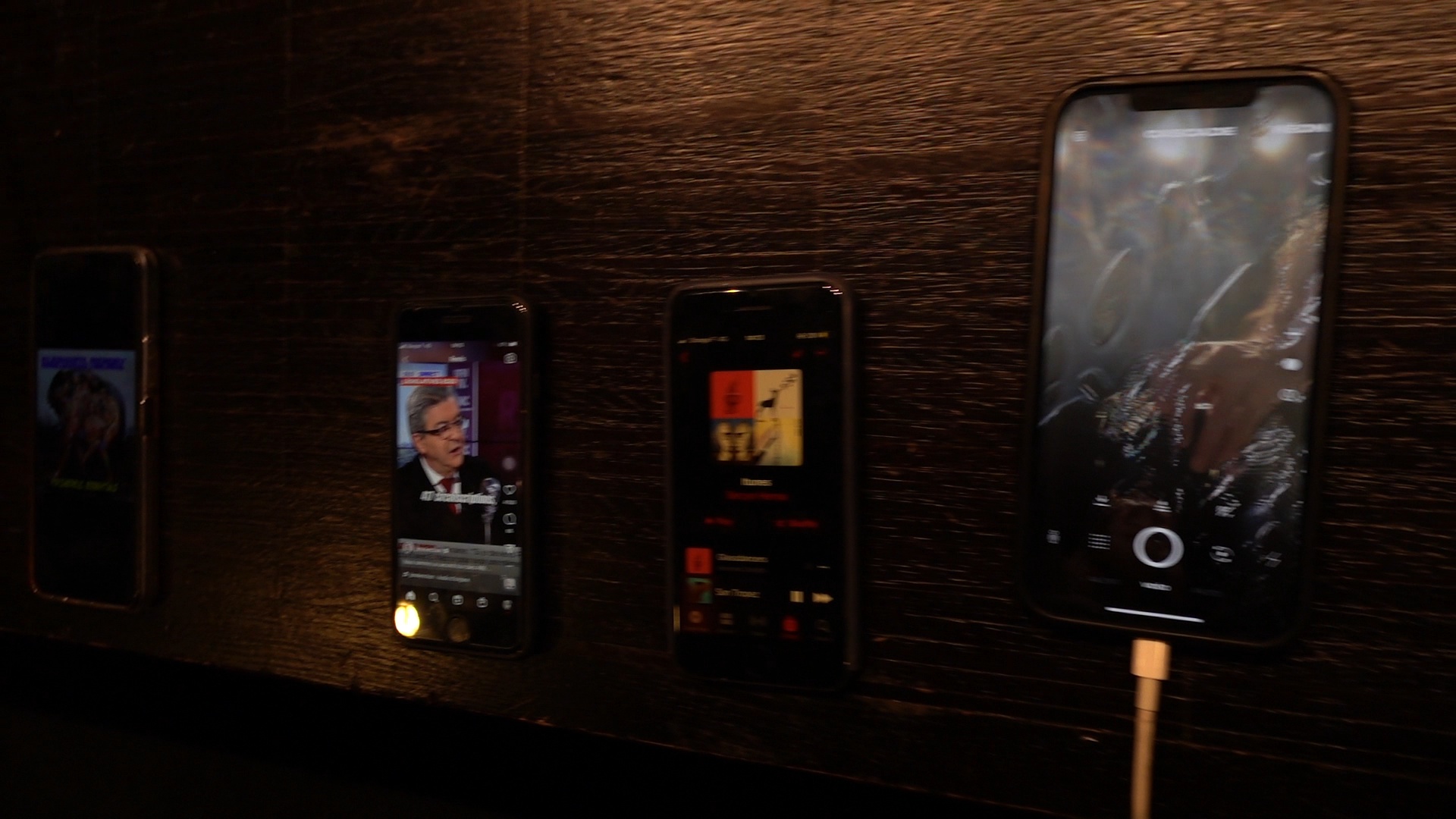
Here’s what I propose to do now: as there are only a few of us, I’m just going to propose that you prepare something on your phone, that you show us your favorite application... what you like on your phone, what you like. And we’re all going to put our phones down there, downstage, and we’re going to look at each other’s phones for five minutes and what we choose to put on them. Who wants to put a video loop of a chat on TikTok, etc.? I’m suggesting this exercise. We do it too. We look for something, we put it there. Come downstage, then we do this, and then it will be Thomas’ turn. And we also do it.
Thank you very much, it is very rich!
Question asked by a person in the audience:
We were talking earlier about the death of cinema, TikTok, all that... Do you think that, for example, cinema is always horizontal, and I am filming the conference vertically. Do you think that cinema can evolve, that is to say broadcast a film, a real film, for example on TikTok, in vertical format, or do you think that it would not be cinema anymore?
Benoît Labourdette :
In fact, as early as 2005, there was a first feature film shot with a cell phone, which was in Cannes in 2006, and as early as 2006, there was also the first feature film shot in vertical format, so these are things that we experimented with very early on. What I think is that it’s a bit like with books: electronics has not replaced paper, the two are complementary. In fact, I think that the cinema in projection is a form, which is very interesting, I love it, I organize a lot of things in cinemas, but I think that it will not be the main form anymore. Yes, maybe we will be able to invent theaters with vertical screens, you know, but once again, it seems to me that what changes more is the modality of interaction: what place does the work take in our life, in the everyday, in the extraordinary, etc.? So we will leave the forms of this tradition. I believe a lot in cinema, and I do a lot of projects with cinemas, because I believe very strongly in what we do together. Here, for example, we are gathered, we are in a cinema, it is very powerful, in psychosocial terms. So I’m in favor of movie theaters, but maybe in more exceptional moments. I don’t think that there will be a regular attendance as there was in the past. That’s my vision.



![Café des images: “Work in short(s)”, carte blanche to Benoît Labourdette[s]“, carte blanche to Benoît Labourdette[S]”, carte blanche to Benoît Labourdette](local/cache-gd2/93/1069abcd76d20a62ee4b9e24a7fc6c.webp?1734242211)


