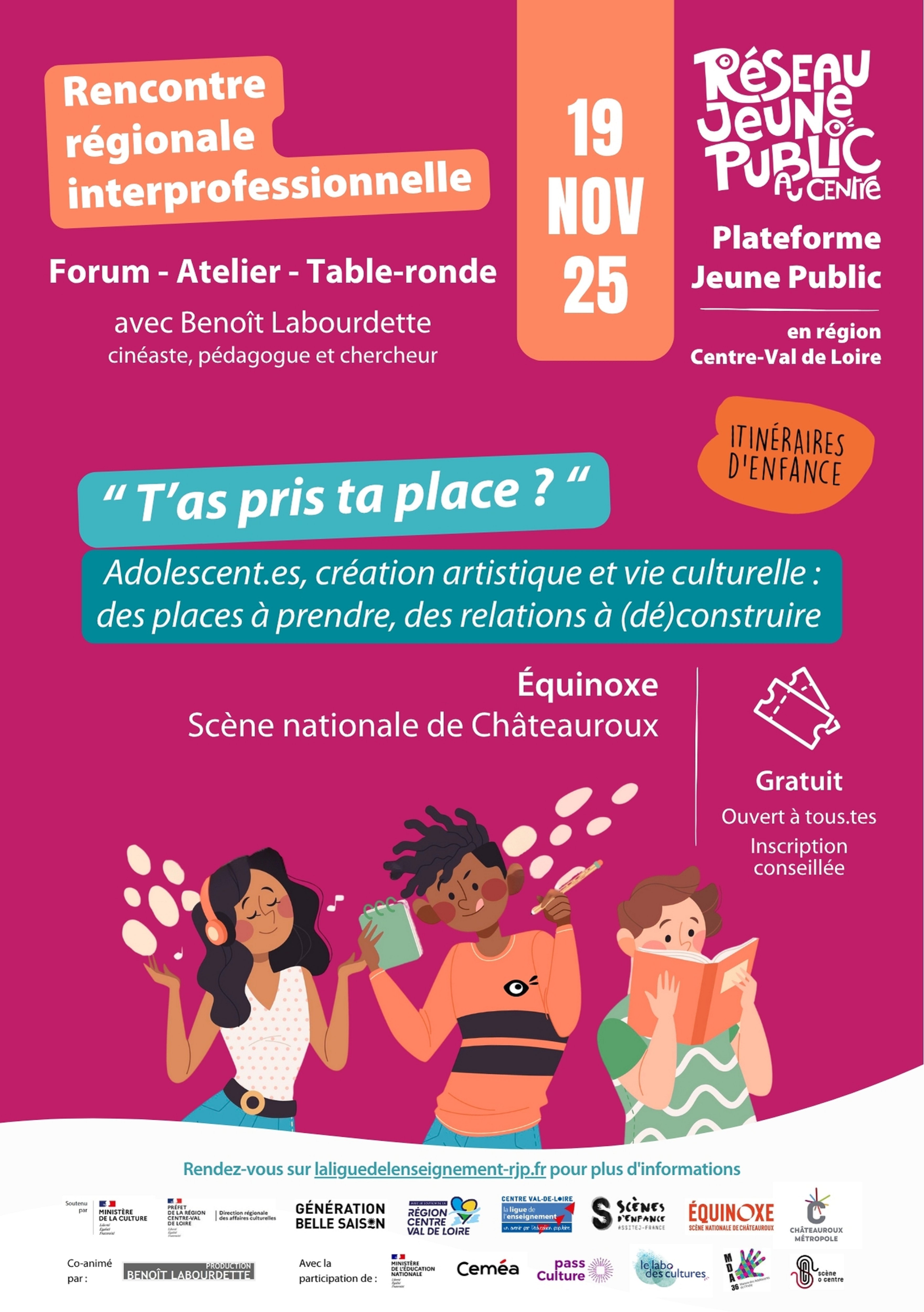
How can we create connections with adolescents in our cultural institutions? The question of their “place” reveals our power relationships and challenges our capacity to recognize their cultures.
Beyond the Myth of a Homogeneous Youth
There is a recurring subject for cultural sector professionals: we want to “reach” young people, we want them to benefit from our offerings. This is very important for multiple reasons, and it even relates to the legitimacy of public funding for culture, one of whose major missions is to serve youth.
But how do we do it? Why is it so difficult? What are the deeper issues at stake? The question of young people’s “place” constitutes a fairly effective, fairly concrete angle of vision for working on this subject and the evolution of professional practices, which are obviously the only possible space for action to make things change.
I co-designed and participate in facilitating a regional interprofessional meeting day on this subject, open to the public, initiated by the Réseau Jeune Public au Centre, in partnership with Équinoxe – Scène nationale de Châteauroux and the Réseau Culture de Châteauroux, on November 19, 2025: “Have You Taken Your Place?” Adolescents, Artistic Creation and Cultural Life: Places to Take, Relationships to (De)construct.
This question of young people’s “place” in cultural life, adolescents in particular, reveals in negative space the power relationships that structure institutions, the mechanisms of cultural legitimization and, fundamentally, our collective capacity to recognize “youth cultures” as legitimate and meaningful, which is a prerequisite for being able to create connections.
“Taking one’s place” means simultaneously occupying a physical, symbolic and political space. For adolescents, it’s a crucial process in their development, in the dialectic between the need for belonging and the desire for differentiation. We must therefore, it seems to me, as professionals, work to create spaces, both real and symbolic, that will allow young people to take their place in them.
Let’s immediately deconstruct a persistent misconception: “young people” do not form a homogeneous group. The work of sociologist Camille Peugny demonstrates this. Reality reveals, on the contrary, an extraordinary diversity of cultural practices and tastes. The adolescent passionate about Pink Floyd today (they still exist) will probably still be so in twenty years, just as their classmate who is a fan of Maître Gims will continue to appreciate this artist. This persistence of individual cultural tastes, observable up to age 65 according to Peugny, invalidates any monolithic approach to youth. For example, seeking to create a project that will “please young people” is nonsensical, both practically and anthropologically. The only common denominator among young people, identified by Camille Peugny, is a shared feeling of fragility about the future, a fear of precariousness, which transcends socio-cultural diversity.
All Spaces of Cultural Life Are Concerned
This subject of “place” (that of professionals too) must therefore be addressed everywhere that cultural life takes place. In educational establishments, of course, where artistic and cultural education oscillates between institutional prescription and genuine emancipation. In cultural venues too—theaters, media libraries, contemporary music venues, art centers—which still struggle to transform their relationship with young people to move from a top-down democratization logic to genuine horizontal co-construction.
Also in popular education spaces, youth centers, community centers, associations, which historically carry this democratic ambition but face permanent challenges of resources and recognition. And finally, in public space itself, where young people invent their own forms of cultural expression, often made invisible or stigmatized by adults.
Obviously, no one has a ready-made solution to answer these questions. Neither researchers, nor institutions, nor artists, nor educators. The complexity of the issues, the diversity of contexts, the uniqueness of each adolescent, make any universal recipe illusory. What is certain for me, however, is that the only possible path goes through collective questioning and sharing of experiences. It’s by confronting our practices, by accepting to deconstruct our professional postures together, by truly listening to what young people have to tell us, that we can collectively advance our understanding and our ways of doing things.
Cultural Democratization Versus Cultural Democracy
This transformation implies, in my view, clearly distinguishing two approaches:
- Cultural democratization, inherited from Malraux, which posits a top-down supply logic: institutions hold the legitimate culture that they must transmit to the people. It is primarily about participation.
- Cultural democracy, on the other hand, recognizes the plurality of cultures and promotes their horizontal dialogue. It is more often about cooperation.
This distinction is not merely intellectual; it has practical implications, of which here are two examples:
- In the first case, what we have the power to do is to bring, via school, “captive audiences” of young people to shows they haven’t chosen. Predictable result: an often negative experience that can lastingly discourage them from subsidized culture.
- In the second case, we co-construct spaces where everyone can bring their references, their practices, their questions. We recognize that cultural expertise is not the prerogative of professionals but is distributed throughout the entire social body.
The Necessary Professional Letting Go
I advocate moving from a posture of vertical transmission to a dynamic of horizontal elaboration, abandoning the position of “the one who knows” to embrace a posture of authentic curiosity. This implies accepting a certain loss of control over discourse and content, which is never comfortable for us professionals, accustomed to holding legitimate expertise.
But it’s precisely this “letting go” that allows, in my view, the emergence of new cultural forms, carried in cooperation with young people themselves and which concern them deeply, enriched by the connections we have authorized to be woven.
This transformation also involves a change in perspective on adolescents’ digital practices. We must move beyond the sterile opposition, in my view, between “real” and “virtual,” which still too often structures our judgments, as well as the notion of “screen time” (because what matters is what we do with screens).
The Digital as a Milieu of Existence
For generations born with the Internet, the digital is not a separate space but a milieu of existence, just like the air we breathe, the earth we walk on, or the language we speak. Inventing languages, particularly audiovisual ones, practicing interactions, radically changing position in the author-spectator paradigm, discovering and working in specific artistic practices, developing unprecedented neural connections, etc.: this is what young people do with digital technology.
Far from being simple passive consumers, they develop knowledge that we, adults, struggle to understand and even less to value.
Recognizing the legitimacy of adolescent cultures is essential to be able to even think about projects and ways of working that are useful to young people in their unique paths to emancipation, so that we too can find our place in order to share with them what we are rich in and what they also need. The need for trustworthy and empathetic adult role models is all the more necessary today as young people have great autonomy in digital spaces.
Placing Experience at the Center
And finally, we must place experience at the center. Art is not the work itself but the lived experience in encountering it. This approach, conceptualized by philosopher and educator John Dewey at the beginning of the 20th century, places the person at the center of the cultural process.
Faced with digital giants who have perfectly understood this principle by creating hyper-personalized experiences, cultural institutions can no longer be content to offer a standardized and “quality” offering while hoping that young people will come. We must invent spaces where each adolescent feels recognized, welcomed and supported, where their unique experience is legitimate.
It’s precisely in this spirit that we co-constructed the regional interprofessional meeting “Have You Taken Your Place?” Adolescents, Artistic Creation and Cultural Life: Places to Take, Relationships to (De)construct, a regional interprofessional meeting day initiated by the Réseau Jeune Public au Centre, in partnership with Équinoxe – Scène nationale de Châteauroux and the Réseau Culture de Châteauroux, on November 19, 2025.
A Necessary Process of Breaking Down Silos
The co-construction of this day has represented in itself a genuine transformation process. Bringing together around the same table actors from the cultural sector, national education, popular education, the artistic world, mental health, research, local authorities, is already creating the conditions for a necessary breaking down of silos.
These different actors often work with the same young people but struggle to meet and collaborate, due to lack of time or mutual knowledge. This meeting aims precisely to create this space for dialogue.
And it’s this movement, this circulation of ideas and experiences, that we must, in my opinion, always cultivate, to remain open, to avoid fixing our practices in comfortable but sterile certainties.


