Digital is not immaterial
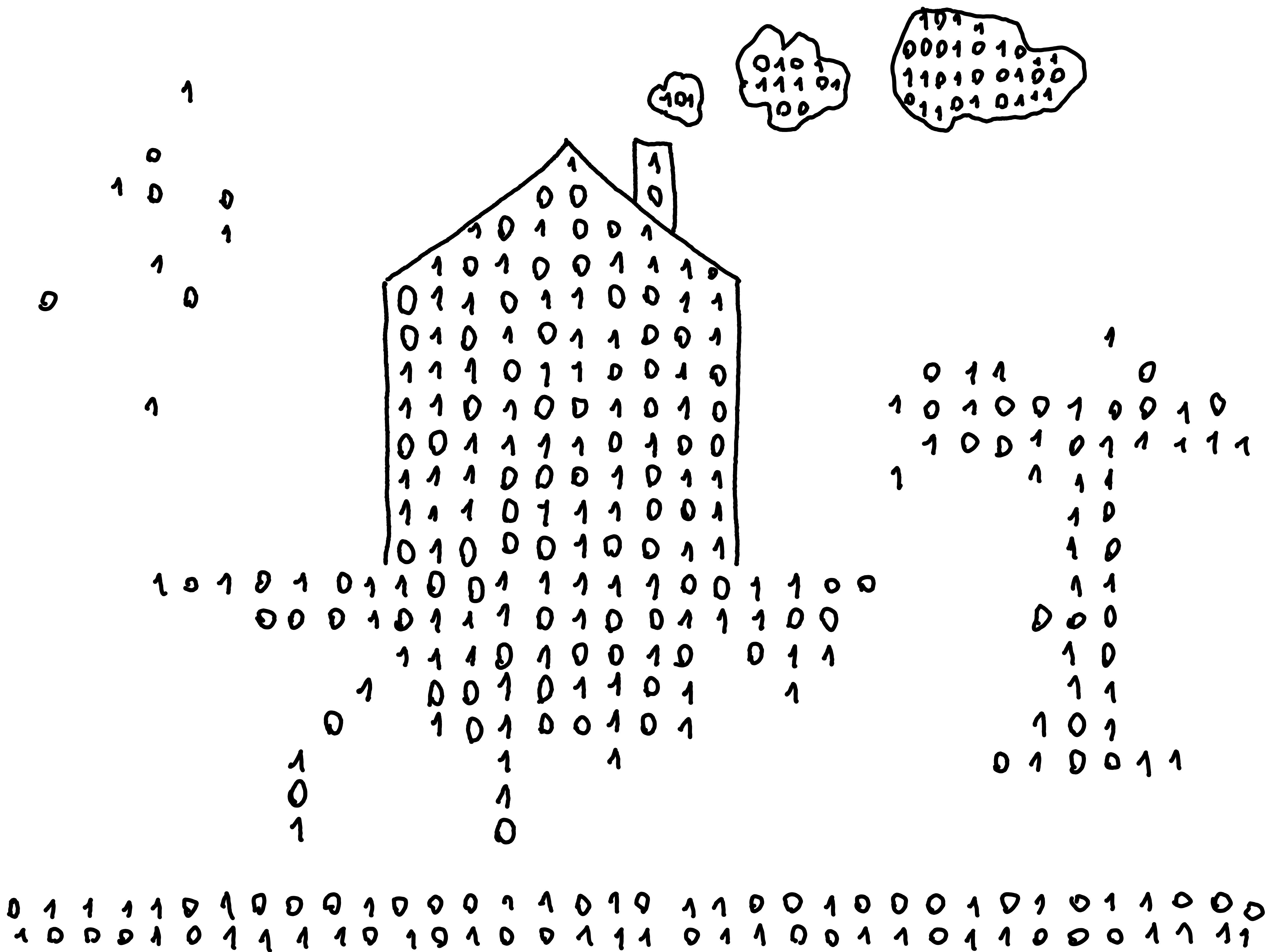
The digital world is much more material than we think. It seems important to me to take the measure of it in a concrete way, it is what can allow to build good strategies of organization of its data: to better manage them, not to lose them in the future and to remain the owner. The stakes are economic, cultural, human, democratic, ecologic, etc.
The magic of digital
Digital technology seems to us to be something immaterial, because of the Internet and wireless connections present almost everywhere, which allow us to access our data (social networks, documents, music, video, photos, address books, agendas, etc.) wherever we are, without any apparent need for a concrete medium.
Nevertheless, when the connection is bad, we become aware that it is a remote link, that our data is in another place to which we must connect. But even in these situations, as the smartphone also has an internal memory and a certain amount of data is duplicated in the device (cached as we say in computer jargon), then synchronized in the “cloud” at the next connection (i.e. copied to the remote computer servers of our service providers, Google, Apple or Facebook for example), we live in a form of almost permanent connection, which plays with the constraints of reality.
Thanks to these great tools, we are evolving in a kind of “magical world of data”, which goes beyond the limits of space and time. I have nothing against this fluidity of use, which is extremely practical, but it risks making us lose our footing when it comes to making the right decisions about the security and durability of our data, both personal and professional.
The return of the real
Data loss is far more common than we think. The example of the fire of a data center of the French web host OVH in Strasbourg in March 2021, which caused the irremediable loss of a huge amount of data (administrative, personal, media, etc.) concerning more than 400,000 websites, has the merit of bringing us back to reality. And this is all the more true that, legally, it is not OVH that has been made responsible for the loss of data, but the owners of these data, who had not put in place backup strategies (which is their responsibility, not OVH’s).
However, some of OVH’s customers who were victims of this fire were able to recover their data almost immediately, thanks to their anticipation, and overcome the disaster with little or no damage. But others, hosted on the same servers, lost their data forever.
How to protect yourself? Let’s start with a point of understanding the materiality of the digital world, the strategies will almost follow by themselves by common sense.
The different natures of digital data
The data we manipulate on a daily basis (our texts, images, sounds, posts on social networks, etc.), what are they, materially speaking? First of all, they are of several natures (to be more precise, they have several types of uses):
- Text: literary, informative, etc. They are made up of alphanumeric characters (upper case, lower case, accented characters, special characters and numbers).
- Computer code (which is also text). It also consists of alphanumeric characters. The difference with simple texts is that these texts, which respect the rules of computer languages (which are very numerous), produce actions: display something on a screen, trigger a data transfer, make a calculation, display an image, etc. Computer code can create drawings on screens, trigger engines to print documents, make trains run, send messages via the Internet to other computers whose addresses they have, create an interaction in a video game, trigger the recording of a file on a USB key, etc.
- Images (still or animated). Images are divided into pixels. These are thousands of small dots side by side, each with a specific color, which reconstitute an image for our eyes. It is the same principle as printing. Have you ever been close to a poster? We see the dots. The density of the points gives the “resolution” of an image, that is to say its technical quality. You may know the term “DPI” (Dot Per Inch)? It is the number of “dots per inch” printed on paper. 300dpi for example, represents 300 dots on the length of 2.4cm (one inch), which is a quality that seems perfect to us. Cell phone screens have about this kind of resolution.
- Sounds. A sound, in the real world, is a variation of the air pressure, produced by the vibration of the vocal cords of a person for example, which will make vibrate the fine membrane (eardrum) present inside our ear. The vibration of the eardrum activates the inner ear system, which produces electrical impulses, transmitted to our brain, which finally gives us the sensation of “hearing”. To transform an air vibration into digital data, a “transducer” (a microphone) is used, which transforms this vibration into a variable electric current. The microphone is associated with an “analog-to-digital converter”, which measures this variable electric current and transforms it into a sequence of numbers. It is a bit like the pixels in a picture: the sound curve is also “pixelated”, simplified, but in a way that is fine enough for the human ear not to perceive it. When the sound is played, it is the opposite process: the data are transformed into a variable electric current, thanks to a “digital-analog converter”, then this variable electric current is sent to a “transducer” (the loudspeaker), which is a membrane that vibrates in a proportional way to the variations of the current and makes the air vibrate in the vicinity, and our eardrums at the other end.
The binary code
Data, in terms of its nature, is therefore text (for text and computer code) as well as number sequences (for images and sounds). To be able to be treated in an automated way by these machines that we call computers, stored, transmitted, transformed thanks to the computer code, these data are all transformed into “binary code”. The “binary code”, they are the “0 and the 1”, the “bits” (Binary Digit), which are the only elements that can be processed by the current computers. But how do we transform texts (text and computer code) and number sequences (images and sounds) into these billions of “0s and 1s”?
The first traces of the use of a binary codification to make calculations or information storage more reliable date back to 750 BC in China. In history until today, many mathematicians and philosophers have used binary for various types of operations (mathematics and logic mainly). This manuscript by Leibnitz from 1703, for example, already describes exactly how contemporary computers do their calculations:

Leibniz shows the correspondence between the binary code and our decimal code. In the same way that our decimal code (which consists of 10 digits) allows us to represent numbers beyond 9, the binary code (which consists of only 2 digits) also allows us to represent numbers beyond 2. We can therefore count in binary, in the same way that we count in decimal: write the numbers, add them, subtract them, etc.
The bytes
First of all, instead of considering the “0 and 1” in isolation, it was decided in 1956 to use them in groups of 8, the “bytes”. A byte, which is thus made up of 8 bits, makes it possible to count from 0 to 255.
| Decimal | Binary |
|---|---|
| 0 | 00000000 |
| 1 | 00000001 |
| 2 | 00000010 |
| 3 | 00000011 |
| 4 | 00000100 |
| … | … |
| 253 | 11111101 |
| 254 | 11111110 |
| 255 | 11111111 |
Okay... we can store numbers from 0 to 255 in bytes, but what’s the point?
Text and numbers
For text, the “ASCII code” (American Standard Code for Information Interchange) was created in 1963, which maps an alphanumeric character to each byte:


This ASCII code is the unique standard used internationally today, which means that strings of 0s and 1s processed by computers (sent, received, manipulated) are immediately converted into alphanumeric characters. These received texts always contain the necessary information to identify their nature. This identification is formatted by common protocols: address of the sender and the recipient, type of file (simple text, computer code, image or sound for example), size of the file, etc., which are always placed in the same places so that the interpretation is exact.
For images and sounds, texts describe them in the header, and the following bytes are used as numbers and no longer as texts. For example, have you noticed that in image processing software (such as Photoshop), when you choose a color, it consists of a combination of the 3 primary colors Red, Green and Blue, each of these three colors having a value between 0 and 255? This makes 16 million possible colors. Each pixel of an image uses 3 bytes to store its color.
The materiality of the binary code
I hope you have understood how texts, images and sounds can be transformed into billions of 0’s and 1’s in order to be stored, processed and transmitted. But, concretely, what is the materiality of the 0s and 1s?
- The optical fibers that flash at high speed: light or no light = 0 or 1.
- Electric current or no electric current at high speed too: in the phone cable ADSL or in the network cable in a company = 0 or 1.
- Tiny areas of a magnetic medium, magnetized or not: on a hard disk = 0 or 1.
- Microscopic “microcuvettes” on a plastic support in front of a reflective layer: on CD, DVD and Blu-ray = 0 or 1.
- Tiny switches placed side by side, turned on or off, which keep their state even without electricity: in a USB key = 0 or 1.
- Black and white squares printed on paper: the QR Codes used more and more often = 0 or 1.
So, there is nothing magical about the digital, it is not in the clouds! It is always well and truly stored materially somewhere.
If we don’t take care of its storage place and its durability by ourselves, there is no “God Almighty” who will do it for us. We are using new technologies, which bring us new kinds of responsibilities. And we need to build new ways of taking those responsibilities. If we don’t, we will simply lose most of our data, in the short, medium and long term. This may be a deliberate choice in a personal capacity. But in a professional capacity, it is a mistake.
Backup Strategies
Even if the big digital industrialists make our lives and uses easier by making our experiences with digital very “fluid”, we must not forget that their job is only to sell us services in the present. This ease of access should not make us forget that our digital data is indeed material and stored somewhere, by someone who does not necessarily have the altruism to ensure the guarantee and durability of our data for us. This service provider can go bankrupt, suffer a fire, a computer attack, etc. Of course, this is very rare, and this is what deceives us all the more, giving us the impression that our data is present in an eternal space, that it will be accessible forever.
In reality, our data is stored on media (nowadays hard disks) in very large data centers. It is a bit like a book in a public library, which does not really belong to you, even if you can borrow it. Unlike a book that you have in your library at home, which belongs to you fully and for which you are also fully responsible (hygrometry, fire safety, etc.).
Today, there is no reliable or durable medium for storing digital data. Hard disks have an average lifespan of 7 years and are very fragile, USB keys have a limited number of access cycles, etc. Thus, the responsible data backup goes through two temporalities:
- In the present: digital data must be duplicated on two separate media, kept in two different locations (ideally at least 900 kilometers apart, for nuclear risk). This allows to prevent physical failures (linked to the medium), contextual failures (water damage, burglary, etc.) and human failures (accidental deletion).
- For the future: every 4 to 5 years, these two supports must be copied onto new supports, which will also be compatible with the new interfaces. And don’t worry, according to Moore’s law, hard disks have bigger and bigger capacities for the same costs, so you won’t multiply hard disks over time, on the contrary.
In conclusion, care for your digital data and its media like you care for your precious books, because your digital data is not less material than your books. They have the advantage of being able to be duplicated without loss, but they have the disadvantage of not having the solidity of a book, which you only need to store on a shelf to preserve over time.
Digital data needs renewed attention, and to be duplicated in two places. These are new kinds of responsibilities that fall to us, linked to the evolution of technology. If we do not take it in hand in a simple and material way, it means that we subcontract this responsibility to others, that is to say that we choose to be irresponsible with regard to our heritage. Do we not maintain our house? It’s the same for digital data.
Bonus: the responsible cloud
It is possible to benefit from the convenience of “cloud” services, while being fully owner of its data and responsible for their backup: it is enough to acquire a NAS (Network Attached Storage).
It is a hard disk with special functions, permanently switched on in our office. It is connected to the Internet box. It is permanently accessible from a distance with a computer or telephone, and offers shared office documents (cf. Google docs), file sharing, agendas, contacts, music, video, etc. NAS offers about the same services (and often better) than commercial cloud services. The difference is that it is done in control and responsibility of its data. For their basic use, NAS can be configured by non-IT specialists. There are also other responsible cloud solutions.
Yes, managing your data requires attention and work: that’s what we call responsibility. This is the real world of today’s adults. This responsibility is quite accessible, even to non-specialists, it is made of common sense, from a lucid awareness of the materiality of digital data.

In the XXIst Century, most of the human productions are made with digital tools and circulate in digital form: written, photo, sound, video, multimedia...
What is heritage? It is the access to human productions of the past and present (cultural, artistic, industrial, built, financial...). Heritage has a cultural, political, economic and historical value. Without heritage, societies have no history. Without the Eiffel Tower, without the Sacré Cœur, without the Louvre Museum and other elements of architectural heritage, Paris would not have a tourist economy, for example.
The heritage that we will be able to produce from contemporary digital productions will strongly contribute to our future wealth, in every sense of the word. But how can we identify, build up and enhance our digital heritage? Methodological, technical and strategic elements.
-

Taking back control of our data
A cultural path, not just a technical and legal one.
When American law reigns over European data, the only response is to rebuild a culture of digital sovereignty, piece by piece, NAS by NAS, one (…) -

Sovereign Digital, a Micropolitical Choice
Escaping the Hegemonic Imaginary of Digital Tools.
Our daily choices of digital tools lock us into a capitalist imaginary. Moving from Microsoft to Free Software is not just a technical issue: it (…) -

Digital sovereignty, a democratic emergency
When our public institutions jeopardize our collective autonomy.
The loss of our digital sovereignty does not result from the thoughtlessness of citizen-users, but from a form of political unconsciousness (…) -

Sovereignty or Security?
Digital responsibility put to the test of reality.
The fire at a state data center in South Korea in September 2025 proves human fragility in the face of digital storage. Between risky sovereignty (…) -

Reflection on the Evolution of Audiovisual Media in Libraries
For a citizen-driven heritage preservation of territorial audiovisual creations.
Libraries are facing the disappearance of physical audiovisual media. This technical transformation calls, in my view, for an anthropological (…) -

Conformism versus Sovereignty
The comfort of digital dependence versus the requirement of data mastery.
Our digital lives rely on standardized tools. While this conformism simplifies usage, it exposes us to a loss of control. Let us reflect on this (…) -

For a Political Consciousness of Digital Technology
When our technological choices shape tomorrow’s world.
Every click, every application used, every digital service adopted constitutes a political act that participates in building our collective (…) -

“The flavor of data”: for a phenomenology of digital autonomy
Sentiment of dependency and digital sovereignty.
In the contemporary digital ecosystem, our apparent freedom of use conceals a structural and total dependence on platforms. This illusion of (…) -

The Fantasy of Digital Ecology
When individual guilt-shaming masks industrial predation.
In our situation of ecological emergency, greenwashing diverts our attention from the real culprits. While we conscientiously sort our waste, the (…) -

Cultural data and cultural rights
For an inclusive heritage democracy in the digital age.
Citizen cultural data is tomorrow’s heritage. Their recognition and preservation constitute a major democratic challenge for building a (…) -

Cultivating digital sovereignty
For a democratic reclaiming of our digital spaces.
Faced with our growing dependence on tech giants, digital sovereignty is becoming a major democratic challenge. It’s time to act collectively. The (…) -

Digital politics
When clicking becomes voting: the hidden face of our technological choices.
Code is law: digital tools are not neutral. Our daily technological choices are political acts that shape the world. Here are concrete elements (…) -

Cultural rights and preservation of digital heritage
Bernard Stiegler’s technical philosophy sheds political light.
Have you ever tried to find a video you loved on YouTube from ten years ago? A blog post that made an impression on you? Your friends’ photos on (…) -

Our fragile memory
For a digital archiving policy.
Our lives are now inscribed in digital form: emails, photos, documents, etc. But this collective memory is excessively fragile. Without active (…) -

Liability and computer backup
To stop turning our backs on our future.
Computer backup is often neglected due to a lack of understanding and the illusion of the ubiquity of digital data. This unawareness exposes us to (…) -

Digital and rationality
For a non-phantasmic vision of digital technologies.
Digital technology, often wrongly associated with rationality, is in reality an imperfect and material technology. Our choices of digital tools (…) -

Podcast: “The living archive”
Benoît Labourdette reflects on the challenges of digital archiving in the arts and culture (44’, 2023).
How empowering people to take responsibility for archiving and using data can be a real strategy for the vitality of creation, both artistically (…) -

Digital is not immaterial
Elements of understanding.
The digital world is much more material than we think. It seems important to me to take the measure of it in a concrete way, it is what can allow (…) -

“The Long Tail”: Cultural Diversity in the Digital Age
Tool for the design of cultural projects.
The “long tail” is one of the essential concepts of the Internet economy. Contrary to popular belief, on the Internet it is the great diversity of (…) -

“Artistic creation and digital heritage”: conference by Benoît Labourdette
Bibliothèque Forney (Paris) on Thursday, April 28, 2022 from 7:30 pm to 9 pm. Free admission.
Awareness and responsibility in the present with regard to our digital heritage are the guarantee of the construction of our humanity.Human (…)


-

Nature of reality in the digital age
Small kaleidoscope of thoughts about digital philosophy.
In my opinion, digital technology is not a subject that should be debated, that deserves to be positioned “for” or “against”. It is in fact an (…) -
Podcast: “The living archive”
Benoît Labourdette reflects on the challenges of digital archiving in the arts and culture (44’, 2023).
How empowering people to take responsibility for archiving and using data can be a real strategy for the vitality of creation, both artistically (…) -

Westward direction Collective film (7’30s, 2019).
Digital things whisper their existence in our ears. -
Liability and computer backup To stop turning our backs on our future.
Computer backup is often neglected due to a lack of understanding and the illusion of the ubiquity of digital data. This unawareness exposes us to (…) -
Sovereignty or Security? Digital responsibility put to the test of reality.
The fire at a state data center in South Korea in September 2025 proves human fragility in the face of digital storage. Between risky sovereignty (…)
