Cultural democratisation and cultural democracy resemble each other and name two different projects. Retracing the history of the first with socio-historian Marjorie Glas, then unfolding the second through cultural rights, helps to understand why the houses of subsidised theatre do not look like their city, and what artistic teams can do with this, for others and for themselves.
Houses that do not look like their city
For decades, surveys of the audiences of subsidised live performance have said roughly the same thing. The houses are filled with people who hold degrees, who belong to the intellectual or liberal professions, who have comfortable incomes, and this social composition barely shifts, even though the economic barriers have been lifted by subsidy, pricing policies, school transport and off-site activities. What resists is symbolic. In most towns, the vast majority of inhabitants do not attend the theatre their taxes fund, and many, when they know it exists, remain convinced that it is not addressed to them.
Faced with this, one can consider it a failure in implementation, calling for more mediation, more communication, more effort in welcoming people. One can also ask whether the problem does not lie in the very design of the cultural democratisation project, which assumes, without ever saying so, that there is a legitimate culture and people to whom it must be brought. It is this second hypothesis that I want to examine here. In the artistic teams, the venues and the mediation departments, some occupy a position of superiority, and it happens that they are at ease in it. What I mean is that they are not responsible for that position. It was built before them, settled into the funding, the formats and the professional habits, and they find themselves occupying it whether they like it or not. Some make their peace with it, others seek to deconstruct it. Understanding how it was built, and what happens when one lets go of it, seems to me more useful than handing out blame.
I have to pause here on a difficulty, because it is what grounds the meaning of this article. To say that this hierarchy produces, over time, the opposite of what it aims at, is to put forward an argument one often hears from those who want to delegitimise the funding of culture and undo projects rooted in their territories. The dialectic is hard. On one side, it is indispensable to think about how the populations of a territory are really concerned by a public spending of which they should be the first beneficiaries. On the other, there are cultural and artistic actors who defend a project of excellence, caught in this conception of an art that elevates, and who argue that supporting demanding forms is a key to collective elevation, that one must not fall into a demagogic or populist instrumentalisation. That argument has its share of truth. But one must not delude oneself about the caste system either, nor forget that art was first of all in the service of power, and that the defence of artistic excellence was long bound up with a political project of influence.
I firmly believe that public authority must organise the possibility of cultural diversity. Its role is to deconstruct the systems of domination, and the cultural actors themselves have to think about this, before elected officials who think about democratic organisation without necessarily having understood how culture can be one of its tools impose, as happened at the Théâtre de Vanves, unilateral and brutal decisions, destructive for a cultural fabric that was to be questioned but was worth the trouble. The cultural actors must therefore work towards questioning the artistic forms themselves. The world changes, art changes function, artists change activity, and that is fine.
A project older than André Malraux
Cultural democratisation is often dated to 1959, to the creation of the Ministry of Cultural Affairs and the Maisons de la culture. André Malraux gave it political legitimacy and unprecedented means, but the project long predates him. As early as the start of the twentieth century, in “Le Théâtre du peuple” (1903), Romain Rolland called for a theatre that would instruct and elevate the working class. Between the two wars, the popular education movements, Catholic as well as Communist, carried out theatrical experiments aimed at working-class and rural communities. After 1945, the companies of what came to be called dramatic decentralisation settled in the provinces by articulating two requirements, the artistic quality of their work and their capacity to reach a broad and popular audience. From 1947, the Secretariat of State for Fine Arts relied on this twofold capacity to award the first subsidies and the label of centre dramatique national. The ministry created in 1959 took up these two pillars and gave them the scale of a state policy, while separating the missions, creation entrusted to the dramatic centres run by artists, animation to the Maisons de la culture, and popular education sent outside the field of culture, towards Youth and Sports.
Under its successive variants, theatre of national communion inherited from Jacques Copeau and Léon Chancerel, theatre of working-class emancipation inspired by Brecht, territorial provision willed by Malraux, the project keeps the presupposition that there are works that elevate, and people to whom they must be brought. This presupposition is generous and sincere, carried by people who devoted their lives to it. It nonetheless installs a hierarchy, that of a culture which gives and of populations which receive, and this hierarchy will produce, over time, the effects opposite to its aims, to the point of denying what grounds the legitimacy of public funding.
Marjorie Glas, or how the audience ceased to be a criterion
Socio-historian Marjorie Glas devoted her doctoral thesis, then a book, to the genealogy of this contradiction. “Quand l’art chasse le populaire. Socio-histoire du théâtre public en France depuis 1945” (Agone, 2023) is, to my mind, indispensable reading for anyone working in subsidised live performance. She recounts that she came to this subject through her experience as a company administrator, struck to find that on the opening night of a creation, after years of work, attention went first to the number of professionals, programmers and journalists present in the house, well before the make-up of the audience and what it had experienced. Her work reconstructs how this inversion happened, step by step, without anyone having decided it.
In the immediate post-war years, she shows, the audience is at the centre of practices and of funding. The decentralisation companies play in village halls and parish halls, rely on local relays drawn from popular education, state education and the network of associations, and take up the tools invented by Jean Vilar’s Théâtre national populaire, correspondents in schools and among activists, pricing policy, explanatory booklets. The notes of the inspectors of the Secretariat of State for Fine Arts, which she has gone through, go so far as to justify financial support for a company whose shows are judged uneven by its sole capacity to mobilise and retain an audience. The relation to the audience is then a funding criterion in its own right.
From the 1970s, several mechanisms combine. The figure of the director imposes itself as the central link of creation, carried by the aesthetic avant-garde and by university theatre studies, and it is this avant-garde that is appointed to head the centres dramatiques nationaux. Budgets concentrate on the production of shows, many animators are dismissed, and in the Maisons de la culture the search for audiences is delegated to subordinate jobs while the directorates devote themselves to spotting young talent. The figure of the programmer emerges. At the same time, the proliferation of statistical studies turns the spectator into a figure on a chart, and attendance numbers become the favoured steering tool of public action. Marjorie Glas speaks of an abstraction of the audience, which remains omnipresent in discourse and becomes secondary in fact.
The 1980s extend the movement through an unexpected channel, the professionalisation of mediation. Until the 1970s, animators trained on the job, in companies or works councils, and came mostly from working-class backgrounds. Passing through the university raises the social level from which mediators are recruited, which changes the perception they may have of the working classes. At the same time, audiences are divided into administrative categories modelled on the lines of funding, schools, hospital, prison, social field, and this division makes the working classes disappear as a category of thought and action. The vocabulary follows. Marjorie Glas notes that the word “popular” does not appear even once in the editorials of the Avignon Festival between 1980 and 2003. The theories of mediation shift at the same moment towards an individual conception of reception, in which each spectator meets the work in a face-to-face encounter said to escape their social determinations, something the whole sociology of culture, from Bourdieu to Bernard Lahire, nonetheless contradicts. And a 1982 report of the Commissariat général au Plan ratifies the abandonment, judging it useless to acculturate “an audience that remains structurally resistant to it”. Since the 1990s, the closed circle has tightened even within the profiles of teams, the share of directors holding a higher-education degree rising from half to 90% today.
What I take above all from this work is that none of these steps was taken by someone who wanted to drive out the popular. Each actor, taken in isolation, did their job as well as possible, defended artistic standards, professionalised their sector, rationalised public spending. Marjorie Glas shows that the structural logics of the institution were stronger than individuals, and it is in this that her reading is useful to today’s teams. It frees us from individual guilt, which paralyses, and shifts attention to the mechanisms, on which one can act.
A questioning that does not serve those who want to cut
I want to say where I speak from, because the critique I develop here can be heard the wrong way. I am convinced that public support for a public culture matters. Commercial culture has its place and its qualities, but it does not have the same virtues, and an art funded by public authority can do what the market does not. The elitism I explore in this article is also denounced, to an altogether different end, by reactionary political figures, and not only on the far right, even if it is the reasoning of a large part of the far right. Those figures use the argument of elitism, and a display of budgetary probity, to justify cutting support for culture. If I propose a questioning, it is not to give them arguments, but to look real problems in the face and to work together at questioning ourselves, not to obey a political diktat, but to rethink the way a subsidised art is created and circulated, so that this public support continues in the right direction. I write this in order to refound support for culture, not to arm those who seek to destroy it.
The eight rights of the Fribourg Declaration, read in four pairs
Cultural democracy starts from another premise, one that Paulo Freire formulated in “Pedagogy of the Oppressed” (1968). No one educates anyone, no one educates themselves alone, human beings educate one another, through the medium of the world. Each person carries a culture that has its full value, and the question is no longer to give access to culture but to organise the encounter between cultures. Cultural rights give this premise a legal and operative form. They understand culture in its anthropological sense, that is, everything that makes up a person, what they love, where they come from, the language they speak, the works and practices that run through them, and not only learned or artistic culture. Formulated in the Fribourg Declaration (2007), they entered French law through the NOTRe Act of 2015 and the Act on freedom of creation, architecture and heritage of 2016, which require cultural policies to respect them.
The Fribourg Declaration identifies eight rights, which I find illuminating to read in four pairs:
- Identity and diversity, the right to choose and to have one’s cultural identity respected, and the right to know one’s own culture as well as other cultures.
- Heritage and community, the right to access cultural heritages, and the right to refer, or not, to one or more cultural communities.
- Participation and cooperation, the right to take part in cultural life, and the right to contribute to cultural cooperation.
- Education and information, the right to be trained with respect for one’s cultural identity, and the right to inform and be informed.
Read this way, these rights describe less a set of services to be supplied than capacities to be guaranteed, to produce meaning, to contribute to the common.
The pair of participation and cooperation is worth pausing on, because it bears directly on current theatrical forms. A show that has the audience vote, that makes it stand, that has it choose between two options, answers the right to participation, and can perfectly well give up nothing of its score. If the choices are bounded by what the artists have planned, the audience participates without cooperating, it plays the role of the active spectator that has been written for it, as yesterday it played the role of the silent spectator. Jacques Rancière pointed to this paradox in “The Emancipated Spectator” (2008), recalling that wanting to make the spectator active amounts to assuming they were passive, therefore less capable, when they already have an inner life, an intelligence, a capacity to make connections. Cooperation begins where the outcome can be displaced by the people present.
There remains the objection often raised against this kind of discourse, that of relativism. If every culture has its value, does everything become equal, and what becomes of artistic standards? These cultural differences are enrichments, and the risk one fears, losing or cheapening one’s own culture by listening to someone else’s, does not exist, it is a fantasy. When one is open to the other, one is enriched by the other, because one builds a system of cultural democracy in which cultures enrich one another. This does not mean becoming hostage to the other’s culture, it means organising the dialogue, and that is the whole concept of democracy. There are people who are experts in something and make a claim out of it, and others who are experts without drawing anything from it. Someone can be an expert in the game of boules, which is a cultural and sporting skill, without turning it into a pretension or a superiority. It is a place of expertise they can share. And with our theatrical expertise, in dialogue with their expertise in boules, we can build something fascinating, in which each is enriched by the other’s expertise.
“They make me move”: a training day with a company
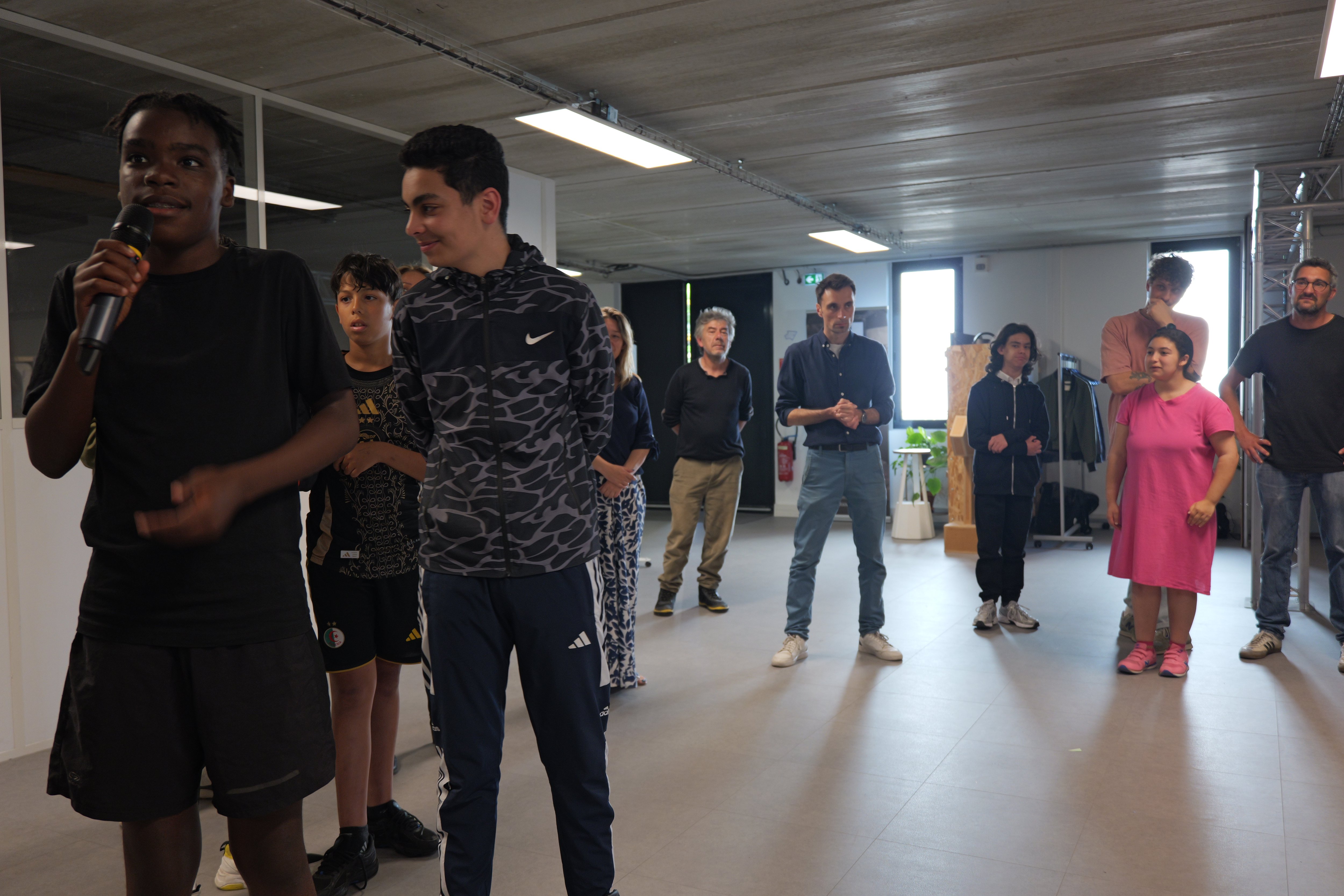
I was recently running a training day for a theatre company and the team of the venue that supports it, around the design of digital creation workshops with school audiences. At one point in the day, someone named with great honesty the tension within which the team works. There is a frame, things to deliver, “there do still have to be the little films”, and when the young people want to take hold of the proposal in their own way, this is unsettling, because we have things to do and they are supposed to take part. The conversation then turned to our criteria. What we judge to be well made, successful, accomplished, owes itself to our professional culture, to our aesthetic references, to our habits, and the people across from us may have criteria other than ours, which are no less grounded.
This situation reproduces a structure everyone knows, that of school. I give an instruction, you respond to it, and if your response falls outside what was expected, it is wrong, even when it bears witness to an intelligence the instruction did not know how to welcome. In a one-to-one relation, the one who frames the instruction holds the power to validate, and this power, here again, no one asked for. It comes with the role of the practitioner, with the format of the workshop, with the deliverables promised to the funders. One is its prisoner without seeing it, because it has the shape of professional self-evidence.
It is here that cultural rights become a tool, and not only a philosophical reference. They tell us that the appropriation of the project by audiences is a good thing, and they authorise us to regard it as such. When the young people take the proposal elsewhere, when they seize on it to make something other than what was planned, it is the sign that we have succeeded in our work, but we no longer necessarily have the expected deliverable. And it is there that things become complicated with partners, funders and teachers, who can be unsettled and say that what was planned has not been done, that it does not conform. Evaluating the project in the light of cultural rights makes it possible to stand up to that worry, because one is then evaluating something else. One is no longer measuring the conformity of the result to the commission, one is measuring what the people experienced, what they allowed themselves to make of the proposal, what they displaced. That is what the tool is for, to give legitimacy, and even a legal basis, to work whose success cannot be read in the deliverable.
To be able to account for it, one has to make a narrative. Living the experience is not enough, one has to keep traces of it, as the action unfolds rather than afterwards, through a journal, through photography, through drawing, through a regular gathering of the participants’ impressions, through witnesses who pass by and offer what they perceived. If the narrative is not built at the same time as the action, cultural rights remain hard to assert, because what is seen is the result, and it is the result that is judged with aesthetic criteria. The process, for its part, is not seen. It lies in what the people lived, and it is that lived experience which must be made visible, so that everyone can understand the meaning of these approaches, their democratic and emancipatory meaning.
It is this experience that cultural rights come to secure, that of being able to say, in the situation, they make me move, I find myself doing something I had not planned, and I learn things thanks to them. What I observe, in this training as in others, is that going beyond the position of superiority is not lived as a renunciation but as a relief. Letting go of one’s criteria when it makes sense, accepting to be displaced, takes nothing away from the craft, it makes it more alive and more nourishing, for the people welcomed as for the artists. Domination is not only unjust for those who undergo it, it is impoverishing for those who exercise it without wanting to. This is perhaps the most convincing argument in favour of cultural democracy, and it does not belong to the order of morality.
Four ways of rereading one’s own project
I close with a few methodological leads, to be taken as proposals for work and not as prescriptions, since each team, each venue, each territory calls for its own answers:
- Rereading through the rights. Reread an existing project in the light of the eight rights of the Fribourg Declaration, asking for each one how the project takes it into account, then putting the answers into discussion. The exercise is done as a team, but gains from opening to people outside the stakes, who give their view on the basis of the narrative we make of our own experience, and whose regard we gather. It brings out blind spots that no activity report shows.
- The question of reciprocity. Ask yourself, once a season, an unusual question of evaluation. What have the people we worked with this year, inhabitants, school groups, workshop participants, displaced in our way of doing things? If the honest answer is “nothing”, that answer simply gives the place to begin, and it has the merit of measuring reciprocity rather than attendance.
- The point that escapes. Reread our own projects to spot the moment when something escaped us, and why it was interesting. From there, think about how to make room for the possible so that the project can escape again, without seeking to master it, but discussing how to prepare for it. It is at that point that participation becomes cooperation, and it is often there that teams, when they experience it, say they live the richest experiences of their craft.
- The capacity for narrative. Equip ourselves with the means to tell the processes, and work at it as a team, legitimising the time it takes. Make these narratives public and participatory, through exhibitions, publications, things put online that are not objects of communication but objects of narrative. Think about how these narratives are produced with the people, how they belong to them, and the access they have to them, which must be immediate and without limit in time.
Cultural democracy is less a state to be reached than a direction of work, and it is a process one can begin not at the next workshop but right now. For this afternoon’s meeting, for tomorrow’s rehearsal, for next month’s communication, for next year’s programming, for the way we will welcome people into the venue tonight. Keeping cultural democracy in mind, and democracy plain and simple, telling oneself another story, anchoring oneself in a real cultural policy, keeping in mind democracy and no longer democratisation. Changing software, almost.


