Theatre and dance companies are now asked to do mediation work, and many artists experience it as a chore tacked on to their art. Drawing on the support work I carry out with companies, I argue here that the relationship with audiences is a field of creation in its own right, one that calls on our living-arts crafts no longer on the stage but in the reality of the encounter.
You are no longer an artist only on stage
Theatre and dance companies that work with public money know it well: agreements, calls for projects and arts-education funding now almost always include a mediation component. You have to offer workshops before and after performances, run post-show discussions, reach out to school groups, “connect with audiences far from culture,” account for your relevance to a given area. These demands are not about to ease off, because they accompany a shift in the profession in which it is now taken for granted that mediation is fully part of the work of professional artists.
This shift is uncomfortable because nothing in artists’ initial training prepared them for it. Theatre and dance schools train people in stage excellence, in precision of gesture, in the making of works, and the same people are then asked to run half an hour of exchange with a class of nine-year-olds or a writing workshop in a neighbourhood. Many artists then experience mediation as a secondary activity, accepted in order to fund their creative work, and they fear becoming, against their will, socio-cultural facilitators, that is, losing in this relationship what makes their identity as artists.
The work I carry out in training with companies starts from this worry, which I take seriously because it asks the right question, that of knowing what we are doing when we do mediation. My answer, which I will set out here from the support work I offer to artists and to theatre and dance companies, is that in the mediation relationship you remain an artist on condition that you are creating there, that is, that you keep creating yourself and invite people to create with you. You are not an artist only during the moment when you offer a performance; you are one just as much in the moments around that offering, before, around, after, wherever you are with people and building something with them. This answer involves a certain conception of art, which has to be made explicit, and concrete ways of doing things, which I will describe from situations I come across regularly.
Art as experience, from John Dewey to Jean Caune
My conception of art owes a great deal to John Dewey, whose book Art as Experience (1934) has been with me for a long time. Dewey distinguishes the art product, which is the physical object, the painting, the performance, the book, from the work of art proper, which is made up of the actions and effects of that product on people’s experience. The product may sleep for centuries in a storeroom without any work taking place. The work takes place whenever an experience is built in the encounter, and the person who perceives is not passive there; they carry out work comparable in kind to that of the artist, they organise what they meet and build the unity of their own experience. If we hold to this definition, art requires neither a durable object, nor virtuosity, nor professional status; it requires that an experience take place and reach completion.
The consequences for companies are direct, since a workshop with children, a post-show discussion or a gathering of residents’ words are situations where experiences may reach completion or fall short, just as a performance may. The material worked on is the same, lived experience, and only the form changes. Running a workshop is therefore not an activity beneath the stage, a second-rank activity placed below the boards in a hierarchy of tasks; it is art practised in another form, on condition that one works at it with the same demand, a demand that then bears on the aesthetics of the relationship as much as on those of image, sound or movement.
Jean Caune, who was an actor and director before heading the Maison de la culture in Chambéry and then teaching at the University of Grenoble, devoted a large part of his theoretical work to this question. In Pour une éthique de la médiation (1999), he shows that cultural mediation cannot be reduced to a transmission of contents or to institutional communication, that it is the construction of a common world through sensory experience, and that the meaning of cultural practices is played out in the relationship itself. In La démocratisation culturelle, une médiation à bout de souffle (2006), he draws up the assessment of the top-down model inherited from Malraux, which consists in bringing works towards audiences assumed to be deprived of them, and he finds it exhausted. This path says something to theatre people: here is a man of the stage who came to consider that the relationship built around works was as serious a matter as the works themselves.
Pushing the tables aside before talking about anything else
Many companies perform in schools, in a playground, in a classroom, in a covered courtyard, and these performances are most often preceded or followed by artists’ interventions with the pupils. It is a situation I know well, and it is the one I take as my example, because it concentrates most of the questions companies put to me.
When I support a company, rather than bringing them facilitation techniques, I propose that they live through experiences. The first one we do together is often the simplest. We are in a room with tables, and we begin by pushing them aside, by clearing space, by sitting differently. If I have them live through this, it is so that we can then talk about what they have just felt, the fact of having transformed a place and, as a result, having lived things there differently. It is exactly what they do when they arrive in a school. Performing is not only setting down a proposal in a space designed for it; it is transforming the conditions of the encounter, and this transformation often passes through a transformation of space.
This transformation, as an artist, you of course bring for the performance, for the moment you have prepared and come to offer. That is the logic of the offering, and I have nothing against it. It is pleasant to receive something others have prepared for you, whether you are a spectator of it or take part in it. But as an artist, you must also act in an artistic approach around that moment of offering, before and after it. And what happens around the offering necessarily belongs to participatory practices, since you are there, with people, building something with people who are present. You have to dare to be an artist as much in those moments as during the performance, dare to transform spaces, dare to organise the way in which people meet.
A group in front of you, and no one inside it
Performances given in schools often carry themes of citizenship, respect for others, listening, the fight against racism, destigmatisation. Through the works offered circulates a whole generous imaginary, in which one wants to offer children, assumed to be unruly, forms of emancipation that would pass through art rather than through school control alone. I share this imaginary. But living together is not dissolving into a group; it is that each person be invited to exercise their own responsibility. The group is an entity in itself, and living together is first of all a matter of individual responsibility.
Yet when an artist arrives to offer an experience different from everyday life and finds themselves in front of thirty, sixty people, they address the group. It seems obvious: one person on one side, a group on the other; we do not question this division. The problem is that, through this very arrangement, the artist considers, without meaning to, the people in front of them not as individuals but as a mass, since they are not addressing them one by one. There is here a form of negation of the individual, and therefore a lack of respect, because one does not address each person as such but as a member of a whole. The critical thinking we call for is precisely thinking for oneself, daring to contribute by stepping out of the group and its uniformity. The relationship, as it sets itself up from the outset, goes in the opposite direction.
You can see it in one detail of the arrangement. The artist who arrives is named; their name is known, they are announced, introduced. The pupils who listen to them are named nowhere in this relationship. There is a dissymmetry here, a recognised identity on one side, erased identities on the other. I will be told that this is normal, that one is indeed a spectator of something and does not feel denied, that one knows where one stands. That is true. But we are not in a stadium; we are in a school, the artist has come to meet people, in a place of education, and there is something to be found there.
Saying hello to each person by their first name
For this I have a very simple proposal, which I have passed on to people who now use it regularly and with success. When I arrive, or when people enter an arrangement I have prepared, and if I am already present in the space and not backstage, I go towards each person. If they agree, I shake their hand, we are close, I ask their first name, I repeat it, I say hello while saying it again, and I give my own. I will not remember all the names; that is not the point. Even with a group of fifty people, doing this takes five minutes, and it changes everything. Each person has been named, each person has been in direct relation with the artist.
It is not a matter of fame, as if it were about having been close to someone well known. It is that, in the artistic interaction of a moment offered by someone one does not know, there is from the outset respect for the dignity and the identity of each person, through the simple fact of naming them. We then enter the experience together quite differently. I do not claim that a first name said at the entrance settles anything on its own; it is one element among others. But the moment when people meet, the way it is organised by the artist, is an artistic responsibility, a question of coherence between the arrangement and the values one claims to be talking about.
What I am describing is nothing other than staging. It is theatre, in the simplest and most ordinary sense of the word. We work on theatre, but not only during the moment of the cultural offering, because culture is not only an offering that people come to consume. This point matters, because one hears a great deal, in the sector, that what we do is precisely not consumption, unlike a trip to a theme park or a sports activity, playful, seductive, but shallow. I share the idea that, paid with public money, we must do something else. It remains to be seen what doing something else means. If one works in theatre, it means working on theatre in depth, across the whole of the experience, and not only in the segment where one steps onto the stage.
A classroom is an arrangement
To grasp what is at stake, one has to be attentive to the arrangement, that is, to the particular staging one creates for people at the moment when one is in relation with them. In theatre, the costumes, the lights, the set, the way bodies move, the place of the audience in relation to the stage, all of this composes the arrangement. The way one enters a school, the way one interacts with the people one meets there, and children in particular, is part of it too. It is not a preliminary to the arrangement; it is already the arrangement, chosen consciously, and it is something one works on.
When I stand in front of a class of pupils seated at their tables and ask them questions, after the performance for example, I am inside an arrangement. It seems natural because it is a classroom, and a classroom does not see itself as an arrangement; it sees itself as a self-evident thing that everyone knows. It is one nonetheless, a certain staging of bodies and a certain distribution of functions among the various people. A classroom is theatre. As they are most often designed, and I do not say always, since what I share here is shared by many, classrooms install a top-down relationship of surveillance and control, which is played out in the arrangement itself. One person is physically above the others, standing while the others are seated, and is to be listened to. The one who is seated and is a pupil receives the injunction to be silent in order to hear the voice of authority, and speaks only if invited to by the person who holds power.
The right to expression, if one may call it that, is granted only by the one who is in a position of power. Should there be transgression, should the pupils speak among themselves to the point that the adult can no longer be heard, the disciplinary arrangement deploys itself: exclusion, punishment, denunciation to parents, up to consequences that reach the child in their intimate life. The threat, through the example made of a scapegoat, weighs on all the others and maintains an order that takes no account of the needs or the expression of the pupils, and that claims to know better than they do what is good for them. To enter this arrangement and claim to be working there on democracy or critical thinking is a contradiction, for critical thinking is the first thing school sanctions, as soon as one does not say what it wishes to hear. The words “critical thinking” are then used in a void, and what young people learn is that we are pretending, since criticism of the system itself is not admitted there.
I am drawing a harsh picture, and I add at once that there is no one to blame. This disciplinary system weighs on teachers too, and it is cultural, not individual. The Finnish school, for example, does not work according to these terms. There is therefore no single person responsible; there is a culture, ours, which one has to know if one wants to lead approaches of emancipation through creation there. And artistic creation is for this a precious vehicle, because it is less contentious than learning subjects, because fewer criteria and right answers are at stake in it, because there is more freedom there.
Profaning the arrangement, in Agamben’s sense
If one looks carefully, in every school, wonderful things happen. They happen because human beings choose to do with the arrangement what Giorgio Agamben, in Profanations (2005), calls profaning, that is, returning to common use what an institution had set apart and withdrawn. Profaning an arrangement is not abolishing it, which one cannot do; it is ceasing to hold it as sacred, questioning it, loosening it, working on it, remembering that it exists without one owing it obedience. It is what humans do among themselves, and these profanations are movements of life.
This is where the artist can intervene, on the basis of a sound understanding of all this. The artist does not come to make a revolution; they come occasionally, once, ten times, and the others remain after them. Their role is to bring shifts, in privileged spaces where creation is what is at stake. Having pupils speak after an intervention, letting them elaborate, symbolise, prolong what they have lived, is precious. But if one does not question the arrangement of the ordinary classroom, which is above all an arrangement of control, one will not bring something else into being.
I have had, in groups of professionals, exchanges that confirm this. One person told me that a little girl, after a discussion in class about tolerance, racism, difference, had told her that they had indeed talked about it in the room, but that, as soon as she went out to return to real life, none of it would have anything to do with real life. That child was right. Some of the professionals I support speak in this regard of right-thinking complacency: we reassure ourselves, we make ourselves believe we have dealt with the subject, when in fact we have only reassured ourselves, through a posture of domination towards the pupils. We have listened to the few pupils who understood the arrangement and understood that, in order to exist in this context, one has to say exactly what the adults expect. We left satisfied with a few formatted statements, spoken not by those who understood the values at stake, but by those who understood how to profit from the arrangement and be seen in a good light within it.
We thus believe we have met the objectives set out in the funding applications, and the teachers themselves find the intervention a success since the pupils gave the right answer. But the objective was not the right answer; it was to work on tolerance, and it is plain that this arrangement organises an absolute intolerance of adults towards children, where the sanction falls on whoever does not say what is expected. Children know it; they are not fooled. What acts, far more strongly than the subject one is talking about, is the way one talks about it, the manner of doing, the arrangement, the staging, our living-arts crafts put to work in the reality of presence and co-construction, and not in the single moment, set apart from reality, of the artistic offering.
Defining racism in pairs, at the same time as everyone else
All of this can be illustrated by a concrete method. If one wants the children to take the floor and express themselves, one will begin, as an artist, by insisting on not being in the layout of the classroom. One will arrange to be in a space where one sits in a circle, on the floor, the adult included. Then, if it is a matter for example of defining racism, rather than asking a pupil to raise their hand to give the right answer, one will form pairs. One will tell each person that they form a pair with their neighbour. For one minute, one of them explains to the other what racism is; during the following minute, the other explains it to them in turn. It is not a discussion; it is one person listening to the other.
All the pupils thus speak at the same time, without any stigmatisation, because one cannot control what they say. Those who do not want to speak remain in the speaking arrangement and choose not to speak in it, but they are still actors in it, they have a choice and a freedom, and no one judges them, since, during that minute, they do what they like with their time. There will have been an autonomy of the children in relation to one another; each will have lived something different. We do not know what they will have lived as far as content or theme is concerned, but we do know that we will have offered a democratic arrangement where each person has the right to speak, without being judged for their speech, and where each has expressed themselves in their own way, without anyone telling them how it had to be done.
In this kind of exercise, precisely, one must not control. One gives a frame, and people do what they like inside it. That is the whole principle of democracy. There is a frame, but this frame is not there to be coercive or to impose what one must think or say; it is there to authorise each person to express what they carry, to dig into their singularity, their personal thought, that is, their critical thinking. There, there is a place for critical thinking.
Building together the place where we will sit
One might object that shaking hands, having people speak in pairs, has nothing artistic about it. I said that we would sit in a circle somewhere, but that somewhere, precisely, can be something other than a room prepared in advance. What I am giving here are not norms but principles. Rather than preparing the room beforehand, I often propose to the children, and it works very well, that we build a set together, that we make it a pleasant place where we will sit in a circle, perhaps on cushions.
One then takes an interest in each person’s inclinations. There are the strong boys who want to carry heavy things, and there are girls who want to as well, and one has to allow them to. There are boys whom fabrics interest and who want to handle the decoration. There are some whom architecture attracts and who would rather think and draw what the room will be. We build a place together. There are the set, the props, the costumes, the handling of space, and all of this is art, scenic art, the art of the living arts.
One can perfectly well propose an activity that would consist only in building a place in this way, sitting in a circle in it, then saying something to one another in pairs for two minutes. It is an artistic action, and it can be very strong, memorable, unique in the lives of the young people who took part in it. One can add to it the offering of a performance in which they take part, of course, but there is no hierarchy to establish between the two. These are principles, and one must above all be in co-creation, as I said at the beginning, asking oneself how to co-create with these young people. The more autonomy one gives them, the better.
A day on which each person has a responsibility
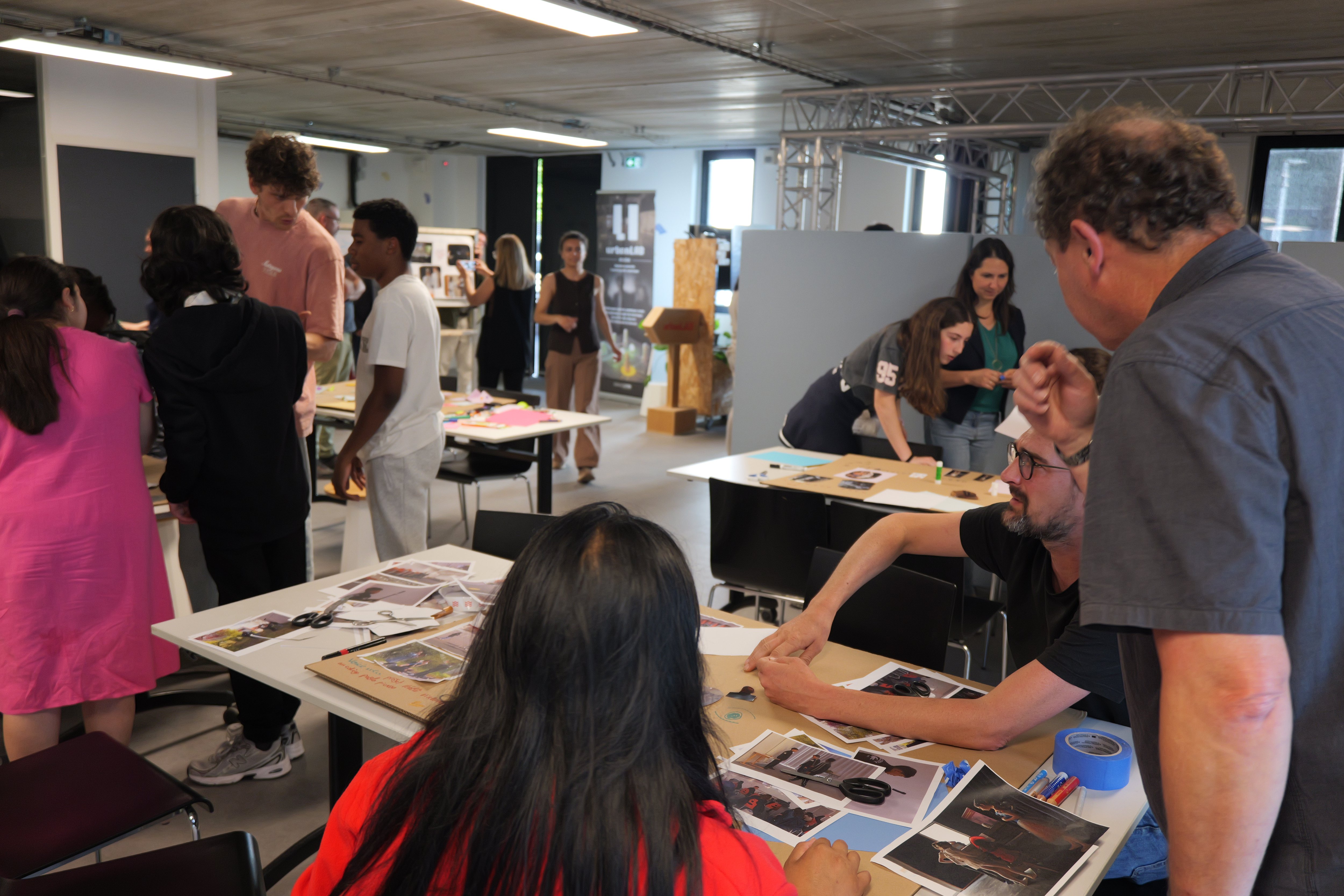
Giving autonomy, I practised it this year very strongly, in a project to make virtual-reality films with secondary-school students. Each one had, at every moment of the day and differently according to the moment, a responsibility, and this responsibility matched their inclinations and their skills. It began with taking an interest in them, in what they wanted to do during that day. My work as an artist consisted in welcoming this diversity of capacities and in orchestrating their complementarity, each one having their full place. It is an important role, and the result looked, aesthetically, like things that resemble me, but with people fully made responsible and free in what they wanted to do, whether for the camera, the sets, the props, the movements.
During the day, I intervened only if asked. There were many moments when I was asked nothing, when the students did things by themselves, and that was very good, that was even the aim. I was there, as an artist, for having authorised all of this, and the project was only the stronger for it, the more invested, because each person had their place in it. During the shoots, it sometimes happened that there were only two actors in a scene, and the others then made prop movements to produce visual effects, or held the sound atmosphere live.
It is readily said that a film is made in the editing, that the sound is mixed afterwards. But the film, here, is a pretext. What matters is the arrangement it makes it possible to put to work so that everyone has an artistic experience. The aim is not the film as object; it is the artistic experience of making it, then the artistic experience of showing it, and first of all that of making it. It was therefore essential that each person have a real place and a real contribution in it.
The object as third party
What makes all of this possible is often the objects. When a professional and a participant face each other, there is always a risk of a power relationship, the one who knows facing the one who does not. When the two build an object together, a film, a text, a drawing, a dance, a set, the object becomes the place of the encounter; it absorbs tensions, it shifts the gaze, it allows each person to invest themselves without feeling judged. The object acts as a third party between people, and that is why creation is not, in mediation, one tool among others, but the very arrangement of the encounter. From this follow a few principles that I work on with companies.
Start from the people, not from the performance. The mediation action does not aim to bring the participants to understand or appreciate the piece; it offers them an occasion to explore something that concerns them, taking the piece as one point of entry among others.
Do not correct. When a participant says or does something that does not match what was expected, the first reflex is almost always a reflex of judgement, and the work consists in setting it aside in order to welcome what comes, because correcting or rephrasing amounts to saying that the other’s thought was not good.
Do not do it in their place. Carl Rogers showed that the person holds within themselves the resources for their own development, provided that one offers them a climate where this can come about, and doing it in their place takes from them the experience of having produced something by themselves, that is, what made the workshop interesting for them.
Leave the traces to those who made them. Everything participants produce belongs to them, in its imperfection and its vitality, and the moment when the professional takes up their work “to make it good” is the moment when they sign it in their place.
Be ready not to know, lastly. One cannot be available to what is happening if one has decided in advance what the other is going to bring, and accepting not to control the outcome is the condition of presence to what comes about.
Mediators do not supervise, they create
There is in the sector a long-standing distinction between cultural mediation, conceived as transmission, explaining the work, preparing the audience, making access easier, and cultural action, conceived as shared creation. This distinction has been useful in defending demanding practices against the reduction of mediation to institutional communication, but it maintains a hierarchy that does not speak its name, with on one side the artists who create and on the other the mediators who transmit. My practice has led me elsewhere. When I hire people to run actions with me, they are artists, or people I put in a position to create, because participants take on the desire to create all the more when they are in the company of people who are creating too and who share this energy with them. Mediators do not supervise; through their presence they create a frame favourable to creation.
The frame, as I understand it, authorises more than it constrains. Taking part in a creation, even a modest one, always represents a personal risk, and what most often keeps people from going for it is fear, fear of others’ judgement and fear of not being up to it. The artist’s role in mediation consists for a large part in lifting these fears, and the surest means I know is to put oneself at stake. In my workshops, I take part in the exercises and I submit my own production to the group’s gaze, unable to defend it, like everyone else. This equality in taking risks changes the nature of the relationship; it says, without any speech, that we are together in the same undertaking.
Taking apart the admiration of artists who dominate
There is, behind these resistances, something deeper, which touches on what we value in the artistic field. Part of the symbolic valuations of our sector remains anchored to systems of domination. We designate the people one ought to admire; we celebrate artistic excellence to the point of excusing, in the name of a great work, human attitudes that are reprehensible in teamwork. We forgive the excesses of artists. This culture is a system of domination to be taken apart, because, in the cultural field, people are on the whole free in their practices. If one does not take this apart, they turn away from it, for no one wants to be dominated, humiliated, or made to feel that it is we who will bring the solution to their life and that it is thanks to us that they will at last be emancipated. Yet this is the discourse of many artists, and not the least of them, who still today proclaim that they wish to emancipate others.
If I write on these subjects, it is to bring tools to relationships, so that art may be truly present and so that, as an artist, one may express oneself there while transforming oneself. If I am in the posture where it is possible that what I am about to live may teach me something, transform me, enrich me, then it is a real moment of shared lived experience. I am there, in my life, people are there too, and we live a unique moment, perhaps the only time this particular group will be brought together. Perhaps artists are simply people who choose to live, in their profession, a greater number of these unique moments, and who are for that reason a little less in the everyday than others, which takes nothing away from the importance of each instant for anyone.
The only training that holds is the one you live
Training a team in this posture takes time, because it is not a matter of passing on techniques but of transforming a relationship to mastery and to legitimacy. Artists trained in the major schools have learned that their worth lay in their excellence and in their capacity to produce works, and they are now asked to put this excellence at the service of the encounter, sometimes to set it back. This demand gives rise to discomfort and to resistance, which deserve to be accompanied by experience rather than by injunction. If a company shifts its way of conducting the moments that surround a performance, it is because it first pushed the tables aside itself, built a set, said its first name to strangers, received in silence the gaze of others, and felt what it is to be there without being able to justify oneself.
Mediation conducted as a gesture of creation does not take time away from the work; it is part of it, and it nourishes the stage as much as the stage nourishes it. It is on this condition that a company can answer what is asked of it without ceasing to be what it is, a company of artists, and it is on this condition that one is an artist all the time, in the moment of the offering as much as in the reality of presence with others.


