How does one actually activate the collective intelligence of a group? Drawing on the analysis of a session run over videoconference and supported by a digital contribution platform, I set out the conditions that make such approaches work, from preparation to the recognition of each person, through to the facilitator’s alignment with themselves. This is the concrete account of a lived situation, and what I take from it for method.
An hour and a quarter, five people, a writing tool
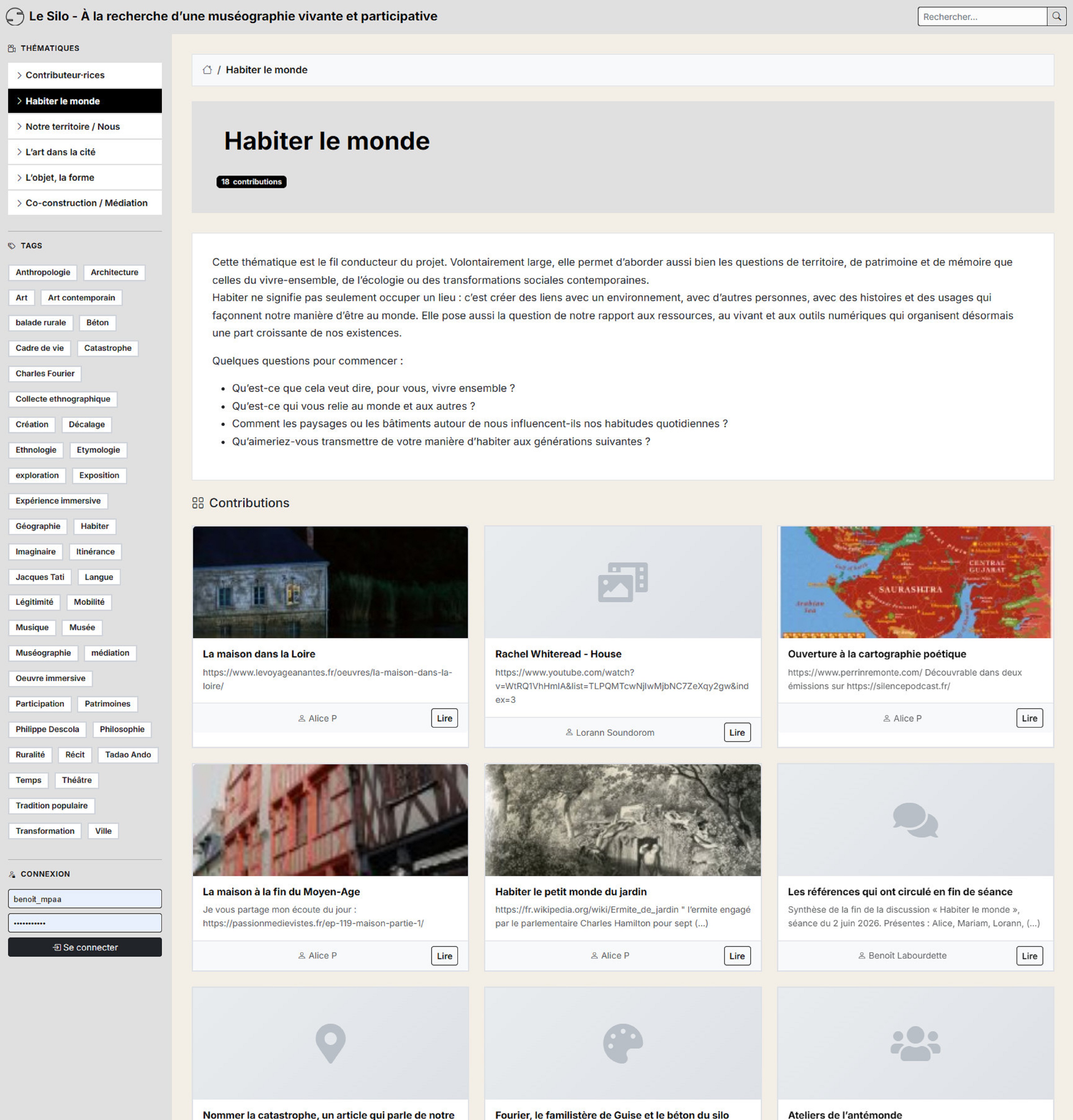
For several years I have been running collective intelligence processes for cultural organisations and local authorities, most often by combining two simple tools: videoconferencing and a free-software digital contribution platform, where each person writes during and between the sessions. A typical session lasts an hour and a quarter. An informal welcome, a discussion during which I take notes shared on screen, a period of individual writing on the platform, and a collective return to what has just been written. The setup is simple, and what makes it produce a great deal, or very little, lies not in the tool but in the way it is conducted. It is that way of conducting it that I want to detail here, from one specific session.
One point should be made straight away, because it runs through everything else. Oral contribution is not a moment for gathering opinions that are already formed. It is a space where we build together each person’s capacity to contribute. As we talk, ideas arise in people, we think of things we had not thought of on arriving, and a path unfolds. The method takes this inner journey seriously, gives it the time to unfold, and sets up the conditions for each person to engage in it autonomously. This is also why, during the discussion, I take notes displayed on screen, as a mind map. Seeing one’s words picked up and connected to those of others gives those words legitimacy, creates the sense of something under way, and means that people spur one another on, each contribution calling forth another.
This session was held on 11 June 2026 as part of the “living museography” project of the Silo, a cultural association based in a reinforced-concrete agricultural silo built in 1907, in the commune of Le Mérévillois, in southern Essonne. Rather than fixing the building’s history in a conventional museum, the project sets out to build, with the residents, artists and institutions of the area, a form that shares the experience of dwelling in this place, and I support its method. After a founding session in May, in which the team defined through contribution what they would do together, and whether they would do it together, a cycle of five weekly public sessions opened in June, supported by a contribution platform. The 11 June session, the second of the cycle, addressed the theme “Our territory / Us” and brought together, alongside Lorann Soundorom, project officer, who co-facilitated with me, and Patrice Barry, who leads the association, two guests who know the area through their work: Aurore Dallerac, head of the museums and heritage department of the Étampois Sud Essonne agglomeration, and Didier Schwechlen, dance and visual arts officer at the Essonne Departmental Council.
The quarter of an hour before
A collective intelligence session begins before the session. In the quarter of an hour before the guests arrived, Lorann and I checked the participants’ accounts on the platform and found one missing, which we created on the spot. We went over the division of roles again, her to open the meeting, me to fill in and take charge of the tool. We anticipated the particularity of the situation: two guests present in their institutional capacity, one more reserved, the other more spontaneous. And we agreed to stay free of our own protocol, accepting in advance that the discussion might run over into the writing time if the exchange called for it.
I have described elsewhere, in « The state of openness », what this preparation produces. Having gone over the coming session several times, having talked it through together, creates an intimacy with the situation that, paradoxically, makes one supple. One knows one will land on one’s feet if things go differently from what was planned, because one carries within oneself the stakes of the moment and no longer merely one’s schedule, and it is this intimacy that then allows one to welcome the unforeseen without anxiety, and so without rigidity.
“The most important thing is to be well together”
When we first began co-facilitating, I had told Lorann that the most important thing, in these moments, is to be well together, because it is by being well together that one feels authorised to contribute, to go beyond one’s assigned places and roles, including those one assigns to oneself, and to share things that matter.
This warmth does not fall from the sky, it is built, in a smile, a way of addressing others, a choice of words. My way of being with myself and with others gives the interaction its energy, and the facilitator bears responsibility for that impulse, for its holding over time, and for the improvisation and adjustment it demands. Energies vary from one group to another, of course, but the initial impulse and the quality of presence rest with whoever facilitates, over videoconference as much as in person. It is a work on oneself before it is a technique of facilitation.
“Do we have the right to speak for ourselves?”
The session opened with an informal moment, news exchanged, a few jokes, then introductions, and each person published their own introduction on the platform, which was both a way of getting to grips with the tool and a first act of contribution. In the welcome, we named the particularity of the guests’ position. They were there in their professional capacity, and we suggested they answer from three positions at once: as individuals, as officers in their function, and as relays for the words of residents they gather in their daily work. This suggestion carries a question that runs through anyone invited to contribute in a professional setting, that of whether one has the right to speak for oneself.
Cultural rights, as I try to put them into practice, and whose coherence I discussed in « Transmitting cultural rights : a question of coherence », begin here. A person contributes only if they first feel recognised in their cultural identity, in their place, in the roles to which they are subject, including those they assign to themselves. This recognition is not obtained through a discourse that would state it. It is built in lived experience, through a welcome that gently names each person’s place without pinning them to it. The facilitator’s speech is there to authorise, without intellectualising what is being lived. No one is under any obligation to produce a result, no one is even obliged to contribute, and it is within this framework free of obligation, once recognition has been felt, that contributions come.
The mind map I keep on screen during the discussion is one of the concrete levers of this recognition. On seeing their words picked up, named, connected to those of others as the session goes on, a person who did not necessarily think of themselves as legitimate feels taken seriously, and that is often what authorises them to go further.
To regulate or to contribute
At one moment in the discussion, I had the sense that the sharing of speech was leaving Didier in the background. The exchange was unfolding more with Aurore, who was more spontaneous, and Didier, more reserved, seemed to me to be getting set aside. The professional reflex looks obvious: one should regulate, give the floor back to the one who is not taking it. Yet I held back from doing so.
Had I stepped in to restore a balance that I alone perceived, I would have acted as if I were not myself a party to the interaction. But I am, and so is Lorann, who was co-facilitating. Cutting in, however tactfully, would have meant that I was judging her way of facilitating by my own criteria, and closing myself off from what I might discover by letting her lead the exchange in her own way. So I waited, trusting her, including on what escaped me. And when my turn came, I did not regulate, I contributed, by bringing something more: a reading of the written contributions, connections between what had just been said.
What followed showed that my sense was speaking mostly of my own frame of reading. Didier ended the discussion with his mind buzzing, a thousand subjects in his head, and his way of contributing ran through channels other than spontaneous speech.
Above all, Lorann is building, over the course of these sessions, her own desire, that of a consultable object, a booklet or some other form, which would give an account of the process and accompany the museographic work to come. She voiced it during the session. Had I set myself up to hold her back or to show that I know better than she does, I would have struck at that desire just as it was taking shape. The heart of a participatory process is to leave room for the other’s desire, that of the residents, the artists, the partners, even when that desire escapes us or unsettles us, and a team that did not practise this among themselves would be asking of others what it does not grant itself.
This is what I call alignment: the coherence between what a process asks of people and the way one holds oneself while facilitating it. That coherence includes accepting to be affected oneself by what happens.
The written contribution of the one who spoke little
During the individual writing time, Didier, who had spoken little, published three contributions, on concrete, on natural heritage, and on the area’s place within the outer ring of the Paris region. He was not being set aside, he was listening, and the platform offered him a channel of contribution that matched his way of being. A setup resting on speech alone would have gathered almost nothing from him, and might have concluded that he had little to say.
The platform offers other properties that speech does not have. Contributions remain, they can be reread, edited, completed at any time, including between sessions and by people who were absent. They are signed, which engages and gives value to their authors, and each is an act of creation in itself, not an answer to a questionnaire. After each session, a synthesis is produced from the whole, written contributions and oral exchanges alike, and it weaves the link from one meeting to the next. As for videoconferencing, so often said to impoverish exchange, Patrice noted at the end of the meeting the fluidity of speech, each person having their time, something that, in his words, is not so often found, over video or elsewhere.
Two public sessions were enough
In an hour and a quarter, the group laid out the area’s being little known to its own residents, the Paris-region rhythms of life that keep it at a distance, the word heritage to be widened beyond old stones, reinforced concrete to be seen differently, and school and play as ways in. Two trajectories of settling answered one another, Lorann’s, who arrived out of practical necessity and is discovering her area by working in it, and Aurore’s, who was born there, and this dialogue shifted heritage towards what one is in the process of building, giving legitimacy to those who have only just arrived. Aurore spoke of the thousand doors opening before her, and of what this pause allowed, in professions where one is always in accelerated motion, to reposition oneself on one’s approach.
A founding session in May, two public sessions in June, three remain, and already the material at hand is built and real. It is nothing like a mere idea. It can be read on the project’s platform, it feeds a synthesis after each session that nourishes the museographic work, and it has given rise within the team to new desires, including that of this consultable object.
Beyond this project, when a collective intelligence process is carried out in alignment, when preparation, the recognition of people and the room left for the other’s desire are practised and not merely proclaimed, it produces greater things, and faster, than one imagines. The same tools, used without this attention to people and to what they live, yield far weaker results, because people do not authorise themselves, and it is indeed this self-authorisation that is at stake, as I set out in « Authorising oneself to create ». The Silo cycle continues throughout June, and the platform stays open between sessions to whoever wishes to read or contribute.
References
- Fribourg Declaration on Cultural Rights, 2007.
- The Silo, Farine de Froment association, Le Mérévillois (southern Essonne): lesilo.org
- The contribution platform of the living museography project: www.benoitlabourdette.com/_docs/projets/2026/2026_projet_le_silo/
- Labourdette, Benoît. « The state of openness », 2025.
- Labourdette, Benoît. « Authorising oneself to create », 2026.
- Labourdette, Benoît. « Transmitting cultural rights : a question of coherence ».


