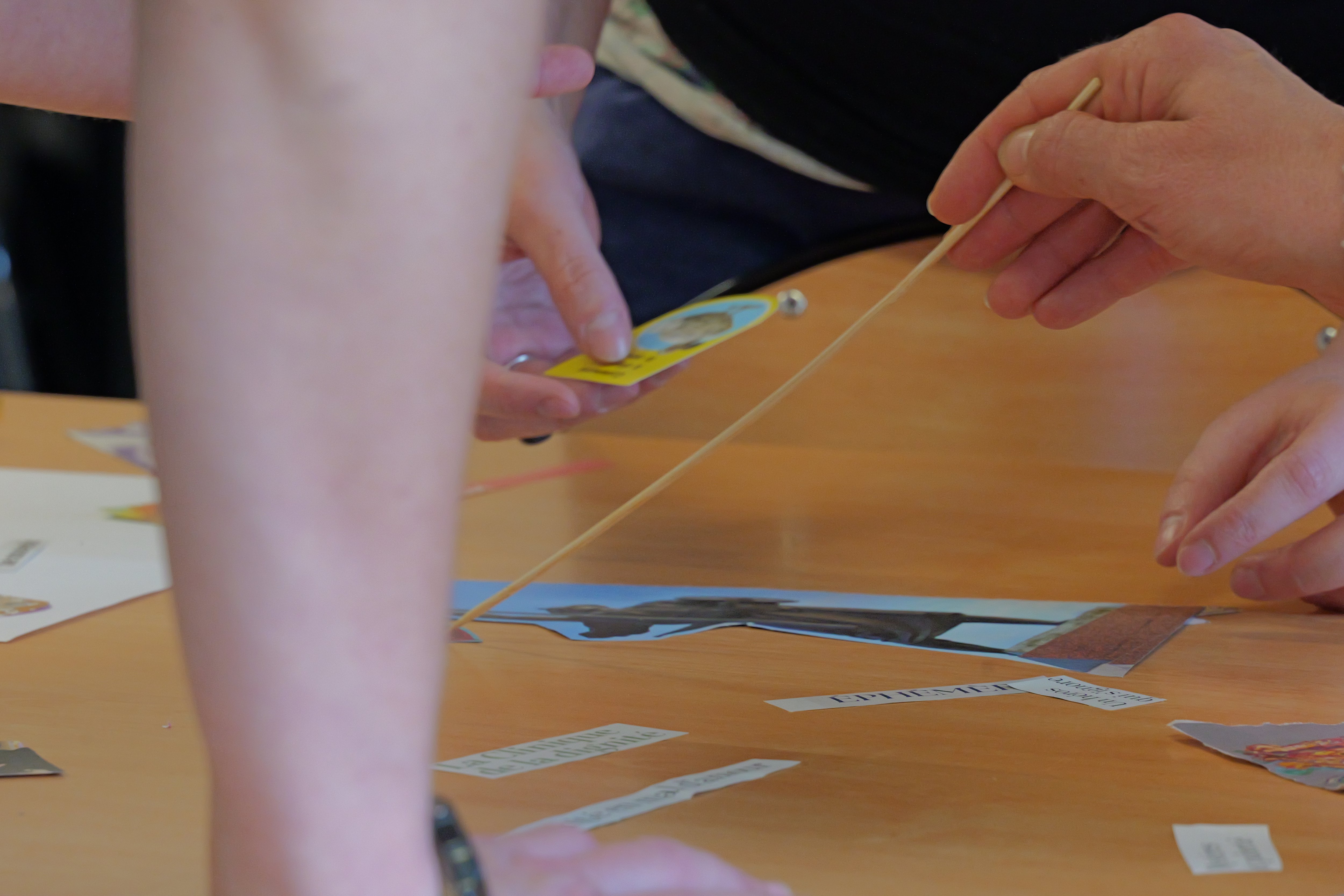
In supported creation workshops, whether they fall within cultural action, arts education, or therapeutic mediation, people often speak of “valorizing” the participants. This word seems to me a trap. To valorize implies the possibility of devaluing: the two faces of the same coin exist simultaneously. The logic I propose here, illustrated through a particular photographic workshop whose unfolding I describe in detail in other articles of this section, is of a different order. It rests on the idea that what is built in a workshop is not built by the attribution of a value, but through a collective journey in which the moment of shared looking is the pivot.
Defining the words
To valorize and to build are not synonyms, nor two variants of the same professional kindness. They are two distinct logics that produce, in the encounter with people, very different effects.
To valorize, derived from the Latin valor, means to attribute value. The operation presupposes one who attributes and one who is attributed: someone who holds the criteria of value, and someone whose production is measured against those criteria. Pierre Bourdieu, in La Distinction (1979), described at length how the attribution of value within the cultural field reproduces social hierarchies, because it always requires a legitimated authority to declare what is worthy. This authority can be generous; it remains structurally vertical. If tomorrow what you do no longer matches my criteria, I will no longer valorize you. You will feel it.
To build comes from the Latin construere, to assemble together, to raise by placing elements one upon another. Construction is gradual, processual, distributed. It has no central attributor. It happens through accumulation, through scaffolding, through interaction. Lev Vygotsky, in Thought and Language (1934), proposed that the human psyche does not develop from the inside outward, but through the gradual internalization of what first played out in exchange with others. What is today inter-psychic, he wrote, will tomorrow be intra-psychic. The construction of the self is woven in relation; it is not an individual matter that would simply need outside encouragement.
These two registers belong to models of life that are not neutral. The biologist Olivier Hamant, in Antidote au culte de la performance (2023), distinguishes two opposed logics in the way systems can endure. Performance optimizes, measures, ranks, eliminates margins in the name of yield. Robustness, which characterizes living systems that endure, rests on the contrary on heterogeneity, redundancy, slowness, the acceptance of fluctuations. A living organism is never optimal, and it is precisely this sub-optimality that makes it resilient in the face of the unexpected. Valorization belongs to the register of performance: it classifies and sorts. Construction belongs to the register of robustness: it accepts slowness, detours, the plurality of paths.
A therapist participant once said to me: “Me, with my patients, I valorize what they do in painting, it helps them consolidate themselves. It narcissizes them a little.” I understand her, and I do not think she is mistaken about what she does. But the word she uses does not exactly name her gesture. What she describes is recognition: she receives what the person has made and says something about it. Consolidation comes from the fact that the gesture has been received, not from the fact that it has been judged good. Recognizing the value of what has been made is not the same operation as attributing a value to the person.
The trap of valorization
I have seen the mechanics of valorization at work in small film competitions for children. We tried hard to soften it, to say that everyone had won, but the violence was there. The children who did not receive the first prize knew it. This violence was not an accident of the device; it was its logical consequence. As soon as there is a ranking, even an implicit one, there are winners and losers. This is the opposite of what we seek to produce in a context of accompaniment.
Institutional valorization is a vertical mechanism. Someone who holds knowledge and taste attributes value to what someone else has produced. It is the logic of the teacher who gives a grade, of the jury that awards a prize. Even when this logic strives to be benevolent, the structure of the relation remains the same: one judges, the other is judged. The consolidation that benevolent professionals seek cannot come from there, because the position of judge and the position of welcome do not overlap.
The work as relation
This distinction between valorizing and building takes on new meaning as soon as we ask about the status of what is produced in a workshop. What is a work of art? The answer has direct consequences on what we do, or do not do, with the result of making.
The schoolroom tradition installs an implicit answer: the work is an object that contains a meaning, deposited within it by its author, and that the work of the person looking consists in retrieving. This conception, which can be called intentionalist, makes meaning a private property of the object. Within this logic, the question “what did the author mean?” is legitimate, because it aims precisely at this meaning supposedly hidden inside the work. It is also the conception that grounds valorization, since it presupposes that there is a truth of the work, capable of being measured against criteria.
John Dewey, in Art as Experience (1934), shifted this conception. Art, for him, is not in the object. It is in the experience lived by people in their encounter with an object or a situation. A sculpture in a closed museum is not art; it becomes art when someone looks at it and something happens. The work is a relational event. If we take this proposition seriously, the moment of encounter, of reception, of looking, is just as constitutive of art as the moment of making.
Édouard Glissant pushed this intuition toward a genuine ontology of relation. In Poetics of Relation (1990), he proposes that what exists does not exist by itself, isolated, autonomous, but within the fabric of the relations that carry it. The work, in this thinking, is less a thing than a knot of relations. Meaning is not deposited and then found there: it is produced in the encounter, each time differently, depending on those who look, speak, listen. Nicolas Bourriaud, in Relational Aesthetics (1998), applied these intuitions to contemporary art by showing that many recent works are nothing other than devices for putting into relation: they exist only through the social moment they make possible.
Umberto Eco had formulated a more interpretive version of this plurality in The Open Work (1962). Every work, according to him, is a field of interpretive possibilities, a proposition that each reader or viewer completes in their own way. The author does their part, the reader does theirs, and this is not a competition: this is how the work lives.
When we propose that people make images and then look at them together, these conceptions cease to be abstract. The others find in the image things that the person had not consciously placed there, readings and resonances they had not anticipated. These readings are the sign that the image is alive, that it exists in the common space as an object that each person receives in their own way. Art escapes its author because it belongs to the order of relation.
The three moments of the workshop
If we take seriously the idea that the work is a relational event, the way of structuring a supported creation workshop is modified. I would like to draw out its simplest architecture, which holds beyond the photographic case I describe elsewhere.
A workshop comprises three successive moments: the instructions, the making, the restitution. The instructions set the frame, the formal constraint, the theme. The making is the moment when each person produces something: an image, an object, a sound, a gesture. The restitution is the moment when the group gathers again to look together at what has been made.
In the workshop culture as it has settled, these three moments are implicitly hierarchized. The making is considered the important moment, the one where “something happens.” The instructions are seen as a utilitarian preamble. The restitution is treated as a closing moment, a formality, where one quickly shows what one has made and states one’s intention. This hierarchy is deeply rooted, and it seems to me false.
In the workshops I conduct, we almost always spend more time looking than making. A photograph taken in fifteen or twenty minutes can give rise to ten or fifteen minutes of shared looking; an animated film shot in thirty minutes can occasion an hour of viewing and discussion. This asymmetry reflects the real importance of the two moments. Collective looking is a practice in its own right, demanding, requiring time and attention. It is not the closure of a workshop but one of its constitutive moments, perhaps the most constructive one.
This does not mean we should do without making. Making produces the object without which there would be nothing to look at. It is making that renders possible the moment of looking. But the made object is not the end of the workshop; it is what allows the workshop to go all the way through, to the moment when the group can gather around it for the shared experience.
Shared looking: a protocol
The classic trap of the restitution is well known: we ask the author to present their work by explaining their intention. This protocol seems self-evident, and yet it considerably reduces the reach of what could occur. When a person explains their intention, they reduce their creation to what they consciously know about it. They say: here it is, this is what I wanted to do. And the others, out of politeness or scholarly habit, stop seeing anything else. The image closes onto a single meaning, the one the author has stated. Everything that the personal and collective unconscious had deposited there, everything the others might have seen, disappears. Interpretive plurality dissolves into a schoolroom logic of the right answer.
Hence the protocol I propose, and which I detail in the article Atelier audiovisuel en médiation thérapeutique: the author does not speak. The others look and say what the image does to them, what it makes them think of. The author listens, and discovers in their own image dimensions they did not know were there. This discovery comes from peers, not from an expert who would judge.
This moment is not reduced to that inversion of speech. It is also, and perhaps above all, a moment when the group gives narrative form to the collective project it has just traversed. We evoke the journey: what we sought, what surprised us, what resisted. We do not restitute only the result; we restitute the process we went through. Paul Ricœur, in Oneself as Another (1990), proposed that it is through narrative that we constitute ourselves as subjects: narrative identity is what allows us to hold together what we are over time. To restitute a workshop by narrating its process is to offer the participants the possibility of constituting themselves as subjects of their own journey, rather than as producers of an object to be validated.
What the gaze of others builds
Collective looking produces two things, both belonging to the order of construction.
The first is the construction of the self. When I hear the others say what they see in my image, I discover that it contains far more than what I had placed there. My creative gesture, even rapid, even made without thought, carries things that have impact on others. I become aware that there is in me a personal unconscious and a collective unconscious that traverse my creation. No one told me “this is good”: I discovered that there was in me more than I believed. Serge Tisseron has worked at length on the idea that the images we make build us in return. When the gaze of others is added to this movement, it amplifies it: what I am is built in the echo of what others receive from what I do.
The second is legitimation in social space. The group looking at the images together constitutes a temporary social space. Within this space, each person occupies a place that is neither hierarchized nor classified: you are there, you have made something, this thing is yours, it is seen by the others. Axel Honneth, in The Struggle for Recognition (1992), distinguished three spheres of recognition: love, which plays out in the sphere of close relations; right, which plays out in the political sphere; and social esteem, which plays out in the sharing of singular contributions to the common. It is this third form that plays out in the workshop. It does not descend from an expert; it comes from peers, and it recognizes the value of the contribution without thereby attributing a value to the person.
This is why I give particular attention to the physical space of viewing. The arrangement of chairs, the size of the screen, the way people place themselves in relation to one another constitute the social space within which recognition will come about. If some see better than others, or if the facilitator stands above the rest, construction does not take place. The space must be egalitarian, circular if possible, so that each person has the same place within this temporary institution.
The case of disengagement
What about a person who does not invest themselves? Who takes their photograph quickly, without intention or care? Who is there because they are required to be and does the bare minimum? Are we still going to spend time looking at their image as if it had the same value as those of the others?
Yes. This is where the logic of construction departs from that of valorization. In valorization, one rewards effort and investment; if someone has not invested themselves, one does not know what to valorize. In construction, one receives what has been produced regardless of the degree of investment, and one says what one sees in it. The others always see things. An image, even made quickly, contains traces and unconscious choices that have impact on those who look at it.
This situation returns to the disengaged person something important: your act, whatever it is, has consequences. Even without intention, what you have done exists in the world and produces effects on others. It is also a seed of confidence. If the others find things in my image when I had placed nothing there, perhaps there is in me more than I believed. Perhaps even my most negligent gestures carry something.
Restituting the process, not the product
All of this has an institutional consequence. If we adopt the logic of construction, what must be shown to funders, to institutional directors, to oversight authorities, is not the finished product. It is the process.
I have seen artist-facilitators, pressed by the institution to show “fine results,” who ended up taking control of the participants’ creation so that the result would meet their own aesthetic criteria. In doing so, they destroyed what had value in the work. The value was not in the beautiful object: it was in the journey and in what had taken place between people during the process.
My trick is this: restitute the process rather than the productions. Recount the stages traversed, the resistances encountered, how the initial project was transformed by the encounter with the people. At the end, yes, also show the productions, but as one element among others within a journey. Funders understand. The hospital director, the DRAC adviser, understand. They see the process, and they find it interesting. As a result, the productions, even imperfect, take on their meaning within the journey that carried them.
To recount the process, one must have traces of it. This requires particular attention, from the very beginning of the workshop, to the idea that the gesture of making cannot occupy the entire space of attention. Someone, whether the facilitator, a person in participant observation, or certain participants who accept the task, must produce the memory of the process while it unfolds. This double presence, investment in making on one side, observation and documentation on the other, is one of the material conditions of the construction I propose.
To restitute the process is not only useful for the institution: it is also an act addressed to the participants themselves. People who have traversed a workshop do not spontaneously remember their own journey. Making mobilizes them so much that it often makes them forget the stages they have been through. When the process is recounted to them, they rediscover themselves as subjects of that journey. And when others listen to that account, they can project their own experience onto it, which creates an immediate empathy in the group. Recounting the process shares an experience rather than assigning places.
Construction against valorization: an ethical choice
Choosing construction over valorization is an ethical choice. It means renouncing the position of the one who attributes value, in order to create the conditions in which value emerges from the group.
This choice demands a work on oneself, because we have all internalized the reflexes of valorization. Saying “this is good” is easier than saying what one receives. Judging is faster than welcoming.
Beyond protocols and institutional choices, what shifts is a certain idea of what builds the person. We believe, by habit, that what builds the person within a creation workshop is the making of the object. The object is supposed to bear the trace of what the person is worth, what they can do, what they have earned. I propose something else. Construction plays out across the entire process, in the journey, in the shared lived experience. The object is not the goal of the workshop; it is almost a pretext, what makes possible a journey that would not have taken place without it. It is this journey that builds, because it is traversed, looked at together, recounted.


