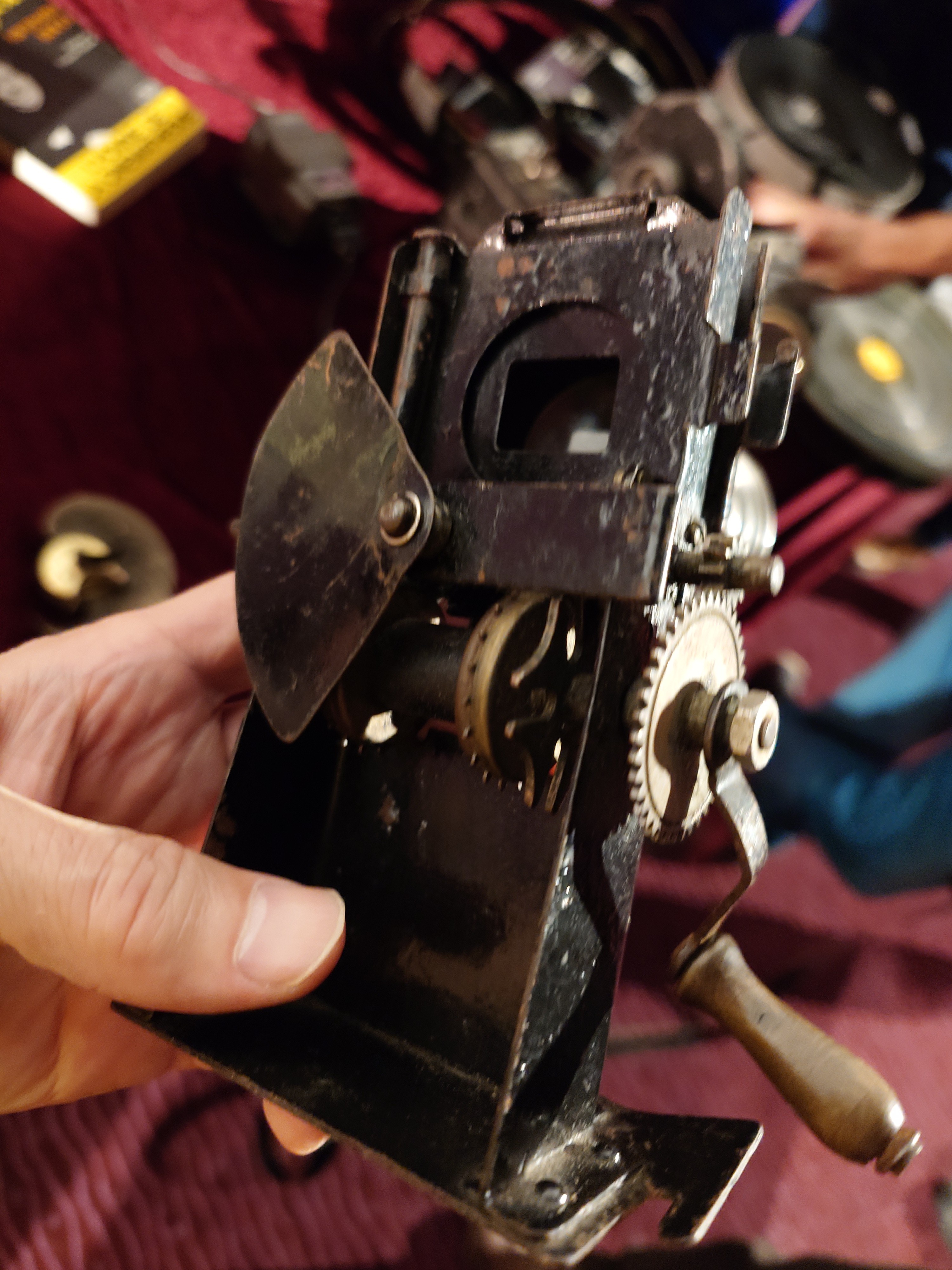
When we choose a tool for mediation, we choose a device of relationships. The technical object carries within it a history, a politics, ways of arranging bodies and gazes. This is true of the Lumière brothers’ cinematograph in 1895 as much as of the smartphone we hold in our pocket in 2026. Thinking through what objects do to us is a way of giving ourselves a chance not to be acted upon by them without our knowing. This article proposes a path in four stages: the object as device, the object as field of power, the object as bifurcation of use, and the object as cognitive prosthesis. It ends with a few practical guidelines for the practice of mediation.
The object is not a detail
One might think that the essential part of mediation plays out in the relationship between people, and that the technical object is merely an accessory in service of an encounter that would happen anyway. This view underestimates what objects do.
Gilbert Simondon, in Du mode d’existence des objets techniques (1958), showed that technical objects carry within them a mode of operation, a scheme, that conditions what can be done with them. A camera calls for framing. A microphone calls for the voice. This call is not metaphorical: it structures what people do and how they arrange themselves in relation to one another.
Bernard Stiegler, a reader of Simondon, extends this analysis. Technical objects are also supports of memory, “tertiary retentions” that extend our biological memory. The book preserves thought outside the brain. The camera preserves the visible outside the eye. Each of these objects modifies our relation to time, to space, to others. Stiegler speaks of pharmakon: every technical object can be remedy or poison depending on how it is used, and is never neutral.
Whenever we do mediation, we always work with objects. Even in theatre or dance, there is a floor, a lighting, a space. In media-based mediations involving images and sound, the object becomes still more central, because without it there is no image.
What is a device?
The word “device” (in French, dispositif) is so common in the vocabulary of mediation that we forget its weight. Michel Foucault, in a 1977 interview, offered a broad definition: “a thoroughly heterogeneous ensemble consisting of discourses, institutions, architectural arrangements, regulatory decisions, laws, administrative measures, scientific statements, philosophical, moral and philanthropic propositions.” The device is the network that establishes itself between these elements and that responds to a strategic urgency.
Giorgio Agamben, in Qu’est-ce qu’un dispositif ? (2007), takes up and extends this notion: “I shall call a device literally anything that has in some way the capacity to capture, orient, determine, intercept, model, control, or secure the gestures, behaviours, opinions, or discourses of living beings.” For Agamben, the pen is a device, as are writing, agriculture, the computer, the mobile phone. Every object that shapes conduct is a device. And what the device produces is subjectivation: it is in the hand-to-hand encounter with the device that the subjects we become are formed.
When we speak of a “mediation device,” we are therefore speaking of a formation that captures, orients, models what people are going to do, feel, say. The camera, the video projector, the microphone, the table, the arrangement of chairs, are not accessories: they are the elements of the device. And this device manufactures subjects.
The object that disposes
I propose a concept to name this phenomenon at the scale of each object: the object that disposes. The verb has a double meaning. To dispose is to arrange, to put in order: the object disposes people in space and in relation. And to dispose is also to make available: the object disposes us, it puts us in a certain availability for what is going to happen.
The history of cinema offers an inaugural example. The flexible photographic film made of celluloid was invented by John Carbutt in 1888 and marketed by George Eastman the following year in unperforated rolls of 70 mm. It was Thomas Edison and his engineer William Kennedy Laurie Dickson who, beginning in 1891, developed 35 mm film with four rectangular perforations on each side of each photogram. The patent for the kinetograph (the Edison camera) was filed on 24 August 1891. From 1893 onward, the film was driven by an intermittent movement in the camera, then by an electric ratchet wheel in the kinetoscope. A few years later, the French mechanic Pierre-Victor Continsouza patented (in November 1896) a four-branch Maltese cross that made each quarter-turn correspond to the advancement of one image, and which would become the universal mechanism of cinema projectors.
It is this same technology that the Lumière brothers used in 1895, with one variation. The 35 mm width, the vertical drive, the principle of the still image held behind the lens by an intermittent mechanism, all of this comes from Edison. To avoid infringing his patent, the Lumières simply replaced the four rectangular perforations with a single round perforation on each side of each photogram. A minor variation, soon abandoned: the Edison format would be adopted in 1906 as international standard.
So it is the same technology that grounds Edison’s kinetoscope (1890-1891) and the Lumière cinematograph (1895). And yet the two devices produce experiences that have nothing in common. The kinetoscope is a closed box in which one looks through an eyepiece at fifty-second loops. The experience is individual, standing, face inside the machine. The contents are boxing matches, strip-tease numbers, the elephant Topsy electrocuted at Coney Island in 1903: fairground spectacle, voyeurism. The cinematograph, by contrast, is a light machine that serves at once as camera, projector, and copying device. It projects in large format on a wall, before a seated audience in a darkened room. The films are living tableaux in the pictorial sense: La Sortie des usines Lumière, L’Arrivée d’un train en gare de La Ciotat, Le Repas de bébé. Fixed frame, one-minute duration (the length of a reel), composition inherited from photography. The device refers to painting and to shared contemplation.
The same technique, two devices, two worlds. The object did not change: the way of disposing it in social space changed everything. And this way of disposing was not decided only by Edison or by the Lumières: it is an era, a culture, social classes, a state of entertainment and of science. The device is a social fact as much as a technical one.
Objects redistribute power
The history of image-making objects is also a history of power relations. And the objects we choose to use in mediation carry these relations within them, whether we want them to or not.
During the first fifteen years of cinema, when it was a fairground art, unprofitable, ill-regarded by the cultural milieu, women were numerous in it. Alice Guy (1873-1968), the first fiction film director in history with La Fée aux choux in 1896, is the best-known symbol. But the list is long. In the United States, Lois Weber (1879-1939) became the highest-paid filmmaker of the silent era, men and women combined, and signed films on contraception, the death penalty, racism. Frances Marion, screenwriter of more than 300 films, and Anita Loos wrote some of the most striking fictions of the silent era. Mabel Normand was a prolific actress and director. Dorothy Arzner would be the only woman member of the Directors Guild in 1938. In France, Germaine Dulac (1882-1942), a feminist activist, signed La Souriante Madame Beudet in 1922 (often considered the first feminist film), La Coquille et le Clergyman in 1928 (the first surrealist film), and published a theory of cinema still read today (Qu’est-ce que le cinéma ?, reissued in 2020). Musidora, star of Feuillade’s serials, herself became producer and director. In Germany, Lotte Reiniger directed Die Abenteuer des Prinzen Achmed in 1926, considered the first feature-length animated film in the world. A study conducted over three years by the American Film Institute identified more than 6,000 films written, directed or produced by women during the silent era.
From 1910-1915, when cinema became a profitable industry (notably with feature films like Griffith’s The Birth of a Nation, 1915), men took back power and women were ejected from it. Classic patriarchal logic: when an activity acquires market value, men take it over. The erasure is not accidental. The first histories of cinema were written between 1925 and 1940, at a moment when Hollywood was already masculinised. Alice Guy is not mentioned in Coissac’s Histoire du cinéma (1925), she is cited as an actress by Brasillach and Bardèche (1935), she is absent from the English-language histories of Rotha, Jacobs, Knight. When a milieu becomes masculinised, it rewrites its own history in the masculine.
In the 1970s, video appeared: a less noble support than film, and far cheaper. Women took it up massively, for militant and feminist films. The Festival international de films de femmes de Créteil, founded in 1979, bears witness to this history. But video supports are fragile. Magnetic tapes demagnetise, formats become obsolete, players disappear. Today, militant films from the 1970s and 1980s have become unreadable. There is here a real matrimonial issue (and not only a patrimonial one): the female vision of the world is technically made fragile because the supports on which it expressed itself are the least durable. The word “patrimony” says clearly where it comes from: from the pater. The part of human expression that took place on less valued supports is lost more quickly, because we do not preserve it with the same care.
This history is not for me an abstract analysis. It is a lived experience. At 18, at university, I began to organise screenings of short films. I deliberately mixed the supports: Super 8, video, 16 mm, 35 mm, slide shows with synchronised sound. I wanted all these films to have the same value on the screen, the same dignity of projection. Without theorising it, I could feel that a power was at work through technique and through money, and that 35 mm film, by its nobility, crushed everything that had not been able to access it. I struggled against this, by placing on equal screen dignity films made with whatever was at hand. It was an intuition of youth, a gesture more than an analysis. That was almost forty years ago. Even today, people who attended those screenings still speak to me about them. Something had been inscribed in the very gesture of mixing supports. (I have developed this question of support hierarchies in my article on systems of domination in the cinema milieu.)
The choice of a support is never innocent. 35 mm film, heavy and costly, requiring specialised knowledge, is a masculine and bourgeois object of power. Light video has been an object of emancipation. The smartphone, accessible to almost everyone, democratises image-making, without however suppressing power relations: the platforms that distribute our content belong to companies whose interests are not ours, and our “free” productions feed an economy of which we are not the beneficiaries. Power changes form; it does not disappear.
When use takes precedence over technique
A lesson runs through this whole history: innovation does not come from technique, it comes from use. And this is what happens in our practices of mediation: we make singular use of technical objects that were not designed for it.
The Lumière brothers first thought of the cinematograph as a scientific curiosity. They were industrialists of photography: their father Antoine Lumière directed in Lyon the first European factory of photographic plates, made prosperous thanks to the invention by Louis Lumière, at age 17, in 1881, of dry gelatin-bromide plates (the famous “Étiquettes bleues”). In 1894, in Paris, Antoine Lumière attended a demonstration of Edison’s kinetoscope, came back with a fragment of film, and urged his sons to invent a competing device capable of projecting in large format. Louis developed the machine with the help of the Parisian engineer Jules Carpentier. The patent was filed on 13 February 1895.
Even before the public projection of 28 December 1895 at the Salon indien of the Grand Café, the Lumières presented their cinematograph to learned societies: Société d’encouragement à l’industrie nationale, congress of photographers in Lyon, Revue générale des sciences in Paris, the Sorbonne. It was within this scientific frame that they inscribed their invention. Louis Lumière would later say to his operator Félix Mesguich, recruited in 1896: “I am not offering you a job with a future, but rather fairground work.” For the Lumières, the cinematograph was a technical advance over photography, not the seed of an art.
When Georges Méliès, magician and owner of the Théâtre Robert-Houdin in Paris, attended the screening of 28 December 1895, he understood at once what he could do with such a machine, and offered to buy the patent or at least to purchase one device. Antoine Lumière refused, with the now-famous sentence: “This invention is not for sale, and besides, my dear friend, you may thank me, for it would be your ruin. It can be exploited for a while as a scientific curiosity, but beyond that, it has no commercial future.”
Méliès turned to London, where the optician Robert William Paul had been marketing since February 1896 a 35 mm projector called Theatrograph. He bought the model n°2 mark 1 (patented on 2 March 1896), equipped with Maltese crosses. Back in Paris, he transformed this projector into a camera: he reversed the system, enclosed it in an oak box with a Zeiss 54 mm lens, added a barrel shutter and a metal pressure plate. With this hand-built apparatus, he shot in June 1896 his first film, Une partie de cartes, an acknowledged plagiarism of a Lumière (the practice of copying was widespread at the time). A few months later, on Place de l’Opéra, the film jammed in the camera. Méliès put the film back in place and resumed shooting. At projection, he discovered that an omnibus had transformed into a hearse. The stop-motion effect had just been born by accident, and with it the “trick film” that Méliès would make his trademark. Escamotage d’une dame chez Robert-Houdin (1896) would be the first film with a deliberate special effect. In 1897, Méliès built in Montreuil the first film studio in the world, a large glass roof inspired by photographic studios. He would shoot more than 500 films there until 1913.
Technique is what the object allows one to do according to its designers. Use is what people make of it in the encounter between their world and that object. And it is use that invents, not the object itself. I call this phenomenon the bifurcation of use: the moment when someone takes a technical object and makes of it something its designers had not foreseen. Stiegler spoke of “knowing-how-to-bifurcate” as the essence of knowledge. Mediation, in its creative dimension, is a permanent knowing-how-to-bifurcate: we take everyday objects and make them bifurcate towards uses that were not inscribed in the machine’s programme.
The phone, and an anthropological thinking of the object
The iPhone, presented by Steve Jobs on 9 January 2007 in San Francisco, is often told as the invention of a product. It is in reality the culmination of a long company history.
Apple Computer was founded in 1976 by Steve Jobs and Steve Wozniak to manufacture personal computers. Apple I, Apple II, commercial success. In 1984, Apple launched the Macintosh: the first mainstream computer with a graphical interface, mouse and icons, designed to be operable without technical knowledge. Apple’s signature was already taking shape: making the technical object a familiar object, where internal sophistication is hidden behind ease of use. In 1985, Steve Jobs was ousted from Apple by John Sculley, the CEO he had himself recruited. He founded NeXT and acquired the animation division of Lucasfilm that would become Pixar. For eleven years, Apple became a maker of computers like any other, without the thinking that had made its singularity. In 1996-1997, in great difficulty, the company bought back NeXT to recover Steve Jobs. He returned to head Apple and there met a young British designer recruited in 1992, Jonathan Ive (Jony Ive), trained at Newcastle Polytechnic, influenced by Dieter Rams and the Bauhaus tradition. The Jobs-Ive partnership, which Jobs would later describe as a “spiritual partnership,” began there.
From that moment, Apple changed trade three times in less than ten years.
In 2001, Apple launched the iPod and became a maker of MP3 players. But MP3 players already existed: Diamond Rio, Archos and others had been offering them since the late 1990s. Apple’s innovation was elsewhere. The iPod has an ergonomics inherited from computers (the mechanical click wheel, which Ive designed), and above all it is linked to a music-organising software, iTunes. This software integration between the object and its use is what changed the experience.
In April 2003, Apple changed trade once again: it became an online music seller with the iTunes Music Store. Legal downloads at 0.99 dollars per song, a catalogue negotiated with the five majors, one million songs sold in the first week. The gesture was not to make yet another machine, but to attach the object to a service. Apple ceased to be only a manufacturer: it became also a distributor. Five years later, the company had become the largest music seller in the United States.
In 2007 came the iPhone. Apple changed trade once more: it became a maker of phones. The keynote of 9 January 2007 at the Macworld Expo is famous. Jobs recalled the two preceding moments (“1984, we introduced the Macintosh. […] In 2001, we introduced the first iPod.”), then announced: “Today, we’re introducing three revolutionary products of this class. The first one is a widescreen iPod with touch controls. The second is a revolutionary mobile phone. And the third is a breakthrough Internet communications device. […] An iPod, a phone, and an Internet communicator. An iPod, a phone… are you getting it ? These are not three separate devices, this is one device, and we are calling it iPhone.” Three objects announced (a touch iPod, a phone, an Internet communicator) which turn out to be one. The rhetoric mimes what the object does: it gathers within itself functions that until then inhabited distinct objects.
The designer behind the iPhone, as behind the iPod, the iMac and everything that has made Apple from 1998 onward, is Jonathan Ive. The Jobs-Ive partnership is what produces the coherence: Jobs poses the vision (what is this object going to do to people’s lives), Ive embodies that vision in matter and in form.
What distinguishes Apple from 1997 onward is an anthropological thinking of the object, which substitutes itself for industrial thinking. Other companies had a better mastery of manufacturing; what Apple introduces is a question prior to any manufacturing: what is this object going to do to people’s lives? Industrial thinking begins with: what do we know how to make? Anthropological thinking begins with: what is this going to do to people’s lives? Apple was able to change trade three times in ten years because the anthropological question came first. Had the question been industrial, the company would have remained a computer maker.
This corporate history opens an analogy for mediation. When a facilitator runs a workshop, their training, their tools, their original trade do not always suffice. The planned session does not work, the audience is not the one expected, the technical object breaks down, the unexpected happens. At that moment, the temptation is to fall back on one’s trade (“I am a filmmaker, I know how to do this, I keep going”). The other path is to change trade in the moment, to bring about what must be brought about with that group. Apple did not innovate by doing better what it already knew how to do; it innovated by doing things for which no one had been trained. Trade is not a heritage of skills; it is a practice that reinvents itself with each encounter.
The smartphone as cognitive prosthesis
Before the smartphone, every technical object had a determined function. The business phone had a keyboard for emails, the music-lover’s phone an MP3 player, the Nokia phone a small video camera. The object was tied to its use. This approach dominated the industry, including at Nokia, then world’s leading manufacturer.
With the iPhone, the object no longer has a predetermined function: it is a pocket computer whose functions depend on the software installed on it. The consequence for mediation is significant. The same object allows one to make images, share them, watch them, comment on them, transform them. The complete chain of creation fits within a single object. And everyone has this object: there is no longer any equipment gap, or almost none, between the one who knows and the one who does not. The object is democratic in its accessibility, even if uses remain unequal.
This object has become a part of us. If someone forgets their phone, what they feel touches on existence itself. Our contacts, our memories, our payment methods, our transport tickets, our links with our loved ones, everything is in this object. As I have written elsewhere, we are cyborgs: our integrity is no longer linked solely to our physical body. The smartphone is a cognitive prosthesis, an extension of our mind into a material artefact.
What this changes in mediation
When I propose a mediation with phones, I am proposing to people to work with an object that is already a part of them. It is not the same thing as giving them a paintbrush or a camera they have never seen. The phone is not a foreign tool that is introduced into the relationship: it is already there, it is already part of their lives, it already carries their images and their conversations.
This changes the nature of mediation. The situation is no longer one in which the facilitator introduces a new tool and accompanies its appropriation. It is the opposite: the tool is already appropriated, and what we propose is to make a different use of it. This is the side-step I often describe. To take the most everyday object there is and to do with it something that steps outside the everyday, just as when one takes a pen, the most banal of objects, and writes a poem.
This side-step is possible because the smartphone has no predetermined function. If the object were only a camera, one could only take photos; if it were only a phone, one could only make calls. Because it is open to all uses, it is also open to those we invent. And because people have technical mastery of it, they can concentrate on what counts: not how to make an image, but why to make it, and with what intention.
The technical object, depending on how one chooses and disposes it, reveals or produces hierarchies between people. When a professional arrives at a workshop with sophisticated equipment that participants do not know, they immediately create a hierarchy: those who know and those who do not, those who own the tool and those who do not. The object disposes people in a power relation, whether the professional wants it or not. And this relation conditions everything that will follow, including the quality of creation. When we propose instead to work with everyone’s own phones, we set from the start a frame of equality. The object disposes people in a horizontal relation. This horizontality is the condition of free creation.
This does not mean we should always stick to phones. I often use compact cameras, simple musical instruments, felt pens and paper for stop-motion animation, a video projector for the public showing. Each of these objects disposes people in a certain way. The compact camera that we pass around creates a play of handing on. The video projector that projects images in large format, in a slightly darkened room, creates a moment of collective ritual borrowed from cinema: we sit, we watch together, we enter another regime of attention. Cut paper animated frame by frame creates a slow, meticulous time, which contrasts with the speed of digital. André Leroi-Gourhan, in Le Geste et la Parole (1964), showed that the tool is inseparable from the gesture that uses it, and that the two co-evolve. In mediation, the same principle applies to object and relation: the choice of object is a choice of mediation.
Guidelines for practice
A few concrete guidelines may help in designing a mediation situation.
Before choosing an object for a mediation, ask what this object is going to do to people. What hierarchy will it instate or undo? What attention will it call for? What posture will it make possible or prevent? The object is the element of the device we control most: it is also the one we question least.
Prefer objects that people already master, when possible. The phone, the pencil, paper, scissors are tools everyone knows how to use. The object already appropriated frees attention for what matters: intention, meaning, encounter. The object that must first be learned absorbs that attention.
Mix supports and techniques to break hierarchies. Place on the same screen a film made with a phone and a film shot in 16 mm, without letting the support’s quality prejudge the dignity of the work. Refuse that available equipment determine the value of expression.
When the planned situation does not work, do not first try to fix it. Ask: what other gesture does this situation call for? Changing trade in the moment is sometimes the only just response. This is a lesson for mediation. Méliès did not repair a Lumière cinematograph that did not exist for him; he made something else, in another trade (magic become trick cinema). Apple did not improve its computers; it changed trade three times in ten years. Mediation can do the same: if the planned session does not work, change trade, become something else for that group.
Cultivate an anthropological thinking of our own practice. Industrial thinking asks what we know how to do, and freezes us in our skills. Anthropological thinking asks what this is going to do to people, and frees us to invent. We are not prisoners of our technical skills; we are the artisans of an encounter.
Our relation to the object is a relation to ourselves. The way we use a camera, a video projector, a smartphone, says our relation to power, to technique, to others, to what we believe legitimate. Mixing supports at 18 was already a posture, before it was a theory. It is in the materiality of our gestures with objects, in the way we dispose them and let them dispose us, that the mediation we make is at stake. Thinking our objects is thinking ourselves while we use them.


