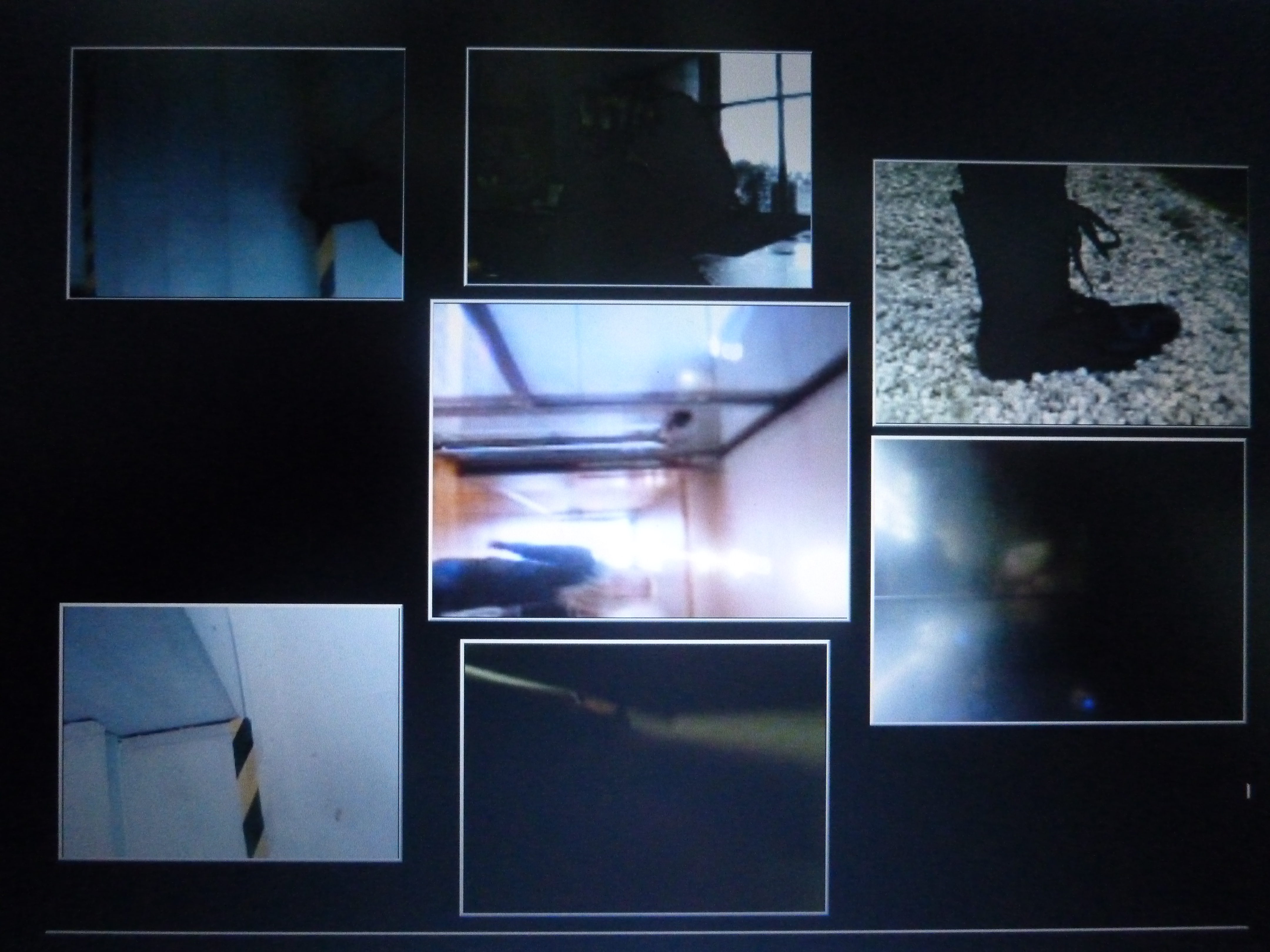
In the cultural and therapeutic mediation workshops I lead, the challenge is to create the conditions for people, often unsure of their own legitimacy to create, to experience producing something out of themselves. My role in this context is to accompany that process, which means trying to let go of my criteria so that objects I do not always understand at first can come into being. And it is difficult, letting go of one’s criteria, letting go of the good one wants to do for others.
What I had to unlearn
I come from cinema. I spent decades shaping my eye for images, learning what makes a shot hold, what gives rhythm to a sequence, how a narrative is built. It is a knowledge formed patiently through practice, and it has its value.
And yet, when I enter a mediation workshop, this knowledge can become an obstacle. If I look at what people produce through my filmmaker’s criteria, I will see “mistakes”: clumsy framings, poorly lit images. And if I correct them, I do something that looks like help but is actually a substitution. I replace their gaze with mine.
What I had to unlearn is the belief that my profession gives me the right to judge what others do. I have a knowledge. The people I work with have another. Theirs is not worth less than mine, it is worth differently, and that is what interests me, provided I am able to see it.
We find this in theorists of cultural mediation. In Et si on partageait la culture ? (2011), Serge Saada defines the mediator as a passer who knows how to step back at the right moment to let the individual continue alone on their way. The mediator, he writes, brings nothing, and certainly not culture; the task is to create the conditions for culture to be shared. In La médiation culturelle (Armand Colin, 2017), Serge Chaumier and François Mairesse formulate the same requirement in negative terms: mediation cannot be reduced to transferring content from a sender to a receiver, it always presupposes an active work on the part of the recipient. Without the space made for the gaze of the person being accompanied, there is no mediation, only a top-down transmission.
The inner movement
Letting go of one’s criteria is not an intellectual decision one makes once and for all. It is an inner movement that must be renewed at every moment, because the criteria come back. They come back every time a person does something I would not have done, every time a result surprises or displeases me. The first movement is almost always a movement of judgment.
I remember a workshop where some participants had brought a garment, a piece of worn clothing, and wanted to use it as stop-motion material under the camera. In thirty-five years of practice, I had never seen this. Fabric, yes, we often use it in cut-paper animation, because it is easy to handle and catches the light. But a garment is bulky, less photogenic in the conventional sense, it does not fit the usual codes of the workshop. My first reflex was to think it would be complicated to film, and that we would probably not get much usable material. The second reflex, the one I have learned to cultivate over the years, was to set this first reaction aside and wait to see what would happen.
What they produced had a real plastic richness. The garment, manipulated under the camera, opened up possibilities that cut-paper does not allow: weight, fall, folds that drape differently, a memory of the human form haunting the image. I discovered this that day, after thirty-five years of practice in animation cinema. I would not have discovered it if I had stayed with my first reflex: the material of the film would have been reduced to what I expected of it, and what the participants had brought to it would have gone unnoticed.
Not doing things in people’s place
One principle seems to me hardly negotiable in the practice of mediation: one does not do things in people’s place. In the reality of a workshop, the temptation is constant. It presents itself in benevolent forms: it is faster, it is more efficient, we are afraid the person will fail, we want to spare them the discomfort of difficulty. And yet, doing something in someone’s place is taking away from them what made the workshop interesting for them in the first place: the experience of having produced something themselves.
Psychologists who work in helping relationships have theorised this for a long time. Carl Rogers, in his person-centred approach developed from the 1950s onwards, holds that the therapist does not direct, does not advise, and does not interpret in the patient’s place. He makes the bet that the person already possesses, within themselves, the resources to orient their own evolution, provided they are offered a climate in which this can happen. From this perspective, doing in someone’s place prevents the helping process from beginning at all: the person is kept in a passive position and does not get to experience their own capacity.
I have worked with art therapists who, with all the goodwill in the world, took the scissors out of participants’ hands to cut for them, guided their hand, said: no, more like this. When I named what I was observing, they thanked me. No one had ever pointed it out to them. Professional training does not teach enough what it means concretely not to do things in people’s place.
Not doing things in someone’s place does not mean abandoning people or leaving them alone with the difficulty. The distinction that matters is the one between help and taking over. To help is to make it possible for the person to do it themselves; to take over is to do it for them, removing the gesture. To help presupposes that we accept that they may do it differently than expected, or take more time. To take over is to impose a rhythm and a form on them. Concretely, in a workshop, this translates into adapting the setup so that the difficulty becomes surmountable. If scissors are a problem, we remove the scissors and propose tearing. If drawing blocks them, we propose collage. If doing sound at the same time as image is too complex, we separate the two moments. It is the mediator who adapts, not the person being accompanied.
The inner conditions for letting go
Letting go of one’s criteria cannot be decreed. It presupposes, during the workshop itself, inner conditions that one must know how to produce and maintain. The first of these conditions is available energy. Receiving what participants bring, especially when it does not correspond to my expectations, is an activity that consumes psychic energy. If I am tired, overloaded, or anxious, I let nothing go: on the contrary, I double down on judgment, because judgment is the fastest cognitive economy.
Olivier Houdé, professor of cognitive psychology at the Sorbonne and researcher at the CNRS, has named this phenomenon cognitive resistance. In Apprendre à résister (Le Pommier, 2014), he shows that our brain has a default tendency to function by automatisms: rapid intuitions, routine patterns of thought, ready-made categorisations that spare us the effort of thinking. To produce new thought, the brain must first inhibit these automatisms. This capacity for inhibition is what he calls cognitive resistance. It is located in the prefrontal cortex, it can be trained, and it has a real metabolic cost: it consumes energy.
This description applies directly to what is at stake in a mediation workshop. Letting go of my filmmaker’s criteria in order to see what the participants are actually doing is an act of cognitive resistance. My criteria are the automatism, the reflex thought; seeing otherwise requires resisting them, that is, inhibiting them long enough for another reading to become possible. It is in this effort of inhibition that new neural connections can form, and that learning becomes possible. But this presupposes having the energy, and that energy is limited.
It is therefore necessary, in the conduct of a workshop day, to make room for moments of recovery: moments of pause, withdrawal, return to oneself. Without these, cognitive resistance gives way, and it is the automatisms that take over again. The dominant professional representation, however, would have it that the facilitator be permanently engaged in doing something. Any time not occupied by visible activity is taken to be wasted time. This representation overlooks the actual work. These moments of recovery are an integral part of the mediation setup: they are what make availability possible at the moment when it is needed. This dimension of practice, and the anxiety it can provoke in facilitators in training, is developed in the article Receiving, or the difficulty of doing nothing.
A knowledge that comes from experience
What I try to convey to the professionals I accompany, and what I regularly remind myself of, is that knowledge is not only what one possesses before the workshop. It is also, and perhaps above all, what is produced during the workshop, in the very experience of making. No one possesses that knowledge in advance, neither the facilitator nor the participants.
When four people make a cut-paper animation film together, negotiations, discoveries, tensions take place between them that no one had foreseen. One proposes, another resists, a third makes an unexpected gesture. The resulting film is no one’s film in particular. It is the product of a collective work that has its own intelligence.
To gain access to this knowledge, to be able to see it and name it, I must have let go of my own criteria. My criteria are a filter: they make me see certain things and hide others from me. When I let them go, I see what is there. And what is there is almost always more interesting than what my criteria, on their own, would have allowed me to see.
What I describe here is not a new knowledge. Professionals of psychic care, psychologists, psychoanalysts, psychotherapists, have elaborated it for a long time. They know that the helping relationship is traversed by unconscious phenomena: the person being accompanied transfers onto the professional affects that come from other relationships in their life (transference), and the professional, in return, reacts to this transference with their own affects, their own histories, their own blind spots (countertransference). These two phenomena, identified from the earliest days of psychoanalysis, are today recognised across all forms of psychotherapy as structural dimensions of the therapeutic relationship.
It is for this reason that the professions of psychic care have institutionalised supervision. Therapists do not work alone: they regularly present their cases to a supervisor whose role is to help them see what they do not see in the relationship, to identify the moments when their countertransference comes to interfere with the clinical work. This setup is considered an ethical safeguard and a protection, as much for the patient as for the practitioner.
The question of criteria, in the field of mediation, is very close to this. When a criterion persists, when a judgment resists, when something in a participant disturbs me without apparent reason, what is at stake is not only a question of method. It is, most often, something lodged in my countertransference: something of mine that awakens on contact with this person, and that prevents me from seeing them as they are. Mediators and visiting artists are almost never trained in this. And yet, we work in relationships that mobilise the same psychic phenomena as those of care. It seems necessary to me that we draw on what the professionals of psychic care have elaborated about the helping relationship, not in order to become therapists ourselves, but in order to benefit from their experience. Supervision, in particular, is a practice that could be extended to the field of mediation: it allows one to become aware of the personal part that speaks, unbeknownst to us, in our criteria.


