An artist is brought in, and results are expected to match the professional who has been paid. This expectation threatens every mediation practice, cultural, educational, therapeutic. One way out is to tell the story of the process.
The trap of the result
I have seen this mechanism at work dozens of times, in very different settings. An artist is invited to take part in a mediation project, cultural, educational, or therapeutic. The regional cultural agency funds the project. The hospital director, or the school principal, gives their approval. At the end of the project, there is a public showing. Everyone comes to see.
Everyone expects an artistic result worthy of the professional who has been paid: beautiful photographs if the artist is a photographer, a fine performance if they are a stage director. Otherwise, people wonder what the artist’s presence was for.
The artist, who is no fool, feels this pressure. Their professional legitimacy depends in part on the visible quality of what will be shown. Their identity is at stake: it is their craft, it is what they live on. If the results are mediocre by conventional aesthetic standards, they will be called a bad artist, and they will not be invited back.
The artist then progressively takes back control, often without realizing it. They tighten the framing, give more aesthetic instructions, guide the hand, retouch the photographs after the fact, edit the film by cutting what is not “good,” homogenize the productions so that they reach an acceptable level. This taking back of control empties the activity of its meaning. The meaning lay in the journey of the participants, in what they dared and discovered, and it disappears as soon as the artist takes hold of the result.
The mechanism sometimes disguises itself as generosity. Artists may say: “I’ll improve the editing, it will value the people.” This intention is dangerous. To value a person is to place them at a certain height, and therefore to make them liable to come down from it. The high position installs a permanent demand, which has nothing to do with construction. Construction draws on the actual journey, on the participants’ attempts and discoveries, and does not need the productions to be ranked in order to exist.
Telling the journey
It can be done differently: by giving an account of the process rather than the productions alone. By telling what stages were gone through, what surprises and detours arose, how the initial project was transformed by the encounter with the people, how the artist themselves did not do what was planned and was modified by that encounter.
At the end of the narrative, the productions are shown, as one element among others in a larger process. Even when they do not match conventional aesthetic standards, the productions then take on their meaning. We understand why they are the way they are, what they carry, and why their very “imperfection” is what makes them precious.
When I tell the story of the process this way to a regional cultural advisor, to a hospital director, or to a school principal, my interlocutors understand. A human story of transformation and encounter is more interesting than an exhibition of well-framed photographs. They also understand why a professional was needed for that process to be possible. The artist came with their practice, their gaze, their way of doing things, and that practice met those of the participants. Out of that encounter came something that no one had foreseen, and that unpredictability called for a professional able to bring their own way of doing into play without imposing their criteria.
Documenting the process
To be able to tell the story of the process, you have to have documented it. Otherwise, you no longer remember it. This is normal: you are caught up in the action, in the present of the workshop, and memories then become blurred and selective. We remember the result more than the path.
To document the process is to take notes, even brief ones, to take photographs of the space and of the participants at work, to record fragments of conversation now and then, to keep a small logbook.
This concern runs through educational and artistic practices as well, and not only therapeutic mediation. When you visit an exhibition, you are often fascinated by the story of how the works were made: the preparatory sketches, the hesitations, the techniques used. Museum captions almost always indicate the technique: “oil on canvas,” “bronze,” “silver gelatin print.” No institutional obligation imposes this. It is a tiny window opened onto the process, which persists even in the most conventional exhibitions, because it answers the visitor’s need to understand how the work was made.
Symbolization and self-narrative
The need to tell the story of the process, to oneself as well as to others, exceeds mere communication. It touches on what psychoanalysts call symbolization.
Wilfred Bion described the process by which raw experience, sensory and emotional, that one cannot manage to think (the beta elements), is transformed into thinkable elements (the alpha elements), capable of being dreamt, remembered, integrated into thought. This is what he calls the alpha function. Without it, experience remains inert, cumbersome, sometimes persecutory. With it, it becomes symbolizable, integrable into the psychic life of the subject.
The narrative of the process performs something of this order. It takes materials that might otherwise remain scattered and fragmentary (what happened during the sessions, what was tried, what failed, what came as a surprise) and gives them a form that makes them thinkable.
Paul Ricœur showed, by another path, that the identity of the subject is not a given fact: it is constructed through narration, in what he calls narrative identity. To become the subject of one’s own experience requires being able to tell it, to oneself and to others. For participants going through a workshop, the narrative of the process makes this appropriation possible. Without the narrative, the experience remains external to the person, it does not constitute itself as a journey, and it does not lastingly nourish the subject.
The artistic object produced during the workshop thus takes on its meaning within a network of relations: the relation to what preceded it, the relation to the people present, the relation to the narrative made of it. It is this network that makes it symbolizable, that gives it meaning for the subject. Outside this network, the object no longer carries anything.
This understanding requires a revision of the status of the result. The artistic result is not the culmination of the process, but one of its stages. The truly final stage is the narrative, made to oneself and to others, which inscribes the experience in the duration of the subject and makes symbolization possible.
Who tells the story?
The narrative of the process has no single narrator. The therapist, the mediator, the teacher, the artist, or the participants themselves may take charge of fragments of this narrative, at different moments and according to forms still to be invented.
Engaging the participants in the narrative of the process is particularly fruitful. During the workshop itself, it becomes possible both to make the artistic object and to tell what one is doing as one does it. This double activity is not a schizophrenia: it is a form of attention to oneself, a recognition of the journey taking place while it takes place.
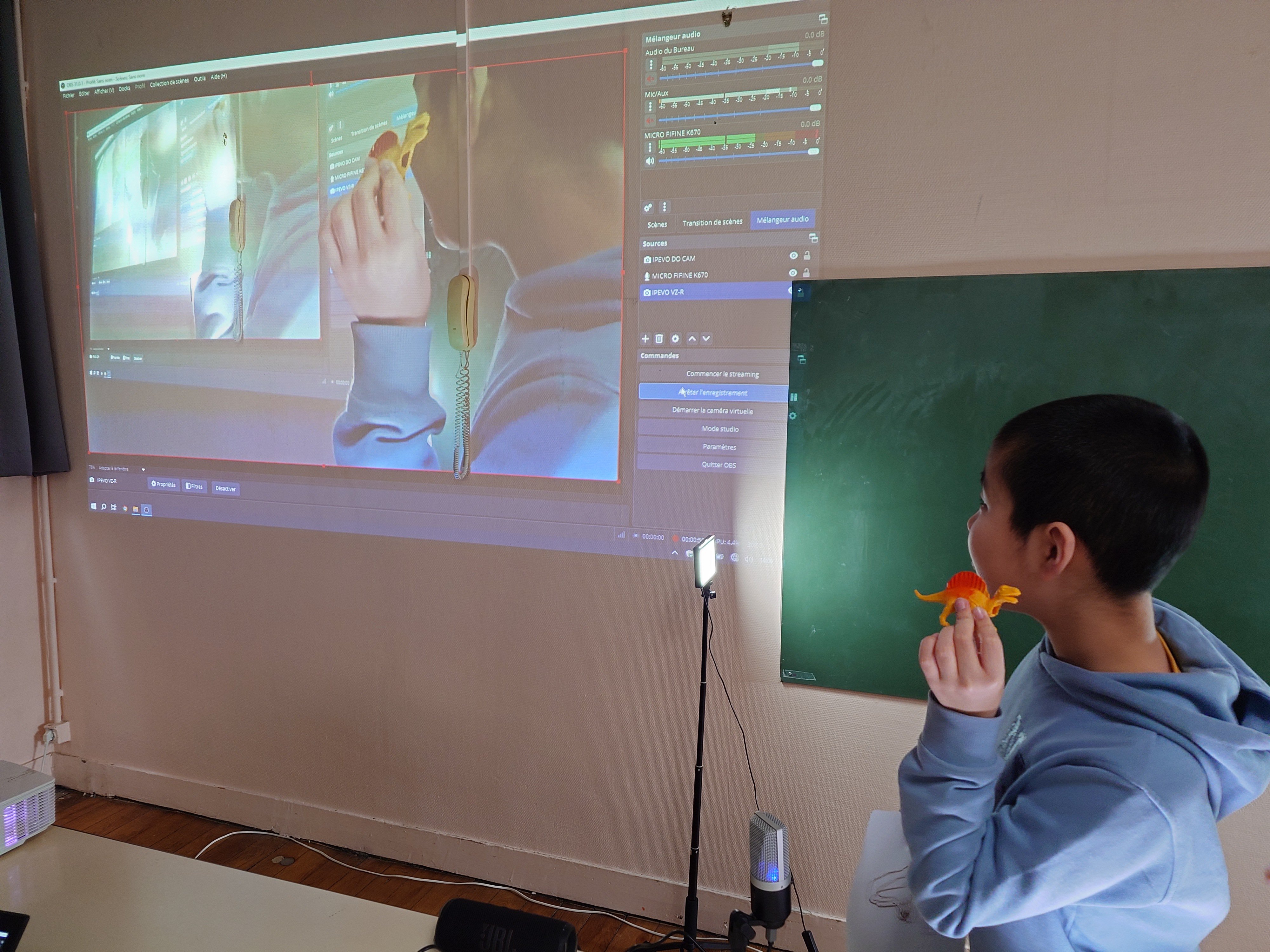
I tried this in a day hospital for autistic children, where I led a series of workshops (video, podcast, music, drawing). I had placed three compact cameras discreetly in a corner of the room, with no instruction. Spontaneously, some of the children took up these cameras and documented the process. They photographed their fellow participants at work, gestures, setups, moments of waiting. No one had asked them to do this. The need to keep a trace, to build a visible memory of what was taking place, came from them.
At the end of the project, we prepared an exhibition. We printed the productions, but also the photographs of the process that the children had taken. The children themselves chose what to display, and they mixed the two. Productions and documentation held different statuses for them but equal value. The exhibition was installed in the corridor of the day hospital. It has remained there for months, and a year later, it is still there. Patients, caregivers, parents, other professionals walk past it every day. They are in contact, without anyone having to explain it, with a process of artistic creation that took place in this therapeutic setting.
This need to keep a trace of the process, to make a narrative of what one goes through, had not been prescribed. When the conditions are met, it comes of itself.
The process is the subject
The process is the subject, not a means in service of a result. It is in the journey that transformation and learning are found. The finished film, the performed show, the completed plastic object are precious traces of this journey, which do not exhaust what took place.
What matters is the work accomplished, the journey traversed by the participants and by myself. When a mediator is in turn transformed by what they have accompanied, something has taken place. Budgets do not measure it, conventional showings do not display it. The narrative of the process is what makes it visible.


