The César ceremony is a ritual. Not an artistic ritual, but a social one, whose analysis reveals the mechanisms of domination at work in the French film industry. The 51st edition, held on February 26, 2026 at the Olympia, hosted by Benjamin Lavernhe and chaired by Camille Cottin, deserves an ethnological reading.
Preamble: Why Pay Attention to the Césars?
I don’t watch the Césars. I’ll admit this ceremony has never interested me. As an audiovisual professional, I’ve been offered several times to participate in the César vote, but I confess I’ve never understood the point of a system where professionals award prizes to each other and turn it into a public event. It’s a simulacrum, a self-feeding system of validation through insider culture, a system of domination presented to the public as entertainment.
Dominating because there are winners and losers. Dominating because the nominees are selected by a vote of professionals, driven by a logic of networks and influence, upon which rests the illusion of an objective aesthetic or social judgment. Dominating, finally, because the televised spectacle that results from it relies on the audience’s projection onto the dominant: the stars are on stage and in the auditorium, lit up and filmed at all times, and the viewer at home feels as though they share in their privilege through the small screen, even as they are excluded from it. It is, one might say, the most basic form of seduction through domination.
This system is comparable to what I analyzed regarding the Cannes Film Festival, with its social hierarchies, its special privileges, its dress codes imposed on bodies. Cinema is an art, but it is also an industry. And this industry needs rituals to legitimize itself, to feed its commerce. The Césars are one of those rituals. The aim here is not to discredit a professional milieu in a simplistic way, but to analyze its symptoms, in the hope of making progress.
If I’m writing today about the 2026 ceremony, it’s because a sequence I came across on social media struck me as sufficiently revealing to warrant this analysis. This is not an opinion piece, but an analysis of power dynamics as they manifest, live, before our eyes.
2020: The Moment the Veil Was Torn
Let’s go back six years. On February 28, 2020, during the 45th César ceremony, the award for best direction was given to Roman Polanski for An Officer and a Spy. As is well known, Roman Polanski was convicted in 1977 in the United States for unlawful sexual intercourse with a thirteen-year-old minor and has been a fugitive from American justice ever since, in addition to multiple other accusations of sexual violence. Actress Adèle Haenel then stood up and walked out of the auditorium, exclaiming: “This is a disgrace!” She was followed by Céline Sciamma, Noémie Merlant, and others.
This gesture was a founding moment. Virginie Despentes celebrated it in a now-landmark text, “From now on we stand up and walk out.” It was rightly perceived as a reaffirmation, following #MeToo (2017), that the French film industry rests on a deeply misogynistic, sexist, and patriarchal system of domination.
But for me, it was not only misogyny and sexism that were being called into question. It was the very legitimacy of this ceremony. Because sexism is one form of domination among many, and they are all interconnected. You cannot address sexism without questioning the entire hierarchical system that produces it. A system that selects, that decrees some people are better than others, that manufactures winners and losers, operates on the same logic as the one that asserts the superiority of one gender over another.
Adèle Haenel subsequently chose to leave the system, to no longer be a film actress in the traditional sense. This is a radical gesture that testifies to the power of this system: to stop participating in it, you have to leave it entirely. Can it be reformed from within?
After 2020, the leadership team of the César Academy was replaced. There was talk of gender parity, renewal, transparency. But fundamentally, the system remained the same. The apparatus of legitimization through insider culture, the spectacular hierarchy, the staging of domination hadn’t budged an inch, because they are intrinsic to the very principle of this type of ceremony.
The Jim Carrey Tribute: When Admiration Manufactures Domination
The 51st ceremony opened with a lengthy routine by the master of ceremonies, Benjamin Lavernhe, a member of the Comédie-Française company, paying tribute to Jim Carrey, who was receiving an honorary César for his entire career. Lavernhe recounted having discovered The Mask in 1994 at the Le Castille cinema in Poitiers, was overwhelmed with emotion, then put on the actual mask from the film, brought from the Cinema and Miniature Museum in Lyon, to recreate a rather spectacular choreography inspired by the film.
The press unanimously praised this performance as “memorable,” “spectacular.” I’d like to offer a different reading.
What is being staged in this sequence is a very precise performance of domination. Lavernhe essentially says: “I’m three meters away from my idol, it’s overwhelming for me.” He publicly positions himself as the dominated, fascinated by the dominant figure, Jim Carrey. But this posture of modesty is actually an act of power. Because it is he who creates the dominant role that he assigns to Jim Carrey. It is he who orchestrates the scene, who chooses to position himself in admiration. He constructs the very hierarchy of which he presents himself as the willing subordinate.
And the payoff is considerable: by appropriating Jim Carrey’s codes, by reproducing his choreography, by wearing his mask, he symbolically absorbs his power. He demonstrates that he can be just as strong, even stronger than his idol, since he performs this “incredible” technical feat on stage, live. This is a chain of domination, not a chain of transmission. Because transmission presupposes otherness, respect for difference. Imitation, however brilliant, is absorption, appropriation. It transmits nothing; it takes.
Jim Carrey himself, who is not at all operating within this logic of domination—his public positions attest to this—found himself instrumentalized by this apparatus. He was clearly moved and grateful, and he delivered a speech entirely in French. But in the symbolic economy of the evening, his presence served to legitimize the system. Admiration is manufactured, and through admiration, the legitimacy of the one who admires is manufactured—who is therefore legitimate to dominate in turn—and so on.
The Simulacrum of Critique: The Epstein Files Joke
During the evening, Benjamin Lavernhe made a joke about the Epstein affair, pretending to open an envelope to announce “the César nominees in the Epstein files,” before commenting, in essence, that there were “far too many of them” in the auditorium. The room laughed. His boldness was applauded.
But let’s analyze precisely what is happening here. He pretends to criticize something in order to actually protect domination. It’s a simulacrum of critique, a façade critique. He mentions the Epstein files, he implies there are people involved in the room, but he names no one. He moves on. Everyone is reassured: people think “he’s tackling the real issues,” but in reality the issues were merely brushed past, swept under the carpet while everyone was made to believe they had been addressed! If there were people in the auditorium who were actually connected to these cases—and there very probably were—they were not named, they were not exposed. They were protected by the very discourse that claimed to denounce them.
This is a highly effective manipulation mechanism and one very difficult to challenge, precisely because it takes on the appearance of transgression. The dominant figure pretends to criticize themselves, and this façade of self-criticism reinforces their position. This is the very definition of the system of domination as I have analyzed it in other contexts: the promise of domination is the promise of being among the dominators. And humor can be a powerful instrument of this promise, because it disarms criticism by turning it into entertainment.
Alison Wheeler: When Truth Walks onto the Stage
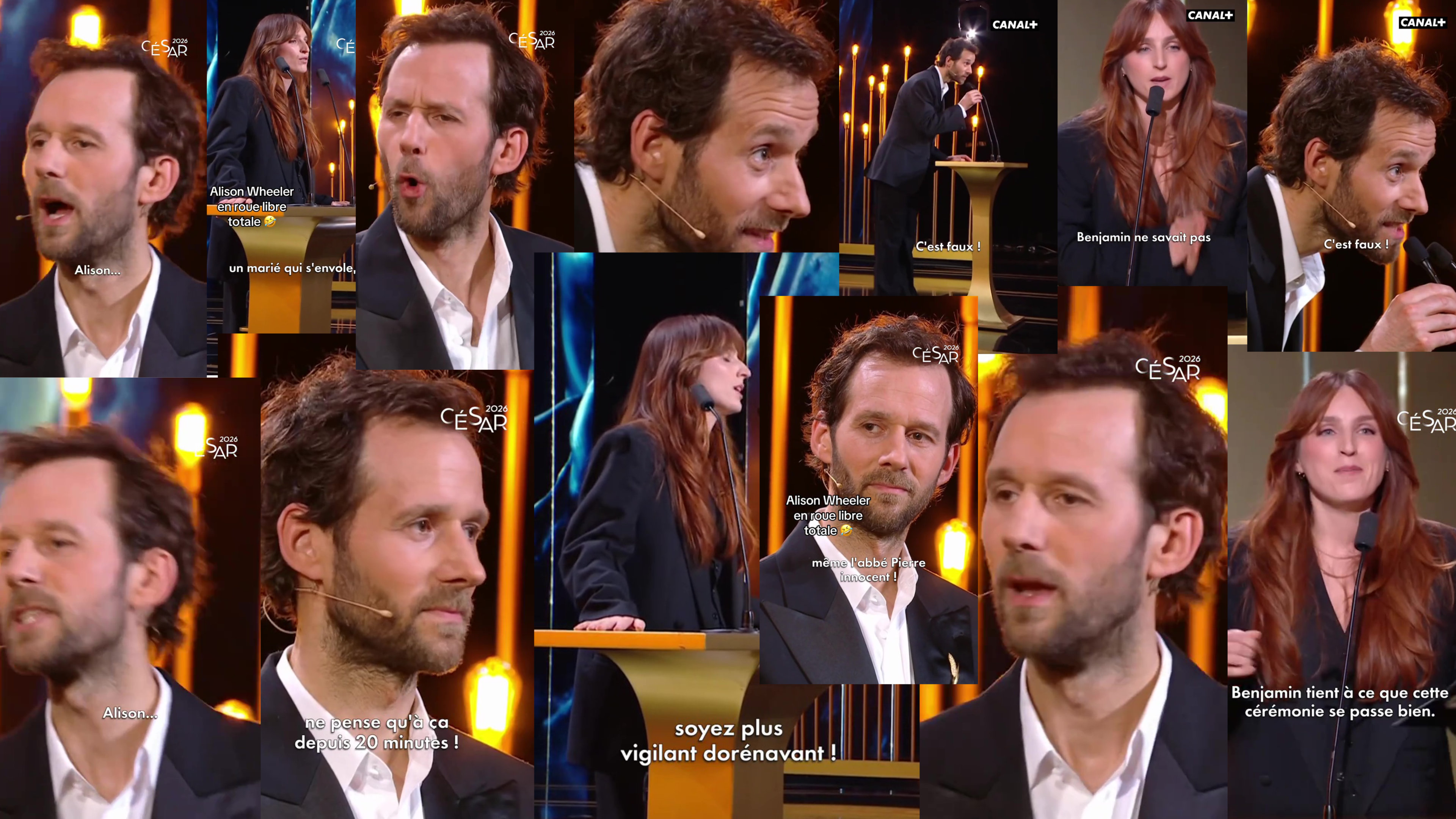
It was through this sequence that I first encountered this ceremony, after discovering a clip on social media. Comedian Alison Wheeler, who had come on stage to present the Césars for best animated short film and best animated feature, dared to do something radically different from Lavernhe’s Epstein joke.
Addressing the master of ceremonies directly, she first ironically highlighted his “great range” as an actor, capable of playing “an orchestra conductor, a groom who flies away, even an innocent Abbé Pierre.” Let us recall that Benjamin Lavernhe played Abbé Pierre in a biopic released just as the scandal of sexual violence committed by the clergyman was breaking into the open. Then Wheeler asked to “lance the boil,” to “separate Benjamin from the Abbé.” And finally, she delivered her punchline, saying that Lavernhe was currently working on securing funding for his next film: a biopic of Jack Lang!
Jack Lang, former Minister of Culture, is notoriously linked to the Epstein affair. The National Financial Prosecutor’s Office has opened an investigation against him for money laundering and aggravated tax fraud. To link him so directly to Lavernhe, even in a joke, on the César stage, was to touch the precise spot where domination protects itself. And that is unacceptable to the system.
What happened next is, in my view, the most revealing moment of the entire evening. The precise transcript of the exchange is eloquent when observed from an ethnographic perspective. As soon as Alison Wheeler begins to mention Abbé Pierre and asks to “lance the boil,” Benjamin Lavernhe immediately intervenes: “No, no, no, no, no, no.” Six rapid-fire negations. She continues regardless, describing how Lavernhe “was heading straight for the César” before discovering that “the old geezer had pressed his saggy old thing on everyone at Emmaüs, across Paris, inner and outer suburbs.” Lavernhe then reacts with what can only be described as a paternalistic grimace: “That’s enough, that’s enough.” In other words: you’ve gone far enough, stop there. But Wheeler doesn’t stop. She finishes with: “Come on, let me hurry up and read the nominees. Benjamin really wants this ceremony to go well, he’s counting on it a lot. He currently has a film whose financing is underway—it’s the Jack Lang biopic.” And there, Lavernhe’s reaction changes in nature. We cross into explicit prohibition: “Come on, that’s enough, that’s enough, that’s enough. Alison Wheeler. Yes, that’s all. That’s false, that’s false.” He calls her by her first name. He passes a verdict. He decrees that what she’s saying is false, stepping very seriously out of humor, panicked. No more irony whatsoever. This is no longer humor, no longer stage banter. It’s a call to order, an injunction to silence, delivered from the position of master of ceremonies—that is, the one who holds power over speech in this space. These words are heard far more distinctly in videos filmed from the auditorium than in the official broadcast, where the sound mix smooths over his reactions. The official broadcast protects the dominant figure right down to its soundtrack.
The difference between Lavernhe’s Epstein joke and Wheeler’s intervention is crucial: Lavernhe made a joke without consequences, a joke that protects. Wheeler said something that touches the truth of the system, and the system reacted. When Lavernhe mentioned Epstein, it was an abstraction. When Wheeler named Abbé Pierre and suggested it could extend to Jack Lang, it was concrete. And the master of ceremonies’ reaction—his rigidity, his call to order—showed us exactly where the boundary lies between authorized criticism that poses no danger to the system and forbidden truth that could potentially destabilize the whole edifice.
It’s no longer even primarily about sexism here, although the fact that it is a woman being ordered to be silent is obviously not without significance. More fundamentally, it is the system of domination itself that reveals itself: you are not allowed to speak the truth of the industry’s hypocrisy. You are not allowed to name things. You can pretend to name them, you can make generic jokes, but you cannot point precisely, you must not touch any of the seats of power.
Speech by Trespass: From Blanche Gardin (2018) to Alison Wheeler (2026)
Because this 2026 sequence is not an isolated case. I’ll cite another example, and others could be found. Eight years earlier, during the 43rd César ceremony in 2018, hosted by Manu Payet, comedian Blanche Gardin, who was on stage to present an award, delivered—in a way unanticipated by the organizers—a significant statement on the subject of sexual violence in the entertainment industry. Recounting her childhood in a theater workshop, she declared: “I loved being on stage with my little classmates. Especially because while we were on stage, the director couldn’t touch us...” Then: “But he was a brilliant director otherwise, mind you. Because you have to know how to separate the man from the artist.” And finally: “And it’s strange, actually, that this indulgence only applies to artists. Because you wouldn’t say, for example, about a baker: well yes it’s true, but he makes an extraordinary baguette, we wouldn’t want to...”
Let’s look more closely at the exact exchange, in an ethnographic analysis: Manu Payet, extremely unsettled, looking at his feet, could only muster a “Right... well...” in response to Blanche Gardin’s first statement, and panicked glances toward the other man on stage, actor and director Nicolas Bedos, who managed to force the transition forward, cutting things short: “Right... Blanche, for the...” accompanied by hand gestures indicating it was time to move on. Two men, then, facing a woman’s words. One petrified, the other calling her to order. Nicolas Bedos, let us recall, was definitively convicted in October 2024 to one year in prison, six months of which were suspended, for sexual assault against two women in 2023. He subsequently dropped his appeal, making the conviction final, and published a book on the subject. The fact that it was precisely he who intervened to silence Blanche Gardin as she spoke about sexual violence says everything there is to know about the structure of power in that room.
The parallel between these two scenes (Gardin/Payet/Bedos in 2018, Wheeler/Lavernhe in 2026) strikes me as illuminating. The structure is rigorously identical: a woman speaks up to tell a truth about violence, and one or more men attempt to contain that speech, to bring it back within the limits of the tolerable. In 2018, Payet stares at his feet and Bedos gestures to move things along. In 2026, Lavernhe explicitly disapproves through words and gestures, and decrees “That’s false, that’s false.” The methods vary—paralyzed embarrassment, authoritative gestures, verbal verdicts—but the function is the same: to contain the disaster that a woman speaking freely on that stage might produce.
This observation requires us to widen our gaze. In order to speak at all, these women must express themselves in the gaps: they have no recognized legitimacy to say what they think, except by trespass. Wheeler came on stage to present an animation award, not to make a political speech. Gardin was also there just to present an award, not to criticize sexual violence in the entertainment industry. They divert the framework assigned to them in order to slip in a truth that no one authorized them to say. This is the very nature of women’s speech throughout the history of emancipation: it has almost always been constructed through trespass, in the interstices of male power.
Olympe de Gouges had to write her Declaration of the Rights of Woman and of the Female Citizen (1791) in the margins of the men’s version, because the legitimate space was closed to her; she was guillotined. The suffragettes chained themselves to the railings of Parliament because the door was closed to them. Rosa Parks sat down in a bus because the podium was denied to her. Geneviève Fraisse, feminist philosopher, theorized this in On Consent (2007): the time for women to speak must also be the time for listening, but that listening is never guaranteed—it must always be won. Women’s speech is revolutionary precisely because it is not authorized. If it were, it would be ensured that it disturbed no one, by censoring it beforehand.
And that is why the system punishes it. Blanche Gardin is today the most striking illustration of this. After a sketch in July 2024 denouncing the instrumentalization of antisemitism accusations to silence critical voices regarding the genocide committed by Israel against the Palestinian people in Gaza, she was purely and simply blacklisted from the French film industry. She no longer receives any job offers. She lost her agent. She had to leave her apartment. The woman who had dared, in 2018, to speak the truth about sexual violence in the entertainment industry, was punished in 2024 for daring to speak the truth about another forbidden subject. The system of domination does not tolerate women’s free speech, regardless of the topic. Whether it concerns sexual violence or international politics, the punishment is the same: silence imposed through professional disappearance.
Despite #MeToo in 2017, between 2018 and 2026, and despite 2020, despite Adèle Haenel’s gesture, despite the promises of renewal, it is in fact exactly the same attitude toward women: the men on stage, whether masters of ceremonies, directors, or actors, play the same role—they try to contain the cataclysm that a woman saying what she thinks might produce. And when the stage is no longer enough to silence them, the entire professional milieu takes over.
A System That Has Locked Down Even More Finely
The comparison between 2020 and 2026 is revealing. In 2020, Adèle Haenel stood up, said “this is a disgrace,” and left the auditorium. The gesture was visible, frontal, unambiguous. It caused an earthquake. The Academy’s leadership team resigned. People believed something was going to change.
Six years later, the system has in reality strengthened and grown more sophisticated. Domination is no longer exercised as crudely as by openly rewarding an alleged rapist. It now operates through a more subtle apparatus: critique is integrated into the spectacle itself. Jokes are made about Epstein. Gender parity is discussed. Tributes are paid to departed figures. A ceremony chair delivers a speech about defending culture. All of this is part of the simulacrum. Façade critique protects the system far more effectively than silence.
And when someone—in this case Alison Wheeler—dares to cross the invisible line between authorized critique and truth, the reaction is immediate. She is ordered to be silent. And she complies with a smile, because she is a professional, and the very format of televised entertainment compels her to maintain the façade. But the consequences for her, in such a tightly controlled industry, will in my opinion be real. There is no longer an Adèle Haenel to stand up in the auditorium. The system has learned.
Chain of Domination or Chain of Transmission?
A question this ceremony raises for me is the difference between a chain of domination and a chain of transmission. Benjamin Lavernhe pays tribute to Jim Carrey by imitating him, by appropriating his codes, by measuring himself against him. This is a logic of absorption, competition, capture. The displayed admiration is in reality a sublimated form of rivalry.
A chain of transmission would presuppose something else. It would presuppose receiving something from Jim Carrey—his art, his freedom, his relationship to his body, his irreverence, his engagement with spirituality—in order to make something else of it, something personal, singular, that doesn’t seek to equal but to extend. Transmission creates otherness. Domination creates repetition.
It is entirely possible to be in relation with an artist one admires without placing oneself in a position of subordination. It is not Jim Carrey who asks to be placed on a pedestal. It is the apparatus of the ceremony that places him there and, in doing so, justifies the hierarchical system as a whole. The implicit message is: domination is desirable, because it allows one to be close to greatness. This is exactly what I call the dark seduction of domination: the promise of being among the dominators is what makes people accept the worst humiliations and support the very system of which they are the victims.
What This Evening Reveals
We are meant to take this evening for a lovely evening. The press praises Lavernhe’s performance, Jim Carrey’s emotion, Golshifteh Farahani’s speech on Iran, Franck Dubosc’s tears upon receiving his first César. And yes, there was emotion, talent, sincerity in places. I’m not saying everything is a lie. I’m saying the overall apparatus is one of domination, and that the moments of sincerity serve precisely to legitimize it.
What shocked me and made me want to put pen to paper was the violence of Lavernhe’s reaction to Wheeler. Not physical violence, even though at the end, his body movement is threatening, in a controlled way. It is the violence of the call to order, of intolerance toward truth, of the absolute rejection of anything that touches the foundations of the system. He could have chosen to say nothing, to smile, to welcome the critique in support of personal and collective questioning, or at least to play along with the humorous complicity, to give this woman’s free speech its rightful place. He didn’t. And that choice reveals everything.
It seems important to me to say this, because this is not a matter of opinion but a matter of ethics. Manipulative domination that pretends to critique itself is the most pernicious form of domination, because it eliminates the very possibility of contestation. If the dominant figure has already made the joke themselves, what remains to contest? This is why it is so important to distinguish façade critique from genuine critique, and to salute those who dare the latter, even when it takes the form of an unplanned sketch of less than two minutes during an animation award presentation.
Cinema deserves better than this. Art deserves better than this. Artists deserve better than this. And audiences deserve not to be made to mistake a ceremony of domination for a celebration of creation.


