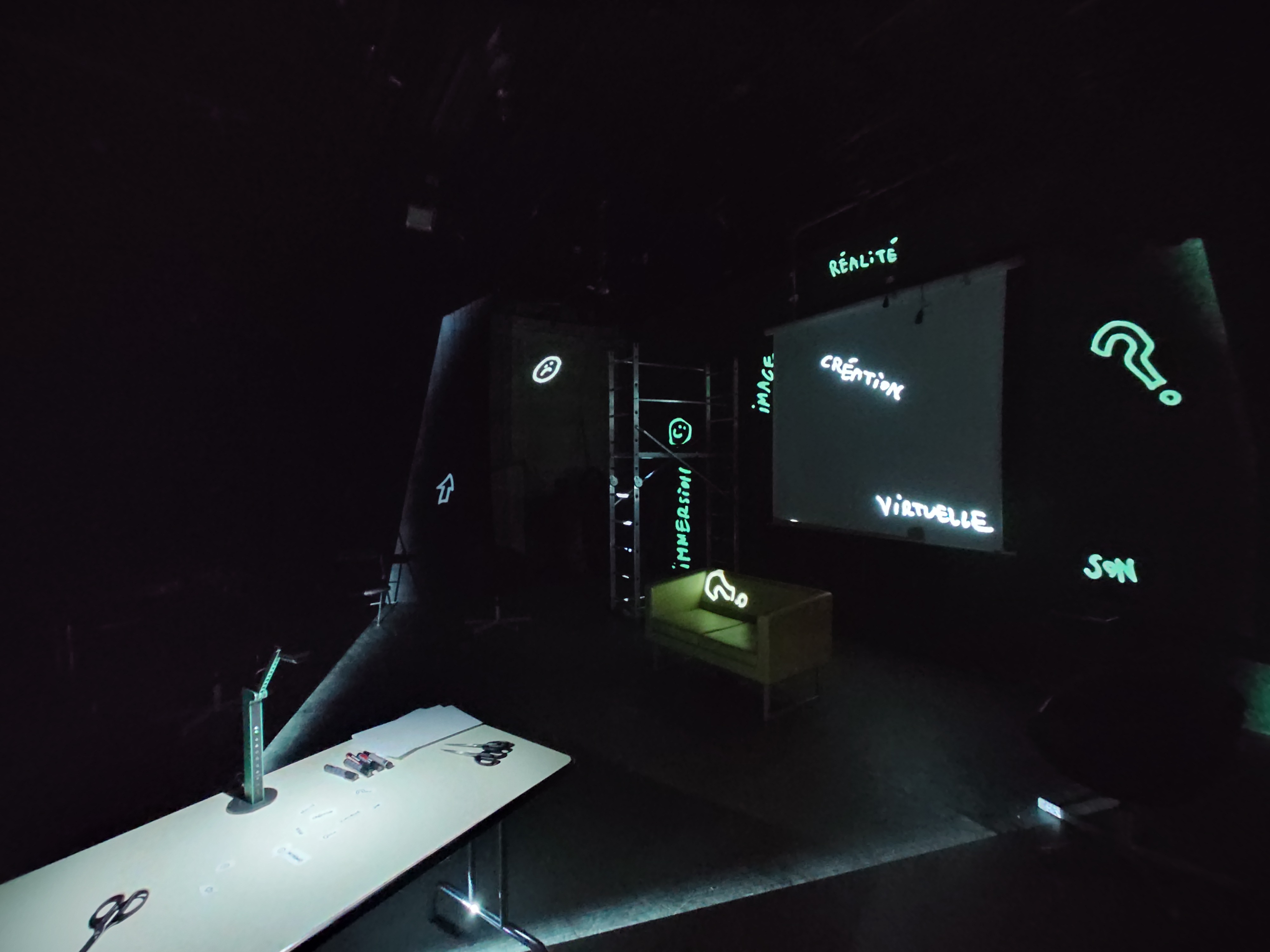
Digital technology has made each of us a potential creator. This anthropological transformation calls for a rethinking of the political function of publicly funded performing arts, and of what their major venues could become for the people who live around them.
I wrote this article for the “Chaillot Augmenté x TMNlab, Performing Arts and Digital Environments 2026” conference (5 and 6 May 2026), where I spoke on a panel about the transformation of audience relationships. The reflections I offer here, however, go well beyond the scope of those two days. They concern what publicly funded cultural venues are, and what they could become in a society that digital technology is transforming in depth. These are questions I have been working on for many years, and I believe they will remain relevant long after the occasion that prompted me to publish them.
Publicly funded performing arts venues are political places in the strongest sense of the word. Digital technology makes visible the urgent need to rebuild their democratic function, a task that cannot be reduced to a matter of simple modernisation.
Getting past the misunderstanding: digital technology is not about projecting pixels onto a stage
A great deal of current thinking about “live arts and digital environments” focuses on what technology makes possible on stage. XR, generative AI, immersive sound, transmedia forms: these explorations are legitimate, and some produce remarkable works, whose artistic value and the labour they demand from the artists engaged in them I fully respect.
I would however like to defend what I believe to be a deeper thesis: many of these proposals, however accomplished, may fail to take the measure of the anthropological shift that digital technology produces. They add technology to an apparatus, in the sense Giorgio Agamben gives the word in What Is an Apparatus? (2006): “anything that has in some way the capacity to capture, orient, determine, intercept, model, control, or secure the gestures, behaviours, opinions, or discourses of living beings”. Yet this apparatus (the proscenium stage, the stage-audience separation, the spectator assigned to passivity, the ritual of symbolic obedience) remains very largely unchanged. Digital technology inside a nineteenth-century bourgeois apparatus is not necessarily the digital transformation I am talking about; it may amount to no more than a modernisation of the façade.
Walter Benjamin, in The Work of Art in the Age of Mechanical Reproduction (1935), showed that mechanical reproduction technologies had allowed art to free itself from central power and to reach a form of cultural democracy. Digital platforms today extend and radicalise that emancipatory movement, giving each of us the means to receive, to produce, and to circulate works. It is no surprise that they destabilise the habits of those who run publicly funded cultural venues: in their own time, the printing press, in the fifteenth century, and then Wikipedia at the turn of the 2000s, were criticised with the same vehemence by the holders of established knowledge, even though they carried the seeds of the Renaissance, or of unprecedented universal access to knowledge. From these precedents, I take it that the challenge facing cultural venues is political more than technological.
Part of the professional field does call for this vigilance, and for a move away from technological fascination towards more embodied artistic proposals, after a decade of euphoria around innovation. I share this concern, and I would like to add some considerations about what really changes with digital technology, beyond its uses on stage.
What changes is the relationship people have with culture. Each of us is now potentially a creator, telling the story of our daily lives, producing images, videos, narratives, circulating them, forming communities of affinity, without any institutional mediation (though with the mediation of commercial digital platforms). Millions of people, every day, engage in cultural practices that pass through no publicly funded cultural venue. This is an anthropological transformation, and cultural professionals must draw its consequences if they want to continue justifying the political existence of their sector and its public funding, in the works it produces as much as in its institutional arrangements.
Digital technology is not a subject one takes sides for or against. It shifts more fundamental questions, that of our relationship to presence and that of who is entitled to create, and it is these shifts, with their political consequences, that must be taken seriously.
Performing arts: a political project, not an extension of Versailles
Publicly funded culture in France is a political and democratic project, which breaks with royal patronage. We are no longer in the time of Louis XIV: cultural funding is the money of the citizens, including those who proportionally pay the highest taxes. Let me recall that, according to the Institut des politiques publiques, when all levies are combined, French households pay on average around 50% of their income, compared to 26% for the few dozen wealthiest households in the country.
Because this funding comes from everyone, a democratic project must give a place to everyone, and therefore dismantle the power mechanisms that stand in the way. The first such mechanism, which materially and symbolically structures most performing arts venues, is the traditional hall, the Italian-style theatre, with its stage-audience frontality and its hierarchy of seating.
I want to be precise on this point, as it is often caricatured. I have nothing against being seated in a hall; it is pleasant, and it can be a deeply moving experience, even in the most classical setting, when an encounter takes place. I have written at length about the work of Pippo Delbono in the article What Artistic Discourse Reveals About Itself, where something can happen within the very walls of an institutional theatre. My objection is political; it is not about the aesthetic pleasure the hall affords.
The problem, to my mind, begins when this apparatus is offered as the only possible form, assigning people to passive roles. Those who lack the required cultural background find themselves, without knowing it, in the position of the dominated, and without the professionals who welcome them with the best intentions knowing it either. As Pierre Bourdieu showed in Distinction (1979), attending legitimate cultural venues functions as a mechanism for accumulating cultural capital, and this capital serves to reproduce the social hierarchy. It therefore happens that publicly funded culture, far from serving its audience in the democratic sense of the word, serves the symbolic domination exercised through the cultivated public over the non-audiences.
Major theatres as public resources for the practices of local people
The major theatres, national stages, and drama centres are extraordinary places: by their size, their architectural quality, the rare technical and artistic skills they bring together (video, lighting, sound, scenography, dramaturgy, choreography, direction), and by the level of public funding they receive, which often reaches several hundred thousand euros, sometimes several millions per year.
It remains to be seen what we, collectively, do with these means. For the most part, we produce and present “quality” performances, in a defensive logic against the erosion of funding, without always measuring its democratic effects. Some productions cost considerable sums, tour very little, and are seen by only a small number of people. Measured against the democratic purposes of public investment, this amounts to throwing money out of the window.
In professional networks attentive to these questions, it is now widely recognised that the challenge to be met is primarily organisational rather than technological. What blocks change lies in production logics, funding frameworks, professional cultures, and in the very conceptions of what art is, of what a valuable work is, of what it means “to make a work”. I share this view, and I draw a consequence from it: if the challenge is organisational, then the legitimate questions the professional field asks itself (how to better host hybrid projects, how to pool resources, how to invent new professions) would gain from being preceded by a more fundamental question, the question of the very purpose of these venues: for whom, and in the service of what, do they exist?
I propose to turn the question around, and to imagine what these venues could be if we first thought of them as public resources at the service of the real cultural practices of the citizens in the digital age.
One concept seems to me essential for redefining the function of these venues: that of experience, in the sense John Dewey gives the word in Art as Experience (1934). A film watched in a cinema hall or on a phone is not the same film in terms of lived experience. The work is the same, but the relationship the viewer has with it is profoundly transformed: leaving home, settling among others, sharing a common time and space, all of this modifies the state of reception and gives the encounter with the work a particular density. It is this dimension of shared experience that makes the irreducible specificity of the physical cultural venue, at a time when content itself circulates abundantly through other channels. Judging a cultural project solely by how full the venues are means overlooking this specificity, treating the venue as a container and postulating a hierarchy between the film watched in the hall and the film watched on a phone that, in truth, hardly respects people’s cultural rights and the diversity of their relationships with art.
Here, starting from this shift from content to experience, are some of the directions I have been defending for years and that I have developed in my book Défendre la culture autrement : méthodes pour demain (Defending Culture Differently : Methods for Tomorrow) (2025):
- Open professional skills to the creative practices of local people. The technical and artistic teams could, for part of their time, accompany the creations of those who come to film, edit, write, or choreograph their own projects. I am not thinking here only of the “audiences from the social field” brought in as small groups to tick the boxes of the social mission, but of all the citizens who have something to create and to say, and who could have access to the exceptional resources of the venue. The Studio 13/16 at the Centre Pompidou has been showing for years that this is possible, and it should, in my view, become the norm.
- Transform the venue into a resource, as much as a programming space. A beautiful theatre, with its backstage areas, workshops, control rooms, archives, can become setting, tool, raw material for creations carried by people who would otherwise never have access to such technical quality. When teenagers say that they would need suitable booths for their TikTok videos, why not install them in the historic backstage corridors of the theatre? The needs of those who use the venue then become the source of cultural projects built with them.
- Programme differently. Many more lightweight and improvised forms, more often, for a greater number of people, including amateur performances on the main stages, which are in high demand from amateur performers and in no way devalue the venue. The “major” productions can continue to be programmed there, when they respond to expectations identified among local people, without being their sole function or the principal criterion of legitimacy. Let us move from art as object to art as experience (as art as object induces an object relation in which, it seems to me, an unhealthy enjoyment of dominating or being dominated is at play).
- Rethink mediation as relationship, rather than as prescription. There is no cultural venue without links. Classic institutional communication, posters, posts on social media, do not suffice to forge such links, which are woven in regular encounters with people, in listening, in the co-construction of projects. This approach is demanding and slow, and requires the teams’ working time to be reorganised. It is, to my mind, the condition for these venues to remain rooted in the city.
Learning from digital platforms without becoming TikTok
Drawing lessons from the platforms is one thing; imitating their codes in order to “meet audiences where they are” is another, which I do not defend. These lessons can help us rebuild our own function.
What one sees first, on the platforms, is that people want to be active in their cultural practices rather than simple spectators, and that anyone can instantly become an author or a producer of content, with no obstacle other than their own shyness. Culture, today, is also, and massively, this active culture without institutional intermediaries, practised by the citizens themselves, which publicly funded institutions struggle to recognise as legitimate.
On a platform such as TikTok, the computer code itself is changing the notion of a work. When thousands of people collectively reuse, remix, and refine a choreography or a piece of music, the singular work gradually disappears behind a collective artistic experience, in which everyone is both spectator and author. The inherited categories that clearly separate the artist from their public lose part of their relevance here. This shift takes place on a massive scale, in the daily lives of billions of people, and it directly touches the relevance of our own venues: a venue that structurally maintains, through its Italian-style hall and its frontality, the separation between those who produce the work and those who receive it, can hardly present itself as a place of cultural democracy, in a society that has largely moved beyond that separation.
In the article The Fertile Margin, I proposed a concept for thinking through this situation. Our publicly funded institutions are no longer at the centre of the cultural game, and will not return there. This margin can be lived in two ways: as a relegation one deplores, while endlessly demanding that our lost place be given back, or as a chosen place, from which we act with more freedom and more relevance because we are no longer subject to the obligations of the centre. It is this second path that I defend. Recognising oneself in this margin means recovering a capacity for invention and experimentation that the centre, now occupied by other actors, has largely lost.
Cultural institutions could take note of this shift with humility, accepting this margin and making it the liveliest place of their action. This involves positioning themselves more as facilitators than as prescribers, as resources on which others can build their own proposals, rather than as authorities delivering a top-down message.
Such a direction can only enrich the role of professional artists, by placing their work back within a milieu in which it is better received and better shared, because it really dialogues with the cultural practices of the citizens instead of standing above them. My own experience of supporting cultural teams in this direction shows me that artists flourish there, even if it requires them to question themselves.
Professional gatherings as spaces of concrete democracy
I often find myself being critical of the professional gatherings of the cultural sector, which sometimes operate in a closed circle, among insiders, where everyone repeats the same received ideas to one another. I do believe, deeply, however, that these moments can be precious, when they are genuinely open to all, and when one can debate in them, disagree, and keep talking. That is what democracy is, in its most concrete sense: spaces where points of view confront one another without cancelling each other out.
The paradox of the apparatus: our gatherings reproduce what we criticise in them
Here, nevertheless, is a paradox I have observed for a long time. Many of these professional gatherings, which deal with the transformation of audience relationships, reproduce in their own format the very apparatus being debated there. Experts speak on a podium while, in the hall, an audience listens; questions from the audience come at the end, when there is hardly any time left. The spectacular apparatus whose effects of symbolic domination I analysed above (frontality, verticality, assignment to passivity) is also the apparatus of our professional gatherings, with the sole difference that what is welcomed on stage is not artists, but experts and heads of institutions.
This is not a fatality, and it is not the fault of any particular organiser: it is a natural slope of our professions, one we can correct together, from within these moments themselves, provided we become aware of it.
Shifting the apparatus from within
This calls for those present in the room to take the floor more than is planned, in order to contribute to the debate, to testify, to bring other perspectives and other experiences from other professions or from civic life. A democratic system remains democratic only on the condition that it is kept in motion. Scrupulously respecting the proposed format can sometimes, despite the best intentions, amount to letting the apparatus assign everyone to their place.
I address a request, fraternal and demanding, to those who take part in this kind of gathering: let us not settle for the role of audience. Each of us has field experiences, constructive disagreements, and concrete proposals, which deserve to circulate. If the gathering takes place only in a top-down register, with “great experts” who “explain life” and an audience that nods politely, we will have missed what we came for.
The place of outside perspectives: a democratic necessity
Cultural professionals need perspectives other than their own. Saying so does them no offence; I simply recognise that, engaged full-time in their practices (which is human, and normal), they often lack the distance needed to question their own assumptions. Some questions that seem secondary or even absurd to them are essential when viewed from the outside; conversely, debates that passionately occupy them sometimes remain incomprehensible to those whom their action is meant to serve, or simply leave them indifferent. The presence of perspectives from other fields (social, educational, scientific, technical, health-related, associative, or simply civic) is therefore an indispensable resource for moving beyond corporatist assumptions. It is even, in my view, a condition of relevance: without it, professionals risk endlessly refining answers to questions that no one outside their circle is asking any more.
Professionals do not always open themselves enough to other contributions, and one can regret it, but the responsibility does not lie on their side only. Publicly funded culture, let me recall, is funded by taxes: it belongs to all of us, and is not only the business of the professionals who take daily charge of it. Citizens who have an opinion, an experience, a skill, a curiosity, or a concern about the way these venues operate (which is, in reality, just about everyone) can and must feel entitled to express themselves in the spaces where these questions are worked out. Professional gatherings open to the public are among these spaces, and taking part in them is less a favour granted by the organisers than a democratic right.
Waiting for professionals to “open up” their gatherings to non-professionals does not suffice: it is also up to the citizens to actively claim their right to contribute. It is of course up to the professionals, whose profession and mission it is, to be the first to reach out to new audiences, and they must be firmly reminded of this responsibility when it is not upheld. Democracy, however, is not decreed from one side only: it is built in the actual encounter between professionals who accept to be moved, and citizens who authorise themselves to speak. Without this twofold requirement, declarations of openness remain a dead letter.
Once outside people are present, there still remains the need for their words to be genuinely listened to, with a real willingness to be shifted by them, and not with the condescending goodwill of those who silently wait for the moment to resume the prepared presentations. Only on this condition can these gatherings have a democratic reach, and not merely a communications exercise, and only on this condition will outside participants come, and come back. When they sense that they are only there as extras, they withdraw, and the dialogue which is the very stake of these moments, between the professionals and those they are meant to serve, is reduced to a pantomime.
Reinventing rather than repairing
It is not a matter of repairing the cultural sector on points of detail, by adding a bit of digital here or a bit of mediation there, or by multiplying a few projects with “excluded audiences”. What I believe is necessary is to refound, or more precisely to reinvent, the political function of publicly funded performing arts in twenty-first-century France. Inventing the function that fits the present world, rather than restoring an older one: this, it seems to me, is what it means to create.
The places where we gather can be essential spaces of citizenship for democracy, and they still are too little. I believe, after decades of practice on the ground, that such a refoundation is possible, provided we accept to dismantle certain power mechanisms and certain symbolic privileges. This acceptance has a cost, and it is at this price that the cultural sector will regain a full democratic legitimacy, at a time when such legitimacy is threatened on all sides.
It is to this work of refoundation that I devote my writings, my public interventions, and my daily practice of supporting cultural teams, and I invite everyone to take their share in it, whether they are a professional or a citizen. It is our collective responsibility, and it will not happen in our stead.


