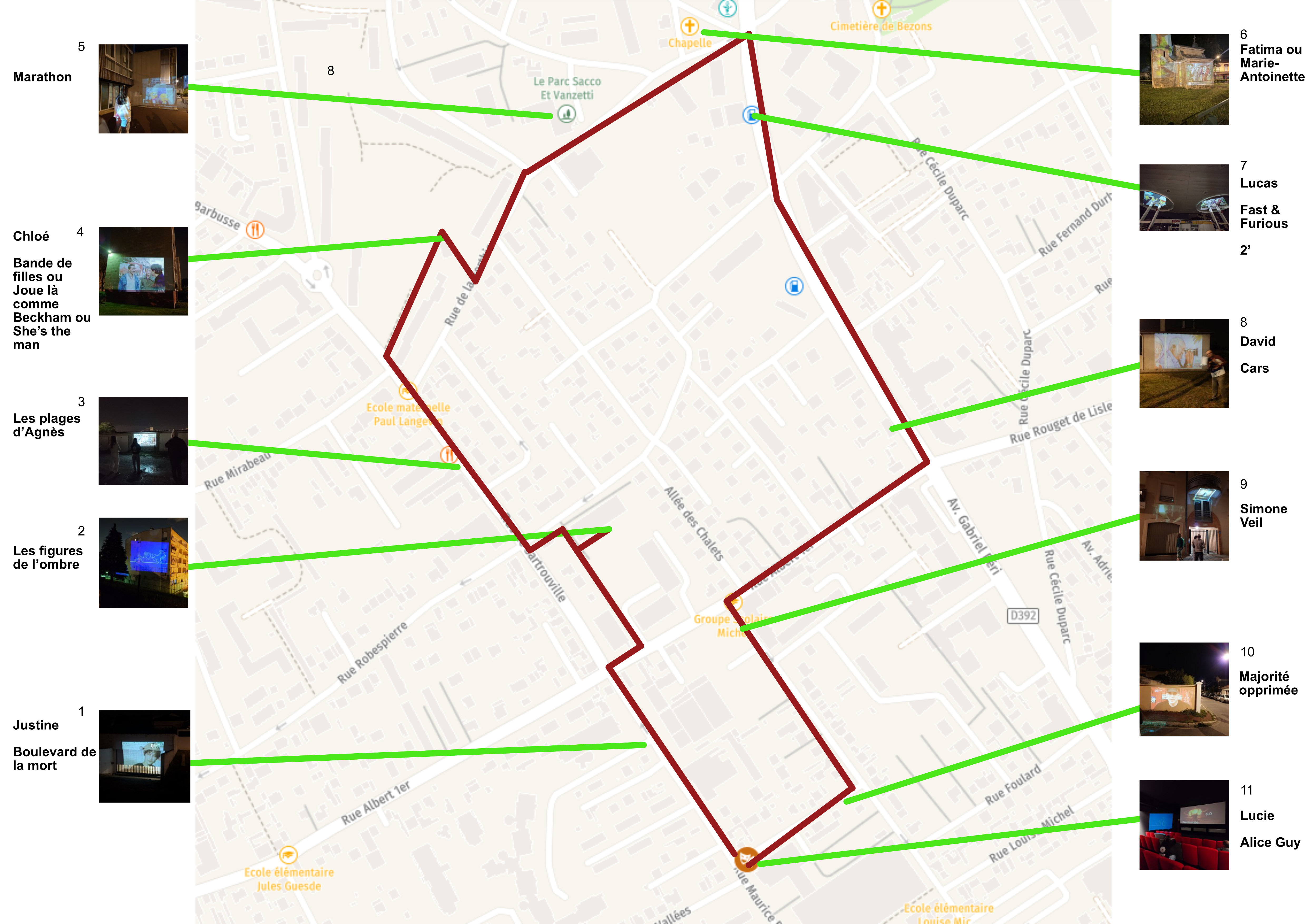
Traveling projections reinvent cinema by transforming public space into a place of sharing, where residents and passersby collectively experience the magic of images, outside traditional frameworks.
A democratic practice of distribution
Traveling projections represent an innovative form of cinematographic distribution that transforms public space into a place of collective expression. This practice, developed by Benoît Labourdette for about fifteen years (2011) thanks to the emergence of portable pico-projectors, allows residents to reclaim their urban environment by projecting films, sometimes of their own creation.
The essence of this approach lies in its profoundly democratic dimension: it is the residents themselves who organize and conduct these projections in their living spaces. Unlike traditional distribution systems, here the power over images is literally in the hands of participants who hold the projector and decide where and what to project.
A simple and mobile technical device
The technical operation relies on autonomous pico-projectors, true “light cameras” that directly contain the files to be projected, without requiring a computer. Only a portable speaker is necessary to broadcast sound. This technical simplicity allows great freedom of movement and improvisation.
The projections, if outdoors, take place exclusively at night and can take over any surface: walls, floors, ceilings, sculptures, or even people. Participants move through neighborhoods, creating unprecedented visual paths that transform urban architecture into ephemeral cinema screens.
A collaborative and thoughtful process
The preparation of these projections follows a precise methodology that involves several stages:
- A preliminary mapping of locations with daytime visits to imagine possibilities
- A nighttime revisit to test projections
- A collective sharing of scouting via QR code system
- An iterative process of refinement and questioning about the meaning of images
This collaborative approach allows going beyond mere technical projection to create events that make sense in their specific context. Mediation is crucial: it’s not about projecting any image anywhere, but creating a meaningful encounter between the work, the territory and its inhabitants.
The magic of rediscovered collective experience
The most striking phenomenon of these projections is their ability to instantly create collective experience. In a world where image consumption has become mostly individual via personal screens, projection in public space recreates the shared experience of cinema. Passersby stop, intrigued by this unexpected luminous apparition, cars slow down, an audience forms spontaneously.
This collective dimension recalls the fairground origins of cinema, where projection was above all a popular and participatory spectacle. The fascination exerted by these projected images stems from their very nature: light reflected by the real world, they create a unique encounter between the imaginary and the real, between the ephemeral and the tangible.
A cultural and political issue
Beyond the technical and spectacular aspect, traveling projections carry a strong cultural and political stake. They allow questioning the place of images in public space, creating moments of collective reflection on societal issues. The example of projecting Simone Veil’s speech for the law authorizing abortion in a collective housing neighborhood illustrates this dimension: the image takes on particular force through its contextualization in the residents’ lived space.
This practice is part of a broader approach to cultural democracy, creating bridges between traditional movie theaters and new forms of distribution. It allows reaching audiences who do not necessarily frequent institutional cultural venues and reinvesting the street as a space for expression and sharing.
Traveling projections thus represent much more than a simple technical innovation: they constitute a true reinvention of the collective relationship to images, restoring to cinematographic projection its magical and unifying dimension in our world saturated with individual screens.


