Sexuality cannot be reduced to a hedonistic quest. It constitutes a privileged pathway to our spiritual dimension, a path towards what transcends and grounds us. To forget this is to limit ourselves.
The dominant paradigm of sexuality reduced to pleasure
Contemporary sexology and most discourses on sexuality share a rarely questioned presupposition: sexuality is essentially a matter of desire and pleasure. This reduction seems problematic to me, as it prevents us from grasping the ontological depth of the erotic experience. We remain on the surface of things, preoccupied with symptoms rather than essence.
I perceive an illuminating analogy with Western medicine, which has built itself around disease rather than health. The dominant medical objective consists of identifying and treating specific pathologies, in their infinite diversity. But the fundamental question of health, what makes an organism live in harmony with itself and its environment, remains largely unthought. The side effects of treatments, the fragmentation of specialties, the absence of a holistic vision testify to this focus on the how at the expense of the why.
Take the example of therapeutic fasting. That a three-week fast could, in certain cases, allow the body to treat certain cancers itself seems to belong to magical thinking for conventional medicine. Yet this practice exists, works, with prudence and discernment, certainly, and reveals an approach centered on enabling the body to mobilize its own healing resources. We can work towards a medicine of health rather than disease. I see a similar issue in sexuality: we focus on dysfunctions and techniques of pleasure without questioning what makes us fundamentally desiring beings.
The superficiality of “engaged” hedonistic approaches
Margaux Terrou’s recent book, La Malbaise (2025), perfectly illustrates this limitation in the representation of sexuality. Her introduction concludes thus: “The French as a whole are going through a sexual crisis. It is high time to take a closer look to understand the issues and root causes of this palpable disinterest for some and growing frustration for others. This is what I propose in this book, with the promise of more fulfilling sexuality for all in sight!” One does not see beyond the objective of achieving better pleasure, presented as fulfilling it is true, but without going into the details of this fulfillment; this is on the contrary what interests me, because it is what seems most important to me, and particularly for untying knots that harm our humanity.
It is true that Margaux Terrou develops a relevant analysis of gendered representations, social injunctions, anatomical ignorance (notably the rediscovery of the real extent of the clitoris), the invisibilization of female desire, sexual violence, mental load and even what she calls the “sexual load”. Her social diagnosis is accurate in terms of symptoms: “Society has shifted sexuality into the realm of obligations, burdens, conformity to a norm, where it should imperatively remain in the sphere of pleasure and freedom.”
She then proposes various paths: dialogue, recognition of desires, questioning the primacy of penetration, renewed sexual education, work on trust, intimacy, consent, equality, creativity, etc. Her conclusion vibrates with militant enthusiasm: “Together, let’s restore their nobility to our desires. Let’s join forces, to desire more strongly, for our greatest pleasure! Let’s leave the battle of the sexes to lead together, men and women, the battle for sex!” I do not at all contest the usefulness of an approach that I prefer to call “engaged” rather than feminist. Equality in the field of sexuality is a necessary fight against the persistent oppression of women. But this perspective, however socially just it may be, seems to me ontologically insufficient, and does not produce, in my opinion, the openings it would like to produce, due to lack of perspective. It remains prisoner of the paradigm it claims to critique: that of sexuality as an end in itself, as territory to conquer for pleasure. And, precisely, this “engagement” is rather a vision of “performance”, that is to say a more patriarchal vision in its “values”, than feminist, contrary to the will of the author, a sexologist, who sees herself as feminist.
Sexuality as spiritual experience
I propose to consider pleasure not as an end but as a symptom, or rather an effect, a wave on the surface of an infinitely vaster and more mysterious ocean. The fundamental question in my opinion is not “how to access pleasure?” but “why do we desire pleasure and what does it change in us?”. This interrogation, systematically eluded, yet touches the heart of our human condition.
Georges Bataille understood this in Eroticism (1957): “Eroticism is the approval of life even unto death.” For him, the erotic experience constitutes a temporary dissolution of the limits of the self, a little death that opens us to the continuity of being. Wilhelm Reich, in The Function of the Orgasm (1927), described the orgasm as a discharge of vital energy allowing the regulation of the entire organism, far beyond simple genital pleasure. Carl Jung saw in sexuality the expression of the union of opposites, a fundamental process of individuation where anima and animus seek their reconciliation.
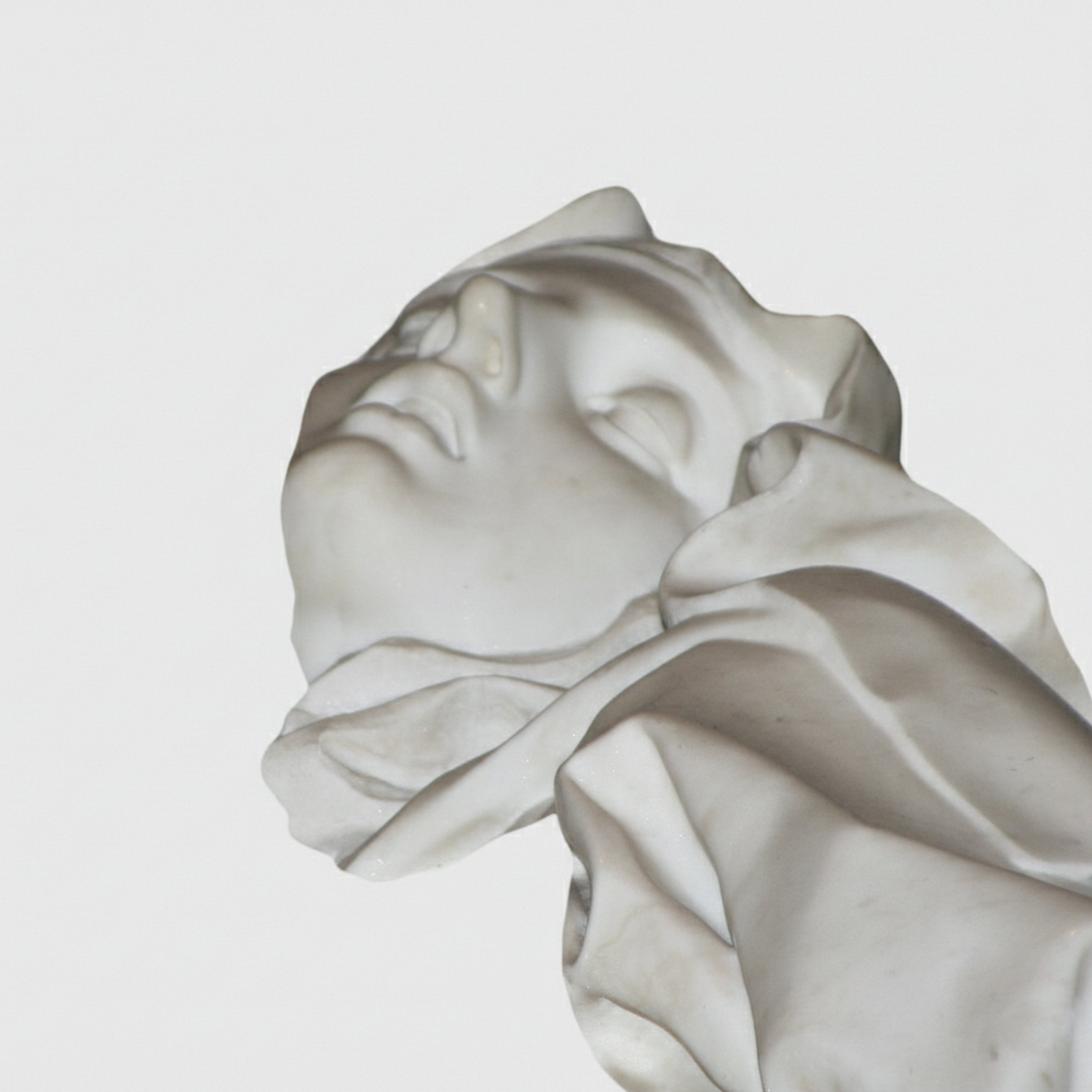
Let us look at this famous sculpture by Bernini, The Ecstasy of Saint Teresa (1657), visible in Rome in the Cornaro Chapel of the church of Santa Maria della Vittoria. The saint’s face expresses manifest jouissance, but this jouissance arises from her mystical union with the divine. The Baroque artist grasped this profound truth: sexual experience and spiritual experience participate in the same movement of transcendence. As Teresa of Avila herself wrote in 1565 (she is the one represented in the sculpture): “The soul feels wounded in the most delicious way [...] This pain that penetrates it gives it a jouissance so excessive that there is no pleasure in life that can give more contentment.”
Desire as spiritual tension
Through sexuality, whether solitary in masturbation, shared with two or more, lived in memory or projection, we touch our deepest spiritual dimension. Sexual pleasure, connected to the vital instinct, links us to the secular force that perpetuates life. Even when we seek pleasure for itself, detached from any reproductive aim, it remains anchored in this vital depth that constitutes us.
Osho, in From Sex to Superconsciousness (1968), affirmed: “Sex is the first step towards the divine.” This tantric perspective considers sexual energy as a primary form of spiritual energy, capable of being transformed and sublimated. Krishnamurti, more nuanced, invited observing without judgment the movement of desire to understand its profound nature, beyond its immediate satisfaction.
The cultural valorization of shared rather than solitary sexuality reveals this “divine” dimension. If pleasure were the only issue, masturbation would be quite sufficient. But we sense that the erotic encounter with the other makes us go out of ourselves, widens our field of consciousness in a dialogue that transcends individualities. It is this self-transcendence in carnal communion that touches the sacred, whether we name this sacred God, Nature, Life or Cosmos matters little.
Rediscovering meaning beyond the symptom
People who turn away from sexuality perhaps do not simply lack pleasure, as classical therapeutic approaches suggest. This interpretation constitutes a new form of performance injunction: those who do not experience pleasure would be deficient. I propose a different reading: these people have perhaps lost contact with the spiritual dimension of sexuality, its profound meaning linked to the very meaning of existence.
Simone de Beauvoir wrote in The Second Sex (1949): “Eroticism implies a claim of the instant against time, of the individual against the collective; it affirms separation against communication; it is rebellion against all regulation; it contains a principle hostile to society.” This rebellion is not simple hedonism but affirmation of an ontological freedom, of an irreducible singularity that nevertheless seeks to transcend itself in fusion. She thus names, through social criteria, what Osho calls “divine”.
Recognizing this spiritual depth of sexuality opens perspectives much richer than the simple technical search for lost pleasure. Spiritual engagement in sexuality, which does not at all imply a religious practice, allows for very powerful and transformative self-exploration and inner growth, as I developed in the article Presence and sexuality. We then find ourselves making choices that elevate us, connect us to this essential that transcends and grounds us.
For an erotics conscious of its dimension
I do not plead for a renunciation of pleasure but for placing it in a vaster horizon, to put oneself in relation with its grandeur. Just as one cannot be in good health by focusing on disease, one cannot live a truly fulfilling sexuality by reducing it to techniques of pleasure. Sexuality must be understood as a modality of our being-in-the-world, a way of inhabiting our existence in its most intimate and most universal dimension at the same time.
This approach requires cultivating a consciousness sensitive to the spiritual resonances of pleasure. When we experience desire or pleasure, we are not just satisfying a physiological or psychological need. We participate in a movement that inscribes us in the very mystery of life, in this creative force that animates the universe. It is because sexuality touches these spiritual depths that it mobilizes us so intensely.
The anchoring of sexuality in spirituality constitutes an infinitely richer and more delicate path than the simple quest for pleasure that one would have lost. Understanding what we truly lose in losing pleasure, and when we experience pleasure, opening ourselves to what it opens us to, that is the real issue. Sexuality can then nourish life itself rather than being reduced to a hedonistic epiphenomenon whose profound meaning we never question.


