This article describes very accurately the film « About the 21st Century : Meeting with Paul Virilio »..
“Martine Stora and Benoît Labourdette, About the 21st Century: Meeting with Paul Virilio (1995)”
Article by Nicolas Villodre in “Jeune cinéma” (April 2021).
30 April 2021
Benoît Labourdette
3 min
Article content
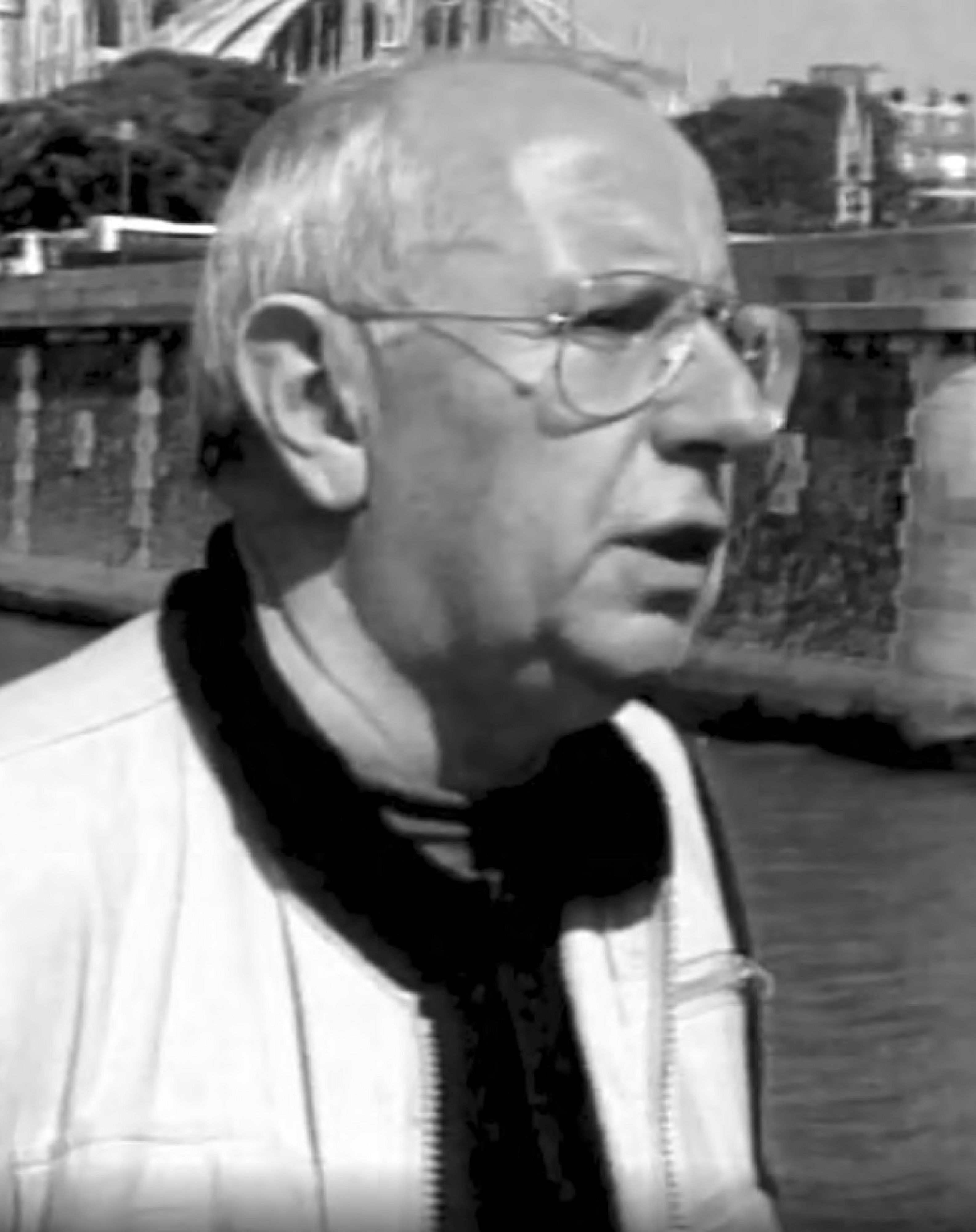
This short documentary film, signed in 1995 by Martine Stora and Benoît Labourdette, summarizes the thought and sketches the portrait of the French intellectual Paul Virilio (1932-2018). Produced a few years before the turn of the century, it is now freely available on the Internet. In a long interview, Virilio, who is very lively, discusses several themes dealt with during his long career, analyzed in detail in his works. The interview, conducted by an off-camera Martine Stora, captured by Benoît Labourdette’s Hi-8 video camera and a lapel microphone, takes place on the deck of a bateau-mouche that travels back and forth on the Seine between the Alma bridge and the Île Saint-Louis. The film is punctuated by intertitles and chromatic turns; it is preceded by a brief introduction and closed by an epilogue. The themes evoked are: art and contemplation, places and memory, literary journey, speed, virtual reality, bio-technology. The speed theorist is paradoxically filmed in a slow tracking shot over the water, reminding us of Marguerite Duras’ short film “Aurelia Steiner, Melbourne” (1977). In the open air, standing on the stern deck, Virilio evokes the “traumatic event” he experienced in Nantes in September 1943, the indiscriminate bombing of the city center by the American air force, which caused hundreds of civilian casualties and destroyed many buildings: “What for the child might have seemed eternal was only a setting that in less than an hour technology could erase. From then on, reality resided for him”more in the memory, more in the soul than in the materiality.“Before becoming an urban planner and essayist, he had taken up painting, an art that is not a way of doing but of seeing:”As long as one does not interpret what one sees, one does not see.“On two occasions, his subject matter is related to buildings in the background: we see the poster for the 1994 Nadar exhibition at the Musée d’Orsay, which dates the shot, and the memorial to the Martyrs of the Deportation designed by architect Georges-Henri Pergusson,”an almost invisible monument,“exemplary in its quality and its truth. The secret, not to say camouflaged, aspect of the building recalls the German bunkers of the Atlantic Wall that he counted, photographed, and studied for years, before building an”aesthetics of disappearance“whose title is partly inspired by Georges Perec’s novel in lipograms - with whom he and Jean Duvignaud created the review”Cause commune“in 1972. A supporter of experimental cinema, Benoît Labourdette takes care of the transitions, uses shutters, negative, saturated and solarized images, superimpositions and long moments in voice-over. What in Virilio’s words might have seemed provocative or neo-futuristic in the 90’s, is now prophetic. In particular, his observations on the passage from animal speed to mechanical speed, from sailing to motorboats, the arrival of the railroad, aviation, and the rocket, which allowed us to”reach the absolute speed“, that of light, of live broadcasting, of instantaneous transmission. In the era of teleworking, we will not be surprised by the”tearing of the hic et nunc“, the bodily transfer at a distance, of tele-seeing, tele-hearing, tele-touching, tele-smelling. As tele-tasting is not yet possible, Virilio observes with humor:”I can’t drink a bottle of wine 2,000 km away; I have to go!"
Nicolas Villodre
Documents
Working together on this subject
See also


Themes


How to cite
Benoît Labourdette, ““Martine Stora and Benoît Labourdette, About the 21st Century: Meeting with Paul Virilio (1995)””, Benoît Labourdette production, 30 April 2021.
https://www.benoitlabourdette.com/les-ressources/revue-de-presse/martine-stora-et-benoit-labourdette-rencontre-avec-paul-virilio-1995?lang=en
This is a long read: you can take it with you.
Download as PDF