What words do to cultural policy
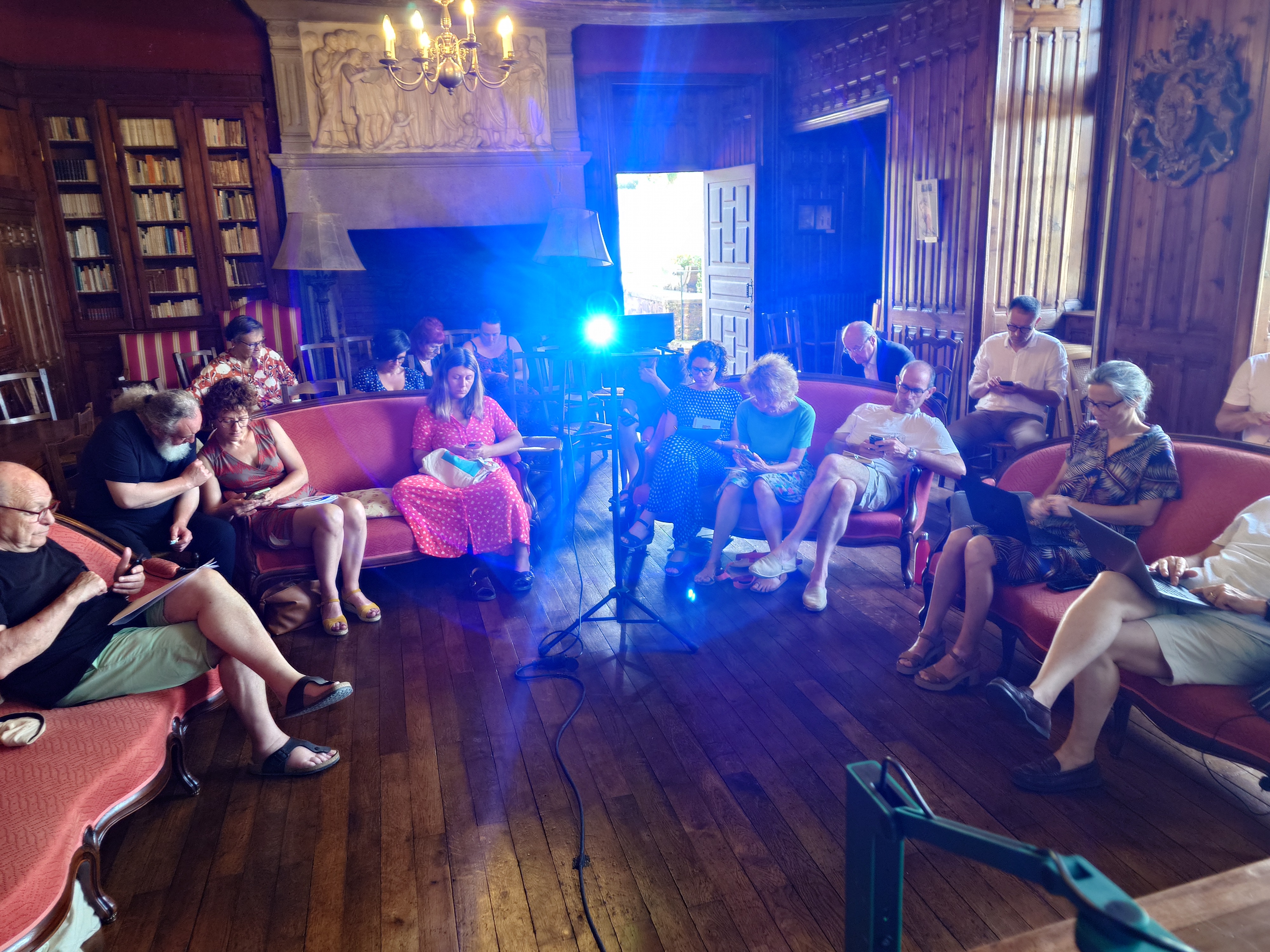
For a week, at Cerisy, researchers, artists, elected officials and practitioners confronted their ways of thinking about cultural policy. I offer here a crossing of that week through its words, because that is where everything is decided. By the end, I hope the reader will come away with a simple, cost-free tool: an attentiveness to vocabulary that lets you transform your own practice without waiting for a budget or a reform.
A symposium on the transformation of cultural policy
From 18 to 24 June 2026, the Centre culturel international de Cerisy-la-Salle, in Normandy, hosted a symposium devoted to the transformations of cultural policy. Cerisy is not a neutral place. Since the 1950s its château has hosted residential gatherings lasting several days, bringing together researchers, writers and artists around a theme, in the lineage of the Décades de Pontigny founded by Paul Desjardins in the early twentieth century. Desjardins, who had taken part in the summer meetings of the Scotsman Patrick Geddes, believed that we learn through contact with the real and through shared inquiry, rather than by receiving knowledge from on high. To hold a symposium on culture in this place was already to inherit that intuition.
The symposium was directed by Jean-Paul Ollivier, former regional director of cultural affairs for Normandy, in partnership with the Cycle des Hautes Études de la Culture, and with the support of the DRAC Normandie, of Normandie Livre & Lecture and of the Matmut. It brought together researchers, artists, elected officials, heads of institutions and practitioners. Jean-Paul Ollivier’s inaugural lecture retraced the trajectory of French cultural policy since Malraux, followed by a dialogue between two generations of leaders: Bernard Latarjet, who has marked the history of French cultural action, and Valérie Senghor, director general of the 104 in Paris. The following days brought into conversation the author and stage director Eva Doumbia, the urban planner Maud Le Floc’h, the founder of cultural venues Fazette Bordage, directors of operas and stages, officials of the Pass Culture, local elected representatives, sociologists of the digital, myself and many other voices.
With Jean-François Marguerin, former director of a regional cultural affairs directorate, I also held throughout the week the role of a reflexive pair. Every morning, for a quarter of an hour, we offered a perspective on the previous day, and we could also step in during the day to weave together the imaginaries that underlie everything being said and debated. My work consisted in revealing those imaginaries hidden beneath our ways of describing things, and in connecting them, so that together we might, rather than survey from above, analyse our own practices and what they presuppose without our noticing. I was active in this approach, but everyone took it up, and it became the spirit of the week: working on words, on representations, on ways of telling.
A reading tool to put to work tomorrow
What I learned, or rather confirmed on a large scale during this week, is that the words we use carry imaginaries, and that these imaginaries do more than describe the world: they fabricate it. The same word, depending on who uses it and from what position, opens or closes a cultural policy, an artistic action, a relationship. Learning to hear what a word does means giving oneself a means of transformation available to any cultural actor, without a budget and without a reform.
Three gestures seem to me directly applicable in everyday work:
- Look at your own practice the way an anthropologist would look at a foreign culture, in order to spot what it presupposes without your knowing.
- Start from what people already carry rather than from what you think you have to bring them, which changes everything in the way a project is conceived.
- Make trust the first condition, because it is trust, and not injunction, that authorises people to contribute.
This text unfolds these gestures through a few words that ran through the symposium, and that deserve a closer look.
A word carries a story, a story produces an apparatus
Behind each word circulates a story about who holds culture, who receives it, who decides; and once that story is installed, it produces apparatuses, in the sense in which Giorgio Agamben uses the word, everything that captures, orients and shapes gestures and thoughts. A funding scheme is an apparatus, an application is an apparatus, a performance hall is an apparatus. Agamben proposes to profane them, to return them to common use, to remove what is set apart in them so that people may take hold of them again. To work on words is one way of profaning.
It was in this spirit that, at the end of the symposium’s first day, the idea of a glossary was born, “Careful, it’s slippery”, to collect the words that change meaning, that are replaced, or that make us slip somewhere we do not yet believe ourselves to be. I found myself building it on top of everything else, during the week, because it was a way of writing inside each word the stakes that ran through it. Not to restore the symposium thematically or in a line, as I do in this article, but to give it back to be taken up differently, through the glossary and through the families of words that gather it. It now holds a hundred and thirty entries, and it accompanies this text. As I noted one morning, words are our world; they are our organ of perception.
The colloquium’s A to Z
- www.benoitlabourdette.com/_docs/projets/2026/2026_colloque_cerisy
- The colloquium’s A to Z (to print).
Most stories follow a hero, and that is a problem
In most of the stories we tell ourselves, a single figure advances and prevails. Replacing the hero with a heroine changes nothing, for the story keeps the same warlike values. Eva Doumbia recalled this through Ursula Le Guin and her carrier-bag theory of fiction. Humanity’s first tool would not be the hero’s weapon but the provisions bag, the basket that gathers and collects, that fills and empties. To tell in the manner of the basket rather than the hero is to make room for the collective, for ties, for what is gathered rather than what is conquered.
This distinction is political, because it is stories that fabricate imaginaries, and these imaginaries preside over the apparatuses we then put in place. To tell is not to describe after the fact, it is to bring into being; and what is not told is not transmitted and, in a sense, does not exist. Mehdi El Afani, who runs a festival of urban literatures, put it in a phrase I have kept: whoever controls language also controls imaginaries. This is why it falls today to artists to tell the story of their creative process, so that its place in the democratic process may once again be understood, and so that elected officials themselves may take up these stories.
The story that believes itself to be reality, and the one that knows it is situated
Not every story carries the same weight, however, and two stances stand out, in which almost everything is at play:
- The story that takes itself as an objective imposes a point of view under cover of good intention, that of teaching or of democratisation, forgetting that it is situated, that it remains one hypothesis among others. That story produces domination.
- The story that owns its subjectivity offers a point of view from a place identified as such, and subjectivity has nothing to do with a lack of seriousness, since such a story can be highly argued, highly constructed. That one produces sharing and mutual enrichment.
A story that knows it is situated can open itself to others, whereas a story that believes itself to be reality ends up wanting to crush them. The greatest danger for anyone acting in culture is therefore the overhang, the act of speaking from a viewpoint one believes neutral when it is itself a culture. During the day on the digital, a speaker judged others’ technological imaginaries to be delusional, without seeing that he was speaking from a rationalist viewpoint, which is itself one culture among others. To judge others’ imaginaries delusional from a place one believes to be outside is to act as if ethnology did not exist. The danger is not telling a story, it is telling one while believing one is not. A condescending position is always very reassuring, and that is precisely why it reassures; it would be more honest to turn the ethnologist’s gaze upon oneself.
The catastrophist imaginary is a stance of power
I insisted a great deal, especially early in the symposium, on the catastrophist imaginary, and this drew reproaches whose interest I now measure. When one holds a catastrophist imaginary, particularly about the digital and about people’s practices, one blocks one’s own energy and settles into a deeply destructive prejudice. To cultivate catastrophism, as I wrote in my notes, is to entrench one’s power, because one sides with those who would have understood everything and who would be denouncing terrible things, as if others were incapable of having a thought about what is happening to them.
I must add one thing, in honesty. By vigorously denouncing this stance, I may have found myself in the same kind of stance, wanting to seize power in my turn. I say it because this symposium saw many debates and tensions, in the productive sense of the term, and because no one, myself included, stands outside the system they describe. Vigilance does not consist in believing oneself immune, but in looking at what our ways of doing things concretely produce.
Leaving the saviour syndrome behind
Listening to the accounts and discourses of the week, a concept came to me, that of the saviour syndrome. It is illuminated by the drama triangle described by Stephen Karpman, in which three roles circulate:
- The saviour, who comes to the rescue.
- The victim, presumed helpless.
- The persecutor, held responsible for the harm.
What holds the triangle together is that each needs the others’ role, the saviour figure needing a victim in order to exist as such. Taking hold of this allowed me to gain a critical distance on the roles and functions we assign ourselves without realising it.
Cultural action is run through by this triangle whenever it thinks of itself as a rescue brought to audiences presumed less cultivated. This reaches even the noblest word in the field, emancipation, for as soon as one looks at who emancipates whom, emancipation claimed on another’s behalf turns into overhang. To want to save is a form of colonialism, the belief that culture would be magical and that it would suffice to expose people to it in order to elevate them. The words by which they are designated carry the same movement:
- The disadvantaged describes people by what they lack, measured from the place where one speaks, and no one calls themselves disadvantaged.
- The non-public ranks people by their absence from an appointment they never set.
To leave this behind means quitting all three roles at once, ceasing to distribute places in order to recognise the other as capable. When we let go of our preconceptions, the barriers fall with them.
Doing the anthropology of one’s own practice
The lesson I retain most clearly comes down to one demand: to look at one’s own practice the way one would look at a foreign culture. An absence of thought about one’s own practice often leads to using tools against the grain. Let me take an example, not to criticise it but because it was revealing. A filmmaker designed for a territory an interactive digital object, made by herself and a technician, but inaccessible on a phone, which inhabitants are then asked to come and watch together in a hall. She was projecting onto this project her professional practice and her legitimacy as a filmmaker, supposedly knowing better than the inhabitants what is good in images, and she dismissed young people’s digital practices with contempt, placing herself in overhang.
The intention was good, but she was a prisoner of her professional practice, believing that what she had to bring people was her filmmaker’s skill. Yet what she was doing there had nothing to do with that. It was a mediation project, a collective project, a shared creation. Her apparatus should therefore not have reproduced professional practices, but invented itself with people. The very making of the digital object should, from the outset, have been in the service of the democratic project, that is, giving full place and full responsibility to the people, including over the object itself.
The sign of success on display is that people gathered to watch the object. But the object hardly matters; what counts is what the tool produces, not being centred on the tool. The same project assumed that the inhabitants, especially the young with their practices on platforms, had no real digital culture. Yet even elderly people, in the most remote villages, use a smartphone every day. To design a digital tool they cannot access from their phone is to project onto them a story of backwardness that has nothing real about it. A more fitting approach would have been simpler: to run a workshop where people film and interview one another, and post their own videos on a shared account. This is not a question of technique, it is a question of stance.
The refusal to rank
Another thread runs through the projects I found most fitting: the refusal to rank. The ensemble Correspondances, a baroque music ensemble directed by Sébastien Daucé and in residence at the Théâtre de Caen, carried out an artistic education project in the priority neighbourhood of La Grâce de Dieu. Its head of cultural action, Laure Ménégoz, did not present a closed success, but an experience that questions her: how a structure specialised in a learned repertoire can build a lasting relationship with inhabitants who do not spontaneously attend either this music or the venues that host it. The founding conviction is a fine one: baroque music can move people in itself, without having to be transformed or mixed with other aesthetics to be made accessible. What remains is the gap between this conviction and the actual encounter, and it is by owning that gap, rather than masking it, that the account becomes useful to others.
The same hidden hierarchy lodges in the word excellence. At school, it was recalled that the norms of excellence are those of one particular form, that the mathematics of school are not the mathematics of research, nor the music of school that of practitioners. Excellence says the best and often means the most conforming to a school form that overvalues the written over the oral. Eva Doumbia, who told of her own inner decolonisation and the way she had to decolonise her relationship to literature, said something that sums up the stakes: what we must get rid of is hierarchisation, even more than visibilisation. And this is also what amateur practice works on, once we recognise that each person has creative capacities and that our role is to reveal them.
To emancipate is to offer the other the place they can take
This shift between a culture one brings and a culture one recognises found its simplest formula in a phrase by Jean-Claude Lemenuel, ethnomusicologist: “to accompany people in what they are doing, and not in what we would like them to do”. The shift sometimes hangs on a single preposition. To do with people supposes that one leads the project and associates them with it; to act with goes further, people take back the means themselves, they no longer take part in another’s action, they are subjects of their own.
To emancipate, ultimately, is not to raise someone towards a culture they would lack, it is to offer them the respect and the place they can take in order to deploy what they already carry. That is what we have to offer one another. Collective creativity is born not of technical virtuosity but of the quality of the bond, and when the bond is well built, people find the room to express themselves, and creativity unfolds without our having to push it.
Putting a third between people
One thing I experimented with during the week, while leading a workshop of collective photographic creation, seems to me central and appears in no discourse on mediation. For a relationship not to freeze into a face-to-face, one must put a third into it, leave the dual relation behind. The cultural object, a photograph, a text, a work, plays precisely this role of the third. We place it in the middle, we create the object together, then we look at it together, and each person has the right to say what they want without having to justify it.
I had given a broad instruction, and within that instruction each group did absolutely what it wanted, as it wanted. The only rule was to deliver a photograph and show it to the others; each was free to put whatever they wanted into it. I had phrased it thus: “it is creation that counts, do not try to illustrate”. Even though the theme was that of the transformation of cultural policy, an artistic gesture is worth first of all by intuition, by what we do without knowing why, and which will then enter into relation with the other images. I had also suggested beginning by finding a place, even a somewhat arbitrary one, and letting oneself be inspired by that milieu, in order to be in connection with the non-human, to capture what happens there and transmit it again.
Anne Aubry and Christelle Blouët, of the Réseau Culture 21 which carries cultural rights, made me a remark about my way of facilitating: I document all the time where we are, what we are doing, whether everyone agrees. In doing so, I make sure we are together. The frame is not imposed once and for all at the start, it is secured all along, and it is because people feel reassured that they can take the risk of expressing themselves. In that workshop there was the experience of making, of creating the object, but a stronger experience still, that of dialoguing together around the object. Those who had made an image did not speak, the others spoke, so that each was enriched by the others’ gaze.
A territory is a lived space, not a division
The word territory, in constant use in cultural policy, is rarely questioned, although it carries the idea of appropriation and of division. A territory is, however, a socially constructed space, made of material, symbolic and identity dimensions, a lived space and made of diverse uses. To define it in a purely quantitative way, as a catchment area, misses what is at play there.
Hence the proposal, heard several times, to prefer to it the milieu, that of which we are part, what runs through us, humans and non-humans mingled. To pass from making territory to making milieu is to accept that one is not above what one develops, but within it. The Parliament of the Loire, presented by Maud Le Floc’h, gives a concrete image of this, where jurists, ecologists, fishers and artists are heard, and where the inquiry draws on fiction to open what a report would close, in the wake of Bruno Latour and his Parliament of Things, which brings non-human entities into deliberation.
The digital, two stories in a single word
The day on the digital showed that the word “digital” carries two stories one can no longer tell apart:
- For some, it is the space of freedom of expression, of access, of sharing.
- For others, it is surveillance capitalism and the exploitation of attention.
The word platform concentrates the same ambiguity, since one no longer knows whether it designates a type of organisation, a service, a business model or a category of companies; and this imprecision is not a flaw, it is its function, for it passes off as a neutral infrastructure what is an economic actor with precise interests.
Yet three realities must be distinguished under the same word. There are commercial platforms, there are the big tech companies, and there are all the public and independent platforms one can create oneself, operate and back up, with free software, hosted on our own servers or in associative and ecological services in France. The space of contribution and collective intelligence that the digital allows is not entirely captured by big tech, and that is our responsibility. If we let ourselves be won over by the catastrophist imaginary that says everything is rotten and already controlled, we spend our energy on what we believe to be a struggle, and we deprive ourselves of it for building. Yet the digital is a tool we all use daily, with which we can build other services, public, generous, open, which in turn share other imaginaries.
This takes work, and that is the whole stake. To believe the digital should be easy and demand no effort is, on a personal level, anyone’s right; but it is a voluntary servitude. At the professional level, however, taking it that way means politically choosing to submit, for if one does not work on one’s own tools, others inscribe us in their imaginaries. To make our tools and exchange them among ourselves is a political gesture that lets other imaginaries come into being.
Taking a personal risk to keep the institution alive
The word evaluation was one of those whose principle the symposium clarified. To evaluate is to count against criteria fixed in advance, and since the operation is by nature quantitative, the expression “qualitative evaluation” is a contradiction in terms. To account for a project otherwise, other words are needed. The narrative report tells the experience, its successes and its failures. The trace follows what an action has sown beyond itself.
The most striking account in this regard was that of Yannick Lefort, director of the CEFEDEM de Normandie, which trains teachers of music and dance. On the afternoon of 21 June, he reported on a degree-granting training project carried out for the territorial authority of French Guiana, as far as the scattered villages of the Upper Maroni, reached after hours, sometimes a day, by canoe. He refused to make it a brochure, and insisted on telling the story from inside a project in progress. The project’s central gesture was a refusal: that of modelling the indigenous music and dances on European academic categories, classical, jazz, contemporary, to make them acceptable to the institution. The dossier named that danger, the risk of the denial of culture. And he titled his talk, by a palindrome, “From the margins to the trace”, because to take the margins seriously, the dwellings scattered along the river, is already to produce a trace.
The project ended up closing, under the effect of two incompatible temporalities: that of training, long and negotiated, and that of administrative management, short and irreversible, where the purchase order takes precedence over the future. An airline liquidated, a drought that makes the rivers unnavigable, an education authority that takes months to draw up an agreement, so many obstacles that are not incidents added to the project, but that belong to the territory. And yet the trace remains: the field inquiry was carried out, relationships with customary chiefs were forged, people were identified and listened to, a knowledge was produced. My thesis is that Yannick Lefort, by not going in the expected institutional direction but by taking a personal risk, does precisely what keeps his institution alive. Without personal risk-taking, an institution becomes a reproducer of the same, it loses its life and even its political meaning. This is also what we call critical thinking, the act of thinking for oneself, and it supposes daring to put oneself in danger.
The thinkers who ran through me, and the voices in the room
A symposium is made with people, and with the thinkers they convene. Several voices ran through me over the week, and it was rather I who mobilised them, because their work illuminated what was at play. Giorgio Agamben for the apparatus and profanation. John Dewey for the public and democracy as experience, against the idea of a public to be filled. Jacques Rancière, for whom explaining can subordinate one intelligence to another, and who opposes to this the equality of intelligences. Joëlle Zask for the depth of the right to participation, taking part and receiving in return. Amartya Sen for capability and the power to act. Olivier Hamant for robustness opposed to the cult of performance. Stephen Karpman for the drama triangle. Victor Klemperer for the way the slippage of words transforms the world. Serge Tisseron for denial as protection against collapse. Bruno Latour, mobilised by Élisabeth Taudière, for the milieu and the representation of non-human entities. And the Fribourg group, with Patrice Meyer-Bisch, whose Declaration on cultural rights was carried by the Réseau Culture 21.
And then there are the living voices in the room, of which I cite here only a few. Anne Aubry and Christelle Blouët, of the Réseau Culture 21, for the presentation of cultural rights. Eva Doumbia and Mathias Echenay on the democracy of words and decolonial stories. Fazette Bordage, who defends another way of counting and who says that the economy has colonised our imaginaries. Maud Le Floc’h for the Parliament of the Loire and art as a way of inquiring. William, that young nineteen-year-old intern, a philosophy student and rap author, who helped with the running of the symposium and was invited to testify about the use of the Pass Culture. Elected officials too, such as Bernard Leroy, president of the Seine-Eure agglomeration community. Directors of structures, such as Emmanuel Pousse at the château de Gaillon, Sonia Leplat at the Maison des pratiques artistiques amateurs, Martine Zussi at the Motoco in Mulhouse, or François Catala at the cultural development of the sculpture park. And all the people whose questions and disagreements made the living matter of these days.
These moments that teach us to cooperate
If I had to say what use is what I learned during this week, I would answer that it serves cooperation. These moments, even when somewhat conflictual, teach precisely how to cooperate, to listen to the other, and they show how difficult this is in a setting where there is, a priori, nothing at stake, where one is merely sharing thoughts. One then discovers that there are many stakes, many representations. The cooperations we absolutely must cultivate in order to move forward are very hard to implement, precisely because we have differing visions of things, and so one must equip oneself to dialogue in earnest.
To put in place democratic apparatuses is not to fall into relativism, where everything would be of equal worth. It is, on the contrary, to invite each person to develop their singular expertise, because we need everyone to contribute as much as possible. What we do not need is for one expertise to dominate the others and prevent them from unfolding. And this supposes one condition: putting people in trust. Critical thinking is a social risk, because not thinking like the group exposes one to exclusion from it; the neurosciences confirm it, one must feel safe in order to dare to take a risk and express oneself. The role of the public actor is therefore to authorise, to create the trust without which no one will venture to contribute.
The symposium ended on a scene that says all this better than any long development. An artist, who runs a venue and a company, presented his work calling himself generous, but in a register of language of domination, of power and control, with the best of intentions. A participant returned to him, at the close of the symposium, everything his words carried without his realising it. She did so without taking power over him, without insulting him, simply telling him what she had felt, and it unsettled him, in the good sense. We do not know what that exchange will have done to him. But there was, there, a space of dialogue on deep matters, and not on the superficial tally of the number of participants. Whether he received it or not, those who listened, and I who transcribe it, and the proceedings that will keep its trace, we can all use it to reflect on our own stances. For the word stance, too, circulated a great deal.
None of the readings of words I have just shared is final. Each is a hypothesis born of a week of conversations, open, debatable, incomplete, and anyone may contest a definition, propose another, add a word that is missing. What I bring back is not a solution but an attentiveness, and a question to ask before each project: who has the right to tell the story, and to make their story count. A story that knows it is situated can open itself to others.
The glossary “Careful, it’s slippery”, a hundred and thirty words that work on cultural policy, is available online and attached to this article in a printable version.


Drawing on Benoît Labourdette’s 30 years of experience in the field of cultural innovation and his research and methodological work, the Benoît Labourdette production agency supports cultural policies in their need for innovation, better encounters with populations, use of digital tools and cooperation, definition of mediation strategies, and support for artistic teams, technicians and elected representatives. Our method is always based on collective intelligence, cooperation and empowerment of people and structures. We work with cities and other local authorities, national networks, institutions and associations.
-

What words do to cultural policy
My situated account of a week-long symposium at Cerisy, and of what I learned there.
For a week, at Cerisy, researchers, artists, elected officials and practitioners confronted their ways of thinking about cultural policy. I offer (…) -

Educating about images, organising disagreement
Practical concepts and tools for building a shared understanding through images.
A detailed account of the lecture given on 10 June 2026 at the Archives départementales de Loire-Atlantique, for the Grandir avec la culture (…) -

The White Paper on Cultural Decentralisation
Material for Dialogue and Self-Transformation.
In late March 2026, the Observatoire des politiques culturelles (the French Cultural Policies Observatory) published a White Paper compiling (…) -

Creating to think
A French-Finnish meeting at L’Alhambra in Marseille on 4 May 2026, as part of the Erasmus+ Visual Thinkers project.
On 4 May 2026, I facilitated a professional meeting at L’Alhambra in Marseille, organised by the Image Clé association as part of the European (…) -

The Book Archipelago
A proposal to elected representatives: making plural bookshops the backbone of territorial cultural policies.
Faced with the tensions running through the bookshop sector today, it is time to put an end to the sanctuary myth. Rather than seeking an (…) -

The photography workshop: creating, showing, looking together
Reflections on a hands-on workshop facilitated by Benoît Labourdette at the professional conference “Cinema, images and young people’s mental health”, held on 14 April 2026 in Romainville, France.
A workshop in nine small groups, fifteen minutes to produce a photograph, then a moment of collective viewing in which the authors remain silent (…) -

« Mental Health and Cinema »
Synthesis of the day “Young people, their images, their spaces: new paradigms” (14 April 2026)
Synthesis of a day of professional gatherings at the Le Trianon cinema in Romainville, bringing together the perspectives of professionals from (…) -

Mental health, young people, images: what are we talking about?
Text of Benoît Labourdette’s opening talk at the professional meetings held on 14 April 2026.
Before entering into projects, we need to pin down the words. Mental health, young people, images: three notions we often use together without (…) -

Transmitting cultural rights: a question of coherence
What facilitation methods reveal about our relationship with people.
How can we talk about cultural democracy within an authoritarian framework? How can we defend respect for each person’s culture while imposing a (…) -

Mental Health and Cinema - Experiencing the World Through Images
Two professional conferences in Romainville (April 14 and 15, 2026).
On April 14 and 15, 2026, ACRIF, as part of its coordination mission for Passeurs d’images in Île-de-France, is organizing two days of (…) -

Collaborative assessment of screen literacy education in Nouvelle-Aquitaine
Collective intelligence methodology, digital platform, and collaborative publication for ALCA (2026).
ALCA, Agence Livre, Cinéma et Audiovisuel en Nouvelle-Aquitaine, entrusted me with the methodological support for a collaborative assessment of (…) -

Media Literacy: Should We Judge or Guide?
Reflections based on the National Meeting of Regional Centers for Media Literacy (Rouen, March 16–17, 2026).
On 16 and 17 March 2026, Normandie Images organised in Rouen the national meeting of France’s regional image education centres (pôles régionaux (…) -

The Meaning of Mediation Methods in Arts and Cultural Education
When practice reveals what theory ignores.
Artists and professionals involved in arts education develop singular methods that most often remain implicit. I wish to lift the veil on the (…) -

Cultural Mediation as a Device for Symbolic Emancipation
Methodological Principles for a Horizontal Approach to Collective Creation.
Lived experience radically transforms our relationship to thought. Cultural mediation does not consist of transmitting knowledge but of creating (…) -

Evaluating Arts and Cultural Education from the Artist’s Perspective
Review of a course given at INSEAC: conceptual and methodological tools for cultural professionals.
On January 15, 2026, as part of the CNAM module EAC104 “Building tools to evaluate ACE projects: qualitative and quantitative survey methodologies (…) -

Developing Psychosocial Skills Through Artistic Practices
Methodological principles for an experiential approach.
Psychosocial skills (PSS) are now at the heart of public health, education, and child protection policies. The 2023-2027 intersectoral roadmap, (…) -

When thirty-five professionals discover their psychosocial skills through creative experience
A look back at the interprofessional seminar of January 12, 2026, in Limoges: a day where theory gave way to lived experience.
At the DRAC Nouvelle-Aquitaine, educators, teachers, caregivers, and cultural actors experienced together what it truly means to develop (…) -

Image Education and Citizenship: When Youth Professionals Rethink Their Practices
{{Reflections on the “Out-of-School Time” professional day that I co-designed with ALCA and the Gironde Departmental Council.}}
On December 2, 2025, around a hundred youth, animation, and culture professionals gathered at the MECA auditorium in Bordeaux to explore together (…) -

Art and Culture in the Service of Psychosocial Skills
Account of a founding seminar for professionals of the Judicial Protection of Youth in Limousin.
On November 27, 2025, the Limousin Regional Directorate of PJJ brought together its teams for a half-day of collective reflection on psychosocial (…) -

Youth and culture: for a radical change in posture
Giving young people the power to create, not just consume culture.
How can cultural institutions break out of their chronic failure with young people? By abandoning condescension to embrace a genuine cultural (…) -

Reinventing youth reception in cinemas
Remote training for cinema operators in Lot-et-Garonne.
How can we transform our cinemas into spaces for authentic encounters with 15-25 year-olds? This question guided an intense training session with (…) -

“Participatory creation as a laboratory for democracy?”
4th edition of the biennial festival of participatory creation - Les Rencontres de la Poudrerie - Théâtre des habitants - May 16 & 17, 2025.
Les Rencontres de la Poudrerie are a moment for reflection and co-construction, at the intersection of art forms and the practice of social life. (…) -

Pour une robustesse coopérative des projets culturels
Réflexion sur les modalités de coopération territoriale et d’évaluation.
Pour que les projets culturels puissent trouver pleinement leur sens social et devenir plus robustes face aux attaques politiques qui les jugent « (…) -

Design of a professional day on “Artistic and digital practices for young people”
Act’art, artistic and cultural action in Seine-et-Marne.
As part of its mission to promote collective intelligence by facilitating local think tanks, Act’art asked Benoît Labourdette to design, (…) -

OPC Media: “What if we changed our posture?”
How can we learn to consider the richness of teenage digital practices and avoid giving in to preconceived ideas?
How can we learn to consider the richness of teenagers’ digital practices and not give in to preconceived ideas? For Benoît Labourdette, if we (…) -

Itinéraire bis, the path of cultural rights
Action research conducted by the MPAA (Paris).
Accompaniment in the animation, production of traces and fabrication of the web platform resources of the research-action “Itinéraire bis, chemin (…) -

Helping young people and professionals to speak out: “Cultures and youth policies” national meeting
Observatory of Cultural Policies / Villeurbanne (TNP, May 11 & 12, 2023).
As part of the Rencontres nationales “Cultures et politiques de la jeunesse” (“Cultures and youth policies”), which brought the year of the French (…) -

"Culture, youth and digital: designing new modalities for cultural and educational projects
Sharing of methodological tracks and professional training.
Deconstructing preconceived ideas about digital transformation and developing projects adapted to young people.The cultural offer is sometimes (…) -

“Media College” platform for Périfééries
Creation of a digital collective intelligence tool.
To meet a need for creative, intellectual emulation and the production of ideas for one of the axes of the Saint-Denis (93) city’s bid for the (…) -

Giant digital brainstorming
Design and implementation of a digital collective intelligence tool.
Method of activating a vast contribution for the axes of a cultural project. The needIn the solidarity I had with the city of Saint-Denis’ bid (…) -

The Périfééries project’s heritage council of influence
Facilitating collective intelligence in a short space of time.
As part of Saint-Denis’s bid to become European Capital of Culture 2028, I led a collective intelligence session to collect proposals on the (…) -

Reinventing cultural projects with youth?
Proposal of questions.
While public cultural action aims to reach people in their great diversity, it is clear that it is often difficult to mobilize youth. However, (…)


-

Professional meeting “Public participation”: presentation by Benoît Labourdette Interview of Benoît Labourdette by Jean-Yves de Lépinay (11’37s, 2020).
Sharing examples of audiovisual creation workshops conducted in the spirit of cultural rights: moving from “participation” to “interaction.” (…) -

The marginality of cultural institutions Lucidity of a paradigm shift.
Traditional cultural institutions, once central, have become marginal in the face of digital practices that now dominate citizens’ attention. This (…) -

Balance and supports A method for the sustainability of projects.
Based on the way the human body balances itself, for a sustainable approach to project management.Observation of nature is often very good (…) -
"Culture, youth and digital: designing new modalities for cultural and educational projects Sharing of methodological tracks and professional training.
Deconstructing preconceived ideas about digital transformation and developing projects adapted to young people.The cultural offer is sometimes (…) -
The Périfééries project’s heritage council of influence Facilitating collective intelligence in a short space of time.
As part of Saint-Denis’s bid to become European Capital of Culture 2028, I led a collective intelligence session to collect proposals on the (…)
