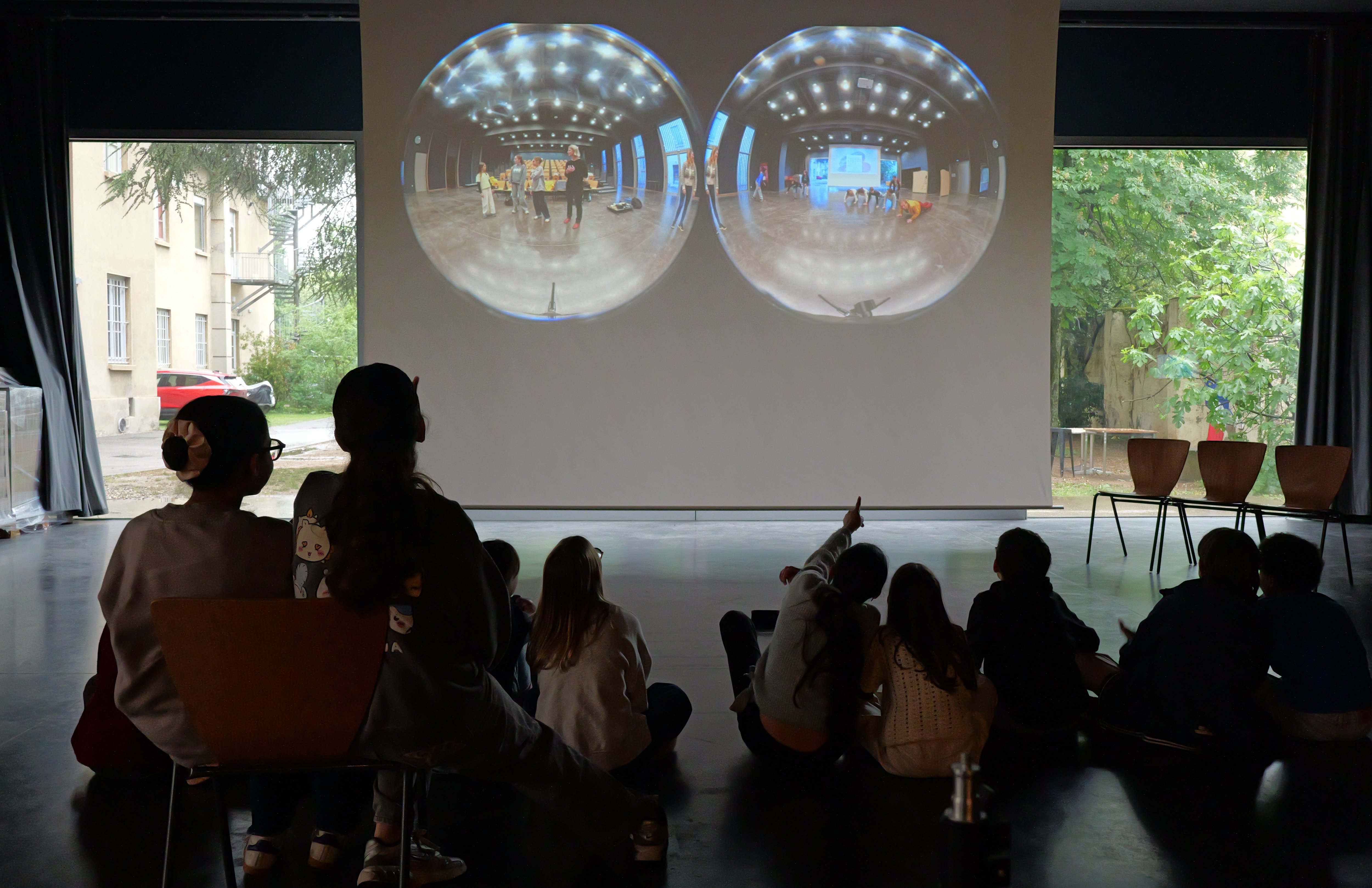
On 4 May 2026, I facilitated a professional meeting at L’Alhambra in Marseille, organised by the Image Clé association as part of the European Erasmus+ Visual Thinkers project. Around fifteen French professionals from cinema, cultural mediation, youth work and image education were present, together with the four Finnish partners of the project. The discussion turned around a simple question: how can artistic creation be a path to critical thinking? Several threads emerged over the afternoon: the priority given to the safe place in Finnish media education pedagogy; the limits of the defensive approach (fact-checking, debunking) that dominates the French field; the responsibility the facilitator carries when participants take a social risk by representing themselves publicly; the need to think of power and representation as political questions of the image. The account that follows is not exhaustive. It shares the contents and elements of method that seem to me most useful beyond the circle of participants.
The Visual Thinkers project
Visual Thinkers in Europe is a small-scale Erasmus+ project, led by the Marseille-based association Image Clé, directed by Pauliina Salminen, in partnership with the Finnish Society for Media Education (Mediakasvatus, in Helsinki) and two Finnish social and media organisations: Signaalimedia, in Helsinki, and a municipal service in the city of Turku that hosts unemployed young adults. The cinema L’Alhambra, Pôle Régional d’Éducation à l’Image (Regional Centre for Image Education), is the other French partner of the project.
Over eighteen months, the project combined a mobility in Finland (Helsinki, Turku, Tampere), monthly webinars, and the co-creation of workshop modules for young people aged 13 to 18. The 4 May meeting was the last public step before the writing of the final outputs. The audience was not made up of teachers but of professionals in cultural mediation, youth work and cinema.
A lesson in method
The afternoon had been designed in two parts: thirty minutes of conceptual introduction, then forty-five minutes of round table. The round of introductions immediately overflowed this frame. Each person introduced themselves while already speaking of their work, their organisation, sometimes opening points of debate. The round table had begun on its own.
There was a lesson in method here, for whoever facilitates a group. The aim of a meeting is for the group to enrich one another; the planned format is only a means in service of that aim. When the group spontaneously finds another path toward the same aim, that path must be welcomed. Listening takes precedence over the programme. The person who facilitates gains by accepting to be transformed by the situation, rather than reverting on instinct to what they had prepared. Following that instinct means putting the comfort of the facilitator before the quality of the encounter.
Critical thinking and creation
How does artistic creation make it possible to work on critical thinking? Agreed upon with Pauliina Salminen as the central axis of the afternoon, this question structured the whole of the exchanges.
To my mind, critical thinking is quite simply thinking for oneself. Socially, it is the most dangerous thing there is, because thinking for oneself means risking not thinking like the majority. It means exposing oneself. Creativity rests on the same gesture: to express what is within, to bring it out through a film, a photograph, a podcast, a text, a drawing, an object. Psychoanalysis calls this passage symbolisation, and we know it is constructive both personally and socially. This is why we work on creation with young people, not to make them artists, but so that they take the risk of becoming the authors of their own gaze.
There exists another way of working on critical thinking, which I call the defensive approach: that of fact-checking, of debunking, of opposing truth and falsehood. This approach dominates the French field of media and information education, and it is often carried by journalists. I have a reservation about it from the outset, and I said so openly, since the meeting was the place to discuss it. The fight against disinformation has its value. But the defensive approach erases subjectivity, presupposes a myth of objectivity, and places the work in a permanent tension between who is right and who is wrong. That tension is bad for learning. Neuroscience shows it: we do not learn when we feel in danger. The body then enters preservation mode. To think for oneself, one needs a space where it is possible to be wrong without being excluded.
Creation offers that space. Working on creativity means in fact working on critical thinking: one realises that an image does not carry a single meaning, that framing is a choice, that one can make it say whatever one wants. We do this through play. Critical thinking is built in this way, through practice, in a relaxed setting.
What Finnish pedagogy brought to the conversation
Several Finnish presentations brought precise conceptual and methodological tools to the French conversation.
In the Finnish school curriculum, as Christa, executive director of Mediakasvatus, set out, media education does not exist as a separate discipline: it is part of “multiliteracy” (multilukutaito), which includes images, texts and graphics. Mediakasvatus distinguishes thinking skills from practical skills, and works to develop the capacity to think about media rather than merely to handle them technically. Media literacy is named there as a civic and democratic competence, written into national cultural policy, and tied to security concerns (proximity to Ukraine, drones).
The most striking observation concerned the priority given to the safe place. In most of the Finnish organisations visited by the French partners during the mobility, the first sessions of a workshop are devoted entirely to building this safe place, with no aim of producing anything. In France, as Pauliina underlined, we do not have that time: we have to go fast, teachers worry. And yet, when this time is taken upstream, what follows is extraordinarily fast. This is a point of method that deserves to be set as a precondition of our work.
This priority given to emotional safety runs through the very definition of the Finnish organisations encountered. At Signaalimedia in Helsinki, run by the city’s media producer Eevi Savolainen, young people come for free, with no contract, as one would attend a leisure activity. A long eight-month film project began with an investigation conducted by the young people themselves with their peers on the question of their place in Helsinki. Eevi’s role, she says, is first of all to listen to what the young people have to say; many speak of their mental health, of things they cannot say elsewhere. The podcast itself is almost a pretext for what plays out between them.
In Turku, Hans Siikonen is a media instructor in a municipal service welcoming unemployed young adults aged 16 to 29, on six-month contracts with an allowance. The service is explicitly defined as an extension of social work: the person comes before the product. Sybille added a detail with no equivalent in France: the “starter” workshops that exist in some Finnish organisations, where one learns to wake up in the morning, to do the shopping, to cook, to keep a household. Social reintegration begins with oneself, and this philosophy runs through the whole chain, all the way to the creation workshops.
Christa finally laid out two notions from the vocabulary of Mediakasvatus that the Visual Thinkers project has worked through. Self-representation consists in giving communities the tools and the power to represent themselves, while avoiding infantilising approaches. Digital well-being is not a therapeutic side note: it is a constitutive dimension of media education.
Social risk and the responsibility of the facilitator
Several of the examples shared during the afternoon pointed to the same question: what happens when a person’s expression meets the gaze of the community?
In a secondary school the previous week, I had run a filming session with students with disabilities. At the end of the day, one of the young girls asked me for a USB key to leave with the rushes, which she wanted to show her mother that very evening, without waiting for me to put them online. I said yes without asking the teacher, because saying no would have felt impossible.
Marius, from the Dodeskaden association, brought several cases that extend this question. A journalism workshop in which secondary school girls began, microphones in hand, to talk among themselves about sexual assault. Sybille pointed out an essential fact here: if they spoke of that, it was not because they were in danger, it was because they felt safe. A young person from Felix Pyat, in Marseille, who was so proud to have played a burlesque character in his film, but who pleaded that not a single person from his neighbourhood should see it, on pain of ruining his life. And finally a workshop in a medico-educational institution with adults living with epileptic poly-disabilities, where the brief to produce a final film ended up contradicting the original aim, while merely using the tools, camera and sound recorder, had already had very strong therapeutic effects.
Pauliina, for her part, recounted the case of an adult woman from an immigrant background, who insisted on being filmed in a performance where she enacted being imprisoned by an evil husband. The film was shown in her neighbourhood, and the criticism from the community was so harsh that she had a very hard time with it. Pauliina was left with the impression that she had wanted to help, and had harmed despite herself.
The road to hell is paved with good intentions. The social risk taken by people who put themselves into representation is real, and it does not vanish because we ignore it. The conclusion to draw is not that we should stop letting people take that risk, but that we should accompany it, prepare it, discuss it with the people themselves, and accept that sometimes things do not go as planned. Marius brought a fitting formulation here: the ownership of the creation must return to the participants. For about ten years, I have offered to all the people I work with the possibility of going home with a QR code giving access to all the files of the workshop. The works are theirs. It is a question of ethics before being a question of law.
Distributing responsibilities
Maxime, a sound engineer and teacher in a film school, brought a constructive disagreement. For him, the central issue with young people is that they learn to work together, to listen to one another. The safe place alone is not enough, because it happens that one person in the group says “this is my idea, this is my creation, this is me” and rejects all the contributions of the others.
An effective way of defusing this problem is to distribute responsibilities rather than have everyone work on the same task. One person does the music, one does the lighting, one does the sound, one fills out the scene sheet. Each person has something only they do. There is then no room for comparison, no competition: the situation re-enacts on a small scale the image of a society in which we are all complementary.
I use a simple tool for this: A3 sheets printed before each scene, where one writes who does what. The young people have it in front of them, they know what is expected of them, and they know they are useful to something.
A few cross-cutting notions
The schedule did not allow us to unfold everything. A few notions deserved nonetheless to be placed on the table, even briefly, because they shed light on these professions.
Life skills, as defined by the World Health Organisation since the 1990s, are a useful path for thinking about the effect of our actions on people: psychic and social capacities, both for professionals and for the publics they work with.
Cross-sectoral work and multidisciplinarity, that is, cooperation between fields that are usually separate (audiovisual, visual arts, music, health, social work), are easy to talk about and difficult to do. Everyone asks us for multidisciplinary projects, and yet each budget line, when one looks for funding, replies: you are not in my field.
Cultural rights, written into French law for the past ten years (loi NOTRe, 2015) and stemming from the Fribourg Declaration of 2007, are a legal and methodological tool for respecting the dignity of persons and recognising the diversity of practices. They cross what Mediakasvatus calls cultural sensitivity. The formulation from April’s webinar was clear: cultural sensitivity in media education is not only about inclusion, it aims at empowerment, respect and the sharing of narratives. I try to speak of these things simply, because when presented in legal or technical terms cultural rights seem off-putting, and they deserve better.
Photography as chemistry, as memory, as power
Late in the afternoon, Pauliina shared a formulation found in a photography museum in Finland. The museum offers three paths through the same collection: photography as chemistry, photography as memory, photography as power. Beatrice added: one can look at the image with the question of manipulation, with the question of what it represents, with the question of what one can do with it. And always with the question of representation: which images one chooses to show, which images one chooses not to show.
This is the question that the Visual Thinkers project placed at the centre of its workshop model, during the co-creation in Helsinki, by choosing “power and representation” as its main theme. The choice goes beyond the narrower angle of “image manipulation” and makes it possible to enter the politics of the image without being reduced to a defensive posture.
To close, provisionally
At the end of the afternoon, I told the group that everyone had taken power, and that I thanked them for it. The format I had prepared was constantly overflowed by the richness of the words exchanged. I did not manage to present everything I had wanted to present, and I hardly regret it, since what was said in place of my prepared developments was well worth hearing.
Jamal, in the room, voiced at the end of the day a sentence that stays with me: creativity is subversive, and we are today caught in an injunction to do MIL (Media and Information Literacy), to decode, decipher, prevent, at the risk of missing what the creative dimension can bring. We need, he said, to lift our heads a little, to do joyful, expressive things, not always serious.
Thanks to Pauliina Salminen and the whole Image Clé team for this invitation, to Amélie at L’Alhambra for stepping in at short notice in place of Sephora, who was ill, to Christa, Johannes, Hans and Eevi for their sharing, and to everyone who spoke. The Visual Thinkers project continues with the writing of its final outputs.


