Media Literacy: Should We Judge or Guide?
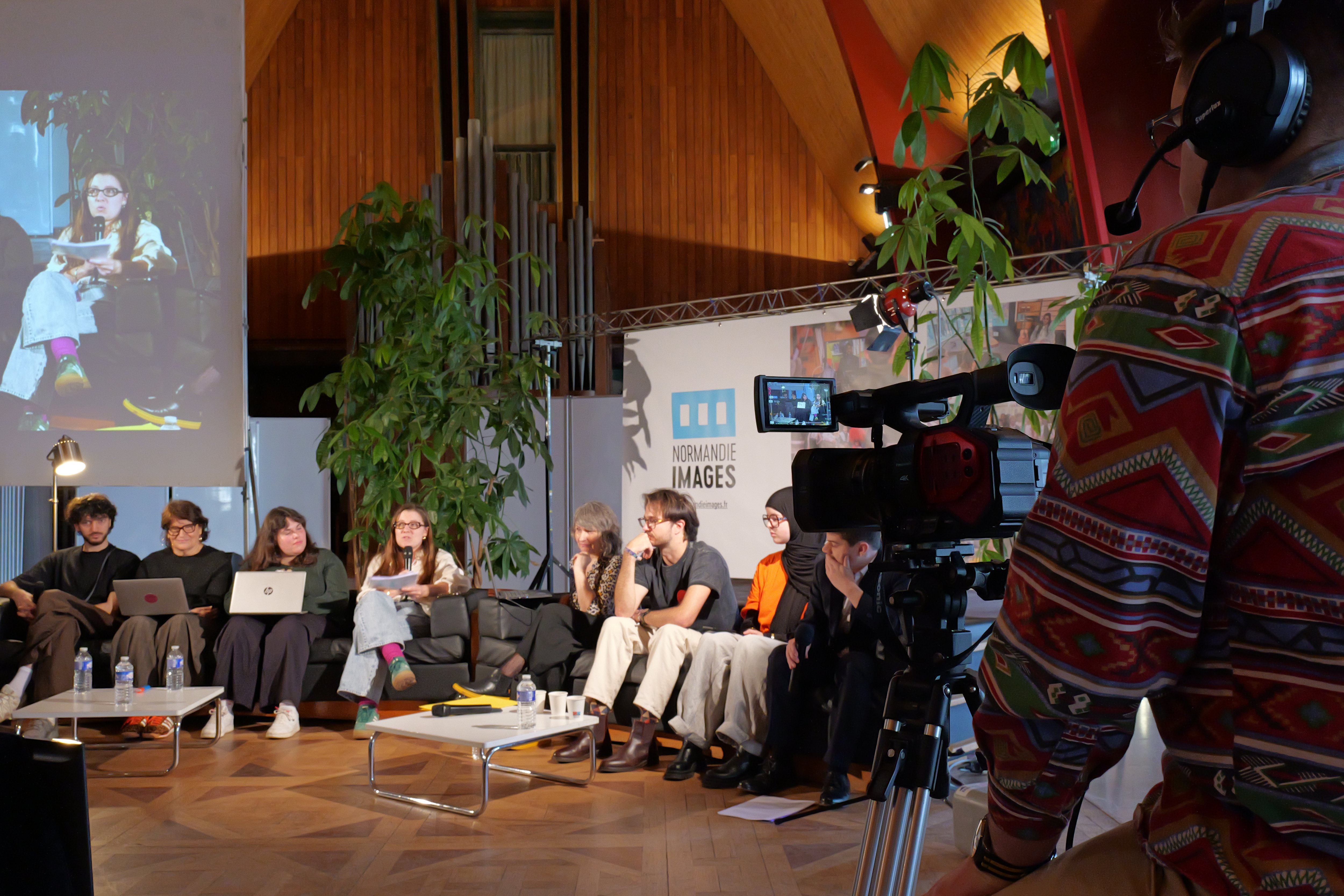
On 16 and 17 March 2026, Normandie Images organised in Rouen the national meeting of France’s regional image education centres (pôles régionaux d’éducation aux images), entitled “Le temps des regards” (“The Time of Gazes”). A hundred and fifty professionals attended, coming from all over France. I participated as a speaker in the round table on the afternoon of the first day, of which I have published a detailed account, and I followed the full two days. What follows is not a narrative of the event. Some cultural policy questions were raised explicitly during the discussions; others are reflections that the encounter inspired in me, which I share here.
Figures and a blind spot
The Association of regional image education centres published, on the occasion of this meeting, a National Overview 2024-2025 that for the first time consolidated data across the network. It is useful work. The figures are there: 550,000 annual beneficiaries, 4,300 partners, 3,000 artists and professionals mobilised, 4,300 interventions, 400 training days. The document acknowledges its methodological limitations (heterogeneous counting methods, absent budget data, variable perimeters across structures) and lays the groundwork for a permanent observatory.
These figures are useful, and they are incomplete. 550,000 beneficiaries tells us nothing about what those people experienced. 4,300 interventions tells us nothing about what the facilitators transmitted or what participants took away. Quantitative consolidation is a tool for dialogue with funding bodies, and that is precisely what it is designed for: justifying funding, demonstrating territorial presence, producing management indicators. But it is not a tool for understanding what is at stake in image education.
By way of comparison, the participatory assessment I conducted in Nouvelle-Aquitaine in 2025-2026 with Aurore Schneekönig (ALCA, coordinator of Imagi’NA) proceeds differently. The approach rests on collective intelligence: one starts from the words of field practitioners, has them work together on the problems they encounter, and lets findings and proposals emerge from those who do the work daily. The result takes the form not of a table of figures but of a mapping of issues, tensions and lines of action, rooted in people’s lived experience.
Both approaches have their value. What concerns me is that the first so thoroughly dominates the second in institutional settings. The speeches on the first day in Rouen, the remarks from the CNC, the DRACs, the elected officials, were almost exclusively structured around figures and policy announcements. That is normal for institutional speeches; it is their role. But when field practitioners take the floor, qualitative space ought to open up, and it did open, but with difficulty. Christian Dutertre, a professor of economics, warned from the audience about the pitfalls of purely quantitative evaluation. He was right. And he was virtually alone in saying so in that setting.
Authority or connection
During the morning round table, one speaker made a remark that stopped me in my tracks. Teenagers, within the “Ma classe au cinéma” scheme, were apparently allowing themselves to challenge the film choices made for them. And they needed to be taught authority again.
This remark reveals something about the logic in which part of the institution still operates. Image education, in this logic, consists of transmitting a predefined body of work to audiences who must receive it. If the audience objects, the problem lies with the audience.
Cultural rights, enshrined in French law since 2015 and 2016 (loi NOTRe, loi LCAP), offer a wholly different reading. Every person carries a culture, practices, references. The work of image education does not consist in replacing those practices with others deemed better. It consists in creating the conditions for an encounter between cultures, starting from respect for what each person carries.
When a teenager challenges a film, it is an act of speech. It is the expression of a gaze asserting itself. That gaze may be undeveloped, uninformed, clumsy. But authority answers nothing here. What answers is connection: taking that speech seriously, trying to understand what it says, accompanying the gaze towards other perspectives without invalidating theirs. It takes longer, it is harder, and it is the only path that does not reproduce a logic of cultural domination.
In my intervention that afternoon, I recalled that the policy of cultural democratisation, born in the 1960s under the impetus of André Malraux and Émile Biasini, carries the traces of its colonial origins. Biasini had been a colonial administrator before becoming Malraux’s right-hand man. The top-down logic, bringing “real” culture to those who would otherwise lack it, is structurally the same as the civilising mission. Acknowledging this lineage does not amount to condemning the work accomplished. It makes it possible to understand why this logic still produces dead ends, and why so many people, in working-class neighbourhoods, in rural areas, in disadvantaged communities, continue to say “it’s not for me”.
Three perspectives, one convergence
The afternoon round table, moderated by Jean-Marie Vinclair, brought together three very different approaches that articulated their complementarity almost immediately. There was no conflict, but rather a mutual enrichment.
Mélanie Boissonneau, a lecturer-researcher at the Sorbonne-Nouvelle, deconstructed alarmist narratives about screens, drawing on the work of Anne Cordier. There is no scientific consensus on the cognitive and behavioural effects of screen use, apart from physiological aspects (sleep, sight, hearing). She told the story of a secondary school student who claimed no longer to watch films “all the way through” but was happily binge-watching five episodes of a Korean drama with subtitles. The problem is not attention; it is what we attend to. She also described a student who, analysing La Féline by Jacques Tourneur, drew a connection to Bollywood cinema, a novel and pertinent angle. These practices are not a sign of degradation. They testify to visual cultures that are widening.
Jean-Fabrice Janaudy, distributor (Les Acacias) and exhibitor at the Vincennes cinema, offered a more conservative counterpoint, openly acknowledged as such, but rooted in thirty years of field practice. He advocates the transmission of repertoire cinema through the choice of films and the quality of mediation. One of his most telling examples: in a vocational school in Vincennes, with students from housing estates across the Île-de-France region, the screening of an American independent film had been met with hostility (“they’re showing us this because we’re Black and from the estates”). The following programme, Yojimbo by Kurosawa, The Man Who Shot Liberty Valance by Ford, North by Northwest by Hitchcock, produced the opposite effect. The students loved Yojimbo (a black-and-white, Japanese, subtitled film). Two or three were in tears at the end of Liberty Valance. One of them said: “Why do they never show us films like these?” Janaudy also described showing the complete Shoah by Claude Lanzmann over two full mornings to students from Belleville, in absolute silence.
For my part, I proposed a different conceptual framework. I began with the collective filmography exercise, in which I ask each person in a class what their favourite film is. The exercise gives each person permission to exist culturally within the group, it makes noise (which often worries the teacher, but that noise is a sign of pleasure), and it reveals visual cultures that the facilitator themselves did not know about. It is a simple gesture of cultural democracy. I then set out the framework of cultural rights and culture as an anthropological fact: culture with a capital C, the one that cultural policies defend, is only one form of culture among many, historically tied to logics of power. We, cultural professionals, are culture’s marginal figures, not its centre, since average screen time is four and a half hours per day. As Godard put it, it is the margins that hold the page together. I also proposed concrete methodological leads: devoting official time to asking young people what they watch and do with images, evaluating our own practices using cultural rights tools, and remembering that cinema itself began as a despised art form, viewed through peepholes, before becoming an art in its own right.
These two approaches do not oppose one another. Mélanie Boissonneau said it: the more we understand out-of-cinema practices, the more we strengthen the cinema experience. Teenagers who watch sped-up videos on their phones adopt different conditions when they want to see a film that interests them. It is not the same screen for the same use. And mediation, as Janaudy practises it (booklets, pre-screening programmes, classroom discussions before the screening), creates the desire that makes the film possible. What unites all three of us is the conviction that the problem is never on the side of young people. It is on the side of the conditions we offer them, or fail to offer them.
War or presence
The question of vocabulary ran through the exchanges on the first day. Catherine Morin-Desailly, senator and chair of the Culture committee, spoke of “war”, war for attention, information warfare, the weakening of young people by social media. She cited the work of David Colon. Olivier Meneux, coordinator of the FACC, suggested not using that word.
The disagreement is not semantic; it is political. A diagnosis framed in terms of war calls for warlike responses: protection, filtering, control, prohibition. Framing the same diagnosis in terms of accompaniment leads to entirely different responses: listening, presence, tooling, trust.
Current scientific research, notably by Anne Cordier, shows that there is no consensus on the cognitive and behavioural effects of screens, apart from physiological aspects (sleep, sight, hearing). The correlation between intensive screen use and ill-being tells us nothing about the direction of causality. What we do know is that the quality of attention depends on the quality of the relationship. A child who watches a film with an adult who discusses it with them afterwards is not in the same situation as a child left alone in front of a screen. The responsibility lies first with adults.
The language of war produces moral panic. Moral panic produces policies of control. Policies of control drive young people away from the institutions that claim to protect them. The regional centres, in their daily work, know this. They know that teenagers who spend three hours on TikTok are not passive victims but people doing something culturally meaningful, even if it is not what adults would like them to do. Accompanying these practices requires recognising them, not fighting them.
The centres as weavers
The nature of the work done by the regional centres is hard to name, and these two days confirmed it.
A regional image education centre is not a cinema, not a school, not a festival, not a research laboratory. It is a little of all of these, in the service of a task that has no simple name: connection. Connection between works and audiences, between institutions and territories, between professionals and teachers, between artists and populations. Olivier Meneux put it plainly: the actors of connection are those who receive the least funding.
The National Overview confirms this in its own way. The five missions of the centres, territorial coordination, observatory, arts education, laboratory and resources, training, describe interface functions. The centres produce few (if any) actions of their own; they make other people’s actions possible. This work is invisible by nature, and that is why it is threatened every time a budget is tightened. Cutting a centre means cutting the thread that connects the meshes. The net does not develop a hole; it comes undone.
Philippe Germain (Ciclic) put three proposals on the table during the first morning: moving beyond school-age silos to think about the young citizen’s journey as a whole, daring to evaluate by accepting that some schemes may need to be stopped and rethought, and transforming the role of the state so that it becomes more strategic and less prescriptive. Jean-Marie Vinclair (Normandie Images) presented the Normandy cartography, an interactive tool developed since 2019 that makes territorial networks and blank zones visible. This kind of tool changes the conversation with partners: one moves from impressions to geographical realities.
Projects that equip
If the first morning was institutional, what followed was something else entirely. The afternoon and the next day were devoted to project presentations, field reports, workshops, substantive discussions. That is where the meeting fulfilled its primary function: equipping participants, giving them confidence, ideas, concrete examples they can reinvest in their own territories.
On Tuesday, the question of young people as passeurs (transmitters) occupied the whole day. Tom Allaire, a young cinema ambassador and student at INSPE Normandie, co-moderated a round table with Juliette Vargas (CNC). What was said in that session struck me by its energy. The young people present did not speak of cinephilia as a heritage to be received. They spoke of it as a space of encounter. The film, in their practice, functions as a third term, in the sense that psychoanalysis gives to the symbolic third: an object that allows two people to meet without confronting each other directly. People gather around a film, they talk about it, and in that conversation something else circulates, something of the order of connection.
The association Nouvel Œil, the Festival du Grain à démoudre in Gonfreville-l’Orche (a festival entirely programmed by young people), the “BFF du ciné” by Salim Hamzaoui, the Young Ambassadors of the AFCAE supported by Anne Ouvrard, the work of Unis-Cité presented by Baptiste Marchand: so many schemes in which young people are not beneficiaries but actors. Tom Allaire highlighted an issue that the other speakers had not formulated as clearly: transmission between 25-year-olds and 15-year-olds is a lever at least as powerful as transmission between adults and teenagers. The gaze of a 25-year-old on cinema is not the same as that of a 50-year-old professional, and proximity in age creates a credibility that institutions cannot manufacture.
Valérie Mocydlarz (Les Yeux Verts, Brive) completed the picture with the reality of rural territories, where young cinephiles are scattered and isolated. Networking schemes, meetings, exchanges, travel, play a vital role for them in recognition and confidence.
The Tuesday afternoon opened another field: festivals as spaces for image education. Plein la Bobine, Clermont-Ferrand, Poitiers Film Festival, Festival Résistances, Festival du Film de Cabourg. The diversity of models showed that image education is not a format but an intention. A short film festival, a children’s festival, a politically engaged cinema festival all work towards the same thing by different paths: creating the conditions for an encounter between an audience and works of art.
The speakers who took the floor in these sessions were not talking about figures. They were talking about what had worked, what had failed, what they had learned by doing. It is this kind of sharing that equips professionals and that ultimately justifies 150 people travelling for two days.
Training, a silent front
One topic ran through both days without quite finding its place on the official agenda: the training of facilitators and the obstacles that the school system places in their way.
Olivier Meneux described the reality of facilitators in the Hauts-de-France region: growing self-censorship in the face of sometimes hostile audiences, the film Tomboy by Céline Sciamma all but banned under pressure from parent associations. Carole Desbarats, speaking from the floor, recalled that school heads within the national education system constitute a daily administrative and human obstacle. She added, with lucid irony, that she had been making the same points in 1999.
Twenty-seven years later, the problem is intact. The 15 measures announced in late 2025 by the Ministry of Education and the CNC will not change things on their own. A national framework, a doubling of “Ma classe au cinéma” numbers, pilot cinema conservatoires: these are levers. They will only have an effect if the facilitators who enter classrooms are trained, supported, paid decently, and find school heads who understand the value of what they bring. That cannot be decreed by a ministerial plan. It is built on the ground, over time. That is the work of the centres.
What a professional meeting is for
Professional meetings are useful and necessary. Image education professionals are often isolated in their territories, working in small structures with limited means. Coming together as 150 people for two days is, in the most literal sense, counting oneself.
But the usefulness of a meeting is measured by what each person takes home. Contacts, ideas, examples, confidence. Jean-Marie Vinclair’s Normandy cartography makes one want to build one for one’s own territory. The young passeurs schemes inspire the idea of creating one in one’s own region. The National Overview provides figures to include in funding applications. The confrontation between Emmanuel Ethis and Daphné Bruneau on the role of institutions with respect to creation gives material for rethinking one’s own positions. And informal moments complement the round tables in building the cooperations that will drive projects forward in the months to come. There could indeed be even more formalisation of these direct encounter times between participants.
This article is my way of participating in that sharing. The session videos will be accessible online, and each person present in Rouen took away their own reflections. I share mine; others will share theirs. It is in the diversity of these perspectives on the same events that collective intelligence is made.
Taking the time, opening the gaze
I could have come to Rouen on Monday afternoon, done my round table, and left. I chose to stay for both days. That choice is what opened my gaze to things I did not know.
What surprised me most was the energy of the young professionals on Tuesday. They use films as media for encounter, in the literal sense: the film is the third term that allows people to come together, to talk, to build connection without direct confrontation. This is not new in itself; it is the very principle of cultural mediation. But these young people are reinventing it with their tools, their networks, their codes, and a drive for distribution that surprised me. The Festival du Grain à démoudre, programmed by young people, the BFF du ciné, the ambassadors: these are not schemes for young people, they are schemes by young people, and the difference is fundamental.
These meetings put me in contact with a generation of professionals thirty years younger than me. I am no longer part of the “new generations”; I have done a great deal in this field, but what I have done does not feel far in the past. What struck me is sensing how much I can be useful to these younger colleagues, through experience, through methods, through the confidence I can help them build, and how much they can bring me methods and perspectives I do not have. I leave Rouen with the desire to collaborate more with these people, to move towards them.
That is, incidentally, the question the meeting carried in its title: the time of gazes. In my round table, I spoke at length about the quality of time, the time of connection, the time of care for the other. By staying for both days, I lived what I was defending. Taking the time for a professional meeting means accepting to be transformed by what one finds there. And the organisers at Normandie Images, through the people they brought together and the way they built these days, created the conditions for that transformation to be possible.
I also take away something about my own role. For a long time, I was in the field, in action, running training sessions and projects. I wrote little. Something has changed. Writing allows me to contribute differently: structuring thought, naming what happens, sharing beyond the circle of those present. It is not a withdrawal from the field; it is an extension of it. And that, too, is why I write this article: because these contents deserve to circulate, and each of us can bring our own share of conceptualisation to this shared work.

Drawing on Benoît Labourdette’s 30 years of experience in the field of cultural innovation and his research and methodological work, the Benoît Labourdette production agency supports cultural policies in their need for innovation, better encounters with populations, use of digital tools and cooperation, definition of mediation strategies, and support for artistic teams, technicians and elected representatives. Our method is always based on collective intelligence, cooperation and empowerment of people and structures. We work with cities and other local authorities, national networks, institutions and associations.
-

Creating to think
A French-Finnish meeting at L’Alhambra in Marseille on 4 May 2026, as part of the Erasmus+ Visual Thinkers project.
On 4 May 2026, I facilitated a professional meeting at L’Alhambra in Marseille, organised by the Image Clé association as part of the European (…) -

The Book Archipelago
A proposal to elected representatives: making plural bookshops the backbone of territorial cultural policies.
Faced with the tensions running through the bookshop sector today, it is time to put an end to the sanctuary myth. Rather than seeking an (…) -

The photography workshop: creating, showing, looking together
Reflections on a hands-on workshop facilitated by Benoît Labourdette at the professional conference “Cinema, images and young people’s mental health”, held on 14 April 2026 in Romainville, France.
A workshop in nine small groups, fifteen minutes to produce a photograph, then a moment of collective viewing in which the authors remain silent (…) -

« Mental Health and Cinema »
Synthesis of the day “Young people, their images, their spaces: new paradigms” (14 April 2026)
Synthesis of a day of professional gatherings at the Le Trianon cinema in Romainville, bringing together the perspectives of professionals from (…) -

Mental health, young people, images: what are we talking about?
Text of Benoît Labourdette’s opening talk at the professional meetings held on 14 April 2026.
Before entering into projects, we need to pin down the words. Mental health, young people, images: three notions we often use together without (…) -

Transmitting cultural rights: a question of coherence
What facilitation methods reveal about our relationship with people.
How can we talk about cultural democracy within an authoritarian framework? How can we defend respect for each person’s culture while imposing a (…) -

Mental Health and Cinema - Experiencing the World Through Images
Two professional conferences in Romainville (April 14 and 15, 2026).
On April 14 and 15, 2026, ACRIF, as part of its coordination mission for Passeurs d’images in Île-de-France, is organizing two days of (…) -

Collaborative assessment of screen literacy education in Nouvelle-Aquitaine
Collective intelligence methodology, digital platform, and collaborative publication for ALCA (2026).
ALCA, Agence Livre, Cinéma et Audiovisuel en Nouvelle-Aquitaine, entrusted me with the methodological support for a collaborative assessment of (…) -

Media Literacy: Should We Judge or Guide?
Reflections based on the National Meeting of Regional Centers for Media Literacy (Rouen, March 16–17, 2026).
On 16 and 17 March 2026, Normandie Images organised in Rouen the national meeting of France’s regional image education centres (pôles régionaux (…) -

The Meaning of Mediation Methods in Arts and Cultural Education
When practice reveals what theory ignores.
Artists and professionals involved in arts education develop singular methods that most often remain implicit. I wish to lift the veil on the (…) -

Cultural Mediation as a Device for Symbolic Emancipation
Methodological Principles for a Horizontal Approach to Collective Creation.
Lived experience radically transforms our relationship to thought. Cultural mediation does not consist of transmitting knowledge but of creating (…) -

Evaluating Arts and Cultural Education from the Artist’s Perspective
Review of a course given at INSEAC: conceptual and methodological tools for cultural professionals.
On January 15, 2026, as part of the CNAM module EAC104 “Building tools to evaluate ACE projects: qualitative and quantitative survey methodologies (…) -

Developing Psychosocial Skills Through Artistic Practices
Methodological principles for an experiential approach.
Psychosocial skills (PSS) are now at the heart of public health, education, and child protection policies. The 2023-2027 intersectoral roadmap, (…) -

When thirty-five professionals discover their psychosocial skills through creative experience
A look back at the interprofessional seminar of January 12, 2026, in Limoges: a day where theory gave way to lived experience.
At the DRAC Nouvelle-Aquitaine, educators, teachers, caregivers, and cultural actors experienced together what it truly means to develop (…) -

Image Education and Citizenship: When Youth Professionals Rethink Their Practices
{{Reflections on the “Out-of-School Time” professional day that I co-designed with ALCA and the Gironde Departmental Council.}}
On December 2, 2025, around a hundred youth, animation, and culture professionals gathered at the MECA auditorium in Bordeaux to explore together (…) -

Art and Culture in the Service of Psychosocial Skills
Account of a founding seminar for professionals of the Judicial Protection of Youth in Limousin.
On November 27, 2025, the Limousin Regional Directorate of PJJ brought together its teams for a half-day of collective reflection on psychosocial (…) -

Youth and culture: for a radical change in posture
Giving young people the power to create, not just consume culture.
How can cultural institutions break out of their chronic failure with young people? By abandoning condescension to embrace a genuine cultural (…) -

Reinventing youth reception in cinemas
Remote training for cinema operators in Lot-et-Garonne.
How can we transform our cinemas into spaces for authentic encounters with 15-25 year-olds? This question guided an intense training session with (…) -

“Participatory creation as a laboratory for democracy?”
4th edition of the biennial festival of participatory creation - Les Rencontres de la Poudrerie - Théâtre des habitants - May 16 & 17, 2025.
Les Rencontres de la Poudrerie are a moment for reflection and co-construction, at the intersection of art forms and the practice of social life. (…) -

Pour une robustesse coopérative des projets culturels
Réflexion sur les modalités de coopération territoriale et d’évaluation.
Pour que les projets culturels puissent trouver pleinement leur sens social et devenir plus robustes face aux attaques politiques qui les jugent « (…) -

Design of a professional day on “Artistic and digital practices for young people”
Act’art, artistic and cultural action in Seine-et-Marne.
As part of its mission to promote collective intelligence by facilitating local think tanks, Act’art asked Benoît Labourdette to design, (…) -

OPC Media: “What if we changed our posture?”
How can we learn to consider the richness of teenage digital practices and avoid giving in to preconceived ideas?
How can we learn to consider the richness of teenagers’ digital practices and not give in to preconceived ideas? For Benoît Labourdette, if we (…) -

Itinéraire bis, the path of cultural rights
Action research conducted by the MPAA (Paris).
Accompaniment in the animation, production of traces and fabrication of the web platform resources of the research-action “Itinéraire bis, chemin (…) -

Helping young people and professionals to speak out: “Cultures and youth policies” national meeting
Observatory of Cultural Policies / Villeurbanne (TNP, May 11 & 12, 2023).
As part of the Rencontres nationales “Cultures et politiques de la jeunesse” (“Cultures and youth policies”), which brought the year of the French (…) -

"Culture, youth and digital: designing new modalities for cultural and educational projects
Sharing of methodological tracks and professional training.
Deconstructing preconceived ideas about digital transformation and developing projects adapted to young people.The cultural offer is sometimes (…) -

“Media College” platform for Périfééries
Creation of a digital collective intelligence tool.
To meet a need for creative, intellectual emulation and the production of ideas for one of the axes of the Saint-Denis (93) city’s bid for the (…) -

Giant digital brainstorming
Design and implementation of a digital collective intelligence tool.
Method of activating a vast contribution for the axes of a cultural project. The needIn the solidarity I had with the city of Saint-Denis’ bid (…) -

The Périfééries project’s heritage council of influence
Facilitating collective intelligence in a short space of time.
As part of Saint-Denis’s bid to become European Capital of Culture 2028, I led a collective intelligence session to collect proposals on the (…) -

Reinventing cultural projects with youth?
Proposal of questions.
While public cultural action aims to reach people in their great diversity, it is clear that it is often difficult to mobilize youth. However, (…)


-

Image education as a space for connection
Trusting how people see to restore dialogue.
On March 16, 2026, during the National Meeting of Regional Image Education Centres, organised by Normandie Images in Rouen, I took part in a round (…) -

Film art and drones Article by Benoît Labourdette.
Filming with a drone singularly changes the way we look at the world, and perhaps the way we write film, in both political and sensitive (…) -

Leaving the house in the presence Reflections on collective presence after lockdowns.
The lockdowns of 2020 and 2021 ultimately revealed our vital need to go out and share collective moments. This experience questions the meaning of (…) -

Dilapidation of resources in supply logic For a democratic revolution of cultural practices.
Faced with the crisis in the cultural sector, it is urgent to shift from a top-down supply logic to a culture of connection and listening, (…) -
Image Education and Citizenship: When Youth Professionals Rethink Their Practices {{Reflections on the “Out-of-School Time” professional day that I co-designed with ALCA and the Gironde Departmental Council.}}
On December 2, 2025, around a hundred youth, animation, and culture professionals gathered at the MECA auditorium in Bordeaux to explore together (…)
