The photography workshop: creating, showing, looking together
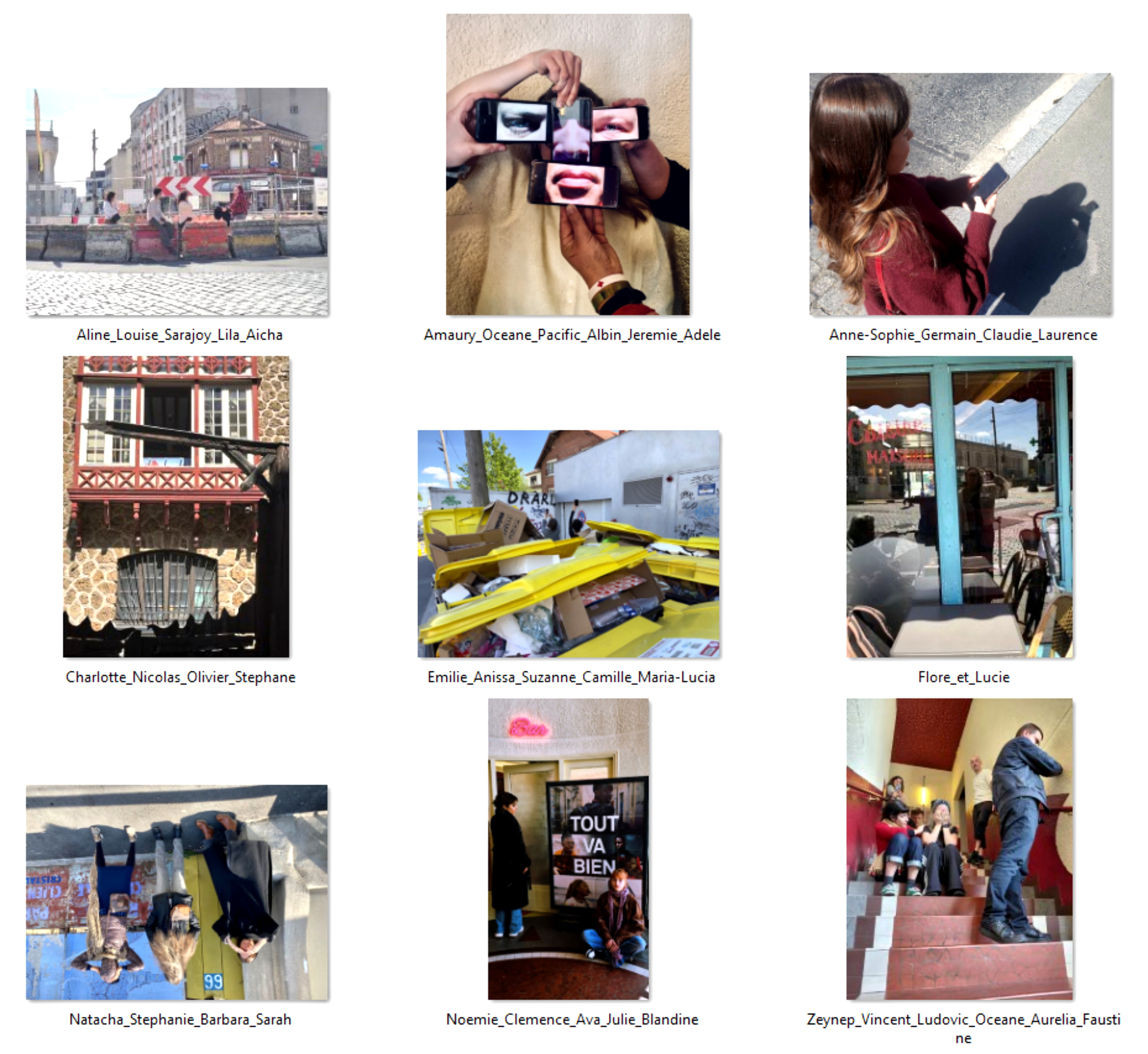
A workshop in nine small groups, fifteen minutes to produce a photograph, then a moment of collective viewing in which the authors remain silent and the others speak of what they see.
The context: an afternoon at the 14 April 2026 conference
This article recounts the photography workshop I facilitated on the afternoon of 14 April 2026, as part of the professional conference “Cinema, images and young people’s mental health”, held on 14 and 15 April 2026 at Le Trianon cinema in Romainville. The two days were organised by ACRIF within its coordination of Passeurs d’images in the Île-de-France region, the second day being co-organised with Cinémas 93. The initiative for these encounters came from Claudie Le Bissonnais, then coordinator of Passeurs d’images Île-de-France. I co-designed the first day with Diane Olivier, who has since taken over the regional coordination from Claudie, and with Maxime Bouillon, cinema mediator at ACRIF.
Two other articles published on this site accompany this one: the overall presentation of the two days on the one hand, and the text of my opening talk on the notions of mental health, young people and images on the other. I refer readers to those articles for the general framework and the basic definitions. The present text focuses on a single moment: the hands-on workshop that opened the afternoon. It is intended as a working document for professionals who might want to re-use this format, or simply to understand from the inside what it produces.
After a dense morning of definitions and a round-table discussion, the afternoon opened with a practical workshop. I had announced the principle that morning: it is not enough to reflect on images, one has to live them. The workshop, in its form and its progression, would put into practice several of the ideas developed in the morning talk.
A simple setup, a few structuring principles
The setup itself was straightforward: nine groups of four to six people, one staged photograph per group, fifteen minutes to produce it in the streets and spaces around Le Trianon, and then a time of collective viewing of the images that had been made.
The instructions were given briefly, but they carried precise intentions.
The first instruction concerned the starting point. Do not begin with the concept. Find a setting first, a place that inspires, and let the place guide the photograph, rather than looking for a setting to match a preconceived idea. This reversal, which consists in moving toward the unknown rather than confirming what one already knows, is an invitation to the unexpected.
The second instruction concerned the subject. The theme was that of the conference: mental health, images, young people. But it was not a commissioned illustration. As I said to the groups: “We’re not in school. The goal is not to explain something, but to create something.” An abstract photograph can be perfectly fitting, and it even happens that a photograph that is not entirely explicable turns out to be richer than a didactic one.
The third instruction was about signature. Each photograph would be titled only with the first names of the people who had made it. No anonymity. This insistence on signature carries a conviction: expression only holds its value if it is claimed. Hiding is more comfortable, but it means renouncing one’s existence in the common space.
The fourth instruction, this one implicit, concerned the distribution of roles. Everyone participates in their own way. Some will be in front of the lens, others behind, others still will bring props or ideas. There is no hierarchy of contributions.
Fifteen minutes outside
The groups headed out into the streets of Romainville with their phones. Le Trianon sits right next to a major urban renewal site linked to the Grand Paris Express project: orange and red construction barriers, broken pavements, temporary signs, places in transformation. Participants moved through this environment at once familiar and unsettling, looking for a setting that spoke to them.
Some groups chose to stage themselves. Others worked with objects, reflections, unexpected angles. One group photographed yellow bins in front of a piece of graffiti. Another leaned over a bridge to create an upside-down image. A third found a restaurant window and played with the reflections in the glass.
The photographs were uploaded to a shared platform via QR code, titled with the participants’ first names alone, and displayed on the projector in the room.
The collective gaze: looking without explaining
This is where the protocol took its full meaning. When the time came to look at the photographs, I set a rule that I have used for a long time and that always throws people a little at first: the people who made the photograph are not allowed to speak. It is the others, those who did not make the image, who describe what they see in it, what they feel in it, what it reminds them of.
The reversal is deliberate. In most workshops, the sharing moment is the one in which people explain what they were trying to do. Here, the opposite happens. One discovers what others see in what one has created, and it is sometimes very far from what one had in mind.
Why this setup? Methodological commentary
After we had looked at the nine photographs together, I took a few minutes to spell out the rationale behind the format. These remarks help one understand what lies under the tool, and how it can be re-used in other contexts.
Collective expression as protection. Being in a group enables something that individual expression makes difficult: daring to show something to others. In a group, one takes part in something shared, one is not alone in being exposed. This matters particularly in the field of mental health, where each person has different capacities, notably with regard to the emotional and social dimensions of the psychosocial skills I spoke about in the morning. In this kind of protocol, each participant contributes as they can, without any hierarchy of contributions.
The autonomy of the groups. There is one instruction, but the groups are then entirely autonomous. The facilitator is not “above” them: he too discovers the images. They are not the product of a guided co-fabrication, but of a genuinely autonomous creation. It is not a biased situation in which the facilitator would hold the participants’ hand and then say “what you did is great”. What has been created really came from the groups.
Starting with action: meeting the person before the pathology. There is a dimension of this workshop that only becomes fully apparent to me in retrospect, and that bears directly on the subject of the conference. In the room, both in the morning and in the afternoon, several of the people who had taken part in the short film to be screened in the second half of the afternoon were present. They are people living with psychic disorders. They were there without a label, simply as participants on the same footing as everyone else. I myself did not know precisely, in the morning, who in the audience had come to present that film; I had not realised how many of the people directly concerned were actually in the room. During the photography workshop, the groups formed naturally, without sorting: cultural professionals, care workers, social workers and people with lived experience found themselves together around the same task, producing a photograph in fifteen minutes. One of the participants wrote to me the next day to tell me that she had only realised, in the second half of the afternoon when the film was presented, that some of the people who had been in her group during the workshop were living with a mental health condition. She had not suspected anything until then. She had met them first as people.
This point is not incidental. It says something about what collective creative action can do on the question of stigmatisation. Starting with an action that has a third object, in this case a photograph to be made together, is to give oneself a point of departure that is not the pathology. Attention is directed elsewhere, toward the setting to find, toward the staging to imagine. People meet one another as people, through what they do together, and not through what they suffer from or what they work on professionally. This is precisely one of the essential stakes of a sound approach to mental health issues: to come back to the person, to who they are, without reducing them from the outset to their pathology. Pathologisation, when it takes up all the space, is dehumanising, and it closes off the spaces of construction in which the person might otherwise exist.
A nuance needs to be made clear, because it is easy to miss. Meeting the person before their pathology does not mean denying that pathology, or acting as though it did not exist. The participants in the film said as much themselves during the afternoon discussion: naming the pathology matters, and for several of them the psychiatric diagnosis had been a relief, the end of a wandering, the possibility at last of putting a word on something that had been there for a long time. One of them used the expression coming out, and the expression was fitting. What is at stake in the format we put in place is thus not the erasure of the pathology, but its placement in context. There need to be spaces in which the pathology can be named, shared, accompanied, and this is precisely what the film and the discussion that followed made possible. There also need to be spaces in which the subject is not the pathology, in which the person exists as a person, among others, around an activity that is not about them. The coexistence of these two kinds of space, within a single day, is what gave the programme its strength. The one would not have worked without the other.
The silence of the authors. When one explains what one intended to do, one reduces the creation to its intentionality. Yet artistic creation exceeds us. The gaze of others allows us to understand better what we have done: it opens, whereas explanation closes. One sees things in one’s own image that one had not put there, and sometimes one realises that others see superb things in an image one considered mediocre. There is something here of recognition and of discovery. It is constructive in the strong sense of the term.
Reception as an experience of construction. There is a point I would like to underline, because it seems to me often underestimated: reception is not a secondary moment in relation to creation. It is in itself an experience of symbolisation, and of self-construction. I recalled in the morning the three functions images can fulfil in our practices: to symbolise, to share, to act. The workshop allows one to experience concretely what “to share” means. Someone who has created an image will in fact meet it in several moments. First there is the encounter with one’s own image, the moment one sees it appear on the screen, having crossed over to the side of the gaze: this is already an event, often unexpected. Then there is the encounter with that same image in a social space, when others are looking at it and saying things that do not necessarily coincide with what one saw there oneself. This gap is not a problem, it is a resource: it opens, it enriches, it shifts. And then there is what one experiences in looking at the images of others, in discovering their poetry, their depth, their social dimension, even though one watched those images being made alongside one’s own. These three moments accumulate within a single experience, and this is why I say that the gaze of others is constructive, and even constitutive. One does not build oneself only by creating. One builds oneself just as much by looking, and by being looked at in what one has made.
Polysemy as a resource. We saw, in the readings of each photograph, how different the gazes were, sometimes opposed. No one was wrong. An image does not have a fixed meaning. To say that diverse gazes all have their place and their value, that there is not one truth but as many truths as there are singular gazes, is a lesson that goes beyond the workshop. In a world of images where powerful actors claim that images have a single meaning (their own), to say that this is false is a political gesture.
The question of sharing the work. An often neglected point in practice-based workshops: when one shows the “result”, the film, the photographs, to partners or to funders, one enters a register of judgement. Is it good? Is it good enough? This can push facilitators to “improve” the participants’ productions for the final showing, which betrays the process. This is also one of the reasons why, in the vocabulary of practice-based artistic workshops, I prefer the word “construction” to the word “valorisation” one hears so often: to valorise presupposes a prior devaluing, and this sets up a hierarchy that can undermine people. One alternative consists in sharing back not only the result, but the process: the stages one went through, what was built, what encounters took place. This shifts attention from evaluation to discovery. And it requires documentation as one goes, of what happened along the way: session photographs, a logbook, various traces.
One spends more time looking together than making: it is there that the image takes on its existence in the social space. It is at the moment of looking together that it becomes something for each person.
Appendix: the photographs and the responses they drew
I gather here, photograph by photograph, the reactions that were voiced during the time of collective viewing. These are not constructed analyses but words spoken as the gaze unfolded, as they were said in the room. If I want to keep a trace of them, it is because they show, in very concrete fashion, what has just been described in the methodological section of this article: the diversity of gazes that a single image can give rise to, the way these gazes open rather than close, and the constructive, even constitutive, character they hold for those who voice them as well as for those whose image is being looked at. One will see that the same photograph can call forth very different, sometimes contradictory readings, and that this plurality is not a blur but the very form through which the image exists in the social space. Each photograph is preceded by a short visual description, then followed by the comments gathered.
Aline, Louise, Sarajoy, Aïcha — the construction barriers
The photograph shows four people sitting on orange concrete barriers, in front of an intersection under roadworks. The group is arranged with a space between some of them and the others.
- A counter-current, an open space on all sides. Barriers, an intersection.
- I see nothing, I watch nothing, I hear nothing: the three monkeys.
- There is the group, and there is being together.
- I see solidarity on one side, and that thing under roadworks on the other. There is something like a border.
- Metaphorically, the great worksite of adolescence.
- There is a space in front, a space behind, like a description of the psyche, the conscious and the unconscious.
- There is one person who makes the link, seated between the two.
- The three red arrows separate the three figures on the left from the figure on the right.
Amaury, Océane Pacifique, Albin, Jérémy, Adèle — the composed portrait
The photograph reconstructs a human face by assembling pictures of eyes, nose and mouth displayed on three mobile phones, held by several hands, in front of the real face of a person whose head is in the background. One of the phone-holders wears a bracelet with a red cross.
- Direction, a way: several paths inside oneself.
- Fragmentation, ambivalence: patchworks within us.
- Co-construction, the intergenerational.
- I have the feeling that it is turning, there is something like a pivot in the middle of the image.
- There is a real person behind, but she is completely reconstructed by the images, as though our existence were more in the images than in real incarnation.
- There is something really positive and joyful, it is not sad.
- It looks a bit like Frankenstein, a human made of many pieces.
- The red cross on the bracelet echoing the crosses on the phones: there is a hospital feel to it.
Anne-Sophie, Germain, Claudie, Laurence — the shadow and the phone
The photograph is taken from some height. It shows a woman seen from behind, from above, holding a phone. The shadow projected on the ground shows the same posture, but slightly different, as though the shadow were holding the phone differently.
- It is the theatre and its shadow.
- There is all the side of the shadow, it could be another person. Something that is projected, but that is not really oneself.
- A duality within us. Like an avatar.
- It looks as though she is photographing her own shadow, as though it were a reflection of ourselves that we send back, that is not really us, but at the same time yes.
- I thought at first glance that it was the shadow of someone else, because the posture is different in the two.
- The smartphone is in the centre, perfectly aligned, it is reassuring in a way.
- Taken from above: it can give a sensation of surveillance.
- It recalls what was said this morning: young people passing through the screen as a link with the outside, with the restriction of movement.
Charlotte, Nicolas, Olivier, Stéphane — the façade and the wood
The photograph shows the stone façade of a building, with red-framed windows, a small piece of semi-historical architecture, and in the foreground a structure of burnt, irregular wood that evokes a gallows or an easel.
- It looks like a gallows.
- The prison below and the gallows at the exit. At the same time, there is a photograph of Robert.
- Is it death, is it freedom?
- It strikes on one side, as though it cancelled something about that window.
- A striking contrast between the house behind, all straight, all clean, and the elaborate quality of the wood.
- I wonder whether it is a screen we can see in the open window.
- I see a conflict of generations. The bourgeoisie behind, looking down from above. Something quite violent.
Émilie, Anissa, Suzanne, Camille, Maria-Lucia — the yellow bins
The photograph shows overflowing yellow rubbish bins in the foreground, occupying most of the frame, with two people in the background photographing a tag on a wall.
- It is chaos.
- It gives me the impression that the world is just heaps of rubbish. And yet they try to make nice pictures, as though to give a fine image of a vile world.
- It is the opposite: it is rather the idea that with phones, one can show a daily life that is usually not seen, that people try to hide.
- The yellow lines bring order to the image. In the disorder, the gaze manages to put things in order.
- The human is very small in terms of surface, but absolutely central.
- There is something about distance: they turn their backs to the bins. A refusal to see.
- The yellow-vest bins.
Flore and Lucie — the reflection in the shop window
The photograph shows the window of a restaurant named “Cuisine Maison” with a complex reflection: the photographer sees herself in the glass, makes a sign with her hand (a kind of victory or peace sign), and in the reflection one also glimpses the street behind and the interior of the restaurant.
- The reality of the mirror.
- It is not a selfie, but at the same time it is a photo of oneself in a mirror, without really showing oneself. Between taking a selfie and not taking one.
- This photo makes me think of Jacques Tati’s film Mon Oncle. There is a confrontation between an old Paris and a more modern space, people who do not quite know how to live in this change.
- How we try to make our own way between ourselves, the world, the reflection, the others: each one their own space.
- There is a screen that allows passage, that is not a border but a passage.
- There is a pharmacy in the frame.
- It echoes the red cross from the other photograph.
Natacha, Stéphanie, Barbara, Sarah — the inverted image
The photograph shows three people standing against a wall covered in old peeling paint, seen in steep upward view from the ground: they appear upside-down in the image, as though suspended by their feet, with a number 99 visible on the ground.
- What is funny is that they are in the shadow. Their feet are at the bottom. And the idea of standing in the shadow: I see ghosts.
- It is as though they were at once facing us and turning their back. And upside-down as well, hanging by their feet.
- The 99 is striking. When one does not understand much, one clings to the 99 one thinks one understands, although it is upside-down. Sometimes, when one does not understand anything, one clings to things that are false anyway.
- Across all these photographs, there is an old quality, the old wall, the old architecture. There is something about the link with the past.
Noémie, Clémence, Ava, Julie, Blandine — the film ’Tout va bien’
The photograph is taken in the foyer of Le Trianon. A young woman sits on the floor against the poster of the film Tout va bien (by Thomas Ellis), on which adolescents are depicted. A second person stands a little apart, looking at the poster. The poster, with its frames and figures, fits into the doorways and the architecture of the foyer.
- A kind of indifference: she looks at the poster as though to say: you are not well, but in spite of it all you are obliged to be well.
- She looks at the poster more than at the person.
- There is a confusion of frames within the frame.
- The heads are the same size on the poster and in front of the poster.
- It is a space composed of images, texts, and pieces of the concrete world. One can no longer tell what is in the image and what is outside it.
Zeynep, Vincent, Ludovic, Océane, Aurélia, Faustine — the staircase
The photograph is taken in the staircase of Le Trianon, from below. Two people are seated in a corner, one hiding her face in her hands, the other looking toward the camera. A third person is descending the stairs, back to the camera, seemingly indifferent. At the top, a person photographs the scene with their phone.
- I see something about bullying. The guy leaving is the one who was violent. Someone keeps a trace of a drama that has just happened. The guy in the middle could not care less.
- Indifference: he is not in the empathy around.
- There is a light very much behind. A seat that takes care of the other too.
- The question of choice: of what one takes part in. Are we only witnesses or do we place ourselves in the situation?
- The setting looks a bit like The Cabinet of Dr. Caligari. It is expressionist. The great vanishing lines. A reference to 1920s German cinema.


Drawing on Benoît Labourdette’s 30 years of experience in the field of cultural innovation and his research and methodological work, the Benoît Labourdette production agency supports cultural policies in their need for innovation, better encounters with populations, use of digital tools and cooperation, definition of mediation strategies, and support for artistic teams, technicians and elected representatives. Our method is always based on collective intelligence, cooperation and empowerment of people and structures. We work with cities and other local authorities, national networks, institutions and associations.
-

Creating to think
A French-Finnish meeting at L’Alhambra in Marseille on 4 May 2026, as part of the Erasmus+ Visual Thinkers project.
On 4 May 2026, I facilitated a professional meeting at L’Alhambra in Marseille, organised by the Image Clé association as part of the European (…) -

The Book Archipelago
A proposal to elected representatives: making plural bookshops the backbone of territorial cultural policies.
Faced with the tensions running through the bookshop sector today, it is time to put an end to the sanctuary myth. Rather than seeking an (…) -

The photography workshop: creating, showing, looking together
Reflections on a hands-on workshop facilitated by Benoît Labourdette at the professional conference “Cinema, images and young people’s mental health”, held on 14 April 2026 in Romainville, France.
A workshop in nine small groups, fifteen minutes to produce a photograph, then a moment of collective viewing in which the authors remain silent (…) -

« Mental Health and Cinema »
Synthesis of the day “Young people, their images, their spaces: new paradigms” (14 April 2026)
Synthesis of a day of professional gatherings at the Le Trianon cinema in Romainville, bringing together the perspectives of professionals from (…) -

Mental health, young people, images: what are we talking about?
Text of Benoît Labourdette’s opening talk at the professional meetings held on 14 April 2026.
Before entering into projects, we need to pin down the words. Mental health, young people, images: three notions we often use together without (…) -

Transmitting cultural rights: a question of coherence
What facilitation methods reveal about our relationship with people.
How can we talk about cultural democracy within an authoritarian framework? How can we defend respect for each person’s culture while imposing a (…) -

Mental Health and Cinema - Experiencing the World Through Images
Two professional conferences in Romainville (April 14 and 15, 2026).
On April 14 and 15, 2026, ACRIF, as part of its coordination mission for Passeurs d’images in Île-de-France, is organizing two days of (…) -

Collaborative assessment of screen literacy education in Nouvelle-Aquitaine
Collective intelligence methodology, digital platform, and collaborative publication for ALCA (2026).
ALCA, Agence Livre, Cinéma et Audiovisuel en Nouvelle-Aquitaine, entrusted me with the methodological support for a collaborative assessment of (…) -

Media Literacy: Should We Judge or Guide?
Reflections based on the National Meeting of Regional Centers for Media Literacy (Rouen, March 16–17, 2026).
On 16 and 17 March 2026, Normandie Images organised in Rouen the national meeting of France’s regional image education centres (pôles régionaux (…) -

The Meaning of Mediation Methods in Arts and Cultural Education
When practice reveals what theory ignores.
Artists and professionals involved in arts education develop singular methods that most often remain implicit. I wish to lift the veil on the (…) -

Cultural Mediation as a Device for Symbolic Emancipation
Methodological Principles for a Horizontal Approach to Collective Creation.
Lived experience radically transforms our relationship to thought. Cultural mediation does not consist of transmitting knowledge but of creating (…) -

Evaluating Arts and Cultural Education from the Artist’s Perspective
Review of a course given at INSEAC: conceptual and methodological tools for cultural professionals.
On January 15, 2026, as part of the CNAM module EAC104 “Building tools to evaluate ACE projects: qualitative and quantitative survey methodologies (…) -

Developing Psychosocial Skills Through Artistic Practices
Methodological principles for an experiential approach.
Psychosocial skills (PSS) are now at the heart of public health, education, and child protection policies. The 2023-2027 intersectoral roadmap, (…) -

When thirty-five professionals discover their psychosocial skills through creative experience
A look back at the interprofessional seminar of January 12, 2026, in Limoges: a day where theory gave way to lived experience.
At the DRAC Nouvelle-Aquitaine, educators, teachers, caregivers, and cultural actors experienced together what it truly means to develop (…) -

Image Education and Citizenship: When Youth Professionals Rethink Their Practices
{{Reflections on the “Out-of-School Time” professional day that I co-designed with ALCA and the Gironde Departmental Council.}}
On December 2, 2025, around a hundred youth, animation, and culture professionals gathered at the MECA auditorium in Bordeaux to explore together (…) -

Art and Culture in the Service of Psychosocial Skills
Account of a founding seminar for professionals of the Judicial Protection of Youth in Limousin.
On November 27, 2025, the Limousin Regional Directorate of PJJ brought together its teams for a half-day of collective reflection on psychosocial (…) -

Youth and culture: for a radical change in posture
Giving young people the power to create, not just consume culture.
How can cultural institutions break out of their chronic failure with young people? By abandoning condescension to embrace a genuine cultural (…) -

Reinventing youth reception in cinemas
Remote training for cinema operators in Lot-et-Garonne.
How can we transform our cinemas into spaces for authentic encounters with 15-25 year-olds? This question guided an intense training session with (…) -

“Participatory creation as a laboratory for democracy?”
4th edition of the biennial festival of participatory creation - Les Rencontres de la Poudrerie - Théâtre des habitants - May 16 & 17, 2025.
Les Rencontres de la Poudrerie are a moment for reflection and co-construction, at the intersection of art forms and the practice of social life. (…) -

Pour une robustesse coopérative des projets culturels
Réflexion sur les modalités de coopération territoriale et d’évaluation.
Pour que les projets culturels puissent trouver pleinement leur sens social et devenir plus robustes face aux attaques politiques qui les jugent « (…) -

Design of a professional day on “Artistic and digital practices for young people”
Act’art, artistic and cultural action in Seine-et-Marne.
As part of its mission to promote collective intelligence by facilitating local think tanks, Act’art asked Benoît Labourdette to design, (…) -

OPC Media: “What if we changed our posture?”
How can we learn to consider the richness of teenage digital practices and avoid giving in to preconceived ideas?
How can we learn to consider the richness of teenagers’ digital practices and not give in to preconceived ideas? For Benoît Labourdette, if we (…) -

Itinéraire bis, the path of cultural rights
Action research conducted by the MPAA (Paris).
Accompaniment in the animation, production of traces and fabrication of the web platform resources of the research-action “Itinéraire bis, chemin (…) -

Helping young people and professionals to speak out: “Cultures and youth policies” national meeting
Observatory of Cultural Policies / Villeurbanne (TNP, May 11 & 12, 2023).
As part of the Rencontres nationales “Cultures et politiques de la jeunesse” (“Cultures and youth policies”), which brought the year of the French (…) -

"Culture, youth and digital: designing new modalities for cultural and educational projects
Sharing of methodological tracks and professional training.
Deconstructing preconceived ideas about digital transformation and developing projects adapted to young people.The cultural offer is sometimes (…) -

“Media College” platform for Périfééries
Creation of a digital collective intelligence tool.
To meet a need for creative, intellectual emulation and the production of ideas for one of the axes of the Saint-Denis (93) city’s bid for the (…) -

Giant digital brainstorming
Design and implementation of a digital collective intelligence tool.
Method of activating a vast contribution for the axes of a cultural project. The needIn the solidarity I had with the city of Saint-Denis’ bid (…) -

The Périfééries project’s heritage council of influence
Facilitating collective intelligence in a short space of time.
As part of Saint-Denis’s bid to become European Capital of Culture 2028, I led a collective intelligence session to collect proposals on the (…) -

Reinventing cultural projects with youth?
Proposal of questions.
While public cultural action aims to reach people in their great diversity, it is clear that it is often difficult to mobilize youth. However, (…)


-
Mental health, young people, images: what are we talking about?
Text of Benoît Labourdette’s opening talk at the professional meetings held on 14 April 2026.
Before entering into projects, we need to pin down the words. Mental health, young people, images: three notions we often use together without (…) -
« Mental Health and Cinema »
Synthesis of the day “Young people, their images, their spaces: new paradigms” (14 April 2026)
Synthesis of a day of professional gatherings at the Le Trianon cinema in Romainville, bringing together the perspectives of professionals from (…) -
Mental Health and Cinema - Experiencing the World Through Images
Two professional conferences in Romainville (April 14 and 15, 2026).
On April 14 and 15, 2026, ACRIF, as part of its coordination mission for Passeurs d’images in Île-de-France, is organizing two days of (…) -

Image Forum: conference “When digital creation enhances self-esteem”. Conferences
Active conference to equip social actors with digital skills to work on self-esteem with adolescents. Exchange of experiences and practices, and (…) -

Tutorials for doing video activities with your children Podcast by Benoît Labourdette (1’37s, 2020).
Very simple tutorial (1 minute 30) to conduct two creative audiovisual activities with your children.During the confinement period in (…)
