Making virtual reality a ground for student autonomy
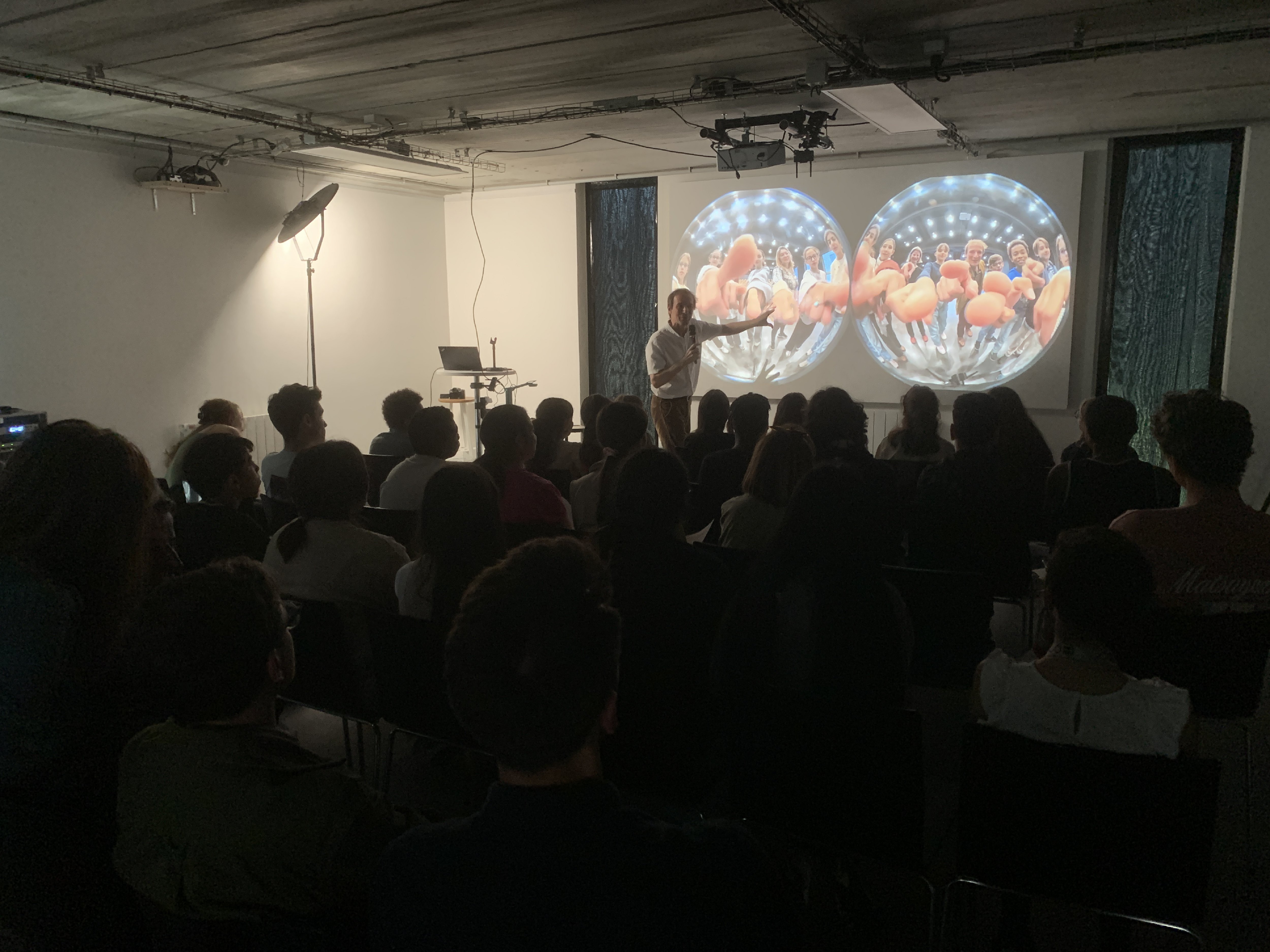
Over the 2025-2026 school year, three classes of middle school students from the Lyon Metropolis made six short films in virtual reality, as part of a Digital Cultural Class run by the Erasme innovation lab. This is the account of a project in which cutting-edge technologies became, for the students, a ground for autonomy and a lever for emancipation through creation.
Erasme, or why a metropolis builds itself an innovation lab
The story begins in a metropolis that, in 2002, made an uncommon choice. Rather than handing over the modernisation of its public services to outside contractors, the Grand Lyon urban community, which became the Lyon Metropolis in 2015, founded its own public innovation lab: Erasme. The wager made by those who launched it was that a local authority needs a place of its own, staffed by public-sector workers, where things are prototyped, tried out, sometimes failed, and shared with researchers, artists, teachers, associations and companies — a place where what could tomorrow become public policy is shaped first.
Twenty-four years on, Erasme is now housed at Pôle Pixel in Villeurbanne, a former industrial site converted into a cluster of companies and organisations dedicated to image and creative industries. The place itself, by its very geography, tells a shift: creative work has taken root where factories once stood. In Erasme’s studios, experimentation with generative artificial intelligence for public uses sits alongside the prototyping of connected objects, the invention of democratic-deliberation set-ups, work with schools around educational robotics, tinkering with micro:bit boards, and explorations of “vibe coding”. The team goes out into the local towns, hosts classes in its studios, and runs residencies with artists and researchers. What this place looks for can be put in a sentence: an innovation that has meaning, that transforms our ways of doing things together in a given territory, not innovation for the sake of innovation.
To be invited to work inside an institution like that is not the same as walking into an ordinary school setting. One enters a tradition of experimentation in which the patience of public service meets the freedom of a creative workshop. I felt this from the start, and it is what, to my mind, made possible what we did this year.
The Digital Cultural Class, a programme that has existed for two decades
Digital Cultural Classes, or CCNs (Classes Culturelles Numériques), are one of Erasme’s longest-standing programmes. Each year, the lab opens a call to middle schools, primary schools and medico-educational institutes across the territory. Artists, scientists and associations propose projects that teachers will run with their classes over several months, weaving together online sessions on the laclasse.com platform, video briefs sent by the practitioners, in-person meetings, and shared closing showcases. The Metropolis funds the whole programme, which makes it possible to reach institutions that would otherwise be excluded from this kind of project, and to mix very different audiences in a single setting.
Christophe Monnet, who has steered the programme since its origins, likes to say that virtual reality, in this context, is a little as though the Lumière brothers had invented the camera and we had immediately put it in the hands of schoolchildren to let them make cinema. The comparison struck me, because it names accurately what is at stake. A new medium always goes through a period when its uses are not yet fixed, when one can still invent, with it, what the industry had not planned for. VR, today, is in that state. This is the moment when education and creation can shape its use, rather than receiving it once it has been standardised. That is the moment Erasme’s team chose to seize, by proposing the first CCN devoted to virtual reality.
At the closing showcase, Christophe Monnet said something to the students that I want to record here: “I think I can say that you are the first middle school students in the Lyon Metropolis to have made virtual reality films. And that is not nothing.” This first-ever, on a given institutional territory, places these young people in a story larger than their own. It gives them, without anyone needing to underline it, a legitimacy that very few young people of their age get to experiment with. It is the fruit of patient work by Erasme’s teams and their partners, and it changes something quiet but deep in the way these young people can, going forward, think of themselves in relation to technologies.
A first encounter that is not a meeting
The project started in October 2025, with a day of encounter at Erasme bringing together the teachers from the three enrolled classes, the Erasme and Canopé teams, the partner association Festivals Connexion VR that was providing the VR headsets, and myself. It could have been turned into an ordinary working session, with the usual round-table and slide-show presentation. I had in mind to offer something else.
I arrived in the room early. Before the teachers came in, I had set up a small immersive space made with two short-throw video projectors, looped images, an ambient soundtrack playing softly, and a few objects placed at the centre. When the teachers arrived, I asked them to close their eyes. I led them in one by one, accompanied each of them by the hand, and sat them down. Only then did I tell them to open their eyes, in this space they had not seen being built.
What happened there can be told in few words. The teachers experienced, before any discussion, an aesthetic encounter with simple digital tools. I then offered them markers, paper and scissors, and invited them to step into the space themselves and act on it, by making negative-image drawings that fed into the video mapping. Later, I gave them musical instruments and small percussion, and together we made a second soundscape, which became the one that filled our space for the rest of the day. They created in common, in a shared energy, before we had even spoken about the project.
I made this choice because what I will be asking the teachers to carry to their students cannot be conveyed to them by mere description. If I want them to pass on to their students an artistic experience with digital tools, they themselves must have lived it. A meeting that simply talks about the upcoming project produces, at best, well-intentioned notes; a shared lived experience nourishes, deeply, the people who shared it. Two months later, when the teachers met their students again to start the work in class, they were carrying that October memory within them — the memory of having let themselves be carried along, and of having created in trust with people they did not know. That is the memory that passed on, ahead of any content.
This way of starting a project is not a detail. It is the first link in a chain in which each link must be of the same nature as the others. The mode by which one enters a project sets up a relationship that, once installed, is very difficult to undo. By starting with a shared artistic experience, I could then offer the students one of the same quality. A top-down meeting, instead, would have already closed the door on what I wanted to open later.
Forgotten women of history, and instructions sent by video
The theme emerged in the discussion with the teachers. Sylvain, who teaches in a SEGPA class (a French specialised programme for students with significant learning difficulties) and was working that year on the theme of otherness, suggested that the students should make visible women whom history has left in the shadows. The proposal resonated with Isabelle and Adrien. The question of invisibilisation has mattered to me for a long time — I have been collaborating for several years with the International Women’s Film Festival in Créteil — and I was glad it became the shared subject for the three classes. Each class then looked for its own figures, and from this came a list including Bertha Benz, Tomoe Gozen, Valentina Tereshkova, Marie Taglioni, Jane Goodall and Aretha Franklin.
Between the October meeting and the spring filming, I sent the classes short video briefs uploaded to the platform. I had chosen this format because a written text would have required the teachers to translate me, whereas a video lets me speak directly to the students, with my face, my voice and my own words. I first asked them to go and see the women chosen by the other classes, so that they would know they were not working alone, that three classes were moving forward together. I then asked them to invent bits of story, fragments of scenes in which we would meet these women, without trying yet to put together a complete narrative. And I set out one truly firm rule, which was that each student should be able to do, in this story, something that genuinely interested them. Costumes, music, sets, research on the characters, fight choreography, dance, prop-making — there are enough different tasks in a film for nobody to be left on the side.
In the meantime, the teachers carried out serious work with their students. Documentary research, scriptwriting, the making of costumes and sets, choice of music, rehearsals. When I arrived for the filming, the classes had already prepared a great deal. I came to film with them the film they had begun to imagine, without adding anything prescriptive of my own.
Three days of filming, and the sound atmosphere chorus
I wanted, for each class, a whole day of filming. That choice matters. A full day leaves time to test, to make mistakes, to try again, to look at what one has done and adjust, where a half-day would force everyone to rush and to cut short what asks to be searched for. So I spent three full days, one with each class, and each was different, because the classes and their projects were.
Sylvain’s class made two films, one on Bertha Benz and one on Tomoe Gozen. Adrien’s class, in Villeurbanne — seven students in a ULIS programme (a French inclusive education unit for students with disabilities) — shot a single film in five scenes, in which Aretha Franklin, on the evening of her concert, is possessed by a demon and saved by a djinn. Isabelle’s class, in Lyon, split into three groups, each with its own film, in three different locations within the school. In all, six films.
The protocol, however, was shared. We always began with a test of the 360° camera, so that the students could understand how it works and where to stand around it. Then, for each scene, we built together, in plain view, a mind map on large paper that I had printed and that we displayed for the day. On that map, we set the narrative on one side and the distribution of roles on the other. Who acts, who handles the camera, who brings in the props, who holds a light, who handles the sound. This moment of drawing the map is already cinema. This is where the film is decided, and it is decided with the students.
The films are shot in long takes, in one continuous run, even when a class strings several sequences together. This choice is rooted as much in pedagogy as in aesthetics. In a long take, everyone is working at the same time, nobody is waiting for their turn. While one student plays Valentina Tereshkova, the others, behind the curtain, make the sound of the Moon. This is what I call, in my methodology articles, the sound atmosphere chorus. I had brought lavalier microphones, and I chose not to use them, keeping only the camera’s own sound. The students thus place themselves in the sound space, adjust the distance between a voice and an instrument, and become the authors of the soundtrack as much as of the image. Those who are not acting in a scene take charge of the sound atmosphere. For the Valentina Tereshkova film, it was the sound of the Moon. For the Tomoe Gozen film, the sound of a medieval Japan with its fights and rustlings. Each class invented its own sonic world live, within the time of the take. I had brought simple instruments, and we invented these atmospheres together. When a student from Adrien’s class said, at the closing showcase, “it was making music with the beautiful instruments that Benoît brought, and I like trying out these instruments, and that’s it”, he was saying, in his own way, the place he had held within the film.
The editing, afterwards, stayed simple — a stringing together of the takes, no effects. With Sylvain’s class, the film shot in the afternoon was less prepared than the one shot in the morning; the camera moved more, the whole thing was a bit long and approximate. I had first thought I would re-edit it, tighten it. I chose, in the end, to leave it almost as it was. This film is what the class made on that afternoon, with the time and the means they had. Showing it as such seemed more accurate to me than correcting it. The lively, handmade aesthetic — the foley sounds made by mouth and percussion, the paper puppets, the unbroken take — is the very form of the project, and I stand by it.
The closing showcase at Pôle Pixel, and the room we invented that morning
The closing showcase took place on 21 May at Pôle Pixel, on Erasme’s premises. Three classes that had never met, coming from very different worlds: a SEGPA class, a ULIS programme, a sixth- and seventh-grade group from a private school in Lyon’s 5th arrondissement. Nothing in their school geography had been set to make them cross paths, and they spent the afternoon together.
I tell here a detail that is not one. When I arrived in the morning, well in advance, the studios we had planned to use — dark spaces with proper dimness for projection — were not available. Another Erasme project was occupying them, the kind of thing that happens in an active lab. The only space left was a large room crossed by windows, with no possible darkness, not at all adapted to what we wanted to do, which was a real cinema-style projection on a big screen. I could have complained, insisted on what had been promised. I chose something else. I suggested to the Erasme team that we transform the room together.
We spent several hours at it. We thought through the layout of the chairs, the angle of the projection, where to place the tables that would serve the graphic-creation workshop, where the tools, the markers and the scissors would go, how people would move between the VR headsets and the creative space. We installed lights I had brought with me to compensate for the daylight. The video projector, on top of all this, had a voltage-input bug between itself and the HDMI converter, and every two or three minutes the image would cut for thirty seconds. I always carry HDMI cables, gaffer tape and a few adapters on me. I solved the problem, on my stomach behind the machine, before the students arrived.
I tell this because that moment was, in its own way, part of the project. It meant that the Erasme team, who gave a great deal that morning, came into the afternoon not as a technical team executing a brief, but as a group of people co-creating a place. The posture I had asked of the teachers in October, and that I ask of the students during filming, I applied to myself in the preparation. When something unforeseen arises, the work consists in treating it as information, and in turning the time of preparation into a time of real encounter. When the students arrived at one o’clock, we were relaxed, glad to welcome them, and the room — which had seemed impossible that morning — had become a warm, modular space in which the three planned activities could unfold at the same time within the same volume.
Three moments that fed into one another
The afternoon unfolded in three moments that nourished one another.
First, the projection of the six films on a large screen, in flat 2D, presented by the students themselves. 360° films projected flat produce very strange images, stretched faces, floors that curl in on themselves. I embraced this choice, because there was something to see in this distortion that one would no longer see inside the headset. The presentations were given by the students. Middle schoolers stepped up in front of everyone, microphone in hand, to say the name of their character, to tell what they had discovered, to say also what had been difficult.
A group from Isabelle’s class, who had prepared their text, spoke for all three films. “We presented our class’s discovery. In that discovery, the words we thought of are: script, actress, filming, set, incredible — because for us it was a bit like a dream that wasn’t going to come true, except we’d never even thought about it; we had never said to ourselves, ’oh yeah, we’re going to start sixth grade and on top of that we’re going to start making a virtual reality film’. We were so happy.” Later, another student said, in conclusion of a presentation prepared in advance: “Up to this point, we did not think it was possible to make a virtual reality film with so little equipment and time. And yet, the result was impressive. We were proud of ourselves. We had the chance to take part in an incredible project.”
For anyone who knows these classes, and the difficulty there sometimes is, at that age, in speaking in public, the event was not a small thing. This speech, I believe, was possible because, since October, room had been made for these young people, and they knew it. Many had come dressed for the occasion. Because they had been able to invest, before the filming, in the fact that this was really their film, the moment of the public projection had for them an importance it could not otherwise have had.
Then came the experience of the films in the virtual reality headsets, provided and installed by the Festivals Connexion VR team. Ten headsets in parallel, swivel stools, and each middle schooler discovering, immersed at 360°, the film they had made and the films of the other classes. This experience is, in technical and sensory terms, of its own kind. To be inside a scene that one has filmed oneself, whose backstage one knows, and to see it now all around oneself as a closed world, does something particular — something the students came out of with visible emotion.
While some watched the films inside the headsets, the others worked on the graphic creation. I had taken, throughout all the filming days, a very large number of photographs, and I had had them printed for the closing event. This is a lesson the project taught me: to take a lot of photos during workshops, because they then serve the participants in reappropriating their own process. The students sat down at the tables, cut, drew, glued, and each of them made an A3 panel that told their own crossing of the project. Each one chose the photos that spoke to them, added drawings, wrote words, signed.
When the first panels were ready, we hung them on the wall. By the time the last ones were finished, we had, in the same room, an exhibition. The third moment consisted in visiting it together and in passing a microphone around inside this exhibition that the students themselves had just made. Christophe Monnet, Tristan, and I asked questions, we moved between people, and the young people took the floor, simply.
The words, which belong to them
What was said in this final time of speech, I would like to record here in a few fragments, because they say, better than I could, what was at stake for these students.
“We worked very hard on the film. We all had roles, we had the foley sounds, we had the actors, we had everything. We were doing several roles at once.”
“We all took part, we all made the effort to come.”
“What I really liked was that we worked together. It wasn’t just the actors doing their little scene, it was everybody. Even those who had a scene later were doing the noises or helping with the set. It was so good. Thank you.”
“It lets me get rid of a bit of my shyness, even if it isn’t easy to speak into a microphone.”
“What I liked was being an actor, playing in this film.”
None of these sentences seeks an eloquent effect, and that is what makes them true. They say that these young people had the experience of a collective piece of work in which each of them had a place, that this place felt obvious to them, that they keep from it the memory of something good. A student who speaks about her shyness into a microphone is a student who, in the same gesture, agrees to be where she is not at ease, because she felt that the microphone was hers for a few seconds.
At the end of the day, Emmanuelle, who was following the project for the Canopé network and had been present at one of the filming days, said to me quietly, as she was stepping away from the students: “That was a real lesson in letting go. And yet, I thought I knew about letting go. I have found my master today.” I record her remark not for myself, but for what it says about the craft, and about the difficulty that meets anyone who engages in it sincerely. Letting go and making room are something one works at, and that work is never quite finished. To make room is to face a fear: that without our adult intervention, things will not happen, or will happen badly. The thirty seconds one leaves a student who is searching for their words, the three minutes during which one lets a class organise itself around a mind map, are left against that fear. They are part of the pedagogical project in the strict sense of the word.
The symbolic third, or how autonomy passes through objects
If I had to name what, in this project, made the students’ autonomy possible, I would say that it passed through the objects. This is an intuition that the project confirmed for me with new clarity.
A 360° camera placed in the middle of a circle of students acts as a focal point around which one walks, looks, touches, and that one learns to understand together. Simple musical instruments laid on a table beside the back curtain invite the students to pick them up and try them, in their own ways, listening to one another. A large mind map drawn by several hands on craft paper, displayed for the day, is an object built together that, once built, says what we are going to do. The printed photographs spread out on a table, the markers, the paper, the scissors and the glue work, in the same way, as invitations.
These objects play what psychoanalysis calls a third: that which stands between subjects and allows them to meet without one dominating the other. When I come into a class with my artist’s world, my instruments, my protocol and my experience, I do not come to impose my framework. I come to offer objects around which each student will be able, in their own way, to do something that holds meaning for them. My intervention is full and complete, but it is non-dominating, and it is through the objects that it can hold this quality. The students can take hold of these objects, handle them, make of them a use that will not be quite the one I had in mind, and this gap is what makes the project alive.
Autonomy, in this context, takes shape in very concrete gestures: a student from Isabelle’s class picks up the camera and triggers the take herself; a student from Sylvain’s class chooses the instrument he is going to play for the sound of Japan; a student from Adrien’s class decides to add a scene to the script because she knows a passage is missing. During the filming days of the second and third classes, I almost never triggered the camera myself. The students did.
An innovation that becomes a lever of emancipation
What remains, in the background of all this, is the question that this project raises about the public use of technologies. A 360° camera and virtual reality headsets are expensive and complex objects that might well only be available to a few highly privileged students in specialised contexts. The economic logic that drives these technologies today towards entertainment markets or the professional training of executives does not think to put them in the hands of middle schoolers from a SEGPA class or a ULIS programme. And yet, within this CCN, it was these very students who found themselves at the controls. This comes from a political decision that inscribes, in its very principle, that public innovation is worth existing on condition that it serves first those who are, as a rule, excluded from it.
I have discussed these stakes in several theoretical articles on my website, drawing on John Dewey’s pragmatist philosophy and on Serge Saada’s work on mediation as hospitality. I would like, here, to put it simply. Technical innovation taken as a value in itself always ends up looking, after the fact, for the audiences who will give it meaning. When the movement is reversed, when one starts from what particular people have to say and to do, then new tools can become levers of emancipation. Everything is at stake in the relationship one establishes with technology, and in the project in which one inscribes it.
For the middle schoolers of this CCN, virtual reality was an experience of innovation, at a moment of their lives in which, as one of them said, they did not imagine it was possible “with so little equipment and time”. This unexpected encounter widened something in them, and gave them, I believe, a relationship to technological newness that they would not have had otherwise. Counter to the dispossession that the constant arrival of new tools tends to accustom us to, as adults, these students experienced that one can take hold of a new tool, handle it together, even divert its use, and turn it into something that the industry which produced it had not planned for. This experience, which they carry with them, has something to do with what is called, in very different contexts, a political education to digital matters.
The digital sharing space
The six films, the photographs taken during filming, the rushes, the graphic panels made during the closing event, all of this remains available to the students on a dedicated digital space on the CCN platform. One of the principles of the programme is that the classes keep access to their own creations. The project does not stop on 21 May. What these middle schoolers have made belongs to them, and will remain at their disposal.
For my part, I have already begun to discuss with Christophe Monnet the next edition. For the 2026-2027 school year, the theme might revolve around democratic deliberation, and we are thinking of using the Council Chamber of the Metropolis, whose circular architecture lends itself to collective filming of another kind. Making yet more room for the young people within this new framework, articulating once again technical innovation with their real autonomy, is what we will be looking for, together with the enrolled classes and the teachers willing to join us.


In the context of cultural events, film festivals, theater festivals, launching of exhibitions, or in the school setting, proposals for innovative and participatory cultural actions with digital technology.
-

Making virtual reality a ground for student autonomy
“Immersion VR”: an account of a Digital Cultural Class at the Erasme innovation lab of the Lyon Metropolis.
Over the 2025-2026 school year, three classes of middle school students from the Lyon Metropolis made six short films in virtual reality, as part (…) -

"Create your own film on the memory of the neighborhood in Villejuif
Presentation of the project by Benoît Labourdette to the Villejuif City Council on February 9, 2023 (5’53s).
On February 9, 2023, the “citizen hour” of the Villejuif (Val de Marne) city council was devoted to culture for all in the city. Several projects (…) -

Bibliothèque Carré d’Art (Nîmes): Meeting a poet / a filmmaker. Cédric Le Penven and Benoît Labourdette
Reading-projection and participative cinematographic creation.
A poet and a filmmaker for a crossing around the figure of the window, or rather the discovery of oneself through its projection on the world. (…) -

« Ma Grande Guerre, regard d’enfant » - C’est mon patrimoine - Musée de la Grande Guerre de Meaux
Réinvestir son lien à l’Histoire par la réalisation de films d’animation. Ateliers pour enfants au Musée de la Grande Guerre de Meaux, dans le (…) -

By my window: Film what you see through a window in your home, and tell about an important memory.
Video platform
On 1 April 2020, during the period of confinement in France, I opened the video contribution platform www.parmafenetre.fr..Following the (…) -

DIA LOG: immersive creation shared with the children of a district of Choisy-le-Roi, “The Navigators”
Immersive video installation at Mac Val Museum (Vitry-sur-Seine) and in the Navigators district (Choisy-le-Roi) on September 21 and 22, 2019. (…) -

Regional meetings Passeurs d’images Rhône Alpes : production of a collective film for 80 people
Collaborative creation of a film for 80 people.The Regional Meetings of Image Passengers of the Rhône-Alpes Region, organized by Acrira (Amaury (…) -

Canopé 92: Project of collaborative web documentary by nine classes
Accompaniment of a collaborative web documentary project initiated by Canopé 92 for the teachers of nine classes in the Hauts-de-Seine department. (…) -

3rd Castres Short Film Festival: participative film
Study day, during which I presented the first version of the film The unconscious actors. Participative projection. A participatory filmThe (…)


-

Immersion VR: launch of an educational project, between collective creation and virtual reality Three middle school classes are about to explore the narrative possibilities of 360° immersive cinema.
On October 15, 2025, at the Canopé workshop in Lyon: the start of a unique creative adventure, having three middle school classes create a virtual (…) -

Pedagogical use of the “By my window” platform Cooperative cultural activity for educational purposes.
Exploit the video platform “By my window” in the pedagogical field during and after lockdown: reweave links and learning through shared (…) -

The Journal of animation : Action article “Making a film with a cell phone: creativity citizenship” Articles
Manage a workshop with mobile phone.The Journal of animation monthly reference tool for facilitators of socio-cultural field, invited me in (…) -

The symbolic third, a tool to connect Psychoanalytical tool to promote the construction of the link.
The symbolic third is a concept that may seem very abstract, but for me it is very effective in creating a constructive link, especially between (…) -

Cinema Jacques Brel Garges-lès-Gonesse: VR workshop for children Virtual Reality
Making VR movies for groups of kids in an hour.As part of the “Almost Screen-Free Week”, the town of Garges-lès-Gonesse offered critical (…)
