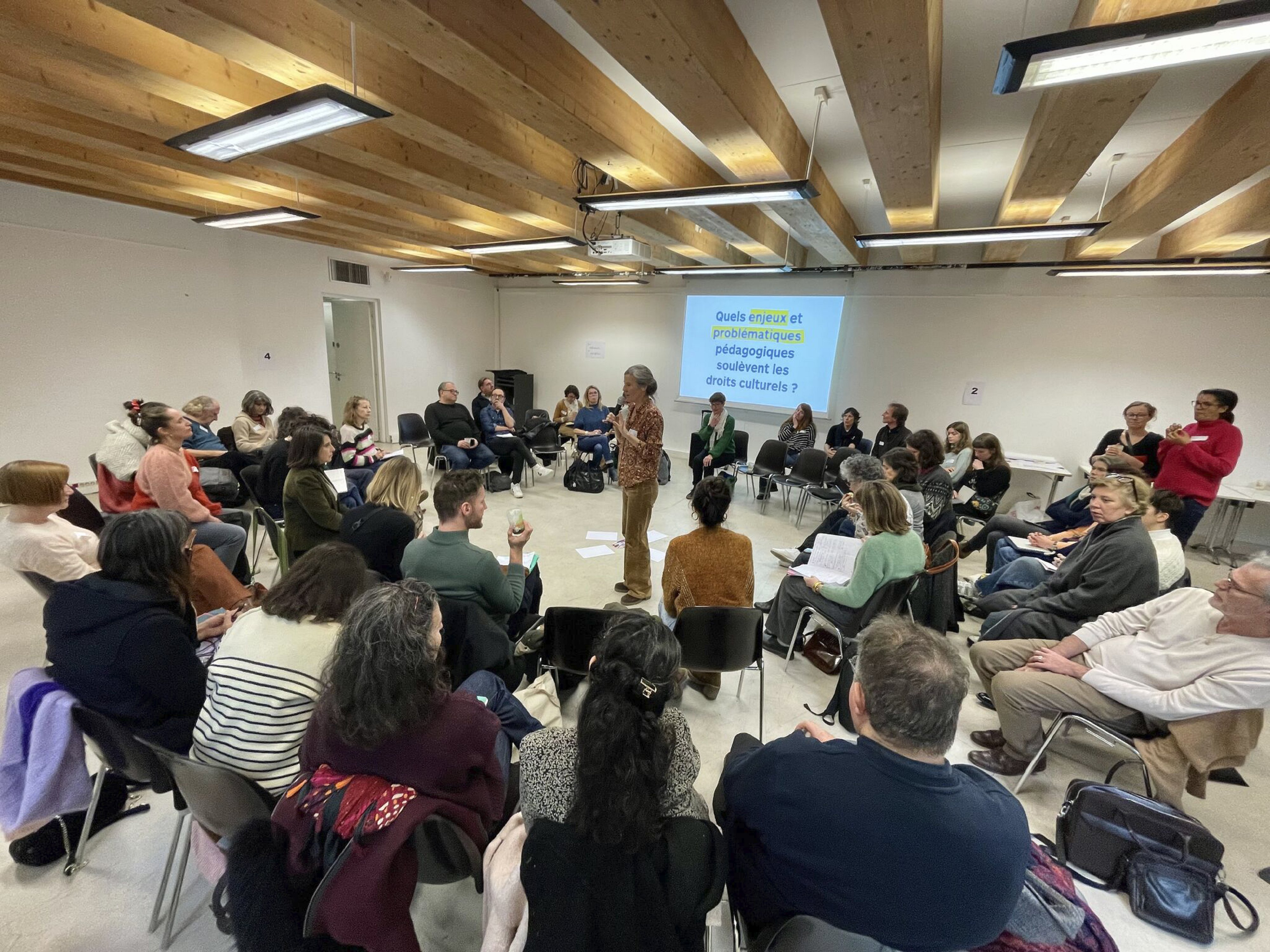
Workshop to find out what stage the partners had reached in their work on the “cultural rights” certification referential project in the context of professional training, to co-construct together (using the open forum method) reflections on specific aspects of the subject of pedagogy and cultural rights, and finally to work out avenues for collective action. I’ll go into a little more detail here about the two workshops I proposed.
Organized by UFISC, Opale, Réseau Culture 21, Observatoire des politiques culturelles, Laboratoire des droits culturels and Ligue de l’enseignement, on February 6, 2025 at Maison des métallos (Paris).
The “cultural rights” certification reference framework project
For the past three years, this group of players has been working on a skills repository for a “cultural rights” certification in the field of professional training. Three main skills have emerged:
Competence 1
Designing a working framework to take into account the diversity of people’s cultural references, enabling the development of expressive skills.
Competence 2
Analyze professional practice to identify the issues and problems involved in putting cultural rights to work, with reference to the corpus of fundamental human rights.
Competence 3
Formalize proposals for action to mobilize cultural rights effectively and continuously, identifying room for maneuver and possibilities for development in one’s professional context.
Workshop: Do we need to name cultural rights in order to pass them on?
I proposed this workshop, which you can read the complete synthesis in mindmapping, because cultural rights seem to me to be an extremely operative notion for the benefit of the meaning of cultural projects, and are too often experienced as highly conceptual. To convey the values of respect for human dignity in certain contexts, it is probably not necessary to name them as such. To clarify points of view and approaches in this direction, I first proposed that we express the reason for our concern, then share our respective definitions of cultural rights, and finally outline the contexts, uses and challenges of naming or not naming cultural rights.
Workshop: How can we help the national education system take people’s cultural rights into account?
I proposed this workshop, which you can read the complete synthesis in mindmapping, because it seems to me that cultural rights could be mobilized with great profit to make the teaching devices evolve within the national education, and it is one of my subjects of work. I proposed first of all to share our respective concerns on this subject, and then to pool our experiences and proposals.
(photos: Alice-Anne Jeandel)


