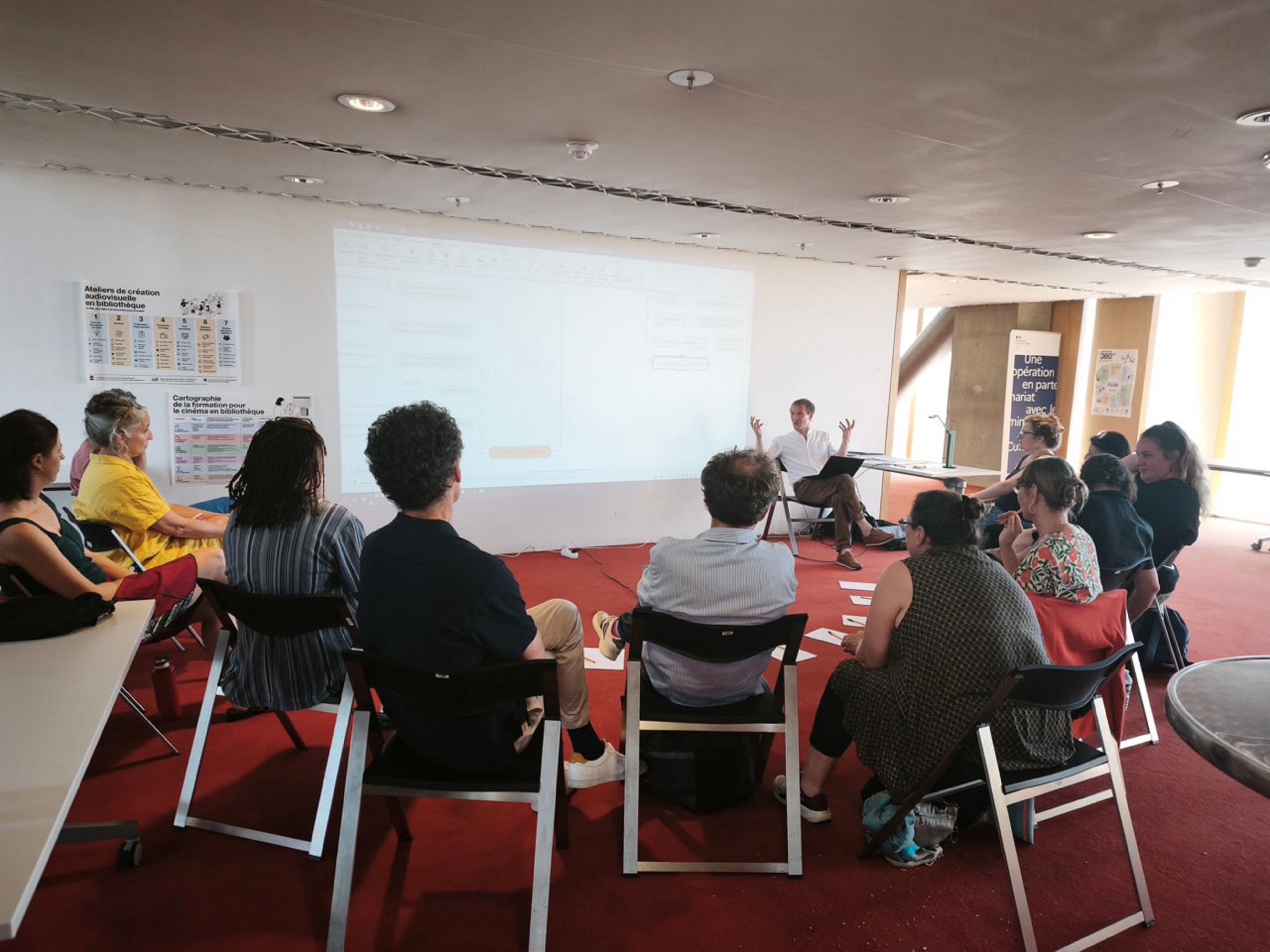
The national project for the future of audiovisual media in public libraries held its concluding presentation day on 6 July 2026 at the BnF, the French national library. That day was not an ending: the work accomplished is a foundation for what comes next, at national level and in local authorities alike. I give here an account of the process, in which I took part as a member of the steering committee.
Jean-Yves de Lépinay’s intuition
It was Jean-Yves de Lépinay who first had the idea for this project and who first gave it shape, in May 2024, while he was president of the association Images en Bibliothèques, in a text entitled “Building a shared visual culture”. For its form, that of action research, he drew on the action research project on teenagers and cinemas that I had led in the Île-de-France region with Claudie Le Bissonnais, co-produced with Arcadi, and of which he was himself a member (https://www.educationauximages.fr/). His starting point was a diagnosis: images have never been so present around us, and never so opaque, so easy to manipulate, so hard to share, so that instead of allowing us to forge common references, they are becoming a source of division. He therefore proposed a goal, building together a visual culture that would allow us to think a world in common, and he identified public libraries as the place for that work, because they have never been merely places giving access to objects, but places where shared cultures are built. He saw in it a project that was at once cultural, educational, social and political.
His text rested on a concrete concern: the massive decline in the use of physical media, already accomplished for music and under way for film and audiovisual works, calls into question the organisation and the identity of media libraries, which were built around their collections. Images en Bibliothèques had already devoted two study days to the subject, one at the BnF in December 2022 on the future of DVD film collections, the other at the Lyon municipal library in December 2023 on video-on-demand offers. Those days had left organisers and participants alike with the frustration of not being able to go further. The action research proposed that further step: gathering experiences, encouraging experiments, starting from realities on the ground and relying on collective intelligence.
A project carried by three partners: the Ministry of Culture, Images en Bibliothèques, the CNC
In the spring of 2024, Images en Bibliothèques therefore proposed to the Book and Reading Service of the French Ministry of Culture (Directorate-General for Media and Cultural Industries) to contribute to a collective reflection on the future of audiovisual media in public libraries. The service had long been challenged by professionals facing the dematerialisation of audiovisual resources and a platform-based offer ill suited to libraries; in October 2024, the main professional associations had in fact sent it an open letter calling for a national consultation on digital resources. The ministry accepted, seeing in this proposal a first building block of that consultation, and it did two things: it brought in the CNC, the French national centre for cinema, which took part through its audiences and territories department and its digital department, and it supported Images en Bibliothèques by funding a dedicated project officer, Joseph Minster, of whom Pascale Issartel, deputy head of the libraries department at the Book and Reading Service, would say on 6 July that he is the soul of this project.
Founded in 1989, Images en Bibliothèques is the French national cooperation association for cinema and audiovisual media in libraries (imagesenbibliotheques.fr). It has more than a thousand members: libraries, cultural associations, cinemas. Since its beginnings it has run the national selection committee for documentary films, whose catalogue has become the Bpi’s platform Les Yeux doc; since 2000 it has coordinated the Mois du film documentaire, the Documentary Film Month, which in 2025 brought together more than 2,300 screenings and 90,000 viewers in more than 1,700 participating organisations, half of them libraries; with the ADRC, the national agency for the development of cinema in the regions, it created Les Mycéliades, a science-fiction festival designed for 15-to-25-year-olds, which pairs a cinema and a library in each town and has grown from 30 to 80 towns, with the February 2027 edition already in preparation; and it trains around 300 professionals every year. This expertise and this network explain how a study of such scope could be carried out in nine months, and they also explain why the ministry did not hesitate to entrust this reflection to an association.
The project was built around a steering committee bringing together the ministry, Images en Bibliothèques, the CNC, the BnF, the Bpi, local-authority libraries and the general inspectorate, and around a questionnaire sent to libraries in the spring of 2025, to which 420 professionals representing more than 500 establishments responded. The questionnaire confirmed seven thematic work streams:
- the future of physical collections;
- the audiovisual offer in media libraries;
- curation and editorialisation;
- the forms of cultural programming;
- audiovisual and digital creation;
- the evolution of professions and skills;
- the design of spaces.
Seven working groups, bringing together more than eighty librarians, worked on these streams, conducting several dozen hearings in all, every one of them published online; more than a hundred people contributed to the whole, and everything can be consulted on the project website: https://projetnational-av-bib.fr/. This choice of transparency is consistent with the way the ministry presented its method on 6 July: defining public policies by building in, upstream, a phase of participation and exchange with professionals.
My place: holding on to the question of why
I took part in this project as a member of the steering committee, where I carried the political dimension of the subject. All the substantive work done in the work streams, on collections, mediation, spaces and skills, can only exist if there is public support for libraries, that is, if libraries have a place in the choices made by the local authorities that fund them. If there is no political commitment to the importance of libraries in their territories, thinking about how is pointless, because the question of why comes first. This insistence on placing audiovisual media in libraries within the wider frame of territorial cultural policies led the steering committee to add to the seven work streams what came to be called a cross-cutting “Cultural Policy” strand: a series of so-called political hearings, which I conducted in June 2026 with Pascale Issartel, with the ADRC, the associations of elected officials, the professional associations, the Observatoire des politiques culturelles and the filmmaker Julie Bertuccelli. I devote a full article to these hearings and to what emerged from them.
This political subject is rooted in a question of definition: what audiovisual media are we talking about? I distinguished three categories:
- Commercial production, the works holding distribution visas, preserved as heritage, whose availability in libraries is becoming more complicated as media formats change.
- Production without a visa, often professional and artistic, particularly in the documentary field, which is not published anywhere.
- Vernacular production, everything that people make as images in their territories, yesterday family films, today everyone’s everyday images.
If audiovisual media are a political subject, it is because they are first of all an anthropological one: they change our lives, and the image-education activities and workshops run in libraries speak to parts of life that cannot be reduced to the position of the spectator.
The morning of 6 July: seven work streams presented
The presentation day took place on 6 July 2026 at the Belvédère of the BnF, which hosted and supported the event:
- Jérôme Belmon, who heads the libraries department at the French Ministry of Culture (Book and Reading Service), set out the frame for the day: not a conclusion but a stage, with avenues to be examined afterwards with all the partners, in a budgetary context that will force priorities to be set.
- Daphné Bruneau, deputy director of the audiences and territories department of the CNC, recalled the national plan for education in cinema and the image, announced in November 2025 with the Ministry of Education, and the fund for innovative projects, which will be renewed in 2027 and to which libraries can apply.
- Dominique Rousselet, co-president of Images en Bibliothèques, retraced the history of the association, without hiding that the fall in cultural budgets is affecting it too and is forcing it to rethink its activities for 2027.
- The Cultural Policy strand opened the substance of the morning: Pascale Issartel presented the approach taken for the hearings, then I summarised them in about ten minutes, the nine main threads that emerged, from demography to public finances, from the elected officials’ request for dialogue to image education, and the avenues of work that would feed two of the afternoon workshops. At that moment I made a point of publicly thanking Jean-Yves de Lépinay, who left the presidency of Images en Bibliothèques a year and a half ago and whose name had not yet been spoken that morning, even though he is at the origin of all this work.
The seven work streams were then presented, in a sequence designed by Joseph Minster: starting from the most visible question, that of collections, then following the questions it leads to, the visibility of works, mediation, spaces, and finally the skills all of this requires. From that morning I retain a few shifts of perspective:
- Physical collections. Starting from anxiety about the disappearance of the DVD, the group reached a more nuanced conclusion: where library networks keep the budgets and the staff for a well-constituted offer, DVD lending is doing well, sometimes very well, and the group explicitly separated the fate of video from that of the CD, with which it is too quickly conflated. Above all, it established that libraries are economic players in the industry: in certain segments such as documentary, children’s films or auteur cinema, their acquisitions account for 30 to 50% of the volumes sold on physical video, and up to 70% of the revenue of certain titles.
- The digital offer. The group set out the central dilemma of video on demand in libraries, caught in France’s regulated release windows: recent films are only available on a pay-per-view basis, so that the more successful an offer is with users, the more it costs the local authority. In 2023, 446 libraries subscribed to a video-on-demand offer, for a total budget of 4.8 million euros and 1.3 million viewings, and these bundled offers deprive librarians of part of their control over the choice of titles and their mediation.
- Curation and editorialisation. This group itself made a shift: starting from the idea of an ideal platform, it ended up locating the specific value of libraries in human recommendation and mediation, which echoes the warning against large centralised platforms voiced by the Observatoire des politiques culturelles during the hearings.
- The forms of cultural programming. The group formulated a reassuring finding, libraries have no new formats to invent, and a challenge, the durability of activities that are often rich but one-off. It insisted on what makes the library singular among all the players in film-related cultural programming, its collections, to which every activity gains by being connected, and it produced an interactive map of the recurring schemes and festivals across the country.
- Audiovisual and digital creation. This group, the hardest to assemble since only three librarians joined it, named what that difficulty reveals: a persistent feeling of illegitimacy among professionals who see themselves as mediators of existing content rather than companions of acts of making, even though good workshops can be set up with 150 to 200 euros of equipment.
- The design of spaces. The group drew up a practical guide of recommendations whose first item will surprise those who think first of screens: acoustics.
- The evolution of professions and skills. Building on the national skills framework updated in 2025, the group produced a map of the skills specific to cinema and audiovisual media, organised by domain and in three levels of training, with a booklet of six profiles of video librarians as a way of thinking about the future of the profession.
The afternoon: six workshops to begin what comes next
In the afternoon, six workshops, co-designed beforehand and run with the support of the Ministry of Culture’s management innovation laboratory, put the participants to work:
- developing new models for video-on-demand offers in libraries;
- building an advocacy document on the role of libraries for audiovisual media, addressed to elected officials;
- imagining what follows the national project and identifying the players to bring on board;
- examining strategies for preserving audiovisual resources in libraries as heritage;
- developing and sharing knowledge of how audiovisual media are used in media libraries;
- thinking of the media library within its territorial ecosystem, in complementarity with its partners.
Before coming to the results, I want to say something about the value of this form of work in itself. Small groups sharing their ideas and their projects, thinking together for two hours: this is precious, because it is in dialogue and cooperation that we move forward and enrich one another. One leaves such workshops with proposals, and also with links between people who, in their territories, would never have met.
The end-of-day presentations give an idea of the avenues opened:
- making works fully accessible to all audiences, with audio description and subtitles for the deaf and hard of hearing, through advocacy directed at publishers and distributors and then, if persuasion is not enough, through regulation;
- asking the State to open negotiations with the platforms on economic models that libraries can sustain;
- making the project website permanent as a national reference portal, and drawing from it a booklet that will be useful to elected officials;
- changing the law to allow donations of DVDs between local authorities and with private individuals, in the spirit of the 2021 Robert law on libraries, creating shared territorial reserves for withdrawn audiovisual documents, and defining weeding criteria specific to these media;
- creating within media libraries a dedicated role for territorial partnerships, and training the staff who will hold it.
I facilitated one of these six workshops, the one devoted to writing an advocacy document on the role of libraries for audiovisual media, addressed to elected officials. This document answers an expectation voiced in almost all the political hearings we had conducted: what is needed is an advocacy document, a guide for elected officials, giving them the means to understand what libraries do and therefore to defend them. A dozen participants wrote, in two hours, the first draft of a complete advocacy document, through a writing-workshop method that evolved as it went: a brainstorm on a mind map projected large, the sharing out of themes, individual writing, then each text read aloud, recorded and transcribed on the spot, the whole shared immediately with everyone through a simple QR code. That same evening, a six-page first draft, with a one-page summary, was online and sent to the participants. I describe this method and what the text contains in another article.
The State as federator, and thousands of local dialogues
Closing the day, Pascale Issartel put things plainly: the State has no magic wand, it has less of one than ever, and what it can do is federate the players. Federate its own operators, the BnF, the Bpi, the CNC; federate the economic players of the industry, some of whom were present in the room; and involve, within the Directorate-General for Media and Cultural Industries itself, the colleagues in charge of audiovisual policy, who among other things oversee the INA, the national audiovisual archive. The deliverables of the work streams, the summaries of the hearings and a report on the day are being published over the summer on the project website, and a second cross-cutting strand, devoted to an international comparison, will be presented in the coming months.
The ministry’s funding of the project is coming to an end, but what was produced in nine months is not a report to be filed away, it is a foundation for work. A process like this one produces deliverables, maps, practical guides, and that is useful. It also produces narrative: this collective work has made visible, documented and argued what libraries do with images and what that means for a territory. And as the hearings taught us, elected officials are asking to understand what libraries have become so that they can defend them. What comes next will therefore not be played out only in the State’s budgetary decisions; it will be played out in thousands of local dialogues between professionals and their elected officials, and it is to equip those dialogues that the guide for elected officials, born of the hearings, and the advocacy document, born of the workshop of 6 July, seem to me the most political fruits of this whole endeavour.


